
The short answer is yes, foreigners can buy property in South Korea with remarkably few restrictions. This accessibility makes it a compelling, if often overlooked, market for global property investors. Unlike many of its Asian neighbours, South Korea maintains a relatively open-door policy for non-residents seeking to purchase land and buildings.
This guide provides the foundational knowledge required to navigate this dynamic and promising market successfully, with a focus on actionable insights for the long-term investor.
An Investor's Overview of the South Korean Property Market
South Korea presents a strong case for property investment, built on the foundations of a resilient, high-tech economy. As the world's 13th largest economy by nominal GDP, according to World Bank data, its stability provides a solid backdrop for real estate. However, it is a market of distinct contrasts, demanding a nuanced approach from any serious investor.
The property landscape is overwhelmingly dominated by the Seoul Capital Area (SCA), which encompasses Seoul, Incheon, and Gyeonggi Province. This sprawling conurbation is home to nearly half of the country's 51 million people, creating intense and sustained housing demand.
Consequently, property values here are among the highest in Asia, driven by extreme population density, prestigious universities, and the headquarters of global corporations such as Samsung and Hyundai.
Established vs Emerging Markets
While Seoul offers prestige and liquidity, astute investors are increasingly looking towards emerging provincial cities. Busan, the country's second-largest city and a major port, offers lower entry points with significant urban regeneration projects underway, signalling potential for future capital growth.
Similarly, planned cities like Sejong, the administrative capital, are experiencing rapid growth and infrastructure investment, hinting at strong future appreciation potential. This mirrors trends in other developed nations where secondary cities see accelerated growth.
For investors more accustomed to Western markets, South Korea's housing stock may appear uniform. The market is dominated by high-rise apartment complexes known as 'apateu'. These account for over 60% of all housing units nationwide and an even higher percentage in urban centres. These complexes are often self-contained communities with their own shops, schools, and green spaces, making them highly desirable.
Investor Takeaway: Understanding the dominance of apartment living is crucial. Unlike Western markets where detached or semi-detached houses are common, in South Korea, the liquidity, demand, and resale value are concentrated in these high-rise developments.
Key Market Characteristics
Beyond the prevalence of apartments, investors must understand the unique rental systems that define the market's financial dynamics.
- Dominant Property Type: High-rise apartments ('apateu') are the most common and liquid asset class, particularly in major cities.
- Rental Systems: The market operates on two primary models—'wolse' (monthly rent with a deposit) and the unique 'jeonse' system (a large lump-sum deposit returned at the end of the lease, with no monthly rent).
- Economic Drivers: A robust export-led economy, low unemployment, and a highly educated workforce support long-term housing demand and price stability.
To put the opportunity into context, a comparison with a market many international investors know well, such as the UK, is instructive.
South Korean vs UK Property Market at a Glance
For investors weighing their options, seeing how South Korea stacks up against a mature market like the UK can be revealing. This table highlights the key differences in property types, rental systems, and economic drivers that shape each landscape.
| Metric | South Korea (Focus on Seoul) | United Kingdom (Focus on Major Cities) |
|---|---|---|
| Dominant Property Type | High-rise apartments (apateu) make up over 76% of the market. | Diverse stock including terraced, semi-detached, and detached houses. |
| Average Property Price | High entry point, particularly in sought-after Seoul districts. | Varies significantly; cities like Manchester average around £235,000. |
| Typical Rental Yield | Generally lower (2-4%), with returns focused on capital appreciation. | Higher yields (5-7%+), especially in northern cities; focus on cash flow. |
| Key Rental System | Unique 'jeonse' (lump-sum deposit) and 'wolse' (monthly rent) systems. | Standard monthly rental model (Assured Shorthold Tenancy). |
| Market Driver | Intense urban density, strong domestic demand, and economic stability. | Structural housing shortages, population growth, and strong rental demand. |
| Recent Price Growth | Subject to government cooling measures; historically strong long-term growth. | Manchester saw 6.8% growth in 2025; performance varies by region. |
While a UK city like Manchester offers a familiar buy-to-let model with solid yields, South Korea presents a different proposition—one geared more towards long-term capital growth in a dense, high-demand urban environment. Neither is inherently better; they simply serve different strategic goals within a global portfolio.
Understanding these fundamentals is the first step. For more general advice, you might be interested in our guides on property investment.
Understanding Foreign Ownership Rules and Legalities
One of South Korea’s most significant advantages for global investors is its straightforward approach to foreign property ownership.
Unlike many Asian countries that complicate foreign investment with bureaucracy, South Korea places non-residents on a largely level playing field with local citizens. This policy removes a substantial barrier, allowing investors to focus on securing the right asset rather than navigating complex legal loopholes.
The system is built on two key pieces of legislation. They are not designed to be restrictive but to ensure transparency and proper reporting.
The first is the Foreign Land Acquisition Act. This law permits foreigners to buy land for residential or commercial use, typically without needing special government pre-approval. In essence, if a Korean national can buy a property, so can a non-resident.
The second is the Foreign Exchange Transactions Act, which governs the movement of capital into and out of the country. When transferring funds for a purchase, the transaction must be reported to a designated foreign exchange bank. This is a standard procedure that validates the transaction and facilitates the repatriation of capital upon sale.
Core Legal Requirements For Foreign Buyers
The process is fundamentally about post-acquisition reporting. There are no pre-approval hurdles for a standard apartment or commercial unit. The legal obligation is on the buyer to report the transaction after completion.
Here is what is required:
- File a Land Acquisition Report: This form is submitted to the local district office (si/gun/gu) with jurisdiction over the property’s location. This must be completed within 60 days of signing the purchase contract.
- Report Your Foreign Exchange Transaction: When the purchase funds are brought into South Korea, they must be declared to your bank. This is a crucial step for repatriating capital and profits later.
Investor Takeaway: The system is based on notification, not permission. For the vast majority of residential property transactions, the government requires a report of the action taken, not a request for approval beforehand. This is a critical distinction that enhances market accessibility.
Failure to meet these deadlines can result in fines. Therefore, engaging a reliable lawyer or real estate agent to manage the administrative process is vital.
Residential vs. Commercial Nuances
While the regulations are broadly consistent, there are subtle points to consider, especially when looking beyond a typical city apartment.
For most residential properties—such as apartments (apateu), villas, or officetels—the 60-day reporting rule is the primary compliance requirement. It is a routine and simple process.
However, certain specific types of land may require pre-approval from the local government. This is rare for the average investor but can apply to land located in protected or designated zones, such as:
- Military facility protection areas
- Designated cultural heritage sites
- Certain ecosystem preservation zones
If you are considering buying a plot of land for development rather than an existing building, thorough due diligence on its zoning status is essential. However, for over 99% of investors targeting urban apartments or commercial units, this pre-approval step will not be a factor. This clarity is a major advantage when comparing South Korea to other markets.
To see how these rules compare with other countries, you can learn more about investing in overseas property in our dedicated guide.
How to Find and Select the Right Property
A successful property search in South Korea hinges on understanding the local market structure. The market is built around specific property types and a unique business culture, which can feel distinct from practices in other global markets.
While a search will almost certainly begin online, on-the-ground expertise is indispensable. The optimal strategy is to combine data from property portals with the irreplaceable insights of a local real estate agent, known as a budongsan.
Navigating the Key Property Types
Before beginning a search, it is crucial to define which property type aligns with your investment objectives. While several options exist, the residential market is dominated by three main categories.
- Apateu (Apartments): These high-rise complexes are the backbone of Korean urban housing, comprising over 60% of homes in cities. They are liquid, consistently in demand for rentals, and their value is predictable. For most foreign buyers, an apateu represents the most direct and secure investment route.
- Officetels (Office + Hotel): These are versatile studio apartments suitable for residential or small office use. They are popular with young professionals and can offer higher rental yields than apartments, though their capital appreciation may be less pronounced.
- Villas (Billa): These are not luxurious mansions but small, low-rise apartment buildings, typically under five floors. They are more affordable than an apateu but often lack the amenities, consistent quality, or strong resale market of larger complexes.
Investor Takeaway: For investors new to the Korean market, an apateu in a well-regarded complex near a subway line is arguably the safest investment. The constant demand and established resale market offer a level of security that is difficult to find with other property types.
The Role of the Local Real Estate Agent
In South Korea, real estate agents (budongsan) are hyper-specialised by neighbourhood. An agent with deep expertise in Gangnam will likely have limited knowledge of the market in Mapo or Seongsu. This means an investor may need to work with several agents when exploring different districts.
Their function is to act as an intermediary, presenting properties and managing negotiations. Commissions are regulated by law and are based on the sale price, typically falling between 0.4% and 0.9%.
Using Property Portals Effectively
Most property searches begin online. While some listings appear on international sites, the most comprehensive data is found on local Korean platforms. The two dominant portals are Naver Real Estate and Zigbang.
The language barrier can present a challenge, but these sites are invaluable for market research. Using a browser's translation function can help identify key metrics: price per square metre, building age, and proximity to public transport. This data enables informed discussions with your budongsan.
How to Vet a Property's Potential
Selecting the right unit involves more than the property itself. The long-term success of an investment is tied directly to its location and surrounding infrastructure. We cover this in more detail in our guide on the critical role of location in real estate investment success.
In a city like Seoul, certain factors are non-negotiable:
- Subway Proximity: A property within a 5-10 minute walk of a subway station is considered yeoksegwon ("station-sphere"). These properties command a significant premium for both rentals and sales.
- School Districts (Hakgun): For family-sized apartments, being in a top school district can be the single most powerful driver of demand and price. Neighbourhoods like Daechi-dong in Gangnam are prime examples.
- Upcoming Infrastructure: Monitor local government plans. A new subway line, business park, or major regeneration project can drive substantial property value increases. Investing before these projects are completed is a key strategy for achieving significant capital gains.
By way of comparison, in London, a market we analyse for experienced UK investors at World Property Investor, the luxury housing market saw a 7.2% surge in 2025. Prime central London prices reached an average of £18,500 per square metre by December 2025, with certain neighbourhoods like Mayfair appreciating by 9.8%. According to Savills, 24% of sales over £5 million were to international buyers, showing how global capital chases prime locations. For more on the local outlook, check out the Korean market outlook from CBRE.
Financing Your Purchase as a Foreign Investor
Securing finance is often the most significant challenge for a non-resident investor in South Korea. While not impossible, obtaining a local mortgage is a more restrictive process than in many other countries and requires thorough preparation. Korean banks are characteristically cautious, viewing foreign buyers as a higher risk due to difficulties in verifying international credit histories and income streams.
This institutional caution results in stricter lending criteria. A typical South Korean homebuyer might be offered a loan-to-value (LTV) ratio of 50-70%, depending on the property's location and prevailing government regulations. As a foreign investor, it is prudent to expect a lower LTV, likely capped at around 40-50%. This necessitates a significantly larger cash down payment.
The Crucial Role of Your Visa Status
Eligibility for a local mortgage is almost entirely contingent on residency status. Banks require evidence of a long-term commitment to living and working in the country before considering an application. This makes your visa the single most important document in the financing process.
A standard tourist visa or short-term permit is insufficient. Lenders look for proof of stability, best demonstrated by one of the following long-term visas:
- F-2 (Resident Visa): Granted through a points system, this visa shows a strong, established connection to Korea.
- F-4 (Overseas Korean Visa): Available to those of Korean heritage, this visa is highly favoured by lenders.
- F-5 (Permanent Resident Visa): This is the gold standard, providing access to financing on terms almost identical to those for local citizens.
- F-6 (Spouse Visa): Marriage to a Korean national is another clear indicator of long-term residency.
Without one of these, the probability of securing a mortgage from a major Korean bank like KB Kookmin or Shinhan Bank is exceptionally low.
Required Documentation for a Mortgage Application
If you hold a qualifying visa, the next step is compiling extensive documentation. Korean banks are meticulous and will require detailed proof of your financial standing and identity. All documents must be professionally translated and notarised.
Key Takeaway: Banks in South Korea heavily prioritise verifiable, domestic-based income. While income from abroad may be considered, it will be scrutinised intensely and will not carry the same weight as income earned and taxed within South Korea.
Your application file will almost always need to include:
- Alien Registration Card (ARC): Your official Korean identification.
- Proof of Income: At least one full year of Korean income tax returns and certificates of employment.
- Credit History: A clean report from the Korea Credit Bureau.
- Property Documents: The fully signed purchase agreement for the target property.
- Down Payment Proof: Bank statements clearly showing the funds are in your account.
Alternative Financing Strategies
If a local mortgage is not viable, other routes can be explored. These strategies often provide international investors with greater flexibility, particularly for those without a long-term Korean visa.
One approach is to engage with the Seoul branches of major international banks, such as HSBC or Standard Chartered. These institutions are more accustomed to dealing with expatriate clients and sometimes offer products designed for foreign property buyers. Their underwriting processes are also better equipped to assess income and assets held in your home country.
Another practical option is to leverage assets owned in your home country. For many UK-based investors, remortgaging a domestic property is the simplest way to release the equity needed to purchase a Korean property with cash. This strategy entirely bypasses the need for local bank financing in Korea, simplifying the transaction considerably.
Our detailed guide on financing an investment property explores these global strategies in greater depth.
The Closing Process: Taxes and Ongoing Costs
Once an offer is accepted and the contract signed, the final stage of the acquisition process begins. This phase transitions from negotiation to legal ownership, and a firm grasp of the associated costs is essential to avoid last-minute financial surprises.
The closing timeline in South Korea is typically swift. The remaining balance of the purchase price is usually due within 30 to 60 days of signing the final agreement. At this point, several mandatory taxes and fees become payable, forming a significant part of the total upfront investment.
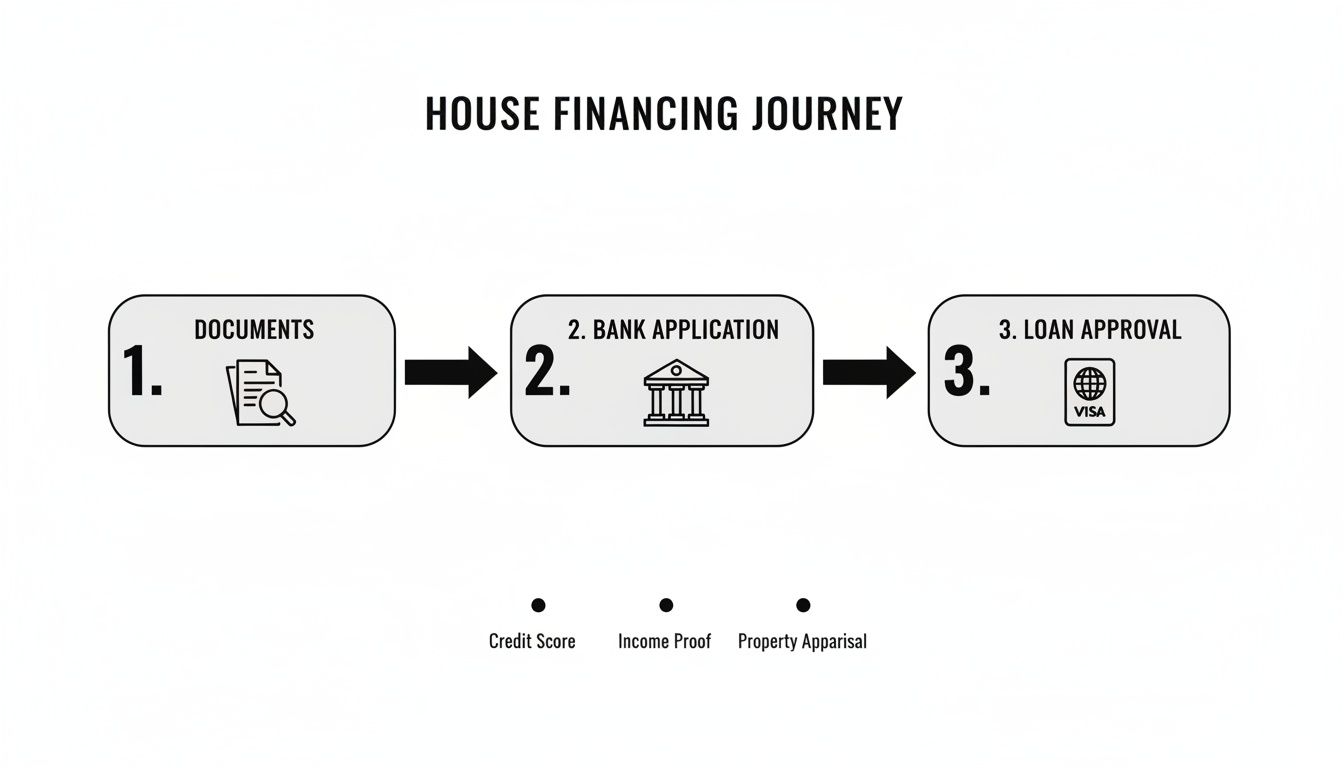
As this illustrates, the journey for a foreign buyer is often tied to legal status in the country. A valid long-term visa is frequently the key that unlocks access to local banks and financing options.
Your Upfront Transactional Costs
Upon official acquisition of a property, the government levies several one-off taxes and fees. These are non-negotiable, calculated based on the property's official value, and represent the final step to legally registering the property in your name.
The largest single expense is the Acquisition Tax. For a standard residential home, this tax is tiered, typically falling between 1% and 3%. However, for investors purchasing multiple properties, this rate can increase substantially as part of government measures to curb speculative buying.
Alongside the acquisition tax, a Registration Tax is also payable. This fee covers the administrative cost of legally registering the property deed under your name. In practice, this is often bundled into a single payment with the acquisition tax.
Other immediate costs to budget for include:
- Stamp Duty: A small, fixed tax paid on the official contract documents.
- Real Estate Agent Commission: Fees are capped by law, typically ranging from 0.4% to 0.9% of the sale price.
- Legal Fees: A lawyer or a certified judicial scrivener (beommusa) is required to handle the title transfer. This cost is typically a few hundred pounds.
Key Takeaway: Budgeting for these upfront costs is essential for an accurate yield calculation. A sound rule of thumb is to set aside an additional 5% to 7% of the purchase price to cover all transactional taxes and professional fees.
Annual Holding Costs and Property Taxes
Financial commitments continue beyond the acquisition. Owning property in South Korea involves recurring annual costs, and understanding these is fundamental to assessing an investment's long-term profitability.
The primary ongoing expense is the annual Property Tax, known locally as Jaesan-se. This is levied by the local district office where the property is located. It is a progressive tax based on the government's official assessed value of the home, with rates typically between 0.1% and 0.4%.
For investors with a high-value portfolio, a second, more substantial tax may apply. The Comprehensive Real Estate Holding Tax (Jonghap Budongsan-se) is a national tax imposed on individuals whose total property holdings exceed a certain threshold (currently around ₩1.2 billion for single-property owners). It is designed to discourage property hoarding and has progressive rates that can significantly impact the returns from a luxury portfolio.
For a deeper analysis of global property taxation, our guide to understand property taxes offers further insight.
Estimated Buying and Holding Costs in South Korea
This table provides a summary to help budget for the main one-off and recurring costs when buying and owning property in South Korea.
| Cost Item | Typical Rate / Amount | Notes for Investors |
|---|---|---|
| Acquisition Tax | 1.1% – 3.5% (standard) | Punitive higher rates can apply if you own multiple properties. |
| Registration Tax | Included in Acquisition Tax | This covers the legal registration of your title deed. |
| Stamp Duty | Fixed fee (up to ₩350,000) | A minor but mandatory cost paid per contract document. |
| Agent Commission | 0.4% – 0.9% | This fee is capped by law. Both the buyer and seller pay their respective agents. |
| Annual Property Tax | 0.1% – 0.4% | Billed twice a year, typically in July and September. |
| Comprehensive Tax | 0.6% – 3.0% (progressive) | This only applies to high-value portfolios that exceed the government's threshold. |
Factoring these costs in from the outset is crucial for a well-planned and successful property investment.
Managing Your Property and Maximising Rental Returns

Acquiring the property is only the first stage. The next objective is to transform the asset into a profitable, long-term investment. To maximise returns in South Korea, it is essential to understand the country's unique rental market.
The standard monthly rent model common in the UK or North America is not the only option. South Korea operates on two distinct systems, and the choice between them will define your cash flow, risk profile, and overall investment strategy.
Understanding Wolse and Jeonse Rental Models
The South Korean rental landscape is built on two contract types: wolse and jeonse. Each has a completely different financial structure.
- Wolse (Monthly Rent): This system is the most familiar to international investors. The tenant pays a security deposit, typically 10-20% of the property's value, followed by regular monthly rent. This provides a predictable income stream, which simplifies covering ongoing costs such as maintenance or taxes.
- Jeonse (Lump-Sum Deposit): This is a rental system unique to South Korea. The tenant pays a large one-off deposit—often 60-80% of the property’s market value—and then occupies the property for a two-year lease without paying any monthly rent. At the end of the term, the landlord must return the full deposit.
Investor Takeaway: The crucial difference lies in how profit is generated. With wolse, profit is derived from monthly cash flow. With jeonse, the return is generated by investing the large lump-sum deposit for the two-year lease term.
Historically, when bank interest rates were high, landlords could generate a significant return simply by placing the jeonse deposit in a high-yield savings account. In today's lower-interest environment, this strategy is less effective, which has contributed to a gradual market shift towards the wolse system.
ROI Implications for Global Investors
A wolse agreement provides immediate liquidity and a clear rental yield, which is ideal for servicing a mortgage or other holding costs. It is the most straightforward method for calculating net returns.
A jeonse contract, conversely, is akin to receiving a large, interest-free loan for two years. The risk is that if the return generated on that capital does not outperform property depreciation and other costs, the investment could result in a net loss. For an active investor, however, that lump sum could be used as a deposit on another property, enabling faster portfolio growth. It is a classic higher-risk, higher-reward strategy.
Property Management On the Ground
For most overseas investors, self-managing a property in South Korea is impractical due to language barriers, time differences, and legal complexities. The prudent course of action is to engage a local property management agency, often run by a budongsan.
These agencies serve as the investor's local team, handling all operational aspects:
- Marketing the property on local platforms.
- Screening potential tenants and verifying their financial stability.
- Drafting legally compliant lease agreements for either wolse or jeonse.
- Collecting rent and addressing maintenance issues.
In cities like Seoul, management fees are typically around 5-10% of the monthly rent for a wolse contract. For a jeonse agreement, a one-off fee is usually negotiated upon signing the lease. This is a necessary operational cost to ensure the investment is properly maintained and remains profitable.
Planning Your Exit Strategy: Capital Gains Tax
Finally, a prudent investor plans their exit from the outset. Upon selling a South Korean property, you will be liable for Capital Gains Tax, known locally as Yangdo-soduk-se. The tax rate is progressive and varies based on the length of ownership and whether you own other properties in the country.
The rates can be substantial, particularly for short-term holds. Holding a property for at least two years generally results in a more favourable tax rate. This system is designed to discourage short-term property speculation, reinforcing the principle that real estate in South Korea is best approached as a long-term investment.
At World Property Investor, we provide the data and analysis you need to navigate global markets with clarity. Explore our in-depth guides to find your next international property investment at https://www.worldpropertyinvestor.com.