
Often referred to as the Malta Golden Visa, the Malta Permanent Residence Programme (MPRP) is one of Europe’s most established residency-by-investment routes. It is designed to provide non-EU investors and their families with a secure foothold in the European Union, complete with permanent residency rights and visa-free travel across the 29-nation Schengen Area.
Understanding the Malta Golden Visa in 2026
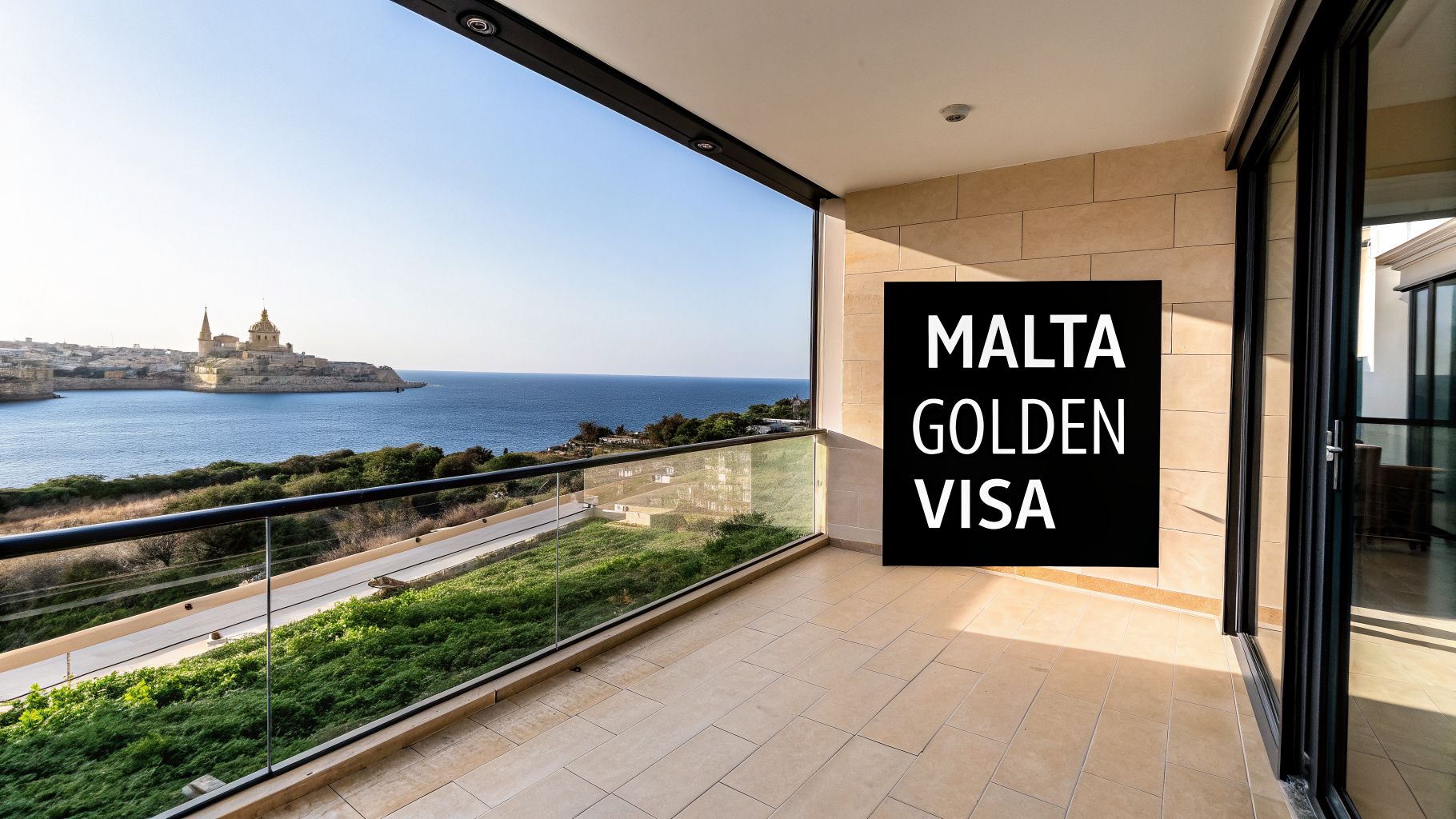
It is crucial to understand that the MPRP is a residency programme, not a direct route to a Maltese passport. Its primary function is to unlock EU-wide mobility and provide a stable European base, rather than confer a new nationality. The programme is structured for global investors seeking stability, a high quality of life, and the commercial advantages of an English-speaking EU member state.
While some competing European schemes, such as Spain's, have faced abrupt termination, Malta has deliberately focused on strengthening its residency programme. This strategic pivot ensures the MPRP aligns with evolving EU standards, enhancing its credibility and long-term value for investors. This demonstrates a mature market, with Malta prioritising a sustainable and well-regulated pathway.
Investment Pathways and Core Benefits
To qualify, applicants must make a series of financial commitments centred on a property investment. There are two primary routes: purchasing a property or entering into a long-term rental agreement. This structure offers investors the flexibility to select the option that best suits their financial strategy.
The programme’s advantages extend far beyond Maltese residency:
- Permanent Residency: From day one, the main applicant and their family gain the right to live, work, and study in Malta indefinitely.
- Family Inclusion: The application can cover the main applicant, their spouse, dependent children, and even dependent parents or grandparents.
- Schengen Area Access: Enjoy visa-free travel throughout the Schengen zone for 90 out of every 180 days.
- Favourable Tax System: Malta offers a remittance-based tax system for non-domiciled residents, with no wealth or inheritance taxes.
These benefits establish the Malta Golden Visa as a premier choice for investors requiring a reliable European base. For a comparison with other programmes, see our guide to other EU Golden Visa options.
The financial requirements are clear and structured, combining a real estate investment with a government contribution and a philanthropic donation. The following table summarises the core financial commitments for a single applicant.
Malta Permanent Residence Programme (MPRP) Key Requirements
| Requirement Category | Property Purchase Option | Property Rental Option |
|---|---|---|
| Government Contribution | €28,000 | €58,000 |
| Property Investment | Minimum €350,000 (or €300,000 in the South/Gozo) | Minimum €12,000 p.a. (or €10,000 in the South/Gozo) |
| Charitable Donation | €2,000 | €2,000 |
This table provides a snapshot of the primary financial outlay. It is important to note that additional government and professional fees apply, but this breakdown serves as a solid starting point for understanding the required investment.
Key Takeaway: The Malta Golden Visa is a strategic investment in permanent EU residency, not a shortcut to citizenship. It offers investors and their families exceptional stability and mobility, backed by a clear legal framework and a choice of investment routes. For those seeking a European base in 2026 and beyond, it remains a highly respected and viable pathway.
Investment and Eligibility: What You Need to Qualify
Securing the Malta Golden Visa involves a two-part process. First, all applicants must pass a rigorous 'fit and proper' test, which is a comprehensive background verification. Second, applicants must fulfil a series of financial commitments: a property investment, a government contribution, and a charitable donation.
This dual-layered approach ensures that successful applicants not only possess the financial stability to contribute to Malta’s economy but also meet the high personal standards set by the Residency Malta Agency. The structure is designed to protect the programme's integrity.
The ‘Fit and Proper’ Test for Applicants
Before any investment is made, every applicant and their dependants must undergo a thorough due diligence process. This is the foundation of the programme’s credibility and is treated with utmost seriousness. Applicants must provide evidence of their good standing.
To pass this stage, you must meet several core requirements:
- A Clean Criminal Record: You and your dependants must provide police certificates confirming no criminal history.
- Financial Solvency: You must demonstrate capital of at least €500,000, with a minimum of €150,000 held in liquid financial assets such as stocks or cash.
- Comprehensive Health Insurance: You are required to hold a health insurance policy that covers all risks across the entire EU, not just Malta.
- Source of Funds: All capital used for the investment must originate from legal sources, and the agency will require detailed evidence to verify this.
This stringent vetting process is a key reason why the Malta Golden Visa is so well-regarded. It ensures that only credible individuals are approved, which in turn protects the long-term value of the residency status.
Your Financial Commitment and Investment Routes
The financial component of the application is straightforward, combining a real estate investment with two non-refundable contributions. The property element offers a choice between owning a tangible asset or opting for greater flexibility.
There are two main pathways for the property requirement:
- Property Purchase: Invest a minimum of €350,000 in a residential property anywhere in Malta. If you choose a property in the South of Malta or on the island of Gozo, this threshold is reduced to €300,000.
- Property Rental: Lease a property for a minimum annual rent of €12,000 (€10,000 in the South of Malta or Gozo). A commitment to this lease for at least five years is required.
The decision to buy or rent depends on an investor's personal strategy. Purchasing offers the potential for capital appreciation and rental income, transforming the visa requirement into a performing asset. Renting, conversely, involves a lower initial outlay and provides greater freedom, particularly for those not planning to reside in Malta full-time. If you are weighing this against other programmes, our guide on various visas for investors may be useful.
Beyond the property, there are two fixed financial obligations. The first is a non-refundable government contribution, set at €28,000 for property purchasers or €58,000 for renters. The second is a €2,000 donation to a Maltese-registered non-governmental organisation, supporting local community initiatives.
These contributions, along with various administrative fees, constitute the total cost of securing residency. A clear understanding of this complete financial picture is critical for any serious investor.
Your Step-By-Step Application Timeline
The application process for the Malta Permanent Residence Programme (MPRP), commonly known as the Malta Golden Visa, may appear complex but follows a well-defined path. The entire process must be managed by an officially licensed agent, which transforms a potentially bureaucratic procedure into a series of predictable steps.
The first step is to select a reputable licensed agent. They will conduct their own preliminary due diligence to ensure you are a suitable candidate for the programme’s high standards. This foundational work is vital. The agent will assist in gathering all necessary documentation, from proof of funds to police clearance certificates, to prepare for a smooth submission.
The Application and Due Diligence Phases
Once your file is complete, your agent will submit it to the Residency Malta Agency. At this point, you will pay an initial, non-refundable administrative fee, which signals your commitment and initiates the formal review.
The Residency Malta Agency then commences its own in-depth due diligence. This is the most critical stage of the process, during which the agency scrutinises every detail of your application, verifying your personal background and the legitimacy of your wealth. The rigour of this stage underpins the credibility and reputation of the Malta Golden Visa.
This timeline provides a simple, visual guide to the main stages.
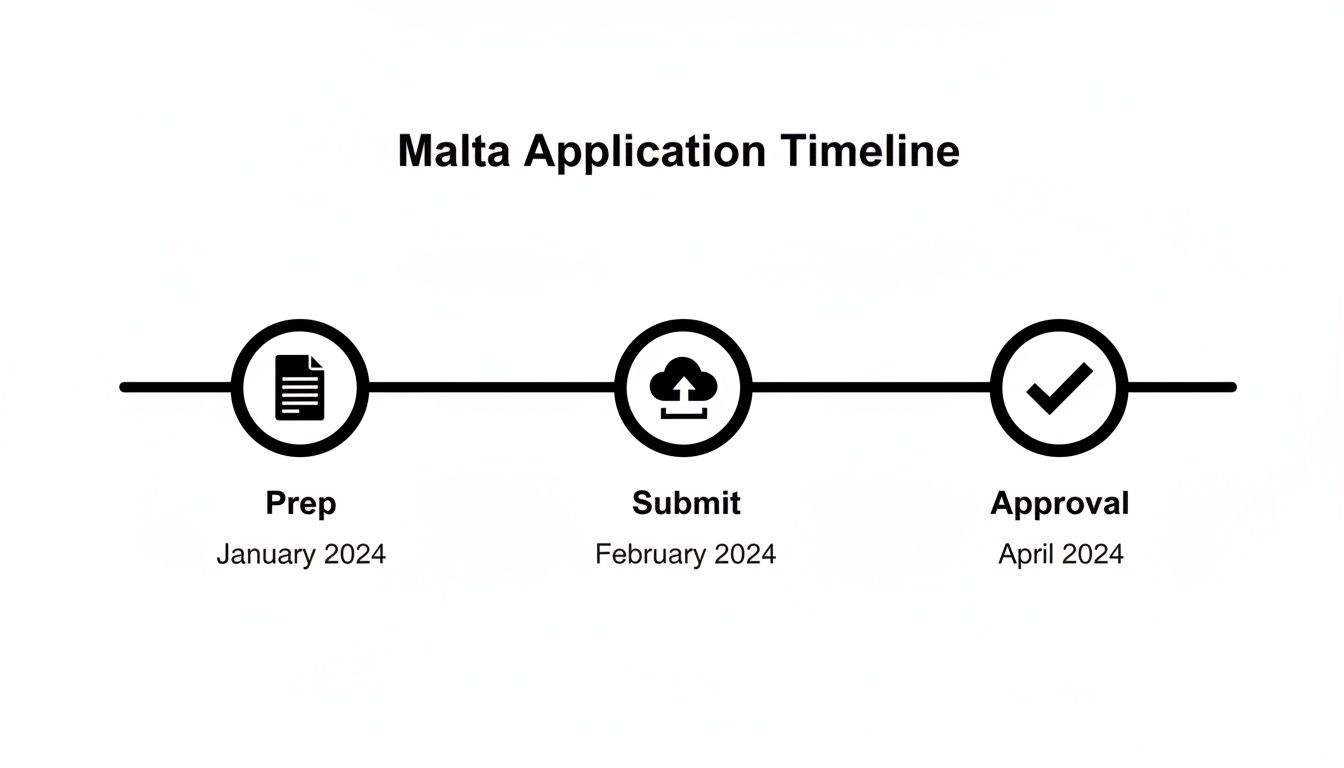
As illustrated, the journey is logical, moving from initial preparation to final approval in a clear sequence.
Approval and Fulfilling Your Investment
Upon successfully passing the due diligence checks, the agency issues a formal Letter of Approval in Principle. This confirms you have met all personal criteria and serves as conditional approval, pending the fulfilment of your investment obligations.
With this letter, you will proceed to complete the financial requirements. This involves three key actions:
- Fulfilling the Property Requirement: You will either complete the purchase of your chosen property or finalise the lease on a qualifying rental home.
- Paying the Government Contribution: The outstanding balance of the government contribution becomes due.
- Making the Charitable Donation: You will make the required €2,000 donation to a registered Maltese non-governmental organisation.
Malta’s processing efficiency is a significant competitive advantage. Full approval for the Malta Golden Visa is typically achieved within 6 to 12 months, positioning it as one of the fastest and most dependable programmes in Europe, with no reported backlogs. This efficiency, combined with a stable, EU-aligned legal framework, contrasts sharply with markets like Portugal, where investors often face longer and more uncertain timelines. You can learn more about Malta's comparative advantages from Endevio's 2026 analysis.
Final Steps to Residency
The final stage is a visit to Malta. You, along with any family members included in your application, must provide biometric data, such as fingerprints and photographs. This is a mandatory step before your residency cards can be issued.
Once your biometrics are captured, the Residency Malta Agency issues your Certificate of Residence and your residency cards. This card serves as proof of your permanent residency, granting you the right to live in Malta and travel visa-free across the Schengen Area.
Analysing Malta's 2026 Property Market for Investors
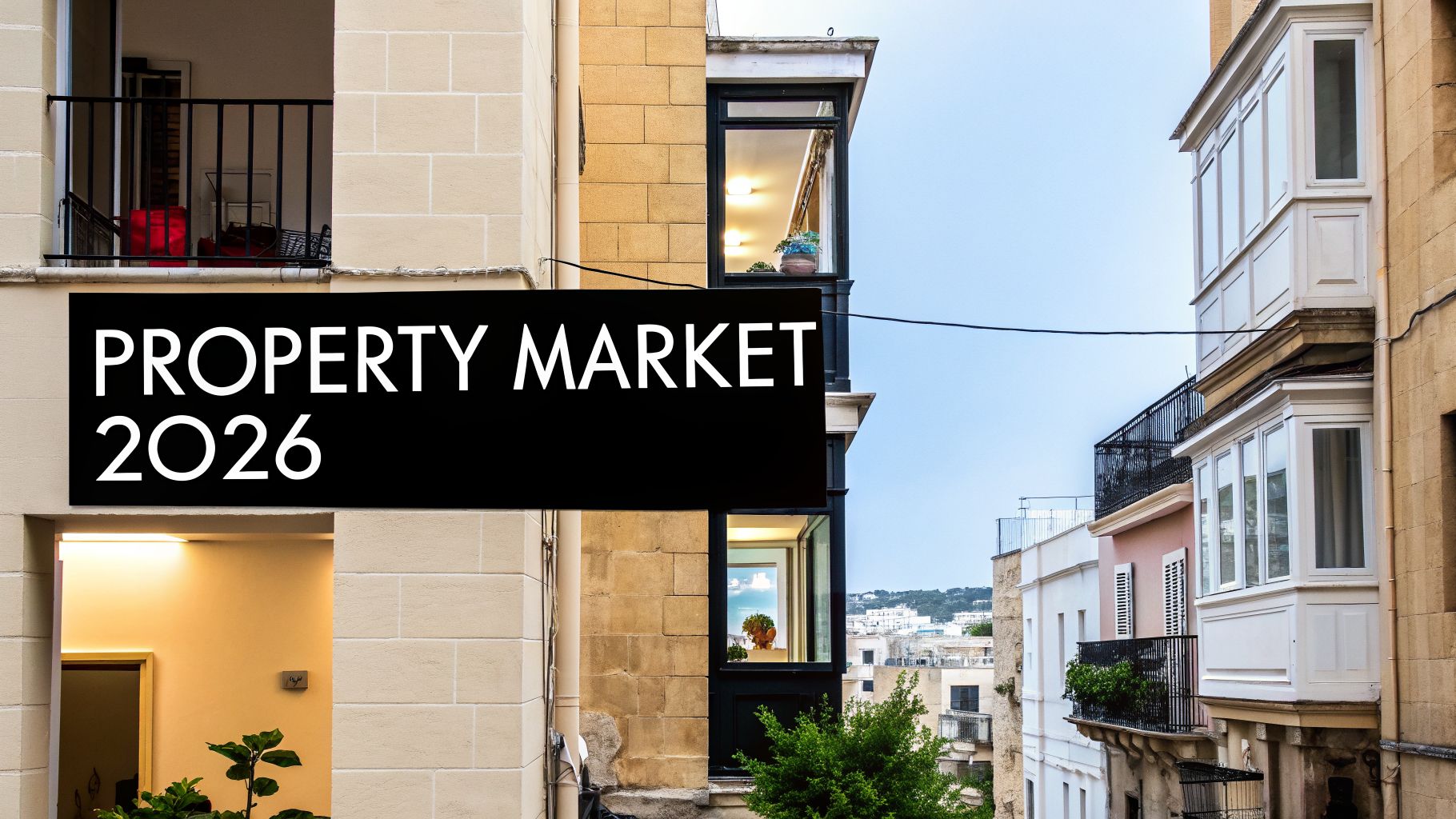
The property investment for the Malta Golden Visa is more than a procedural requirement; it is a strategic decision that can significantly impact a global portfolio. While leasing offers a lower upfront cost, purchasing a property transforms the visa requirement into a performing asset with potential for both capital growth and rental income. A thorough understanding of the market is therefore essential.
The Maltese property market has demonstrated remarkable resilience, consistently outperforming many of its European counterparts. Data from Malta's National Statistics Office indicates a steady upward trend in prices, driven by strong demand from both local and international buyers. This stable growth, combined with a healthy rental market, makes ownership a compelling route for long-term investors.
Key Investment Locations and Yield Expectations
Location is a fundamental factor in any property investment. The optimal choice depends on whether your objectives are primarily lifestyle-oriented or focused on maximising financial returns, as different areas present distinct risk-reward profiles.
Sliema and St. Julian's: These prime coastal towns are Malta’s most sought-after residential areas, attracting high-end tenants and tourists. Property prices here are the highest on the island, as are the potential rental returns. Gross rental yields for long-term lets typically average between 3% and 4%. According to data from local property agencies, short-term holiday lets can generate yields of 5% to 7% during peak season.
Valletta: The historic capital offers a unique investment opportunity, with beautifully restored palazzos and apartments. It is a prime market for boutique tourism, making short-term rentals particularly profitable. However, its UNESCO World Heritage status imposes stricter planning regulations.
Gozo and the North: For investors seeking better value and a more relaxed lifestyle, Malta's sister island of Gozo and the northern regions of the main island offer lower entry prices. These are the areas that qualify for the reduced €300,000 property purchase threshold for the Malta Golden Visa. While long-term rental demand is quieter, the holiday-let market is robust, offering attractive seasonal yields.
For global investors, purchasing property in Malta is not just about securing residency; it is about asset diversification. Unlike more volatile markets, Malta's property fundamentals—driven by a finite supply of land and sustained demand from key sectors like tourism and iGaming—provide a stable foundation for growth.
Calculating Your True Acquisition Costs
Beyond the headline purchase price, it is critical to budget for acquisition costs. These transactional fees typically add 7% to 10% to the property's value—a significant figure that must be factored into any return on investment calculation.
The main costs involved in a Maltese property transaction include:
- Stamp Duty: This is the largest single cost, generally set at 5% of the property’s value. First-time buyers in Malta may be eligible for certain exemptions on the initial portion of the price.
- Notary Fees: These are calculated on a sliding scale mandated by the government and usually range from 1% to 2.5% of the property value.
- Registration Fees: A small fee is payable to the Public Registry to register the deed.
Therefore, for a €350,000 property, a prudent investor should budget an additional €24,500 to €35,000 in associated costs. Accounting for these figures from the outset prevents unexpected financial strain and ensures accurate planning. Investors considering this route may also find our guide on how to move to Malta from the UK useful for other logistical considerations.
Understanding Capital Gains and Tax Implications
A long-term investor must also consider their exit strategy. Malta’s tax system on property sales is relatively straightforward. If you sell the qualifying property after holding it for the mandatory five-year period required by the MPRP, any profit will be subject to capital gains tax.
The standard rate is a final withholding tax of 8% on the sale price. However, if the property has served as your sole ordinary residence for at least three consecutive years, you may be exempt from this tax entirely. This distinction makes the lifestyle versus buy-to-let decision even more important from a financial perspective, as it can directly influence your net return upon exiting the investment.
How Malta Stacks Up Against Other EU Golden Visas
No prudent investor makes a decision in isolation. When the Malta Golden Visa is benchmarked against its main European competitors—namely the programmes in Greece and the evolving routes in Portugal—its unique strengths become apparent. For a global investor, the analysis must extend beyond the initial cost to include processing speed, physical presence requirements, and long-term value.
Each of these programmes is tailored to a different investor profile. Malta’s proposition is centred on permanent residency from day one, offering immediate stability. Greece, by contrast, competes aggressively on its minimum investment threshold. Portugal continues to attract investors with its lifestyle and reputation, despite significant recent changes to its programme.
A Head-to-Head Comparison
To gain a clear perspective on where Malta excels and where its rivals offer alternative benefits, it is useful to compare key investor metrics side-by-side. The following is a breakdown of the leading EU residency-by-investment options, focusing on the practical details that matter most to investors in 2026.
EU Golden Visa Comparison 2026: Malta vs. Portugal vs. Greece
This table provides a direct comparison of the leading EU residency-by-investment programmes, focusing on key metrics for property investors.
| Feature | Malta (MPRP) | Portugal (D2 Visa) | Greece |
|---|---|---|---|
| Minimum Investment | €300,000 property purchase or €10,000 p.a. rental (plus contributions) | No direct property route; €500,000 in qualifying funds is a common path | €250,000 property purchase (rising to €800,000 in prime areas) |
| Residency Type | Permanent residency from day one | Temporary residency, renewed periodically | Temporary residency, renewed every 5 years |
| Physical Stay | No minimum stay required to maintain residency | Minimum of 7 days per year | No minimum stay required |
| Family Inclusion | Very broad: includes spouse, children, and dependent parents/grandparents | Includes spouse, minor children, and dependent adult children | Includes spouse, minor children, and dependent parents |
| Processing Time | 6-12 months on average | Can be highly variable, often exceeding 12-18 months | 6-9 months on average |
Malta’s competitive edge is clear from this comparison. The combination of permanent residency from the outset and zero physical stay requirements provides exceptional flexibility for investors who desire a secure European base but may not be ready to relocate immediately.
According to the Henley & Partners' 2025 Global Citizenship Program Index, Malta has secured the top spot as the world's most attractive citizenship-by-investment programme for the 10th consecutive year, scoring 76 out of 100. In the related Global Residence Program Index, Greece now leads, while Portugal shares third place with the UK and Italy. This context is crucial for British investors, as it highlights that Malta's programme offers superior value compared to their own home country's offering. You can discover more about these rankings on the Henley & Partners website.
Key Differentiators for Investors
While Greece’s low property entry price may appear attractive, it is important to understand the details. The €250,000 threshold often applies to properties requiring significant renovation or located far from prime economic hubs. In high-demand cities like Athens, the minimum investment can rise to €800,000. Malta’s model, with its clear €350,000 and €300,000 property zones, offers far greater predictability.
Portugal, once the leader in property-for-residency schemes, has now pivoted away from direct real estate investment for its main visa. Alternative routes like the D2 visa exist but are more complex and not designed for a straightforward property investor. If you are weighing your options, you might be interested in our deep-dive on the Portugal Golden Visa changes.
Ultimately, Malta’s efficient 6-12 month processing time and English-speaking environment provide significant practical advantages. For an investor who values speed, certainty, and a simple legal framework, the Malta Golden Visa presents a compelling and well-balanced option in a competitive European market.
Your Pre-Application Investor Checklist
Before commencing a formal Malta Golden Visa application, undertaking preliminary groundwork can prevent significant complications. Rushing the process is a common error. This checklist serves as a final review to ensure all bases are covered before committing time and capital.
First, verify that your chosen representative is a government-approved licensed agent. The Residency Malta Agency maintains an official register for this purpose. Engaging with an unlicensed firm is strictly prohibited and will jeopardise your entire investment. This is a non-negotiable compliance step.
Next, conduct a thorough analysis of the property decision. Purchasing a property transforms the visa requirement into a potential asset, whereas renting offers lower upfront costs and greater flexibility. It is essential to calculate the potential return on your property investment, factoring in yields, capital growth prospects, and all acquisition costs for both scenarios.
Preparing for Due Diligence
The source of funds verification is undoubtedly the most demanding part of the process. You will need to meticulously document the origin of every euro used for the investment, contributions, and fees. Begin gathering this evidence as early as possible—this includes bank statements, employment contracts, business ownership documents, and any asset sale agreements.
Key Takeaway: The burden of proof rests 100% on you, the applicant. An ambiguous or incomplete paper trail for your funds is one of the primary reasons for application rejection.
Finally, ensure you have a clear understanding of your ongoing commitments. To maintain your residency status, you must hold the qualifying property (or lease) for a minimum of five years. You will also need to maintain comprehensive, EU-wide health insurance for the entire period. Understanding these long-term obligations from the outset is fundamental to sound financial planning.
Common Questions About the Malta Golden Visa
Any residency-by-investment programme generates questions, and the Malta Permanent Residence Programme (MPRP) is no exception. Clarity on the details is essential for making an informed decision.
Here, we address some of the most common queries from investors, providing practical, straightforward answers based on the programme's real-world application.
Is It Better to Buy or Rent Property for the Visa?
This is a primary consideration for most applicants, and there is no single correct answer. The optimal path depends entirely on your financial objectives and how you intend to use your Maltese residency.
Choosing to buy a property is logical if you view it as a long-term lifestyle asset or a strategic addition to your global real estate portfolio. With a minimum investment of €350,000 (or €300,000 in the South of Malta or Gozo), you secure a tangible asset that has the potential to appreciate and generate rental income.
Conversely, renting offers maximum flexibility and requires a much smaller initial capital outlay. For those seeking a secure EU base without committing significant capital to real estate, the rental route—with a minimum annual lease of €12,000 (€10,000 in the South/Gozo)—is often the more practical choice. It fulfils the requirement simply and efficiently.
Can My Family Be Included in the Application?
Yes, and this is a standout feature of the Malta Golden Visa. The programme’s definition of a ‘dependant’ is significantly more generous than most other EU schemes, allowing for true multi-generational security.
Your application can include:
- Your spouse or long-term partner.
- Dependent children of any age, provided they are unmarried and financially reliant on you.
- Dependent parents and even grandparents, from both your side and your spouse’s.
This comprehensive approach makes the MPRP an exceptionally effective tool for securing long-term stability for your entire family in a single application.
A common point of confusion is whether the Malta Golden Visa leads directly to a passport. It does not. The programme grants permanent residency from day one but is not a fast track to citizenship. While you may become eligible to apply for Maltese citizenship through naturalisation after residing in the country for several years, this is a separate process with its own set of requirements and is never guaranteed.
At World Property Investor, we provide the data and analysis you need to make informed decisions about global real estate and residency programmes. Explore our in-depth guides at https://www.worldpropertyinvestor.com to find your next opportunity.