
Madeira is no longer a discount alternative to mainland Portugal. The latest official regional summary put the median transacted price at about €2,578 per square metre in Q1 2026, compared with about €2,168 nationally (official INE regional data). For a UK buyer, that changes the central question. The issue isn't whether Madeira is attractive, but whether the property, tax structure and rental model can justify paying a premium to enter an increasingly international market.
The post-Brexit position adds another layer. You can still own a house or apartment without becoming Portuguese resident, but ownership doesn't automatically provide a right to live on the island indefinitely. The four decisions that matter are therefore residency status, property type and location, rental strategy, and sterling-euro exposure. The analysis below focuses on the numbers and practical risks behind those choices, rather than repeating the lifestyle pitch.
Table of Contents
- Why Madeira Is on UK Buyers' Radar in 2026
- The Madeira Market in Numbers
- Can a Non-EU Buyer Actually Purchase and Reside
- Real Acquisition Costs for UK Buyers in 2026
- Rental Yields, Holiday Lets and Demand
- The Step-by-Step Buying Process
- Risks and Common Pitfalls
- Decision Framework and Practical Next Steps
Why Madeira Is on UK Buyers' Radar in 2026
Madeira's appeal to British purchasers rests on more than climate and scenery. Official comparisons place the region among Portugal's highest-priced sub-regions, alongside Greater Lisbon, the Algarve and Greater Porto (INE's housing review). The same official comparisons show high lender appraisal values, which gives buyers and banks a useful benchmark for underwriting, although an appraisal isn't a guarantee of resale value.
British demand also has a long-established role in the island's international market. Foreign searches represented 42.5% of total search activity over the preceding three months in late 2024, with Germany and the UK identified as major sources (regional market reporting). Later market coverage reported that British buyers accounted for 17% of foreign listing visits, while overseas demand reached roughly 47% in summer 2025 (UK-focused Madeira property coverage).
Four decisions shape the deal
- Residency: A non-resident purchase may suit occasional use or an investment, while relocation requires a separate immigration route. IFICI can be relevant to qualifying workers, but it isn't a property-purchase benefit.
- Location and type: A Funchal apartment offers a different resale and rental profile from a rural villa or a coastal property in Calheta.
- Rental model: Long-term tenants can reduce operational work. Holiday letting may produce stronger gross income but exposes the owner to seasonality, licensing and management risk.
- Currency: A UK buyer pays a euro price with sterling capital, then may receive euro rental income. Both sides of that exposure need testing before exchange.
The practical consequence is uncomfortable but useful. Madeira can provide liquidity through international demand, yet its premium pricing means buyers need disciplined entry costs and a realistic exit plan. A broader Portugal property investment guide is useful for mainland comparisons, but Madeira should be assessed as its own island market.
The Madeira Market in Numbers
The official Q1 2026 median transaction value was €2,578 per square metre in Madeira, compared with €2,168 per square metre across Portugal. That premium is the starting point for a UK buyer assessing value, before allowing for location, condition, access and permitted use. The comparison comes from the official INE data, already cited earlier, so this section uses it as context rather than repeating the source link.
A separate DREM release provides a useful cross-border comparison. In Q1 2024, dwellings bought by people with tax residence abroad had a median value of €2,443 per square metre, versus €2,006 per square metre for buyers resident in Portugal (DREM housing statistics). This does not show that every international purchaser overpays. It does indicate that overseas demand is concentrated in locations or properties that command higher prices.
What the official figures can and can't tell you
The verified figures support regional and buyer-residence comparisons. They do not yet publish a dependable 2026 breakdown for Funchal's prime and secondary areas, Câmara de Lobos, Calheta or rural parishes, covering achieved median prices, asking prices, annual changes and time on market. A buyer should obtain the latest DREM quarterly releases and, for a specific property, request comparable transactions or local registry extracts through a Portuguese adviser.
For a UK purchaser, the regional median is a screening tool rather than a valuation. Adjust it for building quality, sea or mountain views, road access, parking, refurbishment needs, condominium records and the legality of any proposed rental activity. Asking prices remain negotiation inputs until supported by comparable completed sales. The national context in this Portugal house prices guide is useful, but it cannot replace Madeira-specific evidence.
Until DREM publishes parish-level medians for 2026, benchmark any Funchal or Calheta asking price against €2,578 per square metre. Treat a premium as an investment cost that requires evidence, such as stronger achievable rent, better liquidity or a clearer resale advantage. That test matters more than the lifestyle narrative when calculating the post-tax yield and break-even period.
Can a Non-EU Buyer Actually Purchase and Reside
A UK national can buy Madeira property without first becoming Portuguese resident. Ownership and residence are separate legal questions, so a purchaser may own a villa or apartment while visiting under the applicable Schengen rules, provided the buyer completes normal tax, identity and source-of-funds checks.
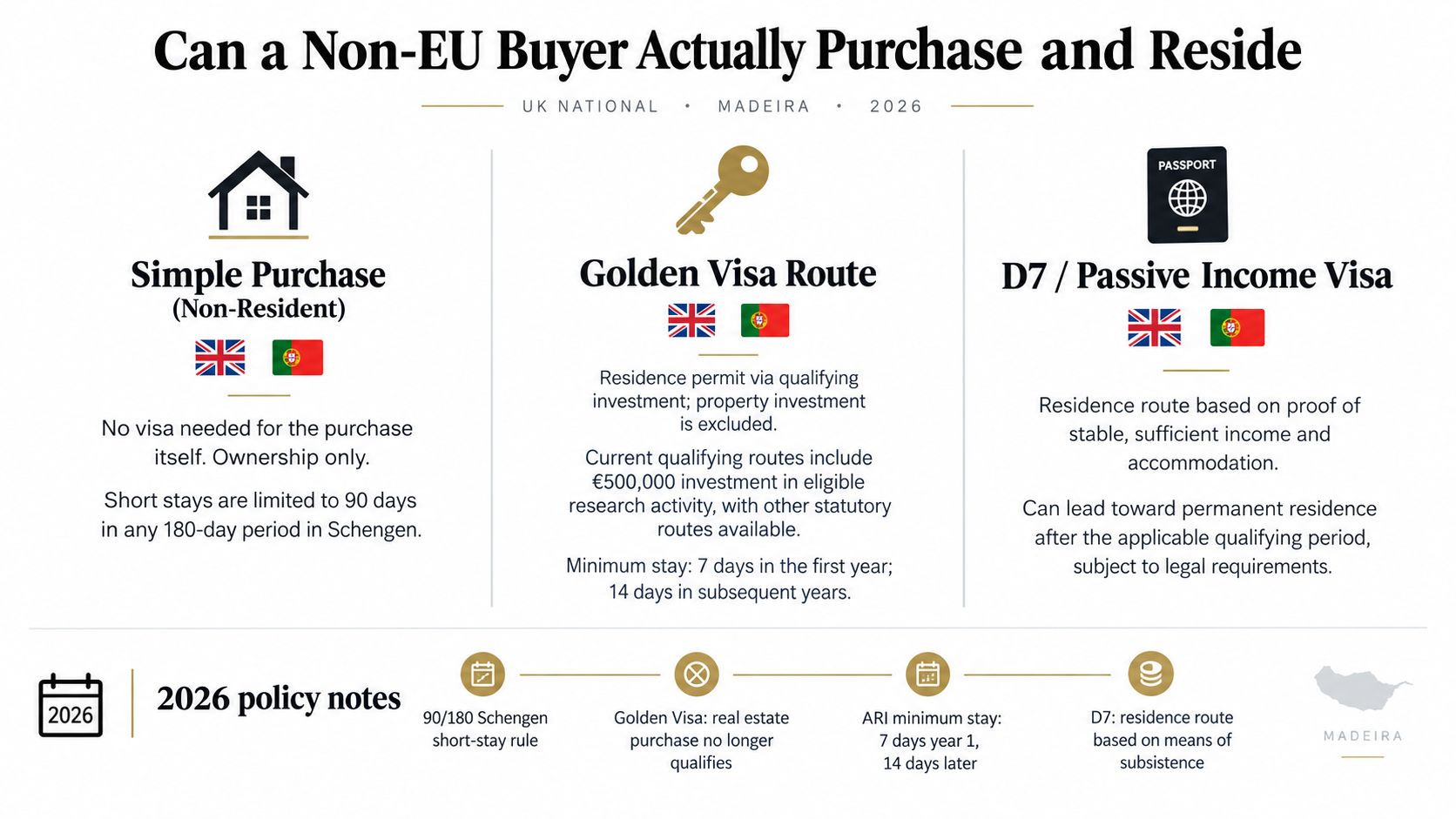
Three routes, three different objectives
Simple non-resident ownership is the cleanest route for a second home or investment. You need a Portuguese tax number and must manage tax filings, insurance and local administration, but the purchase itself doesn't give you an unlimited right to stay.
The Golden Visa is no longer a property-purchase route. Current guidance requires qualifying investment of €500,000 into eligible investment vehicles, rather than buying a Madeira home (Golden Visa information). That makes it a capital-allocation decision, not a way to turn an ordinary villa purchase into residency.
IFICI is a tax regime, not an automatic residence permit. Guidance describes a 20% rate for qualifying Portuguese-source employment and business income for ten consecutive years, with registration due by 15 January of the year after becoming resident (Madeira tax guidance). Eligibility depends on the person's activity and circumstances, so a buyer shouldn't assume that owning property qualifies.
Portugal's treaty framework matters for UK households with pensions, employment income or rental profits. The UK government confirms a double taxation agreement with Portugal and PwC explains the Portuguese NHR framework, although the relevant regime and personal eligibility must be checked at the time of application.
Practical rule: Choose the residence route according to how much time you intend to spend in Madeira and where your income is generated. Don't choose a tax regime because a property advert describes it as an expat benefit.
Real Acquisition Costs for UK Buyers in 2026
The largest change for a UK non-resident is the flat 7.5% IMT charge on residential purchases, which replaces the older progressive approach for this buyer category (Madeira market and tax coverage). That single line can alter the viability of a rental purchase, particularly when the property already carries a premium valuation.
Stamp duty, known as Imposto do Selo, is 0.8% of the deed value (Portugal buying-cost guide). Legal, notary and registration costs sit on top, and the total entry burden is commonly pushed into the mid-single-digit range before financing, furnishing or renovation. Because precise legal and registration fees vary, they should be quoted rather than guessed.
Illustrative tax-only calculation
The following table shows only the two verified percentage-based purchase taxes. It isn't a complete closing statement.
| Cost Item | €300,000 Apartment | €600,000 Villa |
|---|---|---|
| Non-resident IMT at 7.5% | €22,500 | €45,000 |
| Stamp duty at 0.8% | €2,400 | €4,800 |
| Legal fees | Obtain written quote | Obtain written quote |
| Notary and registration | Obtain written quote | Obtain written quote |
| Bank valuation and mortgage costs | If financed, obtain lender quote | If financed, obtain lender quote |
| Total before professional and finance costs | €24,900 | €49,800 |
The tax bill alone is therefore substantial. A buyer who has mentally allocated €300,000 for the apartment needs additional cash for €24,900 of these two taxes, plus professional and transaction charges. The €600,000 villa requires €49,800 before those other items.
Ownership costs continue after completion. IMI is an annual municipal property tax based on the property's taxable value, while condominium charges, insurance, maintenance and utilities depend on the building and use. Rental profits for a non-resident are subject to 28% tax on the relevant income basis, and resale taxation differs according to residence status. Review property taxes in Portugal with a Portuguese tax adviser before making an offer.
Rental Yields, Holiday Lets and Demand
Madeira's rental case is strongest when the buyer separates gross yield from spendable return. Verified market coverage reports prime rental yields of 6-8% gross in some areas, while foreign demand has moved towards short-term and premium rental use (Madeira rental-market reporting). Gross income, however, says nothing about management, furnishing, platform fees, repairs, utilities, empty periods or tax.
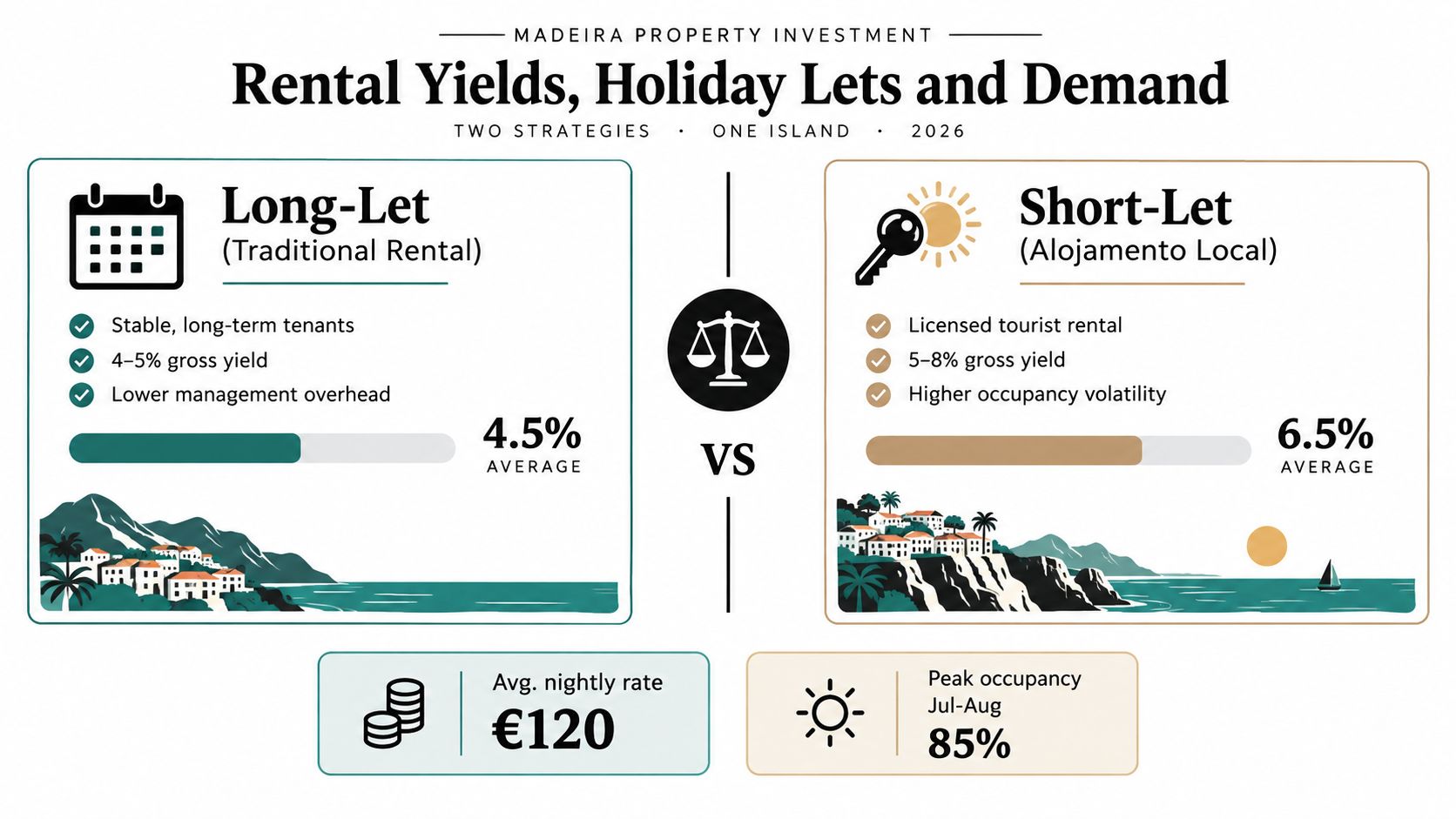
Long lets versus holiday lets
A long-term tenancy usually offers more predictable occupancy and fewer guest turnovers. The trade-off is a lower ceiling for revenue and less flexibility for personal use. It suits an absentee owner who values simple administration over maximum seasonal income.
A holiday let can align with Madeira's international tourism demand, especially in Funchal and other established visitor locations. It also creates operational exposure. The owner must confirm that Alojamento Local registration is available for the exact property and address, comply with applicable standards, and appoint reliable local support if they aren't on the island.
| Strategy | Main strength | Main weakness | Analyst's test |
|---|---|---|---|
| Long-term rental | More stable tenant income | Less personal flexibility | Does rent cover tax, maintenance and finance without optimistic assumptions? |
| Holiday rental | Potentially stronger gross income | Seasonality, compliance and active management | Does the property still work after management and empty-period assumptions? |
The international demand figures support a market with external liquidity, but they don't guarantee occupancy for an individual property. A sea view, parking, lift, reliable internet, access and legal rental status can matter more than a broad Madeira average. Use a holiday-let income calculator to test conservative, base and weak seasons, then ask a local manager for property-specific evidence.
The Step-by-Step Buying Process
The purchase starts with administration, not an offer. Obtain a NIF, appoint a fiscal representative if required, and prepare proof of identity, address, income and source of funds. A Portuguese bank account isn't always a condition of ownership, but it simplifies mortgage payments, utilities, insurance and tax administration.
From shortlist to signed contract
Shortlist properties only after deciding whether the asset is for occupation, long-term rent or holiday use. A local viewing should test humidity, access, road gradient, parking, noise, drainage, retaining walls and the relationship between the advertised condition and the registered documents.
Your independent Portuguese solicitor should examine the Caderneta Predial, land-registry records, usage licence, energy certificate, plans, condominium position and any registered charges. If the building includes extensions, pools, annexes or altered layouts, verify that the physical property matches the legal record.
The Contrato-Promessa de Compra e Venda, or CPCV, records the price, deposit, completion date, conditions and consequences of withdrawal. Deposits are commonly described as ranging from 10% to 30% in Portuguese buying guidance (Cafimo's Madeira purchase guide), but your solicitor should negotiate finance and due-diligence protections before signature.
Finance and completion
Portuguese lenders assess income, existing debt, age, credit history, property value and the source of the deposit. Mortgage approval should precede an unconditional commitment, particularly because the bank's valuation can affect the amount you must contribute.
At completion, the buyer pays the balance and purchase taxes, signs the Escritura before the notary, and registers ownership with the Conservatória do Registo Predial. A power of attorney can sometimes support remote completion, but the document must be drafted for the transaction and any related finance.
For practical relocation planning, UK motorists should review the World Driving Permit Portugal rules before assuming that a foreign driving document will cover every situation.
Risks and Common Pitfalls
Madeira's international demand doesn't remove investment risk. It can make the market more liquid in popular areas, but an apartment in a less accessible micro-location may still take time to sell. Island markets have fewer alternative buyers for unusual layouts, steep-access homes or properties with unresolved paperwork.
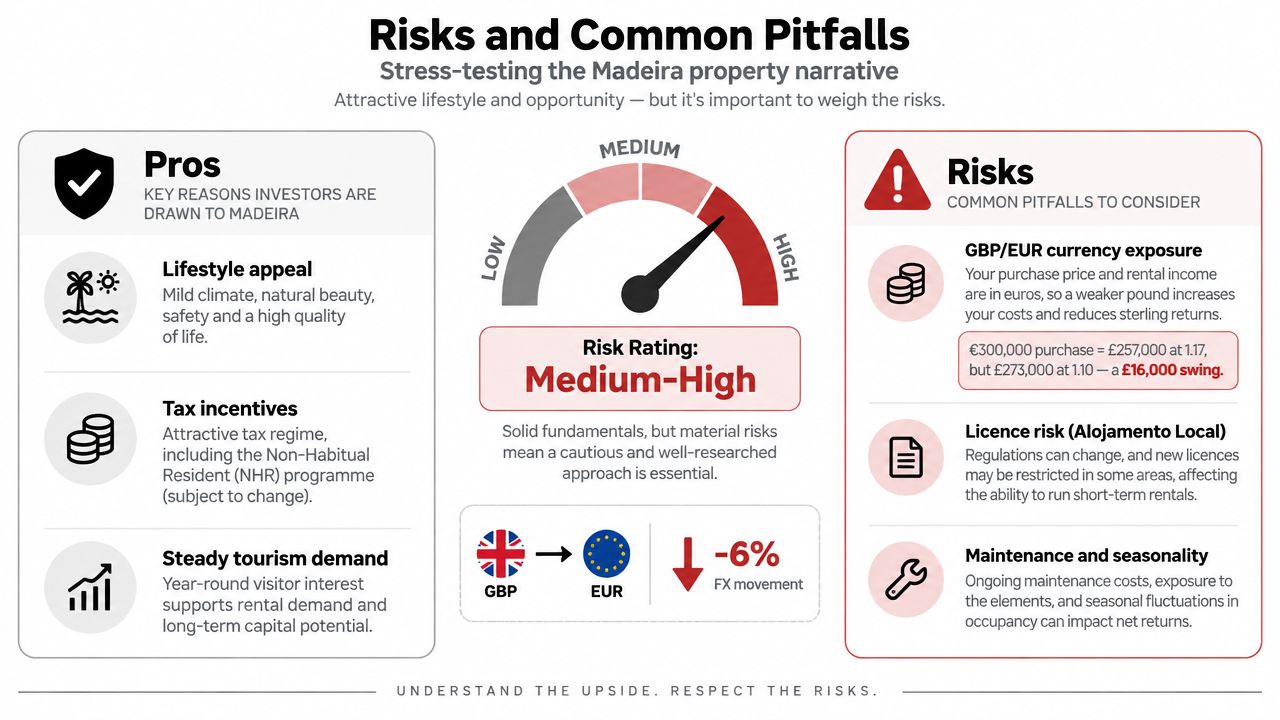
Sterling exposure is immediate. A €250,000 property costs a different number of pounds as the exchange rate moves, and the same applies to euro rental income converted back to the UK. The right response isn't to predict currencies, but to set an exchange budget, consider staged transfers and avoid funding a euro liability with an unhedged sterling assumption.
Tax and exit risk
For Portuguese tax purposes, non-residents are taxed at 28% on 100% of profits from the sale of Portuguese assets, while residents include 50% of real-estate capital gains in taxable income under progressive rates (Madeira tax guidance). That distinction can materially affect the exit calculation, particularly where a UK owner remains non-resident.
A buyer should also obtain Portuguese succession advice. Forced-heirship rules can affect how property passes to family members, and a UK will may not deal cleanly with Portuguese assets. A Portuguese or coordinated mirror-will strategy can reduce administrative uncertainty.
Other hazards deserve equal attention:
- Legal mismatch: The built property may not match the plans, licence or land register.
- Coastal exposure: Cliffs, retaining walls, drainage and landslide risk require a suitable technical inspection.
- Holiday-let permission: Alojamento Local status must be checked before the offer, not assumed from neighbouring listings.
- Developer risk: Off-plan delivery dates, specification changes and completion documentation need contractual protection.
- Peak pricing: Media attention can encourage buyers to anchor on asking prices rather than verified comparable transactions.
A property that works only with perfect occupancy, a favourable exchange rate and a rapid resale isn't an investment case. It's a collection of assumptions.
Decision Framework and Practical Next Steps
The right Madeira purchase depends on the buyer's objective, not on the island's general reputation. A retirement home can justify a lower financial return because personal use carries value. A pure investment needs a stronger margin because the owner pays the full acquisition burden while accepting operating and exit risk.
| Buyer Profile | Ownership Status | Rental Strategy | Min. Budget | Break-Even Horizon |
|---|---|---|---|---|
| Occasional-use second-home buyer | Non-resident | Personal use or selective long let | Set by property and tax cash requirement | Long, because personal use reduces rental income |
| Relocating professional | Resident, subject to immigration approval | Long let or mixed use | Set by home needs and qualifying income | Based on housing cost saved and income stability |
| Absentee income investor | Non-resident | Professionally managed rental | Must include taxes, furnishing and reserves | Longer than a headline gross-yield calculation |
| Capital-preservation buyer | Non-resident or resident | Limited rental activity | Premium, legally clean property | Dependent on resale liquidity and holding period |
A practical 30-60-90 day plan
Days 1 to 14: Obtain a NIF, arrange a Portuguese bank account, define the tax-residence position and shortlist three neighbourhoods. Separate the purchase price from the cash needed for tax, legal work, furnishing and reserves.
Days 15 to 42: Spend five to seven days viewing the island, meet independent estate agents, a solicitor and a tax adviser, and inspect at least six comparable properties. Test the journey from each property to daily services, not just the view from the balcony.
Days 43 to 70: Obtain finance terms, verify the title and licences, test long-let and holiday-let assumptions, and negotiate only after the 7.5% non-resident IMT has been included.
Days 71 to 90: Finalise due diligence, agree CPCV protections, arrange funds and prepare for completion. Keep separate reserves for running costs and exchange-rate movement.
Questions UK buyers ask
Do I need a residence permit to buy? No. You can own as a non-resident, but ownership doesn't grant unlimited residence.
Can I obtain a Portuguese mortgage? Yes, subject to lender affordability, documentation, valuation and source-of-funds checks.
What is the minimum realistic budget in Funchal or Calheta? The verified data doesn't support a single reliable minimum for either location. Compare the property against the regional median of about €2,578 per square metre and price the legal condition, access and rental permissions individually.
Is the Golden Visa available through property in 2026? No. Property purchase is not the qualifying route. The relevant investment threshold of €500,000 applies to eligible investment vehicles, not an ordinary Madeira home.
World Property Investor provides market comparisons, property tax guidance, rental-yield analysis and practical buying advice for international investors. Visit World Property Investor to compare Madeira with other overseas markets and pressure-test your next property decision before committing capital.