
Embarking on a property investment journey has two primary objectives: building long-term wealth through capital appreciation as your asset's value increases, and generating a consistent monthly income from tenants, known as rental yield. Your first and most critical decision is to define which of these goals is your priority. This guide serves as a foundational briefing, designed to equip you with an investor's mindset from the outset.
Starting Your UK Property Investment Journey

Entering the property market requires the discipline of a business owner, not the speculation of a gambler. Sustainable success is built on solid market fundamentals, not on reacting to short-term hype. For any beginner, there are two principal ways to achieve a return, and your strategy must focus on one or both.
The Two Pillars of Property Returns
The first pillar is capital appreciation. This is the increase in your property's value over a sustained period. For example, a property acquired for £200,000 might be valued at £250,000 in five years, creating £50,000 in equity. This strategy is suited to those with a long-term investment horizon.
The second pillar is rental income. This is the net cash flow generated monthly from tenants after all operational expenses—such as mortgage interest, insurance, and maintenance—are paid. This approach delivers immediate, regular returns and is ideal for investors seeking to supplement their monthly income. A well-selected property in a high-demand location can generate positive cash flow from the beginning.
An optimal investment strategy often balances both pillars. A flat in a city undergoing regeneration may offer a modest rental income today but possess significant potential for capital growth over the next decade. Your task is to find the right equilibrium for your financial objectives.
Understanding the Current UK Market
The UK property market is influenced by key economic and regulatory forces that every new investor must comprehend. Interest rates, set by the Bank of England, directly impact the cost of buy-to-let mortgage borrowing. A lower interest rate environment typically reduces borrowing costs, stimulating market activity.
Government policies also play a significant role. Regulations concerning Stamp Duty Land Tax (SDLT), capital gains tax, and landlord compliance can materially affect your costs and legal obligations. For instance, adhering to local landlord licensing schemes, as detailed on Gov.uk, is a legal necessity. For a broader perspective on these fundamentals, review our beginner’s guide to real estate investing.
Your journey begins with education. By understanding these core concepts—capital growth, rental income, and key market drivers—you can start making informed, data-led decisions and build a robust foundation for your portfolio.
Mastering The Numbers Behind Smart Investments

Successful property investment is built on data, not emotion. To identify a viable opportunity and avoid a financial liability, you must become proficient with the key metrics that measure a property's performance.
For any beginner, two metrics are paramount: Net Rental Yield and Return on Investment (ROI).
These calculations cut through marketing rhetoric and reveal the true profitability of a property. They enable you to compare disparate assets—a city-centre apartment versus a suburban house, for instance—on an equal footing, ensuring your decisions are driven by objective analysis.
Calculating Net Rental Yield
Net Rental Yield is the most important metric for understanding a property's annual income performance. It measures your net rental profit against the property's total acquisition cost, crucially, after deducting all operational expenses.
This provides a more accurate financial picture than the ‘gross yield’ often quoted by agents, which omits the real-world costs you will incur.
The formula is:
Net Rental Yield (%) = [(Annual Rental Income – Annual Running Costs) / Total Property Cost] x 100
This formula enforces financial realism. You must account for every cost, from management fees and insurance to potential void periods. A healthy net yield is the cornerstone of any sustainable buy-to-let portfolio.
Here is a practical breakdown illustrating the calculation of a net yield for a typical investment property, factoring in all necessary expenses.
Example Net Rental Yield Calculation for a UK Buy-to-Let
| Financial Item | Example Value (£) |
|---|---|
| Purchase Price | £170,000 |
| Transaction Costs (Stamp Duty, legal fees) | £5,000 |
| Initial Refurbishment | £5,000 |
| Total Property Cost | £180,000 |
| Annual Rental Income (£900 x 12) | £10,800 |
| Annual Costs: | |
| Letting Agent Fees (12% of rent) | £1,296 |
| Landlord Insurance | £300 |
| Maintenance & Repairs (10% of rent) | £1,080 |
| Ground Rent & Service Charge | £1,200 |
| Mortgage Interest (not capital repayment) | £4,500 |
| Total Annual Costs | £8,376 |
| Net Annual Profit | £2,424 |
| Net Rental Yield Calculation | (£2,424 ÷ £180,000) x 100 |
| Final Net Rental Yield | 1.34% |
This calculation provides the true cash-on-cash return from your rental income after all liabilities have been met. It is the definitive figure that tells you if the property is generating a monthly profit.
Understanding Return on Investment (ROI)
While yield focuses on annual cash flow, Return on Investment (ROI) provides a holistic view by incorporating capital appreciation. It measures the total return relative to the actual cash you invested.
For a more detailed analysis, it is worth exploring our full guide on how to calculate ROI for real estate to master this metric.
ROI is particularly potent in markets experiencing strong growth. For example, established markets like the UK offer stability, whereas emerging markets in Eastern Europe or South East Asia may present higher growth potential alongside increased risk. Within the UK, cities like Manchester and Birmingham are offering gross rental yields between 6% to 8%, significantly outperforming London's typical 3–4%, according to recent market analysis.
Let's return to our property example and assume its market value has increased from £170,000 to £175,000 after one year.
- Initial Cash Invested: A 25% deposit (£42,500) plus £10,000 in costs totals £52,500 of initial capital outlay.
- Annual Profit (from yield calculation): £2,424
- Capital Growth: £5,000 (£175,000 – £170,000)
- Total Annual Gain: £7,424 (£2,424 rental profit + £5,000 growth)
The ROI calculation is therefore:
(£7,424 / £52,500) x 100 = 14.14% ROI
This powerful metric combines both rental profit and equity gain, giving you a complete view of your investment's annual performance. Mastering these two calculations will enable you to analyse any property deal with genuine confidence.
How to Find the Right Investment Location

In property investment, location is a critical determinant of success. The area you choose to buy in will dictate tenant demand, rental income, and potential for long-term capital growth. An effective decision requires looking beyond media headlines and learning to analyse a location’s fundamental strengths.
For a beginner, the choice often lies between established, high-value markets and emerging regional hubs. While London has long been a focus for global investors, its high entry costs and compressed rental yields make it a challenging starting point. In contrast, cities in the North and Midlands of England are increasingly offering a more balanced risk-reward profile, with lower acquisition costs and higher potential yields.
Your research should be built on three core pillars: economic health, population trends, and local housing dynamics. Mastering these provides a repeatable framework for identifying opportunities in any market.
Analysing a Location’s Economic Health
A thriving local economy is the engine of a successful property investment. It creates jobs, attracts skilled workers, and expands the pool of reliable tenants. When researching an area, look for clear evidence of sustainable economic activity.
Begin by investigating major infrastructure projects. New transport links, such as the HS2 high-speed railway, can dramatically enhance a location's appeal and drive property value appreciation. Similarly, significant public or private investment in urban regeneration, business parks, or cultural facilities signals confidence in the area's future.
Credible data on regional economic performance can be found from sources like the Office for National Statistics (ONS) or by reviewing local authority development plans. These documents provide objective insights into job growth, key industries, and planned regeneration.
Key Takeaway: A strong, diverse local economy underpins consistent tenant demand. Prioritise areas with sustained job growth and major infrastructure investment, as these are leading indicators of future capital appreciation.
Understanding Population and Demographic Trends
An area's demographic profile determines the type of housing in demand. Analysing population trends is therefore a vital part of due diligence. Is the population growing? Is the area attracting tenants who align with your investment strategy?
Key demographic groups to consider include:
- Young Professionals: Cities with expanding finance, technology, or creative sectors act as magnets for this demographic, who are typically long-term renters.
- Students: A major university guarantees a predictable annual stream of tenants, making student accommodation a reliable investment class.
- Families: Suburban areas with good schools, green spaces, and effective transport links will consistently attract families, who often seek larger homes and longer tenancies.
Emerging regional hubs are now outperforming prime markets on many of these metrics. Cities like Manchester and Birmingham, for instance, are top choices for beginner property investment in the UK. Their strong rental demand supports yields of 6% to 8%, far exceeding those in London. This appeal is amplified by major urban regeneration and thriving specialist sectors.
Assessing Local Housing Market Dynamics
Finally, you must analyse the specifics of the local housing market. The objective is to find an area where rental demand exceeds supply, as this imbalance drives rental growth and supports property values.
Research average rental yields for different postcodes within your target city. While property portals provide a baseline, you must verify this data with local letting agents. They possess on-the-ground knowledge and can advise which property types are in highest demand.
Be prepared to ask targeted questions:
- What is the average void period between tenancies?
- Is there a significant supply of new-build developments coming to market that could saturate rental demand?
- Are there any local licensing schemes or regulations to be aware of?
This micro-level analysis is essential. While macroeconomics points you to the right city, it is this granular understanding of local dynamics that helps you choose the right street. For more guidance, read our article on the importance of location in real estate investment success.
By combining these three pillars of research, you can build a robust process for identifying high-potential locations and make your first investment with confidence.
Securing Your First Investment Property Loan
Obtaining the right financing is a significant hurdle for new property investors. The process is entirely different from securing a residential mortgage. Lenders view an investment property as a commercial asset, which fundamentally changes their assessment criteria.
When you transition from homebuyer to investor, the lender’s focus shifts. For a residential mortgage, they prioritise your personal salary. For a buy-to-let (BTL) loan, they are primarily concerned with the property's ability to generate sufficient income to service the debt. Understanding this distinction is key to a successful application.
The Buy-to-Let Mortgage Explained
The standard financing instrument is a buy-to-let (BTL) mortgage. These are specialist loans for landlords, and their affordability rules are distinct. Lenders require the projected monthly rent to comfortably exceed the mortgage payments.
Typically, they mandate that the monthly rent is 125% to 145% of the mortgage payment, a calculation known as the interest coverage ratio (ICR). This buffer ensures you can service the mortgage during void periods or when faced with unexpected repairs. It is a risk-management measure for both you and the lender.
Key Takeaway: Lenders are not just providing capital; they are assessing a business proposition. Their primary concern is whether the asset can self-finance while maintaining a margin for unforeseen circumstances.
Another significant difference is the deposit requirement. While a residential mortgage may be possible with a 5% deposit, the threshold for a BTL mortgage is substantially higher.
- Typical Deposit: Expect to provide a minimum of 25% of the property’s value.
- Better Rates: To access the most competitive interest rates and a wider choice of lenders, a deposit of 40% or more is often necessary.
Exploring Alternative Financing Routes
While a BTL mortgage is the conventional route, it is not the only option. If you are an existing homeowner with significant equity, you may have alternative ways to fund a purchase.
One strategy is to remortgage your primary residence to release equity as a tax-free lump sum. This capital can then be used for an outright cash purchase or to fund the deposit for a BTL mortgage. While this is an effective way to raise capital, it increases the debt secured against your own home and requires careful consideration.
For time-sensitive transactions, such as acquiring a property at auction, a bridging loan can be a useful, albeit expensive, tool. These are short-term loans designed to “bridge” a financing gap until long-term funding is arranged. They offer speed and flexibility but come with higher interest rates. For a detailed comparison, our guide on financing investment property outlines the pros and cons.
Budgeting for All Associated Costs
A common error for new investors is underestimating the upfront costs beyond the deposit. A range of fees and taxes can amount to thousands of pounds, and failing to budget for them can jeopardise the entire transaction.
Here is a checklist of the costs you must plan for:
- Stamp Duty Land Tax (SDLT): In England and Northern Ireland, you will pay a significant surcharge on top of standard SDLT rates for any additional property. This is a major expense.
- Legal Fees: A solicitor or conveyancer is required to handle the legal transfer of ownership. Budget for £1,000 to £2,500.
- Mortgage Arrangement Fees: Many BTL products include a fee for setting up the loan, which can be a flat rate or a percentage of the loan amount.
- Survey and Valuation Fees: An independent survey is essential to identify potential structural defects, while the lender will conduct its own valuation to confirm the property's worth.
- Contingency Fund: This is non-negotiable. Always set aside a cash buffer equivalent to at least three to six months of mortgage payments to cover initial repairs, furnishing, or unexpected void periods.
Navigating the Property Purchase Process
Once your offer has been accepted, the UK property purchase process becomes a coordinated effort between a team of professionals. For a beginner, understanding each expert's role and the sequence of events is key to a smooth transaction.
The process now follows two parallel tracks: securing your mortgage (the financial component) and the legal work (conveyancing). Success depends on assembling your team promptly and managing the process effectively.
Assembling Your Professional Team
Your purchase is a project, and these professionals are your expert team. Each manages a critical part of the process, and your role is to ensure they work in concert.
- Estate Agent: Although the agent is instructed by the seller, they are your primary contact for negotiation and arranging access for surveys. Maintain a professional and communicative relationship.
- Mortgage Advisor: Your advisor navigates the financing landscape. They will identify the most suitable BTL product and manage the application, ensuring all financial documentation is accurate and complete.
- Solicitor (or Conveyancer): This is your legal expert. They conduct all legal due diligence, from verifying the seller's title to the property to raising enquiries and conducting local authority searches.
- Surveyor: An independent expert who inspects the property's physical condition. Their report is a critical piece of due diligence that can uncover costly hidden issues before you are legally committed to the purchase.
This flowchart breaks down the core financial steps.
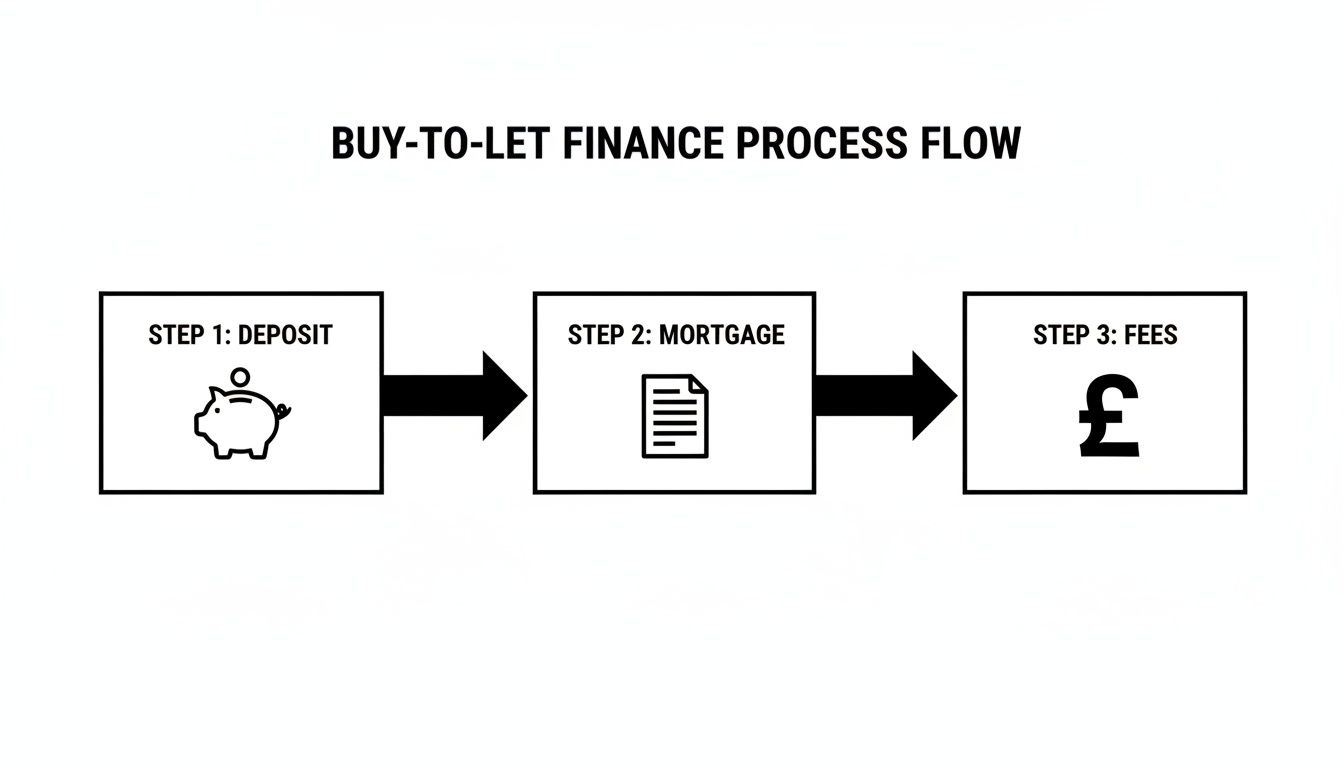
It highlights the foundational pillars of any property transaction: securing your deposit, obtaining mortgage approval, and covering all associated fees.
Your Essential Due Diligence Checklist
Due diligence is your defence against a poor investment. It is a systematic investigation into every aspect of the property—legal, physical, and financial—before you exchange contracts and become legally bound. This step should never be skipped.
The goal is not to find a flawless property, as none exists. The goal is to uncover all potential issues to make an informed decision with full awareness of the risks.
Here is a practical checklist for a first-time property investment:
- Legal Checks: Your solicitor will lead this, but you must understand their findings. Pay close attention to the title deeds and any restrictive covenants that might limit your use of the property.
- Leasehold Scrutiny (for flats): If buying an apartment, the lease is critical. A significant red flag is a short lease—anything below 80 years can be difficult to mortgage and expensive to extend. You must also verify the annual ground rent and service charges, requesting several years of accounts to identify any sharp increases.
- Physical Inspection (The Survey): Always commission an independent survey. The lender's valuation is for their benefit, not yours. A RICS Home Survey (Level 2 or 3) will check for structural issues such as subsidence, damp, or roofing problems. The survey cost is negligible compared to the potential cost of remediation.
- Local Market Analysis: Speak to at least three local letting agents. Enquire about rental demand for that specific property type, the achievable rent, and the typical tenant profile. This validates your own research and stress-tests your financial forecasts.
Understanding the wider market context is also vital. Data from bodies like the ONS or major mortgage lenders can reveal trends in supply, demand, and pricing. For instance, a market where housing completions are falling while population growth is rising signals a supply-demand imbalance that typically supports price growth and rental demand. You can read more analysis of UK property market trends.
Answering Your Top Investment Questions
Every new investor has questions. Obtaining clear, practical answers is the difference between confident action and indefinite delay. This section addresses the most common queries from those beginning their property journey, distilling the key lessons from this guide into actionable advice.
How Much Money Do I Realistically Need to Start?
It is a common error to focus solely on the mortgage deposit. While a 25% deposit is standard for a BTL loan, your total initial capital must also cover transaction costs and a contingency fund.
Using a £200,000 property as an example:
- Deposit (25%): £50,000
- Stamp Duty Surcharge: c. £6,000
- Legal & Conveyancing Fees: £1,500 – £2,000
- Surveys & Valuation: £700 – £1,000
Crucially, you must also hold a contingency fund. A reserve of at least £5,000 for initial refurbishment, furnishing, or to cover a potential void period is non-negotiable. This brings the realistic starting capital to approximately £63,000, though this figure will vary based on the property's price and location.
Should I Manage the Property Myself or Use an Agent?
This decision is a trade-off between your time, location, and expertise. Self-management allows you to save on letting agent fees, which are typically 10-15% of the monthly rent. However, it requires a significant time commitment.
Being a landlord involves far more than collecting rent; it includes handling tenant communications, arranging emergency repairs, and ensuring compliance with the 150+ pieces of legislation governing the UK rental sector. If you live far from the property or have a demanding schedule, a professional agent is often the more prudent choice. It transforms your property into a more passive investment, but this convenience comes at a direct cost to your net income.
Key Insight: Your first investment should build momentum, not cause burnout. If you lack the time or local knowledge, appointing a reputable letting agent is a wise investment in protecting your asset and your time.
What Are the Biggest Risks for a New Investor?
Understanding risks is the first step toward mitigating them. The main challenges are predictable and can be managed with careful planning.
- Rental Voids: An empty property generates no income, but mortgage payments continue. Mitigate this risk by investing in areas with high tenant demand, a robust local economy, and diverse employment sectors.
- Unexpected Costs: A boiler failure or a major leak can erode months of profit. A dedicated contingency fund is your primary defence against such inevitable maintenance issues.
- Rising Interest Rates: If you have a variable-rate mortgage, rising rates will increase your payments and could eliminate your profit margin. Consider longer-term fixed-rate products to provide cost certainty for the initial years.
- Problem Tenants: Dealing with rent arrears or property damage is stressful and costly. This risk is best managed through rigorous tenant referencing and background checks—a service a reputable letting agent will perform.
Is a New-Build or an Older Property Better?
There is no single correct answer; the optimal choice depends on your strategy. New-build properties are typically more energy-efficient, require less initial maintenance, and may come with guarantees, attracting professional tenants willing to pay a premium. The disadvantage is that you often pay a premium purchase price, which can limit capital growth in the short term.
Conversely, older properties can offer greater scope to add value through refurbishment and often possess more character. The trade-off is a higher risk of latent maintenance issues and the need for more hands-on management. To learn more about the financial implications, read our guide to better understand property taxes.
At World Property Investor, we provide the data-driven guides and market analysis you need to make informed decisions. Whether you are exploring the UK or comparing opportunities across the globe, our resources are designed to help you invest with confidence. Start your research today at https://www.worldpropertyinvestor.com.