
Investing in property abroad is a strategic move to diversify a portfolio, pursue higher returns, and hedge against domestic economic stagnation. It involves the acquisition of real estate in another country—a discipline that demands rigorous analysis of global markets, a firm grasp of foreign legal frameworks, and a pragmatic approach to financial risk.
Why global property investment is gaining momentum

Once the preserve of institutional funds and high-net-worth individuals, direct overseas property investment is now a mainstream strategy for sophisticated investors. The primary driver is access to high-growth economies and the acquisition of assets uncorrelated with a single domestic market.
For many UK-based investors, international diversification is a logical step. While the UK property market offers stability, Office for National Statistics (ONS) data periodically indicates periods of slow growth, making overseas opportunities an attractive alternative for both yield and capital appreciation.
The core motivations for investing abroad
The rationale for investing in property abroad extends beyond simple risk diversification. Several key financial drivers attract capital to overseas markets:
- Higher Rental Yields: Emerging markets, particularly in urban centres across Southeast Asia or Central and Eastern Europe, can deliver net rental yields that are difficult to achieve in established hubs like London. Yields of 6-8% are attainable in such markets, compared to the 3-4% typical of major UK cities.
- Capital Appreciation Potential: Investing in regions with significant planned infrastructure projects or a rapidly expanding middle class can lead to substantial long-term capital growth. The appreciation in property values in Portugal's Algarve region, driven by foreign investment and tourism growth, serves as a recent example.
- Lifestyle and Personal Use: The dual utility of a financial asset that also serves as a holiday home is a significant motivator. This allows investors to blend personal enjoyment with a sound financial strategy.
A well-chosen foreign property must be assessed as a calculated business decision, not an emotional holiday purchase. The fundamentals—economic stability, legal protections for foreign owners, and a clear exit strategy—must always take precedence.
Understanding the inherent challenges
The decision to invest in property abroad introduces a distinct set of challenges. Navigating unfamiliar legal and tax systems is often the first significant hurdle. The property acquisition process in Spain, for instance, is overseen by a public notary, a system fundamentally different from the solicitor-led conveyancing process in the UK.
Currency fluctuation presents a material risk. A sudden depreciation of the local currency against sterling can directly reduce rental income and erode capital gains upon repatriation.
Tax obligations are another critical consideration. An investor must understand their liability for capital gains tax in the host country and how this interacts with UK tax law via Double Taxation Agreements. Failure to do so can result in significant financial penalties.
Before committing capital, it is wise to explore a broad range of property investment insights to build a solid foundation of knowledge.
At a glance: key factors for international property investment
A systematic assessment of market fundamentals is essential before transferring any funds. This table outlines the critical factors every global investor must evaluate.
| Factor | Key Questions to Ask | Potential Impact on Investment |
|---|---|---|
| Economic & Political Stability | Is the country's GDP growing consistently? Is the government stable? What is the long-term economic outlook? | An unstable environment can lead to currency devaluation, property value decline, and legal uncertainty. |
| Foreign Ownership Rules | Are there restrictions on non-residents acquiring property? Is a full freehold title available? | Some nations only offer leaseholds or require a local partner, affecting ownership rights and resale value. |
| Taxation | What are the property, rental income, and capital gains taxes for non-residents? Does a tax treaty with the UK exist? | Unforeseen taxes can drastically reduce net returns and create complex reporting obligations. |
| Currency Risk | How volatile is the local currency against sterling? What is the strategy for managing exchange rate fluctuations? | A weak local currency erodes rental income and the asset's value when converted back to sterling. |
| Financing Options | Can non-residents secure a local mortgage? What are the interest rates and loan-to-value (LTV) limits? | Securing local finance can be difficult. Relying on UK-based funds may be necessary but limits leverage. |
| Exit Strategy | How liquid is the market? How easy will it be to sell the property in 5-10 years? Who is the target buyer? | An illiquid market can trap capital, making it difficult to realise gains according to your timeline. |
This level of due diligence separates professional investors from amateurs and is fundamental to long-term success when you invest in property abroad.
How to pinpoint your ideal investment market

Selecting the right country is the most critical decision an international property investor will make. This choice dictates potential returns, tenant profile, and the legal and tax frameworks one must navigate.
Market selection must be a data-driven process, guided by clear investment objectives. Are you seeking immediate cash flow from rental yields, or is the primary goal long-term capital appreciation? The answer will point towards very different types of markets.
Established vs. emerging markets: a comparison
The global property landscape can be broadly divided into established and emerging markets, each presenting a distinct risk-reward profile.
- Established Markets: Locations such as Spain, Portugal, or France offer political stability, transparent legal systems, and proven rental demand. The trade-off is typically slower capital growth and more modest yields, often in the 3-5% range. These markets represent a lower-risk entry point for international investment.
- Emerging Markets: Destinations in Eastern Europe or Southeast Asia can offer significant growth potential and higher rental yields, sometimes exceeding 8%. This upside is accompanied by greater economic volatility, less transparent legal frameworks, and heightened currency risk.
A balanced portfolio may eventually incorporate exposure to both. For a deeper analysis, review our guide to the top emerging property investment markets to identify current high-growth opportunities.
The core principle is to align the market's profile with your personal risk tolerance and financial goals. An investor nearing retirement may prioritise the stability of a city like Lisbon, whereas a younger investor with a longer time horizon might accept the higher risks of Warsaw for greater growth potential.
Analysing macroeconomic fundamentals
A robust property market cannot exist in a contracting economy. Before assessing specific property metrics, it is crucial to analyse the country's macroeconomic health.
Look for consistent GDP growth over several years, using data from credible sources like the World Bank or IMF. Strong foreign direct investment (FDI) is another key indicator; when multinational corporations invest heavily in a country, it stimulates job creation and housing demand. Similarly, significant government expenditure on infrastructure—new airports, transport networks, or business hubs—acts as a powerful catalyst for future property value appreciation.
Drilling down to property metrics
Once a shortlist of economically sound countries is established, the focus shifts to property-specific data. This is where theoretical analysis becomes practical deal evaluation.
Key metrics to analyse include:
- Gross Rental Yield: Calculated as the annual rent divided by the purchase price, this allows for a quick comparison of income potential across different markets.
- Price-to-Rent Ratio: This metric, derived by dividing the median property price by the median annual rent, indicates whether it is more affordable to buy or rent. A low ratio suggests property prices are reasonable relative to the rental income they can generate, favouring buy-to-let investors.
- Housing Supply and Demand: Data from local housing authorities can reveal whether there is a housing shortage or a market saturated with new developments. A supply deficit coupled with a growing population is a strong indicator of future rent and price increases.
- Vacancy Rates: Low vacancy rates, ideally below 5%, signal strong and consistent tenant demand, reducing the risk of costly void periods.
By weighing these metrics against the macroeconomic backdrop, you can make an informed decision that aligns with your strategy to invest in property abroad.
Securing finance and managing currency risk
Structuring the finance for an overseas purchase and mitigating foreign exchange risk are critical operational challenges. A robust financial strategy is as vital as market selection; without it, an otherwise promising investment can fail.
Most UK lenders are unwilling to secure a loan against an asset located in a foreign legal jurisdiction, making a standard British mortgage for an overseas property a rarity.
Exploring your financing avenues
Investors typically pursue one of two financing routes: securing a mortgage from a lender in the target country or releasing equity from their existing UK property portfolio.
-
Local Mortgages for Non-Residents: Banks in established markets like Spain or Portugal are accustomed to lending to foreign buyers. However, terms are often stricter. Expect to provide a larger deposit—typically 30-40% of the property's value—and undergo rigorous affordability checks on your global income. Be prepared to supply translated and certified financial documents.
-
Leveraging Existing Equity: Remortgaging a UK property to release capital is often a simpler and faster route. This strategy positions you as a cash buyer, providing significant negotiating power and avoiding the complexities of a foreign mortgage application. The clear disadvantage is the increased leverage against your domestic assets.
Before committing, it is essential to understand the options. Our guide provides a detailed breakdown of financing an investment property to help you weigh the alternatives.
The critical nature of currency risk
From the moment a price is agreed in a foreign currency, an investor is exposed to exchange rate risk. Even minor fluctuations between sterling and the local currency can have a substantial financial impact.
For example, an agreement to purchase a €300,000 property when the exchange rate is £1 = €1.18 results in a sterling cost of £254,237. If sterling weakens to £1 = €1.15 by the completion date, the cost rises to £260,870—an increase of over £6,600 due to market movement alone.
This volatility also affects:
- Mortgage payments: If your mortgage is in euros but your income is in sterling, a weaker pound increases the cost of your monthly repayments.
- Rental income: Rent collected in the local currency is worth less when converted back to pounds if the exchange rate moves against you.
The key takeaway is that managing currency risk is not optional; it is a fundamental part of a successful international property investment strategy. Ignoring it is an unacceptable gamble.
Practical strategies to mitigate risk
Fortunately, established financial tools exist to protect investments from currency volatility. A foreign exchange (FX) specialist can offer solutions that high street banks typically do not provide.
The most common tool is a forward contract. This allows you to lock in an exchange rate for a future transaction, typically for up to two years. By agreeing on a rate today for a transfer required in three months, you eliminate uncertainty and fix the exact sterling cost of your property, irrespective of intervening market movements.
According to major economic bodies, while debt markets remain active, non-resident buyers often face higher borrowing costs and stricter loan covenants, influenced by central bank policies and inflation. This makes prudent management of both borrowing and currency exposure more critical than ever.
Navigating foreign legal and tax systems
Successful international property investment depends on mastering local bureaucracy. A failure to navigate the legal and tax landscape correctly can transform a promising asset into a costly liability. It is a mistake to assume foreign procedures will mirror those in the UK.
Understanding the legal landscape
Legal due diligence is non-negotiable and must be completed before any funds are transferred. This process verifies the legitimacy of the property, confirms it is free from encumbrances, and ensures that you, as a foreign national, have the legal right to own it.
Essential legal checks include:
- Title Verification: Your local solicitor must conduct a thorough search of the land registry to confirm the seller has a clean and undisputed title to the property. This search will identify any hidden claims, debts, or legal disputes.
- Ownership Structures: You must be clear on the type of ownership being acquired. Is it freehold, granting absolute ownership of the property and the land it occupies? Or is it leasehold, granting ownership for a fixed term? This distinction has a profound impact on the property's value and your rights.
- Foreign Ownership Restrictions: Some nations impose restrictions on foreign buyers. Thailand, for example, prohibits direct foreign ownership of land, necessitating the use of corporate structures or long-term leases. Conversely, countries like Spain and Portugal have open markets for overseas investors.
The conveyancing process can also be unfamiliar. Many European countries, including France and Spain, use a public notary—a quasi-governmental official who oversees and validates the transaction, providing a different procedural framework and timeline compared to the UK's solicitor-led system.
Your most critical appointment is a reputable, independent, and bilingual local solicitor. Ensure they specialise in property transactions for foreign investors and that their duty of care is exclusively to you, not the seller or estate agent.
Decoding tax obligations
The purchase price is merely the starting point. A range of taxes will impact both your initial outlay and your long-term returns. Failure to budget for these will render any ROI calculation inaccurate.
Tax liabilities generally fall into four categories:
- Purchase Taxes: This is typically a transfer tax or stamp duty. In Portugal, this is the IMT, which can be up to 8%. In Spain, the ITP tax varies by region but is often between 6% and 10%.
- Annual Property Taxes: Almost all countries levy an annual tax based on the property's assessed value. In France, this is the taxe foncière; in Spain, it is the IBI. These are recurring operational costs.
- Tax on Rental Income: Rental profits are taxable in the country where the property is located. Tax rates for non-residents may differ, and rules on deductible expenses vary significantly.
- Capital Gains Tax (CGT) on Sale: Upon disposal of the asset, the host country will tax the profit. CGT rates can be substantial; for instance, a non-EU resident selling a Spanish property may face a CGT rate of 24%.
To understand how these costs affect profitability, it is essential to understand property taxes across different markets and model their impact on your net returns.
The importance of double taxation agreements
For any UK investor, a Double Taxation Agreement (DTA) is a crucial component of tax planning. A full list of treaties is available on the Gov.uk website.
A DTA prevents income from being taxed twice—once in the host country and again in the UK. It allows you to offset tax paid abroad against your UK tax liability. Without a DTA, rental profits and capital gains could be significantly diminished, undermining the viability of the investment.
Assembling your team and executing the purchase
Once you have identified your market and arranged finance, the process moves from research to execution. This transactional phase requires precision, patience, and a trusted professional team on the ground. The success of a remote purchase depends almost entirely on the quality of the professionals you appoint to represent your interests.
Building your professional support network
Your 'on-the-ground' team acts as your legal and commercial representative. Vetting these professionals is one of the most important steps in the entire process.
-
A Buyer's Agent: Unlike a standard estate agent who is legally contracted to the seller, a buyer's agent works exclusively for you. Their role is to source suitable properties, negotiate the best possible price, and represent your interests unequivocally. Seek agents with verifiable testimonials from other foreign investors and obtain their fee structure in writing.
-
A Bilingual Property Solicitor: This is non-negotiable. You require an independent solicitor specialising in property law and experienced in acting for foreign nationals. They will conduct due diligence, scrutinise contracts, and ensure the purchase complies with all local regulations. Never use a solicitor recommended by the seller or their agent.
-
A Qualified Surveyor: A thorough building survey is as crucial abroad as it is in the UK. A local surveyor will identify structural issues, defects, or required repairs that could impact the property's value and serve as a powerful negotiating tool.
This process highlights the essential pillars needed for a secure foreign property transaction.
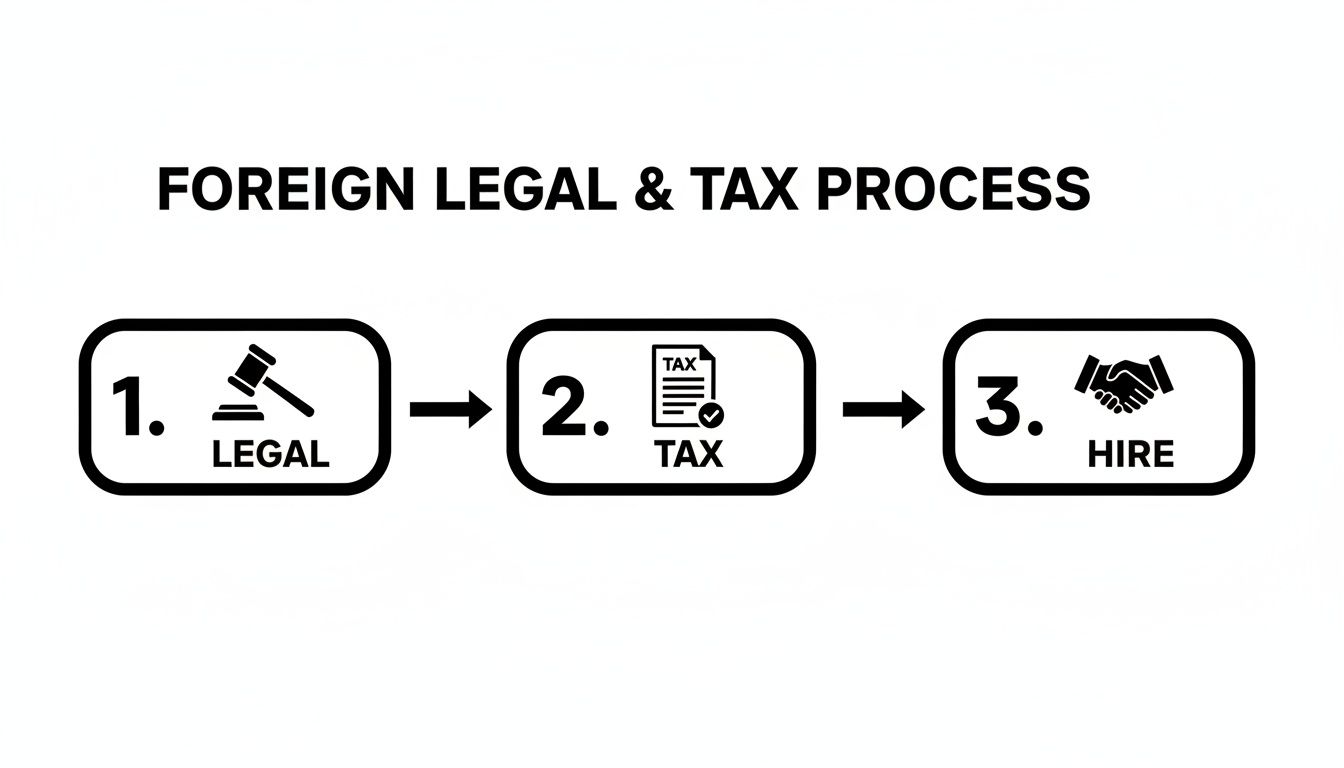
As this demonstrates, robust legal and tax diligence is contingent upon hiring the right independent professionals.
Navigating the purchase process
While the exact sequence and terminology vary, most property purchases follow a similar framework.
-
Making a Formal Offer: Once a property is identified, your agent will submit a formal offer. In some countries, such as France, this initial offer can become legally binding much earlier than in the UK. Always seek legal advice before signing any document.
-
Signing the Preliminary Contract: This key milestone, known as the compromis de vente in France or contratto preliminare in Italy, involves paying a substantial deposit (often 10-20%) into a secure escrow account. This contract formalises the price and terms of the sale.
-
Completion and Title Deed Transfer: On the agreed completion date, your solicitor will manage the final payment and oversee the signing of the title deed (escritura in Spain), typically before a public notary who officially registers you as the new owner.
Key Takeaway: Be prepared for cultural differences in negotiation and administrative processes. Maintain open communication with your team and trust their guidance on local practices.
This is the point where global capital flows are converted into tangible assets. The UK, for instance, remained a primary target for cross-border real estate capital in 2025, with investment reaching approximately £33.0 billion by the end of Q3. Sustained interest from North America and Asia-Pacific underscores the importance of these robust transaction processes. You can find more detail on these UK real estate investment figures on CBRE.com.
By assembling a skilled team and understanding the key stages of the purchase, you can execute your investment with confidence and minimise risk from the outset.
Common questions about investing in property abroad
Entering the international property market naturally raises numerous questions. Gaining clear, accurate answers is essential for building the confidence required to proceed.
Here, we address some of the most frequent queries from prospective global investors.
How much capital is required to start?
A common misconception is that overseas property investment requires vast capital. While this may be true for prime central London or Paris, many high-potential markets offer more accessible entry points.
It is possible, for instance, to acquire a modern city-centre apartment in parts of Eastern Europe for under £100,000. However, it is critical to calculate the total acquisition cost, not just the list price. This must include:
- Purchase Taxes: Transfer Tax or Stamp Duty can add 3% to 10% to the purchase price.
- Legal and Notary Fees: These professional fees typically add another 1-2%.
- Agent Fees: Ensure these are clearly defined and agreed in advance.
A sound rule of thumb is to budget an additional 10-15% on top of the property price. This buffer will cover all associated transaction costs and taxes, preventing unexpected financial shortfalls at completion.
Is my rental income from abroad taxable in the UK?
Yes. As a UK resident, you are taxed on your worldwide income. Therefore, any net profit from an overseas rental property must be declared to HM Revenue & Customs (HMRC) via your annual Self Assessment tax return.
This does not necessarily lead to double taxation. The UK has Double Taxation Agreements (DTAs) with many countries, designed to prevent this. These treaties allow you to offset the tax already paid in the foreign country against your UK tax liability. In effect, you pay the higher of the two tax rates, but not both. An experienced tax advisor can provide crucial guidance on the specific DTA relevant to your investment.
What happens if the local currency weakens?
Currency fluctuation is a primary risk in overseas investment. A significant depreciation of the local currency against sterling impacts your investment in two key ways:
- Reduced Rental Income: The rental income, when converted back to sterling, will be worth less.
- Erosion of Capital Value: The property's value in sterling terms will decrease, potentially negating any capital gains made in the local currency.
For example, a $200,000 property purchased at an exchange rate of £1 = $1.30 costs £153,846. If the rate moves to £1 = $1.45, the asset's sterling value falls to £137,931. This illustrates why active currency risk management, using financial instruments like forward contracts, is a core component of a professional international investment strategy. Our beginner's guide to real estate investing offers more detail on managing these foundational risks.
Can I get a mortgage for a property in another country?
Securing finance is achievable, although it requires a different approach. UK high street banks are generally unwilling to lend against a foreign property due to legal complexities. This leaves two primary routes:
- Remortgage a UK Property: Releasing equity from your home or an existing UK investment property is often the most straightforward method. It allows you to act as a cash buyer abroad, which provides a strong negotiating position.
- Apply for a Local Mortgage: In many investor-friendly markets like Spain, France, or the USA, local banks are equipped to lend to non-residents. However, expect stricter lending criteria, including larger deposits (typically 30-40%) and rigorous income verification.
Each option has strategic implications. Using UK equity is fast, while a local mortgage can provide a natural hedge against currency risk, as both the loan and the rental income are in the same currency.