
Venturing into property investment can seem daunting, but the fundamental concept is straightforward. An investment property is any real estate purchased not for personal use, but to generate income—either through rental revenue or capital appreciation upon sale. For a beginner, it represents an opportunity to own a tangible asset that can provide a consistent income stream and build substantial long-term wealth.
Your First Step into Property Investment
This guide is designed to cut through industry jargon, providing a clear, practical roadmap for investing in property. We will examine the core principles, from calculating realistic returns to selecting the right market and arranging finance. The objective is to equip you with the confidence that comes from a well-researched plan, not merely a desire to invest.

What Makes Property a Unique Investment
Unlike shares or bonds, which are intangible, property is a physical asset. For many new investors, this tangibility offers a powerful sense of security. Crucially, it provides two distinct avenues for generating a return on investment.
The first is rental income, which creates monthly cash flow—the net profit remaining after all expenses, including mortgage payments, have been settled. The second is capital appreciation, where the property's value increases over time, steadily building your net worth. A successful investment property delivers on both fronts.
A well-chosen property does not just cover its own costs through rental income; it also appreciates in value, effectively creating two streams of return from a single asset. This dual-return potential is what makes real estate a cornerstone of many wealth-building strategies.
Established vs. Emerging Markets for Beginners
Deciding where to purchase is one of the most critical early decisions. Established markets, such as those in the UK or Germany, offer stability, transparent legal frameworks, and decades of historical property data. For instance, Office for National Statistics (ONS) data consistently shows steady, predictable house price growth in many UK regions, providing a reassuring environment for a first-time investor.
Conversely, emerging markets in locations like Southeast Asia or Eastern Europe can offer significantly higher rental yields and the potential for more rapid capital growth. However, this potential is accompanied by higher risks, including currency fluctuations, less transparent regulations, and greater economic volatility.
A prudent strategy for many beginners is to start in a familiar, established market. Learn the fundamentals there first, then, once confident, explore higher-risk, higher-reward opportunities abroad. You can find detailed breakdowns on our property investment guides to help you compare global markets and build your foundational knowledge.
Understanding Different Investment Property Types
Selecting the right type of investment property is a foundational decision that will shape your entire investment journey. Not all properties are equal; each presents unique risks, management demands, and potential rewards. For a beginner, understanding these distinctions is key to aligning a strategy with your financial goals, budget, and time commitment.
The most common entry point for new investors is the Buy-to-Let (BTL) model. This involves purchasing a property, typically a single-family home or a flat, and letting it to a tenant on a long-term lease, usually for six to twelve months. BTLs are popular because they are relatively straightforward and can provide a steady, predictable income alongside long-term capital growth.
Your chosen strategy must align with your ambitions. A BTL offers stability, but other models are designed for higher cash flow or faster returns.
Traditional Buy-to-Let Properties
The BTL model is the bedrock of countless property portfolios, and its appeal lies in its simplicity. You find a suitable property in an area with solid rental demand, secure a long-term tenant, and collect rent each month. In stable markets like many parts of the UK, ONS data consistently shows strong rental demand, providing a welcome degree of security.
Tenants are typically individuals, couples, or families seeking a stable home. This often results in lower tenant turnover, which reduces the costs and administrative burden of finding new renters. While monthly cash flow may be more modest compared to other strategies, the combination of rental income and gradual property value growth makes it an excellent choice for building wealth over the long term.
Houses in Multiple Occupation (HMOs)
A House in Multiple Occupation (HMO) is a property let to at least three people who are not from the same household but share facilities like a kitchen and bathroom. Examples include student housing or shared houses for young professionals in city centres. The primary attraction of an HMO is its potential for a significantly higher rental yield.
By letting individual rooms, the total income can substantially exceed what you would earn from a single tenancy in the same property. For example, a four-bedroom house that might let for £1,500 per month to a family could generate £2,400 per month (£600 per room) as an HMO. This higher return, however, comes with greater management responsibilities.
HMOs are not a passive investment. They demand active management, from handling multiple tenancies to ensuring compliance with stringent safety regulations. In the UK, local authorities require mandatory licensing for larger HMOs, adding an administrative layer that beginners must be prepared for.
Short-Term and Holiday Lets
Short-term lets, popularised by platforms like Airbnb, involve letting a property on a nightly or weekly basis to tourists, business travellers, or others needing temporary accommodation. The income potential can be substantial, particularly in tourist hotspots or major cities where nightly rates can far exceed long-term rental equivalents.
This strategy also offers flexibility, allowing you to block out dates for personal use. The drawback is the intense management required. It involves a constant cycle of marketing, guest communication, cleaning, and maintenance. Income can also be seasonal and less predictable than with a BTL. It is also vital to research local regulations, as many cities are introducing stringent restrictions on short-term lets. You can also explore different market entry points, and learning about the pros and cons of buying off-plan properties provides another valuable perspective.
Comparing Investment Property Types for Beginners
This table breaks down the key differences between these strategies to help you compare them side-by-side. It offers a quick way to evaluate potential returns, required effort, and the main risks associated with each approach for a beginner investor.
| Property Type | Best For | Potential Yield | Management Level | Key Risk |
|---|---|---|---|---|
| Buy-to-Let (BTL) | Beginners seeking stable, long-term growth. | Low to Medium | Low | A single vacancy halts all income. |
| HMO | Investors focused on maximising cash flow. | High | Medium to High | Stricter regulations and higher tenant turnover. |
| Short-Term Let | Those in tourist areas willing to be hands-on. | Very High (Seasonal) | High | Unpredictable income and regulatory changes. |
Ultimately, choosing the right investment property as a beginner involves balancing potential profit with practical reality. A BTL is a solid, lower-maintenance starting point, while HMOs and short-term lets offer higher cash flow for those prepared to take on a more active management role.
How to Calculate Your Potential Returns
Profitability in property investment extends far beyond the purchase price. To succeed, you must understand the key metrics that measure a property's financial performance.
Mastering a few simple calculations will enable you to analyse potential deals, forecast income, and make decisions based on data, not emotion. This is the only way to ensure your financial projections are grounded in reality from the outset.
You need to distinguish between a high-level overview and the true, on-the-ground profitability of an asset. Each calculation offers a unique perspective, from a property's annual efficiency to the actual funds remaining in your bank account each month.
The flowchart below illustrates how the journey and demands differ for the main investment types discussed.
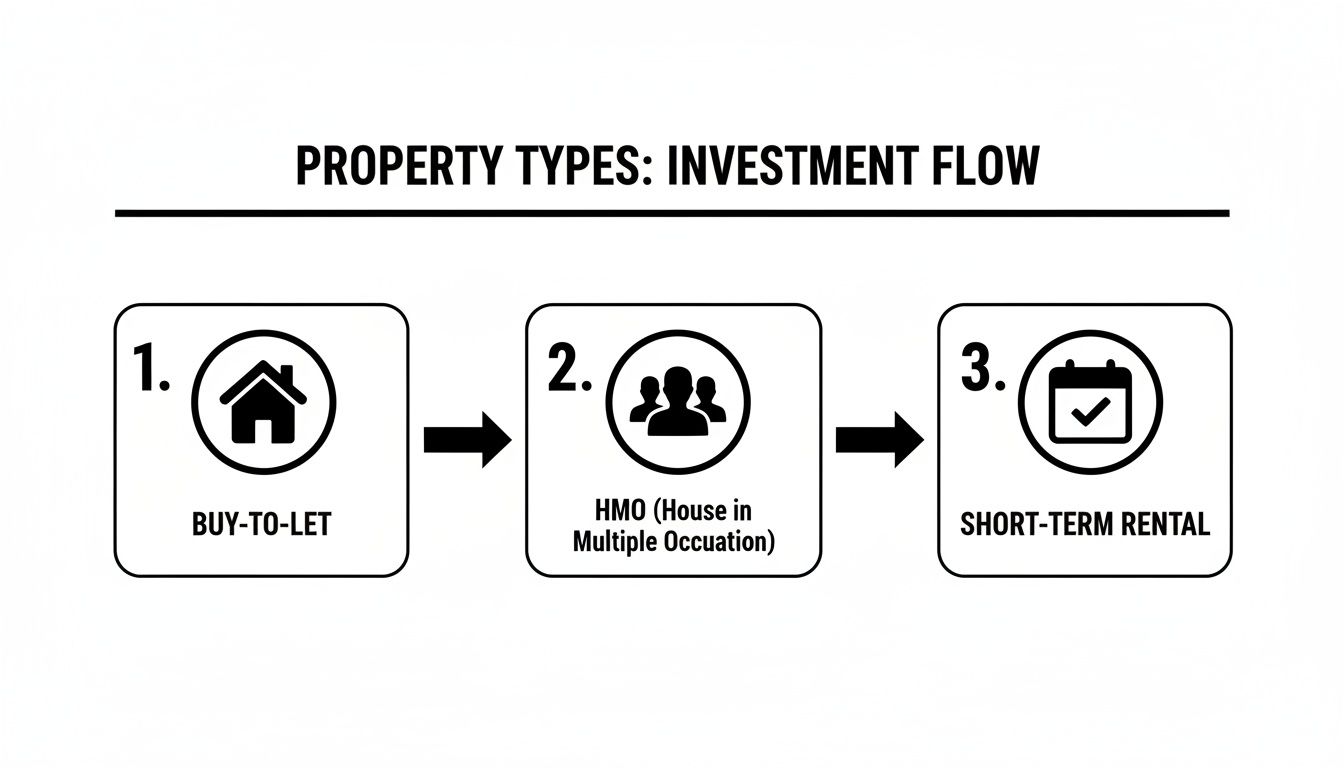
As you can see, while the goal is always income, the management demands for a simple Buy-to-Let, a multi-tenancy HMO, or a high-turnover Short-Term Let are fundamentally different.
Gross and Net Rental Yield
Your first metric is rental yield. This measures the annual return from your property as a percentage of its value. It is a quick and effective way to compare different properties, whether in established UK markets or emerging ones abroad.
There are two types of yield to understand:
- Gross Rental Yield: This is the simplest calculation. Take the total annual rent, divide it by the property’s purchase price, and multiply by 100 to get a percentage. It is useful for a raw, high-level comparison.
- Net Rental Yield: This is the figure that truly matters. It accounts for all operating costs by subtracting them from the annual rent before dividing by the purchase price. These costs include letting agent fees, insurance, maintenance, and service charges.
Worked Example: Net Yield
You purchase a flat for £200,000 that lets for £1,000 per month (£12,000 annually). Your annual operating costs (excluding the mortgage) total £2,500.
- Annual Rent: £12,000
- Annual Costs: – £2,500
- Net Annual Income: £9,500
- Calculation: (£9,500 / £200,000) x 100 = 4.75% Net Yield
Cash Flow: The Most Important Metric
While yield is a useful tool for comparing deals, cash flow is the true measure of a property's monthly profitability. It is the actual money left in your bank account each month after all expenses—including your mortgage payment—have been paid.
Positive cash flow means the property is self-sustaining and generating a profit. To calculate it, subtract your total monthly expenses from your monthly rental income.
- Your Total Monthly Expenses Will Include:
- Mortgage Repayment (principal and interest)
- Insurance (buildings and landlord)
- Letting Agent Fees (typically 8-12% of rent)
- Maintenance Fund (budget 5-10% of rent for future repairs)
- Service Charges or Ground Rent (for leasehold properties)
- Void Period Provision (it is prudent to budget for one month of no rent per year)
A property with a high yield but negative cash flow is not a sustainable investment. It drains your finances monthly, even if its value is appreciating. For beginners, prioritising positive cash flow is the safest strategy for building a stable portfolio.
Return on Investment (ROI)
Finally, Return on Investment (ROI) measures how effectively your own capital is performing. Unlike yield, which is based on the property's total value, ROI focuses only on the capital you personally invested—your deposit, legal fees, stamp duty, and any refurbishment costs.
This is a critical metric for understanding the efficiency of your capital deployment. It measures your annual net profit against the total cash you invested in the deal, with a higher ROI indicating a more efficient investment.
To learn more, you can consult our detailed guide on how to calculate return on investment for real estate. Mastering these three calculations—yield, cash flow, and ROI—is fundamental for any new investor.
Choosing the Right Investment Market
Every seasoned investor affirms that location dictates almost everything. It drives rental income, long-term capital growth, and ultimately, success. A ‘good’ market is not just an attractive neighbourhood; it is an economic engine that creates constant, reliable demand for housing. For a new property investor, learning to analyse a location is the single most important skill to develop.
A property is only valuable if people want to live in it, and people move to where opportunities exist. This means your research should begin not with property listings, but with the economic and social health of a city or region.
Identifying Key Market Drivers
Before considering a single property, you must examine the broader economic landscape. A thriving rental market is the direct result of several interconnected factors, and your task is to find data that confirms their presence.
-
Local Economic Growth: Is the local economy diverse and expanding? Look for areas with major public and private investment, such as new business parks, technology hubs, or corporate relocations. A strong economy means more jobs and higher wages, creating a larger and more reliable pool of tenants.
-
Population and Job Trends: Is the population growing? Local authorities and government statistics offices, such as the ONS, publish invaluable population forecasts. A rising population, particularly of young professionals and families, is one of the clearest indicators of sustained rental demand.
-
Infrastructure Projects: Are there significant transport upgrades or regeneration projects planned? A new rail line, motorway link, or large-scale urban renewal can transform an area, boosting property values and rental appeal for years to come.
Established vs. High-Growth Markets
When choosing where to invest, beginners often weigh the stability of an established market against the higher potential returns of a growth area. An established market, such as a prime UK city centre, generally offers lower risk and predictable returns. The trade-off is higher entry prices, which can compress your initial yield.
Conversely, a high-growth area might be a commuter town set to benefit from a new transport link or a city undergoing major regeneration. These locations offer lower purchase prices and the potential for greater capital growth. The key is to separate genuine potential from speculation by adhering to economic fundamentals. For a deeper analysis, you can explore some of the top emerging property investment markets currently monitored by analysts.
The most successful investors seek markets where rental demand is projected to outpace housing supply. This imbalance is the engine that drives both rental income and property values upwards over the long term.
Recent ONS data illustrates these regional differences. While average UK house prices saw modest annual growth, this figure conceals a more complex story. London prices experienced a fall, while regions in Northern England and the Midlands performed much better, attracting investors with greater affordability and strong rental demand. This trend is supported by a nationwide surge in private rents, indicating that in the right locations, rental income is growing faster than property prices—an ideal scenario for a new investor.
By focusing your research on these core drivers—economic health, job creation, and infrastructure investment—you move beyond simply buying a property. You are investing in a location’s future, a strategy that lays the foundation for a successful and resilient portfolio.
Securing Finance and Understanding Taxes
Managing the financial aspects correctly is crucial for a successful property investment. This requires a clear, structured plan for funding the purchase and handling your tax responsibilities from the outset.
Mastering these two pillars—securing the right mortgage and understanding UK tax obligations—sets the foundation for sustainable portfolio growth.
The Buy-to-Let Mortgage Explained
When purchasing a property to let, a standard residential mortgage is not suitable. You need a specialist product called a buy-to-let (BTL) mortgage. While the application process is similar, the lender's assessment criteria are fundamentally different.
Lenders are less concerned with your personal salary and more focused on the property's income-generating potential. The key test is whether the expected rent will cover the mortgage interest payments by a specific margin, typically 125% to 145%. This is known as the Interest Coverage Ratio (ICR).
The most significant difference with BTL mortgages is the deposit requirement. While a residential loan may require as little as 5%, investors are expected to contribute a larger share. You will typically need a deposit of 25% or more of the property’s value, reflecting the higher risk lenders associate with investment properties.
Understanding Your Tax Obligations
Once your property starts generating rental income, you will have several tax obligations. Understanding these is vital for managing your cash flow and ensuring legal compliance. Overlooking tax is one of the most common and costly mistakes new investors make.
Here are the three main UK taxes you need to be aware of:
- Stamp Duty Land Tax (SDLT): When you purchase an additional property, you must pay a surcharge on top of the standard SDLT rates. This applies to almost all buy-to-let purchases and can significantly increase your upfront costs.
- Income Tax: The profit you make from rent is taxable. You calculate your profit by deducting allowable expenses (such as letting agent fees, insurance, and maintenance) from your total rental income. The resulting figure is then taxed at your personal Income Tax rate.
- Capital Gains Tax (CGT): If you eventually sell your investment property for more than you paid for it, the profit is subject to Capital Gains Tax. Everyone has a tax-free allowance each year, but any profit above this threshold will be taxed.
Navigating the finances can seem complex, which is why consulting with specialist mortgage brokers and tax advisors is essential. For a deeper dive into funding strategies, our guide on financing investment property offers tailored insights for international buyers. Understanding these fundamentals allows you to structure your investment for maximum efficiency from the start.
Your Step-by-Step Purchase Checklist
Now, let's translate theory into practice. Knowing the concepts is one thing, but purchasing your first property is a significant step. This checklist breaks the process into manageable stages, from arranging finance to collecting the keys.
Think of this as your blueprint. Following it will keep you organised, help you avoid common mistakes, and build your confidence as you move from aspiring investor to property owner.

This is a proven path to guide you through your first property acquisition.
Phase 1: Laying the Financial and Legal Foundations
Before viewing any properties, you must get your finances in order. This is the most critical phase. Proper preparation ensures you know exactly what you can afford and can act quickly when a good opportunity arises.
- Define Your Budget: Determine precisely how much capital you can invest. You will need your deposit (plan for at least 25% for a buy-to-let mortgage), plus funds for Stamp Duty, solicitor fees, and a contingency for any immediate repairs.
- Obtain a Mortgage in Principle: Speak to a mortgage broker specialising in buy-to-let finance. An Agreement in Principle (AIP) is a lender's indication of how much they are prepared to lend you. It demonstrates to sellers that you are a serious, credible buyer.
- Appoint Your Solicitor: Do not wait until you have found a property to engage a solicitor or licensed conveyancer. Instruct them early. They will handle all the legal work, from checking the property’s title to managing the final transfer of funds.
Phase 2: Finding and Securing Your Property
With your finances arranged, the search can begin. This stage is about research, financial analysis, and being ready to act decisively when you find the right property.
Making an offer should be based on a thorough assessment of the building's condition and its true potential to generate profit, not just a gut feeling.
An offer is not just a number; it is a reflection of your due diligence. It should account for the property's condition, local market value, and any necessary refurbishment costs, ensuring your investment is profitable from day one.
Phase 3: The Conveyancing Process
Once your offer is accepted, the legal process, known as conveyancing, begins. Your solicitor ensures the purchase is legally sound and your investment is protected.
- Searches and Surveys: Your solicitor will order local authority searches to uncover any planning issues or restrictions. Simultaneously, you must commission a property survey—either a RICS HomeBuyer Report for standard properties or a full structural survey for older or more complex ones. This is your defence against hidden, costly problems.
- Mortgage Offer and Exchange of Contracts: After the lender has valued the property, they will issue a formal mortgage offer. Once your solicitor has completed all checks, you and the seller will exchange signed contracts. At this point, the deal becomes legally binding.
- Completion Day: On an agreed date, the final step occurs. Your solicitor transfers the funds to the seller's solicitor, and you officially become the owner. It is time to collect the keys and begin your journey as a property investor.
Common Questions About Property Investing
To conclude, let's address some of the most common questions for new investors. This section aims to resolve any remaining doubts and provide the confidence to take the next step.
How Much Capital Do I Need to Start?
The amount of capital required is flexible and depends entirely on the market you choose. While a deposit of at least 25% is typical for a buy-to-let mortgage in the UK, the total upfront investment varies significantly by location.
An investment property in an affordable northern city will require less capital than one in London. It is crucial to budget for more than just the deposit. You must also cover legal fees, Stamp Duty, and have a contingency fund for initial repairs or furnishings—budgeting an additional 5-10% of the purchase price is a prudent approach.
Is Property a Better Investment Than Shares?
Property and shares are different asset classes, each with its own strengths. Property offers the security of a tangible asset. It also allows you to use leverage (a mortgage) to control a high-value asset with a smaller initial investment. Returns are generated through both monthly rental income and long-term capital appreciation.
Shares, on the other hand, are more liquid (easier to buy and sell) and have a lower barrier to entry in terms of capital. Most successful investors diversify their portfolios across both asset classes. For beginners, the tangible nature and predictable income of property can feel more accessible than the volatility of the stock market.
What Is a Realistic Return to Expect?
Returns vary widely depending on strategy and location, but it is vital to analyse the complete picture. According to market analysis from firms like Aberdeen Investments, total returns on UK real estate can be robust, often driven by strong rental income and a limited supply of quality properties.
Key Takeaway: A solid first investment property should aim for a net rental yield of 4-6%. More importantly, it must generate positive monthly cash flow after all expenses, including the mortgage, are paid. Long-term capital growth is the additional benefit on top of this.
Can I Invest with No Experience?
Yes, absolutely. No one starts as an expert. The key is to mitigate risk by conducting thorough research, starting small, and choosing a stable, familiar market for your first purchase. This guide is designed to provide that solid foundation.
Your first property will be your steepest learning curve. Keep it simple with a straightforward buy-to-let in an area with high rental demand, be conservative with your financial projections, and do not hesitate to rely on professionals—letting agents, mortgage brokers, and solicitors are there to help you succeed.
At World Property Investor, we provide the data-driven guides and market analysis you need to compare global opportunities and make your first investment with confidence. Explore our resources at https://www.worldpropertyinvestor.com.