
The ‘best’ location for a property investment is not a single city or country; it is the one that aligns precisely with your financial strategy. The ideal market for an investor chasing immediate rental income is fundamentally different from one targeting long-term capital growth.
Your goals dictate your destination, not the other way around.
Defining Your Investment Goals to Find the Right Market

Before analysing a single property, you must be crystal clear on what a successful investment looks like to you. Without that clarity, you risk chasing headlines or, worse, sinking capital into a market entirely mismatched to your financial requirements.
This first step is about understanding the two primary ways property generates returns.
Capital Growth or Rental Yield?
Every property investment strategy, at its core, is a balance between two key metrics: capital growth and rental yield.
Capital Growth (or Appreciation): This is the increase in your property's value over time. It is a long-term play, where your real profit is realised upon selling the asset. A prime London flat, for instance, might offer a modest rental return but has historically delivered significant capital growth over decades.
Rental Yield: This measures your annual rental income as a percentage of the property's purchase price. It is the critical metric for investors who require immediate and consistent cash flow. Regional cities with strong rental demand, such as Liverpool or Manchester, often deliver superior yields.
It is rare for a single location to excel in both simultaneously. High-growth areas typically command high prices, which supresses rental yields. Conversely, high-yield locations may be more affordable but are unlikely to experience the same explosive price growth.
The first question to ask yourself is: what is my priority? If you are still mastering the basics, our beginner's guide to real estate investing provides an excellent starting point.
The most common mistake new investors make is failing to align their choice of location with their financial objectives. An investor needing monthly cash flow will find little success in a market geared purely for long-term appreciation, regardless of its prestige.
Matching Your Investment Goal to a Market Type
The table below illustrates how your primary goal connects to the type of market you should target. It helps translate your financial aim into a tangible location profile.
| Investment Goal | Typical Market Characteristics | Example Location | Primary Risk Factor |
|---|---|---|---|
| High Capital Growth | Established "blue-chip" city, strong economic fundamentals, high demand, limited supply. | Central London, UK | Low rental yield, high entry cost, market cyclicality. |
| High Rental Yield | University town or regional hub, strong price-to-rent ratio, consistent tenant demand. | Liverpool, UK | Slower capital appreciation, potential for tenant turnover. |
| Balanced Return | Commuter belt town, growing infrastructure, mix of families and professionals. | Reading, UK | May not excel in either growth or yield, moderate returns. |
| Lifestyle/Holiday Let | Popular tourist destination, strong seasonal demand, lifestyle appeal. | The Algarve, Portugal | Income can be seasonal, requires active management. |
Thinking through this table forces an honest assessment of your objectives, making your property search infinitely more focused and effective.
Aligning Strategy with Market Type
Once you have settled on your primary goal, you can filter potential markets with ruthless efficiency. Your strategy becomes the lens through which you view every opportunity, saving countless hours and preventing expensive mistakes.
Consider which of these two profiles best describes you:
The Cash Flow Investor: This person’s priority is generating a reliable monthly income. They hunt for markets with a strong price-to-rent ratio, meaning property prices are reasonable compared to the rent they can command. They focus on high-yield markets, often found in university towns or bustling regional economic centres.
The Wealth Builder: This investor is playing the long game, focused on capital appreciation over many years. They are less concerned with immediate monthly returns. Instead, they invest in established, "blue-chip" markets with rock-solid economic fundamentals that promise sustained value growth.
Determining which camp you fall into is the most critical first step. It transforms a vague, global search into a sharp, strategic mission to find the perfect location for your portfolio.
How to Properly Analyse a Property Market

Before committing capital, a disciplined investor must learn to look past glossy brochures and read a market’s vital signs. Finding the best location for property investment is not about guesswork or gut feelings; it is about a forensic approach to data. This analysis is your shield against hype and the bedrock of a profitable decision.
The first step is to master the key metrics that measure a property's likely performance. These numbers tell the true story of an asset's potential, starting with its primary function: generating income.
Decoding Rental Yields
Rental yield is the engine of a buy-to-let investment, but not all yield calculations are equal. It is crucial to distinguish between the headline figure in an advertisement and the one that actually arrives in your bank account.
Gross Rental Yield: This is the simplest calculation—the total annual rent divided by the property’s purchase price. While useful for quick comparisons, it provides an incomplete and often misleading picture of profitability.
Net Rental Yield: This is the figure that truly matters. It accounts for all operational costs, including mortgage interest, insurance, management fees, maintenance, and potential voids. The net figure is your true return on investment.
An asset might be advertised with a tempting 7% gross yield, but once high service charges and local taxes are factored in, the net yield could easily drop to 4%. Always calculate the net yield to understand your actual cash flow position.
Identifying Drivers of Capital Growth
While yield reflects your immediate returns, capital growth is about a location's future. This growth is rarely an accident; it is driven by tangible economic and social developments that increase demand for housing.
The core principle is simple: invest where jobs are being created and people want to live. A rising economic tide lifts property values, and your job is to identify those tides before they peak.
Look for clear indicators of economic expansion:
- Major Infrastructure Projects: New transport links, such as a high-speed rail line or a motorway extension, can dramatically improve a city’s appeal and unlock value in previously overlooked areas.
- Corporate Relocation: When large companies move headquarters or open new offices, they bring a wave of professionals who all need housing. This directly fuels rental demand.
- Government Investment: Large-scale regeneration schemes and public funding signal long-term confidence in an area, attracting further private investment and boosting local economies.
A prime example is the UK government's "Northern Powerhouse" initiative, which channelled significant investment into cities like Manchester. This led to a surge in job growth and a corresponding rise in property values, as confirmed by ONS data. These are the fundamental catalysts that support long-term capital appreciation.
You can learn more about how to determine a property's investment potential in our detailed guide.
Using the Price-to-Rent Ratio
One of the most powerful tools for spotting market imbalances is the price-to-rent ratio. This metric compares the median home price to the median annual rent in a specific area.
A high ratio suggests property prices are expensive relative to the rents they generate. This could indicate an overvalued market, or one better suited to investors focused on long-term capital growth strategies.
Conversely, a low price-to-rent ratio signals that rents are strong compared to property prices. This often points to a market ripe for cash flow investors, where high net yields are more achievable. It is a simple calculation that helps you quickly assess whether a location's fundamentals align with your investment goal.
Weighing the Safety of Established Markets vs. the Potential of Emerging Markets
A key decision for any global investor is whether to prioritise the security of an established, 'blue-chip' market or the higher growth potential of an emerging one. Each approach presents a distinct risk-reward profile.
The Case for Established Markets: London, New York, Paris
Established markets are the real estate equivalent of blue-chip stocks—solid, dependable, and known for stability. They offer a powerful mix of economic resilience, transparent legal systems, and deep, consistent demand from a global pool of buyers.
This appeal is anchored by robust, diversified economies that weather financial storms better than most. For instance, data from Gov.uk consistently shows London attracting vast international capital, which helps to maintain a high floor for property values. For an investor whose primary goal is wealth preservation, this stability is the main attraction.
However, this security comes at a price. The very factors that make these markets safe create significant trade-offs. The high entry cost severely supresses rental yields; a prime city apartment often struggles to produce a net yield above 2-3%. Investing here is fundamentally a long-term capital growth strategy, but after years of sustained growth, there is a real risk of market stagnation. An investor who buys at the top of a cycle could wait years to see meaningful appreciation.
The Case for Emerging Markets: Southeast Asia, Eastern Europe
For investors chasing higher returns, emerging markets offer the potential for both rapid capital growth and impressive rental yields, driven by powerful economic and demographic shifts. Rapid urbanisation and a growing middle class fuel immense housing demand.
In many of these markets, it is not unusual to find gross rental yields hitting 7-10%, a figure unheard of in mature Western cities. This is often due to a simple supply-demand imbalance, where the supply of quality housing cannot keep up with a growing, mobile workforce.
This high potential comes with heightened risks. Currency volatility, political instability, and opaque legal frameworks are significant concerns. A sudden drop in the local currency can erase gains, and property laws concerning foreign ownership can be complex or subject to change. Rigorous due diligence and a reliable local team are not optional—they are essential defences against financial loss.
The single biggest mistake an investor can make in an emerging market is assuming the rules are the same as back home. Local knowledge isn't a 'nice-to-have'; it's your most critical defence against financial loss.
A Comparative Overview: Established vs. Emerging
| Market Type | Entry Price | Typical Net Yield | Primary Return Driver | Key Risk |
|---|---|---|---|---|
| Established Market | Very High | 1.5% – 3% | Long-Term Capital Growth | Market Stagnation |
| Emerging Market | Low to Moderate | 5% – 8% | High Yield & Rapid Growth | Currency & Political Volatility |
For the average investor seeking a healthy mix of income and growth, the numbers will often point towards more balanced, regional markets that bridge this gap. You can explore our guides on the best buy-to-let locations and top emerging property investment markets for more detailed insights.
Why UK Regional Cities Offer a Balanced Return
For investors hunting for a powerful blend of stability and growth, the UK's regional cities present a compelling case. While London has long been the epicentre of UK property, savvy investors are increasingly turning their attention to major hubs outside the capital—particularly in the North of England. This shift is driven by solid economic fundamentals and a clear value proposition.
These cities offer what many consider the investment 'sweet spot'. They balance affordable entry prices with strong rental yields that consistently outperform London. This creates a more accessible and often more profitable environment for building a property portfolio.
The Economic Engines Fuelling Growth
The appeal of cities like Manchester, Liverpool, and Leeds is anchored in tangible economic development. Government initiatives such as the ‘Northern Powerhouse’ have channelled significant funding into infrastructure, transport, and technology.
This has triggered a wave of major corporate relocations, with large companies moving significant operations away from the expensive capital. For instance, major broadcasters and financial institutions have established huge offices in Manchester, bringing thousands of high-skilled, well-paid jobs. This influx of professionals directly fuels demand for quality rental accommodation, creating a stable and growing tenant pool.
The core principle here is simple: follow the jobs and the investment. A city with a growing professional population and ongoing regeneration is a city with a sustainable rental market.
Favourable Mathematics for Investors
The key difference between London and a city like Liverpool comes down to the numbers. In London, exceptionally high property prices supress rental yields, often making positive cash flow a challenge. Regional cities flip this equation.
Lower average property prices mean an investor’s capital goes much further. When that affordability is combined with robust rental demand, the result is significantly higher yields. It is this combination that makes finding the best location for property investment a numbers game where northern cities frequently come out on top.
This is a classic investment scenario.
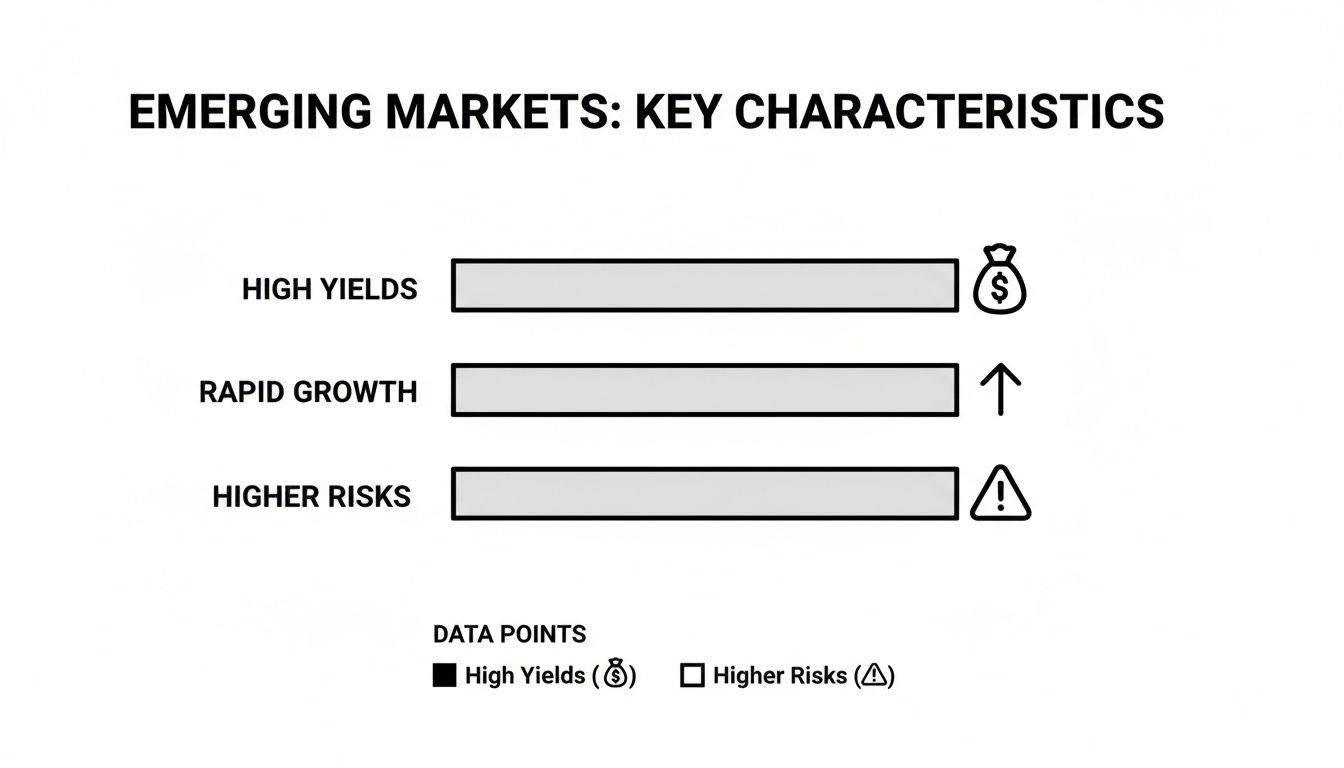
As the visual shows, higher yields and rapid growth often come with a trade-off against risk—a balance that many of these regional UK cities currently manage very well.
A Data-Driven Look at the Numbers
Data from credible sources consistently backs up the strength of these regional markets. The North West of England, in particular, stands out as a prime location for property investment in the UK.
A recent analysis revealed just how compelling the figures are.
UK Regional Property Investment Snapshot
| Region | Average Property Price (GBP) | Average Gross Rental Yield (%) | Key Economic Drivers |
|---|---|---|---|
| North West | £221,896 | 5.89% | Tech, media, logistics, major regeneration, Northern Powerhouse |
| Yorkshire & Humber | £215,487 | 5.24% | Finance, legal services, manufacturing, growing student population |
| East Midlands | £249,762 | 2.54% | Logistics, engineering, strong transport links to the South |
| London | £523,666 | 2.80% | Global finance, professional services, tech, high capital values |
Data sourced from a 2025 property analysis.
The table puts the opportunity into perspective. The powerful combination of accessible prices and market-leading yields in places like the North West is precisely what attracts global investors.
It provides a clear, data-driven path to building a property portfolio that generates immediate cash flow and has solid potential for long-term capital appreciation as these regional economies continue to expand.
Your Step-by-Step Investment Location Checklist
Turning theory into a profitable deal comes down to a structured, repeatable process. This checklist distils the core lessons from this guide into an actionable framework, helping you move from broad ideas to a specific, well-vetted location.
Following these steps ensures you make data-driven decisions, not emotional ones. It is the difference between hoping for the best and building a portfolio with confidence.
Stage One: Foundational Strategy
This first phase is about you. Before looking at a market, you must be clear on your financial goals, as this will dictate every subsequent decision.
Define Your Primary Goal: Are you chasing immediate cash flow (yield-focused) or long-term wealth creation (growth-focused)? Be honest about your financial needs and risk tolerance. This single decision will filter out 90% of unsuitable markets from the start.
Establish Your Budget: Know exactly how much capital you can deploy. This is not just your deposit; it includes legal fees, stamp duty (or its equivalent), and a contingency fund for unforeseen costs. A clear budget keeps your search focused and realistic.
Stage Two: Macro Market Analysis
With your strategy set, you can start assessing potential countries and cities. This stage is about finding stable, growing economies where your capital will be secure and has room to appreciate.
Country-Level Research: Focus on political stability, economic growth forecasts (GDP), and straightforward foreign ownership laws. Use data from major economic bodies like the World Bank or IMF to ensure you are investing in a country with a sound and transparent future.
City-Level Vetting: Drill down into specific cities. Look for strong, diverse employment sectors, positive population growth, and major infrastructure projects in the pipeline. A city with new transport links and major corporate investment is primed for growth.
Stage Three: Micro Location Due Diligence
Once you have shortlisted a promising city, the on-the-ground research begins. This is where you pinpoint the specific neighbourhoods with the highest potential.
A great city does not guarantee a great investment; success is often determined at the neighbourhood level. Proximity to key amenities can dramatically influence both rental demand and future appreciation.
Neighbourhood Investigation: Get granular. Analyse local amenities like schools, parks, public transport, and shops. Check tenant demand by looking at rental listings—how quickly are properties being let? High demand and low vacancy rates are strong positive indicators.
Legal and Tax Assessment: Consult a local, independent solicitor to understand the full costs and obligations. This includes property taxes, income tax on rental earnings, and any capital gains tax upon sale. Miscalculating tax implications can severely erode your net returns. Learn more in our guide on financing an investment property.
Assemble Your Local Team: Your final, and arguably most important, step is to build a reliable team on the ground. This should include a vetted letting agent, a trustworthy solicitor, and a maintenance contact. A strong local team is your most valuable asset, especially when investing from afar.
Frequently Asked Questions
When exploring property investment, particularly in a new country, questions are natural. Here are some of the most common queries, with straightforward, practical answers.
How much does rental yield matter compared to capital growth?
This is a fundamental question in property, and the answer depends entirely on your investment objective.
If your primary goal is monthly income—to cover the mortgage and provide cash flow—then a strong rental yield is paramount. Most cash-flow-focused investors target a net yield of 5% or more.
Conversely, if you are playing the long game and do not need immediate income, capital growth is where significant wealth is built. In this case, you would focus on locations with powerful economic drivers and population growth, even if yields are lower. A balanced strategy, which many astute investors pursue, targets locations like UK regional cities that offer a healthy mix of both.
What are the biggest hidden costs of investing abroad?
The purchase price is just the starting point. When investing overseas, you must budget for other costs. These typically include legal fees, property taxes (like Stamp Duty in the UK), currency exchange costs, and mortgage arrangement fees.
However, it is the ongoing costs that can catch new investors out. Be prepared for:
- Property management fees, which typically range from 8% to 15% of the rental income.
- Service charges for apartments or properties with shared areas.
- Landlord insurance to protect your asset.
- A maintenance fund for unexpected repairs.
- Income tax on your rental profits in the country of investment.
Always obtain a detailed cost breakdown from a local expert before you commit. Skipping this step is one of the fastest ways to turn a promising investment into a financial liability.
Is it better to invest in a city centre flat or a suburban house?
This choice hinges on your target tenant demographic.
City centre flats attract young professionals and students. They tend to generate higher rent per square metre and benefit from constant demand. The trade-off is often higher service charges, and their capital growth can sometimes lag behind houses.
Suburban houses, meanwhile, appeal to families. They attract tenants seeking space, good schools, and stability, which often translates into longer, more reliable tenancies. This can also lead to stronger capital growth over the long term, especially in areas with excellent transport links. The key is to analyse the demographics in your target market and select the property type that fits local demand.
Ready to find your ideal investment location? At World Property Investor, we provide in-depth guides, market analysis, and practical advice to help you invest with confidence. Explore our resources at https://www.worldpropertyinvestor.com to start your global property journey.