
Identifying the best countries to invest in property requires moving beyond sensational headlines. In a complex global economy, savvy investors must prioritise markets with strong fundamentals: stable governance, favourable tax regimes, robust economic drivers, and clear legal protections for foreign owners. This analysis cuts through the noise to provide a data-driven breakdown of the world's most promising property markets for 2025 and beyond.
Our guide evaluates ten key destinations, comparing established powerhouses like the UK and Germany against dynamic, high-growth markets such as the UAE and Portugal. We recognise that no single country is "best" for every investor; your ideal location depends entirely on your specific financial objectives. Therefore, we have structured our insights to help you align your strategy with the right global market.
Within this comprehensive roundup, you will discover:
-
Established markets excelling in capital growth for long-term appreciation.
-
Emerging markets offering higher rental yields for consistent cash flow.
-
Locations with attractive residency-by-investment or "Golden Visa" programmes.
-
Stable, low-risk environments for capital preservation.
Each country profile is supported by key economic indicators and an analysis of market fundamentals. We provide the clear, practical information you need to weigh the pros and cons, understand the regulatory landscape, and make confident investment decisions. This article is your starting point for building a resilient and profitable international property portfolio.
1. United States – Real Estate Investment Trust (REIT) Market
The United States presents one of the globe's most mature and liquid property markets, making it a cornerstone for international investors. While direct ownership can be complex due to varied state laws and tax implications, Real Estate Investment Trusts (REITs) offer a streamlined and accessible entry point. A REIT is a company that owns, and in most cases operates, income-producing real estate, allowing individuals to invest in portfolios of large-scale properties in the same way they invest in other industries – through the purchase of stock.
This structure allows investors to gain exposure to diverse sectors, from residential apartment blocks in high-growth Sun Belt cities like Austin and Nashville to industrial warehouses capitalising on the e-commerce boom. It circumvents the challenges of direct management, legal navigation, and significant capital outlay, making it one of the best countries to invest in property for portfolio diversification.
Actionable Investor Strategy
For those new to the US market, starting with publicly-traded REITs on major stock exchanges offers high liquidity and transparency. As you gain familiarity, you can explore non-traded public REITs or private REITs for potentially higher returns, albeit with less liquidity.
-
Focus on Growth Sectors: Prioritise REITs specialising in sectors with strong secular tailwinds. For example, industrial REITs benefit from logistics and e-commerce growth, while data centre REITs are fuelled by the expansion of cloud computing.
-
Geographic Diversification: Select REITs with assets spread across different regions. A fund focused on the Sun Belt offers exposure to population growth, while one with properties in the Midwest might offer stability and higher yields.
-
Understand the Tax Implications: Foreign investors in US REITs are typically subject to a withholding tax on dividends. It is crucial to consult a tax professional to structure your investment efficiently, potentially using an LLC or C-Corp, to mitigate tax liabilities.
-
Monitor Economic Indicators: Keep a close watch on US interest rate trends and employment data, as these directly influence property valuations and rental income. Accurate financial modelling is key; understanding how to calculate your return on investment for real estate is fundamental before committing capital.
2. United Kingdom – Buy-to-Let and Premium Residential Market
The United Kingdom has long been a global magnet for property investment, underpinned by a robust legal framework, political stability, and consistent housing demand. Its buy-to-let sector is particularly well-established, offering a clear pathway for investors to generate rental income, while the premium residential market in cities like London provides opportunities for significant capital appreciation. This dual appeal makes it one of the best countries to invest in property for a blended strategy of income and growth.

While London remains a primary focus, government initiatives like the Northern Powerhouse have catalysed regeneration and growth in cities such as Manchester and Liverpool, creating new investment hotspots. The consistent demand for student accommodation in university cities like Oxford and Cambridge further diversifies the opportunities available, allowing investors to tailor their approach to either high-yield regional markets or high-growth premium locations.
Actionable Investor Strategy
For international investors, understanding the nuance between regional yield and prime capital growth is key to success in the UK market. A well-defined strategy should account for both the initial acquisition costs and the ongoing tax landscape.
-
Balance Yield and Growth: Consider a dual-pronged approach. Allocate capital to premium London postcodes for long-term capital preservation and growth, while investing in cities like Manchester or Birmingham for stronger rental yields. This diversifies your portfolio against regional market fluctuations.
-
Structure Your Purchase Efficiently: Purchasing property through a limited company (a corporate entity) has become a popular strategy. This approach can offer greater tax efficiency, particularly concerning mortgage interest relief, following the legislative changes to Section 24 of the Finance Act 2015. Professional tax advice is essential here.
-
Account for All Costs: UK property transactions include significant upfront costs. Factor in Stamp Duty Land Tax (SDLT), including the 3% surcharge for additional properties, as well as legal fees and potential renovation costs when calculating your net yield and overall return on investment.
-
Focus on Regeneration and Infrastructure: Target areas with planned infrastructure projects or large-scale regeneration, such as the areas surrounding the HS2 rail line. Engaging with local council development plans can provide insight into future growth corridors and potential valuation uplifts.
3. Germany – Residential and Sustainable Investment Market
Germany stands out as a bastion of stability in the European property market, offering investors a low-risk environment backed by Europe’s largest economy. The market is defined by a strong rental culture, conservative property valuations, and a growing emphasis on sustainability. Unlike more volatile markets, Germany’s property sector is characterised by steady, long-term appreciation rather than speculative peaks, making it one of the best countries to invest in property for capital preservation and reliable income.
This stability is reinforced by robust tenant protection laws and a high demand for rental accommodation, particularly in major economic hubs. The national focus on energy efficiency and green building standards also presents a unique opportunity. Properties with high energy performance ratings (Energieausweis) are increasingly commanding premium rents and valuations, future-proofing investments against stricter environmental regulations and appealing to a conscientious tenant base.
Actionable Investor Strategy
For foreign investors, success in Germany requires a deep understanding of local regulations and a focus on high-demand urban centres. Navigating the legal and tax landscape is crucial, as is recognising the value of sustainable features in attracting and retaining quality tenants.
-
Prioritise Energy-Efficient Properties: Focus on modern builds or refurbished older properties with excellent energy efficiency. These assets not only attract higher-quality tenants but are also less susceptible to future regulatory costs.
-
Target Major Employment Hubs: Concentrate your search on the "Big 7" cities: Berlin, Munich, Hamburg, Frankfurt, Cologne, Stuttgart, and Düsseldorf. These cities benefit from strong job markets, population growth, and sustained rental demand.
-
Structure Your Purchase Correctly: Consider using a German legal entity (like a GmbH) to hold the property, which can offer tax advantages, particularly for long-term holds. Professional advice on this structure is essential.
-
Budget for Ancillary Costs: Be prepared for significant transaction costs. In Germany, these typically amount to 7-12% of the purchase price and include property transfer tax (Grunderwerbsteuer), notary fees, and estate agent commissions.
-
Engage Local Expertise: Hire a German-speaking solicitor and tax advisor who specialise in property law. Their expertise is invaluable for navigating contracts, understanding tenant rights, and ensuring full legal compliance.
4. Canada – Multi-Family and Regional Growth Market
Canada's property market is defined by its robust economic fundamentals, political stability, and strong, consistent immigration policies that fuel sustained housing demand. This makes it one of the best countries to invest in property for long-term, stable growth. While major hubs like Toronto and Vancouver are mature, high-value markets, significant opportunities lie in multi-family developments and burgeoning secondary cities.
The investment thesis centres on persistent rental demand driven by a growing population, which outpaces housing supply. This dynamic supports strong rental yields and capital appreciation, particularly in the multi-family sector. Investors can find value in developing or acquiring apartment buildings in cities like Calgary and Edmonton, which are benefiting from an economic resurgence, or tech-centric hubs like Montreal where a growing workforce seeks quality rental accommodation.
Actionable Investor Strategy
Success in the Canadian market hinges on navigating provincial regulations and identifying high-growth corridors. Foreign investors must strategically account for specific taxes and leverage local partnerships to maximise financing and returns.
-
Target Regional Growth Hubs: Look beyond Toronto and Vancouver to cities like Calgary, Edmonton, and Winnipeg. These markets often offer more attractive entry prices, higher rental yields, and strong economic diversification drivers, such as energy and logistics, that support long-term population growth.
-
Focus on Multi-Family Assets: Prioritise investments in multi-family properties (apartment blocks) in areas with low vacancy rates and strong immigration influx. This strategy provides multiple income streams from a single asset, mitigating the risk associated with single-family lets.
-
Navigate Foreign Buyer Regulations: Be aware of provincial-level foreign buyer taxes and the federal prohibition on non-resident purchases of certain residential properties. Structure your investment through a Canadian corporation or partner with residents to navigate these rules and improve access to local lending facilities.
-
Analyse Immigration Trends: Monitor federal and provincial immigration targets. Cities designated as key settlement areas for new arrivals will experience the most immediate and sustained demand for rental housing, creating predictable investment opportunities.
5. Australia – High-Growth Residential and Development Market
Australia’s property market stands out for its strong long-term capital appreciation potential, supported by robust economic fundamentals and a stable political landscape. The market is continually fuelled by consistent international migration, which drives housing demand, and is underpinned by stringent lending standards that promote market stability. This combination makes it a compelling choice for investors seeking growth.
The country’s geographic and economic diversity provides multiple entry points, from high-end residential conversions in Sydney’s central business district to emerging markets like Brisbane, which is attracting capital from more expensive cities. This variety allows investors to target different strategies, whether it's capital growth in urban centres or higher rental yields in thriving regional hubs like the Sunshine Coast or Canberra. For those with a higher risk tolerance, the development boom on the Gold Coast presents significant opportunities, particularly in the short-term rental sector.
Actionable Investor Strategy
Navigating Australia’s market requires a strategic approach, particularly for foreign investors who face specific regulations. Targeting new builds is often a preferred route, as it can offer tax advantages and aligns with Foreign Investment Review Board (FIRB) guidelines.
-
Focus on Emerging Regional Markets: Look beyond Sydney and Melbourne to cities like Brisbane, Canberra, and Hobart. These areas are experiencing strong population growth and infrastructure investment, often outperforming the major capitals in terms of percentage growth and rental yields.
-
Utilise Tax-Efficient Structures: Australia’s tax system allows for "negative gearing," a strategy where investment property expenses can offset other income. Engaging a local tax advisor is crucial to structure your purchase correctly and maximise these benefits.
-
Monitor Currency and Financing: As a foreign investor, currency fluctuations can significantly impact your returns. Consider hedging strategies to protect your capital. Furthermore, understanding the nuances of how to finance an investment property in Australia is a critical first step.
-
Consider Joint Venture Partnerships: Partnering with an Australian entity or resident can provide a pathway to navigate investment restrictions, particularly for acquiring established residential properties rather than new developments. This can open up a wider range of investment opportunities.
6. Portugal – Digital Nomad and Golden Visa Real Estate Market
Portugal has rapidly become a focal point for international property investors, offering an attractive blend of lifestyle, affordability, and supportive government programmes. Its appeal is largely driven by initiatives like the Golden Visa and the D7 Passive Income Visa, which provide residency pathways linked to investment. This, combined with a burgeoning tech scene and its reputation as a haven for digital nomads, has created sustained demand for both long-term and short-term rental properties, particularly in major hubs like Lisbon and Porto.

The market offers a compelling duality: investors can capitalise on the high-yield, tourism-driven short-term let market, especially in the Algarve or historic city centres, or secure stable, long-term rental income from the growing expatriate and professional population. The transformation of riverside properties in Porto and the growth of tech hubs in Lisbon illustrate the country's dynamic capital appreciation potential, making it one of the best countries to invest in property for those seeking both income and growth.
Actionable Investor Strategy
For investors drawn to Portugal, the key is to align the property strategy with a specific goal, whether it's European residency, high rental yields, or long-term capital growth. Understanding the nuances of local regulations and tax schemes is critical for maximising returns.
-
Align with Visa Requirements: If seeking residency, ensure your property purchase meets the criteria for the Golden Visa or other relevant programmes. This often dictates the minimum investment value and geographic location, so structure your acquisition accordingly.
-
Target Emerging Neighbourhoods: Look beyond the prime, saturated areas of Lisbon and Porto. Investing in adjacent, up-and-coming districts before gentrification fully takes hold can yield significant capital appreciation.
-
Structure for Short-Term Lets: If targeting the tourist market, engage a local property management company experienced in Alojamento Local (AL) licensing and compliance. Regulations are tightening, so professional guidance is essential to operate legally and efficiently.
-
Leverage Tax Incentives: For those establishing tax residency, explore the Non-Habitual Resident (NHR) scheme, which can offer significant tax benefits on foreign income for a 10-year period. This can substantially enhance your overall investment returns.
-
Analyse Market Dynamics: The dynamics of Portugal's property sector place it among the top emerging property investment markets. Continuously monitor tourism figures, foreign investment flows, and local housing policies to adapt your strategy effectively.
7. United Arab Emirates (UAE) – Luxury and Tax-Free Investment Market
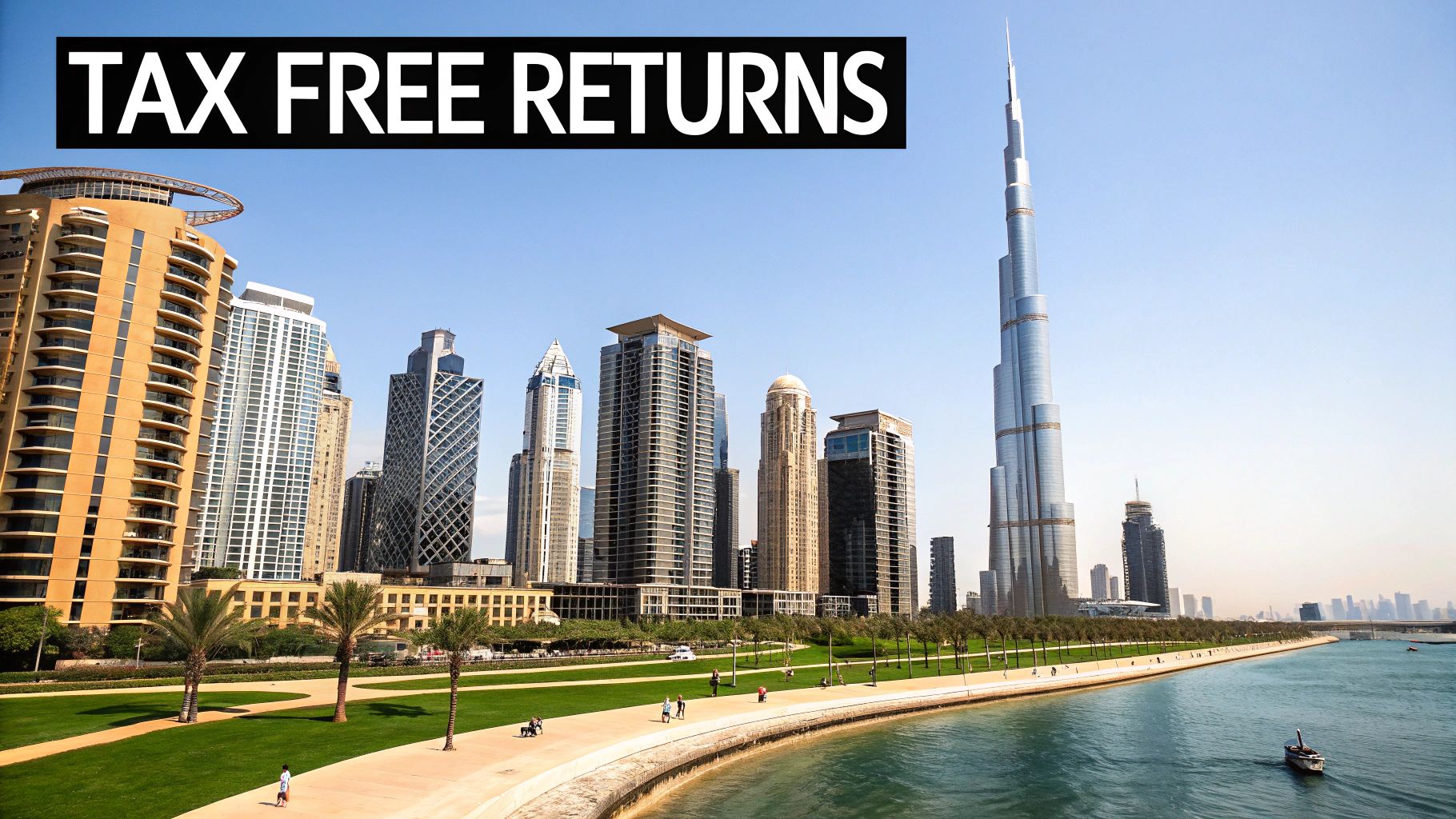
The United Arab Emirates, particularly the emirates of Dubai and Abu Dhabi, has cemented its position as a global hub for luxury real estate. The market's primary allure lies in its tax-efficient environment, offering international investors the prospect of tax-free rental income and zero capital gains tax. This favourable fiscal policy, combined with a world-class infrastructure and pro-business government initiatives, makes it one of the best countries to invest in property for high-net-worth individuals seeking both lifestyle returns and financial growth.
Recent legal reforms have significantly improved foreign ownership rights in designated freehold areas, opening up prime locations to a global investor base. This has fuelled demand for high-end properties, from luxury apartments in Downtown Dubai overlooking the Burj Khalifa to exclusive villas on Palm Jumeirah. The market offers a compelling blend of strong rental yields in established communities and significant capital appreciation potential in emerging cultural and residential districts like Abu Dhabi's Saadiyat Island.
Actionable Investor Strategy
Success in the UAE property market requires a focus on prime assets and a clear understanding of its unique regulatory landscape. For newcomers, targeting established, high-demand communities provides a stable entry point, while seasoned investors might explore off-plan opportunities in up-and-coming areas for higher growth potential.
-
Prioritise Prime Locations: Concentrate on globally recognised districts such as Dubai Marina, Downtown Dubai, and Palm Jumeirah. These areas consistently command higher rents and demonstrate greater resilience during market fluctuations, securing long-term capital appreciation.
-
Leverage Local Expertise: Build strong relationships with reputable, RERA-certified (Real Estate Regulatory Agency) local brokers. Their on-the-ground knowledge provides access to exclusive listings and invaluable guidance through the purchasing process.
-
Understand Tax and Ownership Structures: While personal income is tax-free, corporate ownership structures may offer enhanced legal protection and succession planning benefits. It is essential to understand the nuances of property tax regulations; a comprehensive overview can help investors navigate global property tax systems effectively.
-
Monitor Regulatory Changes: The UAE's legal framework for foreign property ownership is continually evolving. Stay informed about updates to visa programmes, such as the Golden Visa, and changes to freehold ownership rules, as these can directly impact market sentiment and property values.
8. Singapore – Compact Urban and High-Growth Market
Singapore stands out as a global financial hub offering a property market defined by political stability, strong legal frameworks, and consistent long-term capital appreciation. Its appeal lies in its scarcity value; as a small island nation with limited land, property is a highly prized asset. This environment creates a robust, high-quality market that attracts institutional and high-net-worth investors from around the world, making it one of the best countries to invest in property for portfolio security and growth.
While rental yields are modest compared to other global cities, the primary draw is capital growth, driven by a thriving economy and its status as a premier destination for business and talent. Foreign ownership is permitted in condominiums and certain landed properties (with approval), allowing international investors to access prime real estate in districts like Orchard Road or exclusive enclaves on Sentosa Island. The market is highly regulated, ensuring transparency and protecting investor interests.
Actionable Investor Strategy
Navigating Singapore's market requires a strategic approach focused on capital growth and understanding its unique regulatory landscape. High transaction costs, including significant stamp duties for foreigners, mean that investments must be well-researched for long-term potential.
-
Focus on Capital Appreciation: Prioritise properties in locations with strong growth drivers. While central districts like Marina Bay offer prestige, emerging areas such as the Jurong Lake District, poised to become the second Central Business District, present significant upside potential.
-
Budget for Additional Costs: Foreign buyers face an Additional Buyer's Stamp Duty (ABSD), which is substantial. Factor this, along with legal fees and agent commissions, into your financial modelling. These costs can add over 60% to the purchase price, necessitating a long-term investment horizon.
-
Explore Entry-Level Segments: While luxury condominiums are prominent, consider newer, more affordable private developments in Rest of Central Region (RCR) or Outside Central Region (OCR) locations. These areas often benefit from government infrastructure projects and decentralisation efforts.
-
Engage with Local Experts: A knowledgeable local property agent is invaluable. They provide access to off-market opportunities, navigate complex regulations, and offer insights into specific neighbourhood dynamics and upcoming government master plans that will influence future property values.
9. New Zealand – Stable Rental and Migration-Driven Market
New Zealand's property market is characterised by strong economic fundamentals, consistent net migration, and an investment-friendly legal framework. While its larger neighbour, Australia, often captures headlines, New Zealand offers a compelling alternative with strong rental demand and potential for steady, long-term capital appreciation, cementing its place as one of the best countries to invest in property for stability. The market is heavily influenced by population growth, creating consistent housing demand in key urban centres.
This environment provides a solid foundation for buy-to-let investors. Cities like Auckland, Wellington, and Christchurch offer diverse opportunities, from high-growth central suburbs to areas underpinned by public sector employment or reconstruction efforts. The country's appeal to skilled migrants and international students continually fuels the rental pool, mitigating vacancy risks for well-located properties and ensuring a reliable income stream for landlords.
Actionable Investor Strategy
Navigating New Zealand's market requires understanding its foreign ownership rules. The Overseas Investment Act 2005 generally restricts non-residents from buying existing homes, making new-build properties the most accessible route. This government policy aims to increase housing stock while still welcoming foreign capital into the construction sector.
-
Focus on New Builds: To bypass most foreign ownership restrictions, concentrate your search on newly constructed properties or off-plan developments. This is the most direct and legally straightforward entry point for non-resident investors.
-
Target Secondary City Growth: While Auckland is the largest market, cities like Wellington, Hamilton, and Tauranga often present higher rental yields. Wellington's stable government and tech sectors support strong rental demand, while Hamilton and Tauranga are experiencing significant population and economic growth.
-
Optimise Your Tax Structure: New Zealand allows investors to claim deductions for most rental property expenses, including interest on loans, rates, insurance, and repairs. Engaging a local accountant is crucial to maximise legitimate claims and understand your tax obligations, including any applicable bright-line property rules.
-
Factor in Natural Disaster Insurance: Given New Zealand's seismic activity, particularly in regions like Wellington and Christchurch, securing comprehensive insurance is non-negotiable. Factor the higher cost of premiums for earthquake coverage into your financial modelling to ensure your investment remains profitable.
10. Japan – Stable Long-Term and Undervalued Market
Japan’s property market presents a unique combination of stability, high-quality assets, and potential undervaluation, particularly when compared to its strong economy. For international investors, it offers a secure legal framework with full foreign ownership rights and a transparent transaction process, making it one of the best countries to invest in property for long-term, stable returns and currency diversification.
The market is characterised by modest but steady appreciation, particularly in major urban centres like Tokyo and Osaka. Unlike many Western markets, Japan has experienced decades of low interest rates, creating a stable financing environment. Opportunities exist not only in prime residential properties in areas like Tokyo's Shibuya and Shinjuku, driven by foreign capital and corporate housing demand, but also in regional cities benefiting from economic revitalisation. This makes it an attractive destination for investors seeking to avoid speculative bubbles.
Actionable Investor Strategy
Success in Japan requires navigating a unique cultural and bureaucratic landscape. Partnering with local, bilingual professionals is not just advisable; it is essential for a smooth acquisition. Focusing on major metropolitan areas provides a reliable stream of tenants and liquidity.
-
Prioritise Prime Locations: Concentrate on central wards in Tokyo and Osaka. These areas maintain high demand from both local and expatriate renters, ensuring consistent occupancy rates and stable rental income from corporate-leased properties.
-
Engage Local Expertise: Hire a Japanese-speaking lawyer and a reputable real estate agent (fudousan) from the outset. They are critical for due diligence, navigating contracts, and understanding local regulations.
-
Optimise Your Tax Structure: Investigate structuring your purchase through a Japanese corporate entity (Godo Kaisha or Kabushiki Kaisha). This can offer significant advantages for managing expenses and optimising tax liabilities on rental income.
-
Assess Seismic Risks: Japan is seismically active, and earthquake insurance is a crucial consideration. Thoroughly research regional risks and ensure your building meets modern seismic codes (shin-taishin), which applies to structures built after 1981. This is a vital step in discovering how to find undervalued properties in hot markets without inheriting unacceptable risk.
-
Plan for Currency Fluctuations: The Japanese Yen can be volatile. Consider currency hedging strategies to protect your investment's value and maximise returns when repatriating funds, particularly if the Yen appreciates against your home currency.
Top 10 Property Investment Markets — Comparison
| Market | Implementation complexity | Resource requirements | Expected outcomes | Ideal use cases | Key advantages |
|---|---|---|---|---|---|
| United States – REIT Market | Moderate — complex tax rules for foreigners; straightforward via REITs | High for direct ownership; low–moderate via REITs / public markets | Yields ~3–8%; capital growth ~3–5%; interest‑rate sensitivity | Passive exposure via REITs; diversified commercial/residential allocation | High liquidity, transparent markets, strong financing and legal protections |
| United Kingdom – Buy-to-Let & Premium | Moderate — transaction taxes and regulatory compliance | High in London; moderate in regional markets | Yields 3–5% London, 5–7% regions; capital growth 1–4% | Buy‑to‑let, student housing, mix of London premium + regional yield plays | Established investor products, predictable legal framework, strong tenant demand |
| Germany – Residential & Sustainable | High — strict tenant protections, notary processes, rent controls | Moderate capital; higher costs for sustainable upgrades | Yields 2.5–4%; capital growth ~1–3%; very stable income | Long‑term rental holds, ESG/energy‑efficient investments | Regulatory stability, strong ESG standards, long tenancy security |
| Canada – Multi‑Family & Regional Growth | Moderate — provincial rules and foreign buyer taxes | High in Toronto/Vancouver; moderate in secondary cities | Yields 3–5% (majors), 5–7% (secondary); capital growth 2–4% | Multifamily and immigration‑driven rental plays; secondary city value | Immigration‑fuelled demand, transparent markets, stable lending |
| Australia – High‑Growth Residential & Development | Moderate‑high — foreign limits, visa/tax complexity | Very high in Sydney/Melbourne; moderate in regions | Yields 3–6%; historic capital growth 5–8% (market dependent) | Capital‑growth focused investments; new builds for foreign buyers | Strong long‑term appreciation, tax strategies (negative gearing), migration support |
| Portugal – Digital Nomad & Golden Visa | Low‑moderate — Golden Visa paperwork; rising short‑term rental rules | Relatively low entry capital vs Western Europe | Short‑term yields 8–12% in hotspots; long‑term 3–5%; capital growth ~3–5% | Residency via investment, short‑term vacation rentals, lifestyle relocation | Pathway to EU residency, strong tourist yields, affordable entry |
| UAE – Luxury & Tax‑Free Market | Moderate — evolving ownership rules; local compliance needed | High capital for prime assets; moderate for peripheral areas | Yields 5–8%; capital growth 3–6% in established areas; tax‑free returns | Tax‑sensitive investors, luxury/resort residences, expatriate rentals | Zero personal income and capital gains tax, strong expat tenant demand |
| Singapore – Compact Urban Market | High — strict cooling measures and foreign buyer taxes | Very high capital required; limited supply | Yields 2–4%; capital growth 4–7% (scarcity driven) | Capital appreciation plays for HNW investors; strategic off‑market buys | Scarcity value, top infrastructure, political and legal stability |
| New Zealand – Stable Rental & Migration‑Driven | Moderate — foreign restrictions (new builds) and visa rules | Moderate capital; accessible vs Australia in many cases | Yields 3–5%; capital growth 4–6% historically | New builds for foreign buyers, migration‑driven rental investments | Stable market, favorable tax deductions for landlords, clear processes |
| Japan – Stable Long‑Term & Undervalued | High — complex acquisition processes and cultural/language barriers | Moderate capital in many regional markets; higher in Tokyo/Osaka | Yields 2–4%; capital growth 0–2% (select urban upside) | Value investors targeting undervalued urban assets and corporate leases | Full foreign ownership permitted, legal protections, undervalued opportunities |
Your Next Steps in Global Property Investment
Embarking on a journey into global real estate is a significant undertaking, one that blends meticulous financial planning with a bold vision for the future. As we have explored, the world is not a monolithic market. The best countries to invest in property are not defined by a single metric but by how well their unique characteristics align with your specific investment philosophy.
From the resilient, tenant-driven markets of Germany and the UK to the high-growth, innovation-fuelled hubs of the UAE and Singapore, each nation offers a distinct pathway to wealth creation. Stable, mature economies may promise lower but more predictable returns, ideal for risk-averse investors. In contrast, emerging markets or those undergoing economic transformation, such as Portugal, can offer higher rental yields and significant capital appreciation, balanced by a different set of risks.
The central theme woven through this guide is the critical importance of matching the market to your mission. Your investment strategy is the compass that guides every decision. Are you building a portfolio for long-term rental income, seeking rapid capital growth, or leveraging property to gain residency? Your answer will dictate whether you focus on a high-yield apartment in Dubai, a stable multi-family unit in Canada, or a city-centre flat in Lisbon.
Synthesising Your Strategy: From Research to Action
Moving from a theoretical understanding to a tangible investment requires a structured, actionable plan. This is where diligent research transitions into decisive action. Here are the pivotal next steps to take:
-
Define Your Investment Persona: Before anything else, clarify your goals. Are you a ‘Yield Hunter’, a ‘Growth Seeker’, or a ‘Stability-First’ investor? Write down your primary objective, your budget, your timeline, and your risk tolerance. This document becomes your strategic blueprint.
-
Conduct Micro-Market Analysis: The country is the starting point, but the city and even the neighbourhood are where your investment will succeed or fail. Once you have shortlisted one or two countries, drill down into specific urban centres. Analyse local job growth, infrastructure projects, population trends, and rental demand. A city like Manchester in the UK offers a different risk-reward profile to central London, just as a property in Porto will differ from one in the Algarve.
-
Assemble Your Local 'Dream Team': You cannot successfully invest from thousands of miles away without trusted professionals on the ground. Your essential team should include:
-
A reputable, well-connected estate agent.
-
An independent solicitor or lawyer who specialises in property law and foreign ownership.
-
A tax advisor familiar with both local tax liabilities and international reporting requirements for your home country.
-
A reliable property manager, if you are pursuing a buy-to-let strategy.
-
-
Stress-Test Your Financials: Build a detailed financial model for your target property. This must go beyond the purchase price. Factor in acquisition costs like stamp duty, legal fees, and agent commissions. Project ongoing expenses, including maintenance, property management fees, insurance, and potential void periods. This rigorous analysis separates speculative hope from a sound investment case.
Key Insight: The most successful international property investors operate with a global mindset but execute with hyper-local expertise. Your success will not be determined by picking a 'hot' country, but by understanding the specific dynamics of the street on which you choose to buy.
Ultimately, investing in property abroad is more than a financial transaction; it's a strategic diversification of your assets that can unlock new streams of income, offer a hedge against domestic economic volatility, and provide profound personal and lifestyle benefits. The path is complex, but with a clear strategy and the right support, it is an immensely rewarding one. Use the insights from this guide as your launchpad to build a robust, profitable, and truly global property portfolio.
Ready to turn this knowledge into a powerful investment strategy? World Property Investor provides the deep-dive market analysis, expert guides, and data-driven tools you need to invest with confidence. Visit World Property Investor to access exclusive insights and take the next definitive step on your global property journey.