
The buy-to-let definition is straightforward: it refers to purchasing a residential property not to live in, but with the explicit intention of renting it out to tenants. The strategy is built on two core financial ambitions: generating a recurring income stream from rent and benefiting from the property's increase in value over time, a process known as capital appreciation.
What Is a Buy-to-Let Investment?
Think of a buy-to-let (BTL) property not as a home, but as a business asset. The property is the core asset, and the monthly rent paid by tenants is its revenue. It is a tangible, physical asset that provides a route to wealth creation through both income and long-term growth.
The primary appeal for many global investors is the potential to create a source of passive income from rental property that requires less daily management than a conventional business. While informal property letting is centuries old, the modern BTL model gained formal structure in the UK following the launch of the first dedicated buy-to-let mortgage in 1996. For a historical perspective, you can explore this deep dive into the UK's BTL market.
The Two Pillars of BTL Returns
A successful buy-to-let investment is founded on two distinct financial pillars. Understanding both is critical for any serious investor.
- Rental Yield: This is the annual income generated from rent, expressed as a percentage of the property’s value. It is the primary metric for assessing the asset's income-generating performance.
- Capital Appreciation: This is the profit realised from the property's increase in market value over the long term. This gain is only secured upon the eventual sale of the asset.
Takeaway: A well-selected buy-to-let property balances a healthy rental yield for immediate cash flow with strong prospects for long-term capital appreciation, creating a powerful wealth-building instrument.
This dual-return structure is what attracts global capital to property markets. Whether considering a flat in Manchester or a villa in Dubai, these principles are universal. The skill lies in balancing rental income against operational costs—such as mortgage payments, maintenance, and taxes—to ensure sustained profitability.
For investors looking beyond domestic borders, our guide on international buy-to-let opportunities offers a closer look at the key considerations.
The Mechanics of a Buy-to-Let Investment
How does a buy-to-let investment function in practice? The process follows a clear sequence, from securing appropriate financing to installing the first tenant. For any investor, mastering these mechanics transforms the theoretical 'buy to let definition' into a tangible, income-producing asset. The journey almost always begins with the mortgage.
A buy-to-let (BTL) mortgage is fundamentally different from a standard residential home loan. Lenders are less concerned with your personal salary and focus instead on the property's potential rental income. They must be satisfied that the projected rent will comfortably cover the mortgage payments, typically requiring a rental coverage ratio of 125% to 145% of the monthly interest payment. Furthermore, a larger deposit is required—usually a minimum of 25% of the property’s purchase price.
This diagram illustrates the core buy-to-let cycle in three essential stages.
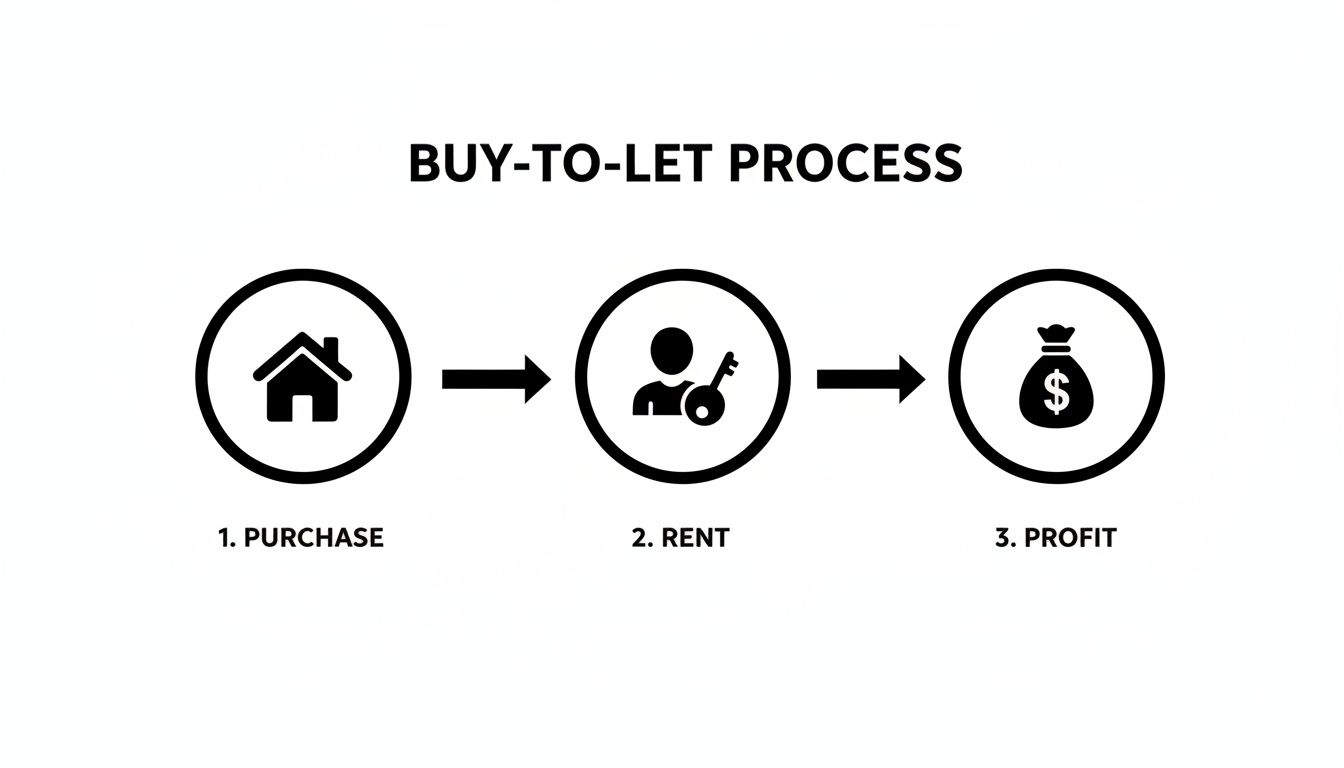
As shown, a successful investment extends beyond the purchase; it requires effective management of each phase to ensure the property generates a consistent net profit from rental income.
Calculating Returns and Managing the Property
Once financing is secured and the property acquired, your focus shifts to performance measurement and operational management. Two key metrics govern a landlord's financial world:
- Rental Yield: This metric expresses your annual rental income as a percentage of the property's value. A higher yield indicates a better income return on the initial investment.
- Return on Investment (ROI): This is a more precise calculation. It measures the total net profit against the actual cash invested, including the deposit, acquisition fees, and any renovation costs.
Takeaway: The operational aspect is as crucial as the financial. As a landlord, you have legal responsibilities regarding tenant safety, deposit protection, and maintaining a habitable living environment, as mandated by local housing authorities. Understanding these obligations is not optional.
A key strategic decision is whether to manage the property yourself or engage a letting agent. Self-management can save the typical agent fee of 10-15% of monthly rent, but it places all responsibilities—from tenant sourcing to emergency repairs—on you. For most investors, particularly those based overseas, a reputable agent is an indispensable partner. It is also vital to understand the legal ownership structure; our guide on the differences between freehold and leasehold ownership is an excellent starting point.
Calculating Your Real-World Returns

Understanding the buy-to-let definition is the first step; achieving profitability requires rigorous financial analysis. The ability to look beyond headline figures to determine an asset's true net return is what separates successful investors from speculators.
The initial assessment of a deal often starts with the gross rental yield. This is a quick calculation but can be misleading. For instance, a £250,000 property generating £1,250 per month (£15,000 annually) shows a gross yield of 6% (£15,000 ÷ £250,000). While appealing, this figure ignores the real-world costs that erode your income.
Beyond Gross Yield: The Real Costs of Landlording
To ascertain if a property will be profitable, you must calculate its net rental yield and monthly cash flow. This involves deducting all operational expenses from your gross rental income.
Every professional investor factors these costs into their due diligence:
- Mortgage Interest: The financing cost of your buy-to-let loan.
- Letting Agent Fees: Typically 10-15% of monthly rent for a fully managed service.
- Landlord Insurance: Essential cover for the building, public liability, and often loss of rent.
- Maintenance & Repairs: A prudent budget is 1% of the property’s value annually.
- Void Periods: Astute investors factor in at least one month of vacancy per year.
Takeaway: A high gross yield is meaningless if operational costs are uncontrolled. Deducting these real-world expenses is the only way to uncover a property's true profitability and avoid turning a promising investment into a monthly liability.
Let's apply this to a practical example for our £250,000 UK property.
Sample Buy-to-Let Financial Breakdown (UK Example)
This table demonstrates the process of moving from a superficial gross yield to the crucial net cash flow figure.
| Financial Metric | Calculation/Value |
|---|---|
| Purchase Price | £250,000 |
| Monthly Rent | £1,250 |
| Annual Gross Rent | £15,000 |
| Annual Costs | |
| Mortgage Interest | £5,500 (approx. based on typical rates) |
| Letting Agent Fees (12%) | £1,800 |
| Insurance & Safety Checks | £700 |
| Maintenance Buffer (1%) | £2,500 |
| Total Annual Costs | £10,500 |
| Net Annual Profit (Pre-Tax) | £15,000 – £10,500 = £4,500 |
| Net Rental Yield | (£4,500 ÷ £250,000) x 100 = 1.8% |
| Monthly Net Cash Flow (Pre-Tax) | £4,500 ÷ 12 = £375 |
As this analysis shows, the initial 6% gross yield translates to a more realistic 1.8% net yield, with approximately £375 of pre-tax cash flow per month. This is the figure that truly defines the investment's performance.
This type of analysis is fundamental to sound decision-making. For a more detailed walkthrough, learn how to calculate return on investment for property with our complete guide.
Navigating Global Tax and Regulations
For any serious global investor, mastering local tax and regulations is non-negotiable. While the buy-to-let concept is universal, its ultimate profitability is determined by the specific rules of the country in which you invest.
The difference between a high-performing asset and a financial liability often hinges on tax planning. These regulations affect every stage of the investment, from upfront acquisition costs to monthly income and the final profit realised upon sale.
A critical part of your due diligence is understanding exactly How Is Rental Income Taxed? in your target market. Miscalculations here can lead to unexpected tax bills that nullify your returns.
A Tale of Two Markets: UK vs. Dubai
To illustrate the importance of the regulatory environment, let's compare two major investment hubs with starkly different approaches: the United Kingdom and Dubai. In recent years, the UK has introduced measures that have increased the tax burden on landlords, while Dubai has maintained a simple, low-tax framework.
The UK Buy-to-Let Landscape:
- Stamp Duty Land Tax (SDLT): The purchase of an additional property incurs a 3% surcharge on top of standard SDLT rates, according to Gov.uk data.
- Section 24: This major legislative change means landlords can no longer deduct their full mortgage interest costs from rental income to reduce their tax liability. Instead, they receive a tax credit equivalent to 20% of their interest payments.
- Capital Gains Tax (CGT): When you sell the property, any profit is subject to tax. For residential property, the rates are higher than for other assets, currently at 18% or 24%, depending on the vendor's income tax band.
Takeaway: The UK's regulatory changes, particularly Section 24, have fundamentally altered the BTL landscape. The system now heavily favours cash buyers or those with low leverage, making sophisticated financial planning more critical than ever.
The Dubai Buy-to-Let Advantage:
Dubai presents an entirely different proposition for property investors, characterised by its simplicity and tax efficiency.
There is no income tax on rental earnings and no capital gains tax upon the sale of a property. This straightforward, low-tax model allows investors to retain a much larger portion of their returns, significantly boosting both monthly cash flow and overall ROI.
Understanding the specific second home tax implications across different jurisdictions is a critical part of your research before committing to an investment.
Weighing The Rewards Against The Realities

An objective discussion of buy-to-let must move beyond hyperbole. On one side, it offers powerful, long-term wealth-building potential. On the other, it presents real-world risks that demand respect and diligent management.
The upside is compelling. A well-selected property can generate a steady, inflation-hedged income stream. Beyond rental income, there is the potential for significant capital growth as property values rise over the long term. BTL also offers the unique advantage of using leverage (a mortgage) to control a high-value asset, thereby amplifying the return on your initial cash outlay.
Data from the Bank of England illustrates the scale and resilience of the sector. UK BTL mortgage lending grew from £9 billion in 2000 to £140 billion by 2008. After the global financial crisis, it recovered from a low of £8.6 billion in 2009 to £37.9 billion by 2015. You can find a full breakdown in this analysis of the buy-to-let sector and financial stability.
The Other Side Of The Coin: Real-World Risks
However, being a landlord is not a passive activity. You must understand the realities. Market downturns can erode equity, and unexpected void periods between tenancies can quickly drain cash reserves.
Takeaway: Landlording is a business, not a hobby. Success requires a clear-eyed assessment of both the potential profits and the genuine pitfalls involved in managing property and tenants.
This table provides a balanced overview, helping you determine if the risks are a fair trade for the rewards within your personal financial strategy.
Buy-to-Let Investment Advantages vs Disadvantages
| Pros (Potential Rewards) | Cons (Potential Risks) |
|---|---|
| Generates a consistent income stream | Market downturns can reduce property value (capital risk) |
| Potential for long-term capital growth | Unexpected void periods stop all cash flow (income risk) |
| Use leverage (mortgages) to amplify returns | Unforeseen maintenance and expensive repair bills |
| You own a tangible asset that you control | Dealing with difficult or defaulting tenants |
| Favourable tax treatment in certain markets | The regulatory landscape is subject to change |
Your Next Steps in Property Investment
Understanding the buy-to-let definition is one thing; translating that knowledge into a real, income-producing asset is where the work—and the reward—truly lies. Your next action depends on your current position in your investment journey.
Here is a practical roadmap to help you proceed with confidence, tailored to your level of experience.
For the First-Time Investor
If you are just beginning, your primary task is to build a solid foundation of knowledge. This means conducting thorough due diligence before viewing a single property. Focus on target areas with proven rental demand, robust transport infrastructure, and clear indicators of economic growth, such as regeneration projects or new corporate headquarters.
Simultaneously, assemble your professional support network. This should include a mortgage broker specialising in BTL finance, a solicitor experienced in investment property conveyancing, and a trustworthy local letting agent for on-the-ground intelligence. This team is your most valuable asset.
For the Experienced Portfolio Holder
It is time to think strategically about scaling and diversification. Look beyond standard single-family lets towards higher-yielding assets like Houses in Multiple Occupation (HMOs) or multi-unit freehold blocks, which can significantly enhance cash flow.
Alternatively, this may be the opportune moment to explore emerging international markets where the potential for capital growth could outpace more mature locations. For example, a market like Portugal's Algarve region offers strong tourism-driven rental demand, while cities in the UAE like Dubai provide a tax-efficient environment. This strategy requires careful analysis of local economic drivers and legal frameworks but can add powerful, non-correlated diversification to your portfolio.
Takeaway: Acting on a well-researched plan is what separates armchair investors from successful ones. The current market, while presenting challenges, also offers significant opportunities for those prepared to execute their strategy.
For the Expat Investor
Your primary challenges will likely be distance and financing. Initiate conversations regarding international finance early. Certain lenders and brokers specialise in mortgages for non-residents; find one with proven expertise in this niche.
Secondly, you must be rigorous when vetting potential property management companies. This firm will be your operational partner on the ground. Scrutinise their references, ensure you understand every line of their fee structure, and confirm they have a robust process for tenant screening and maintenance handling. For an expat investor, selecting the right manager is the single most critical decision you will make.
For a deeper dive, you may find our full guide on how to buy an investment property a useful next step.
Frequently Asked Questions About Buy-to-Let
Once you grasp the fundamentals of the buy-to-let definition, several practical questions inevitably arise. Here are the straightforward answers for investors considering their first purchase.
Deposits And Mortgages
How much deposit do I need for a buy-to-let mortgage?
You should budget for a 25% deposit as the industry standard. While some lenders may offer terms with a 20% deposit for a very strong application, others may require as much as 40%, particularly for more complex investments.
The final figure depends on the lender's risk assessment of the deal and the property's projected rental income. A larger deposit almost always secures a more favourable interest rate, which directly improves your monthly cash flow.
Can I use a normal mortgage for a rental property?
No, you absolutely cannot. Using a standard residential mortgage for a property you intend to rent out is a serious breach of your lending agreement and can be considered mortgage fraud.
You must secure a specific buy-to-let mortgage designed for investment properties. Lenders view these as a different risk category, so the products, underwriting criteria, and interest rates are entirely separate.
Profitability And Strategy
Is buy-to-let still profitable in 2026?
Yes, but the era of easy, passive profits has passed. Success in the current climate is contingent on strategy. Today, generating a strong return is dependent on three key disciplines:
- Intelligent Property Selection: Choosing locations with genuine, long-term rental demand and strong economic fundamentals, supported by data from sources like the ONS or local city councils.
- Efficient Operations: Maintaining strict control over costs, from maintenance and agent fees to minimising void periods.
- Sound Financial Structuring: Structuring your investment to be tax-efficient and resilient to interest rate fluctuations.
Takeaway: A well-chosen and professionally managed property can still deliver excellent long-term returns. Through a combination of rental income and capital appreciation, it remains a robust component of a diversified investment portfolio.