
Canada attracts property investors for obvious reasons. The legal system is stable, financing is familiar to UK-based buyers, and major cities remain globally recognised wealth hubs. That combination leads many investors to the same assumption: buy a flat or commercial unit in Canada, then use that purchase to secure residency.
That assumption is wrong.
Canada does not run a straightforward property-linked residency programme in the way some investors associate with European golden visa models. If your plan is “buy real estate first, get a visa second”, you’re starting from the wrong side of the process. In Canada, immigration policy is built around business activity, job creation, innovation, regional economic contribution, and personal admissibility. Property can sit inside your wider wealth strategy, but it isn't the ticket in.
For readers comparing global options, Canada distinguishes itself from markets promoted through direct investment migration. If you want a broader comparison of property-linked residency models elsewhere, this guide to https://www.worldpropertyinvestor.com/citizenship-by-investment/ helps frame the difference. If your ultimate end goal is nationality rather than just residence, it also helps to understand how to become a Canadian citizen before you commit capital or time.

The investability of Canadian property is clear. The key question is which canada investor visa requirements are relevant if you want lawful long-term residence as an investor or entrepreneur. That means looking at active business routes, provincial programmes, and Quebec’s passive investor option, rather than treating a condo purchase as an immigration strategy.
The Myth of Canada's Property Buyer Visa
There is no federal Canadian visa that grants permanent residence because you bought residential or commercial property.
That point needs to be stated plainly because it still catches out experienced investors. Buyers often assume that if they can purchase in Vancouver, Toronto, Montreal, or Calgary, some form of immigration advantage must follow. In Canada, ownership rights and immigration rights are separate issues.
Why the misconception persists
Property investors often move between jurisdictions where real estate and residency are marketed together. Portugal became a reference point for this style of thinking, and many buyers still approach Canada with the same mental model. If you’ve looked at European examples such as https://www.worldpropertyinvestor.com/portugal-golden-visa/, it’s easy to see why the confusion starts.
Canada takes a different view. The government’s investor-facing immigration routes are designed to pull in founders, operators, and high-net-worth applicants who satisfy programme-specific economic criteria. That usually means one of two things:
- Active enterprise: You build, operate, or scale a business that creates economic value.
- Structured investment: You meet a tightly defined programme with documented capital, management background, and other eligibility conditions.
Buying a flat for rental income doesn’t satisfy either test on its own.
Practical rule: In Canada, property ownership may support your life after immigration. It doesn’t usually create the immigration right itself.
What property can do, and what it cannot
Property can still play a role in your Canadian strategy. Once you hold the right status, owning real estate may help with portfolio diversification, local market access, and cash-flow planning. It may also form part of your long-term settlement picture.
What it cannot do is replace:
- A qualifying business plan
- A provincial nomination path
- A designated organisation’s support
- A language requirement where one applies
- Source-of-funds evidence
- Residency compliance after approval
That distinction matters because investors often spend months underwriting property deals while leaving immigration structuring until later. In practice, the order should be reversed. First secure a lawful route. Then decide how Canadian real estate fits into your asset allocation.
The better way to frame the opportunity
A more accurate mindset is this: use immigration status to enable property investment, not property investment to try to force immigration status.
For some clients, that means building an original venture under a federal route. For others, it means choosing a province where entrepreneurial activity is welcomed. For a narrower group with the right profile, Quebec may offer a passive route subject to strict conditions.
That is the framework that matters when assessing canada investor visa requirements. Not the title deed.
Understanding Canada's Business Immigration Framework
Most investors make better decisions once they stop looking for a single “Canada investor visa” and start looking at a framework of routes.
Canada’s business immigration system has two main lanes. One sits at the federal level. The other sits at the provincial level. The difference is strategic, not just administrative.
Federal routes for nationally relevant businesses
The best-known federal route is the Start-Up Visa. It is aimed at founders building businesses with scale, innovation, and commercial backing. That makes it a poor fit for passive investors and a realistic fit only for people who can defend an actual operating venture.
Canada’s Start-Up Visa programme granted permanent residence to 5,595 entrepreneurs in 2024, up from 1,105 in 2022 and 1,185 in 2023, according to Global Citizen Solutions’ review of the Canada Start-Up Visa programme. The same analysis notes that the programme launched as a pilot in 2013, became permanent in 2018, and requires applicants to secure backing from designated organisations, hold at least 10% ownership in a qualifying start-up, demonstrate CLB 5 language proficiency, and show sufficient settlement funds. It also notes that the programme closed to new applicants as of 31 December 2025, with later processing shaped by tighter targets and due diligence.
That data tells you two things. Demand surged. Access tightened.
Provincial routes for regional economic needs
Provincial Nominee Programmes work differently. A province looks at what it needs locally, then designs streams around those gaps. That may favour regional business creation, local employment, or investment in sectors the province wants to grow.
Think of the federal route as pitching a company for national relevance. Think of a provincial route as pitching a business to a region that wants practical economic contribution.
For investors comparing jurisdictions, that makes this guide to https://www.worldpropertyinvestor.com/visa-for-investors/ useful as a broad benchmark. Canada isn’t one product. It’s a layered system with different gatekeepers.
How investors should choose between them
A simple decision filter helps:
| Route type | Better fit for | Usually a poor fit for |
|---|---|---|
| Federal Start-Up style route | Founders with innovation, traction, and designated support | Passive property buyers |
| Provincial entrepreneur route | Operators willing to live in a specific province and build a business there | Investors who want no management involvement |
| Quebec passive investor route | High-net-worth applicants comfortable with the capital commitment and French requirement | English-only applicants seeking a low-friction process |
If your business case depends on property appreciation alone, you’re probably looking at the wrong Canadian immigration route.
The investor who succeeds in Canada usually arrives with a business thesis first and a property thesis second.
Federal Pathway The Start-Up Visa Programme
For the right applicant, the Start-Up Visa has been Canada’s most recognisable business immigration route. For the wrong applicant, it’s a costly distraction.

The central point is simple. This programme is designed for venture-backed innovation, not for someone who wants to park capital in property and wait.
The core entry test
Canada’s Start-Up Visa programme achieved a record high in 2024 by granting permanent residence to 5,595 entrepreneurs. This represented a more than fourfold increase from previous years and highlighted its popularity before its closure to new applicants on 31 December 2025. Applicants had to secure a minimum investment commitment of CAD 75,000 from a designated angel investor group or CAD 200,000 from a designated venture capital fund, according to this Canada investment visa overview from Wise.
There is also an incubator path where acceptance, rather than direct investment, can satisfy the designated organisation requirement. But investors often misunderstand that route. Incubator acceptance is not a soft option. It still requires a business that stands up to scrutiny.
What works in practice
The strongest Start-Up Visa files tend to have a few common features:
- A defendable business model: The venture solves a real problem and can explain why Canada is the right operating base.
- Commercial backing: A designated organisation is willing to support the file because the business is credible.
- Founder suitability: The applicant can show they’re not just funding the business. They can run it.
- Clear ownership structure: Cap tables, founder roles, and decision-making powers are coherent.
What usually fails is the reverse. A property investor creates a thin “proptech” wrapper around a basic real estate concept, seeks a letter of support, and expects immigration authorities to treat it as innovation. That rarely survives proper review.
A Canada Start-Up Visa file is not a brochure for your wealth. It is a due diligence exercise on your business.
Active route versus passive route
Investors should compare the Start-Up Visa with Quebec’s investor programme, because the contrast is sharp.
| Factor | Start-Up Visa | Quebec investor route |
|---|---|---|
| Investment style | Active, venture-backed | Passive, capital-based |
| Commercial expectation | Innovative and scalable business | No need to build a venture-backed start-up |
| Applicant role | Active management matters | Passive model by design |
| Language | English or French requirement applies | French requirement is central |
If you want to see how practitioners explain the Start-Up Visa mechanics, this short overview helps set the tone before you spend money on structuring:
The strategic trade-off
The reward is obvious. This pathway historically offered a route to permanent residence without a fixed passive investment floor beyond the designated support model. The cost is equally obvious. You need a real business, active involvement, and a file solid enough to withstand scrutiny.
For property-focused investors, the right question isn’t “Can I fit my real estate idea into SUV?” It’s “Do I have a groundbreaking, scalable company that happens to intersect with real estate, logistics, housing operations, fintech, construction technology, or another defensible niche?”
If the answer is no, force-fitting the Start-Up Visa usually wastes time and professional fees.
Provincial Nominee Programmes Your Regional Options
When the federal route narrows, serious applicants start looking regionally.
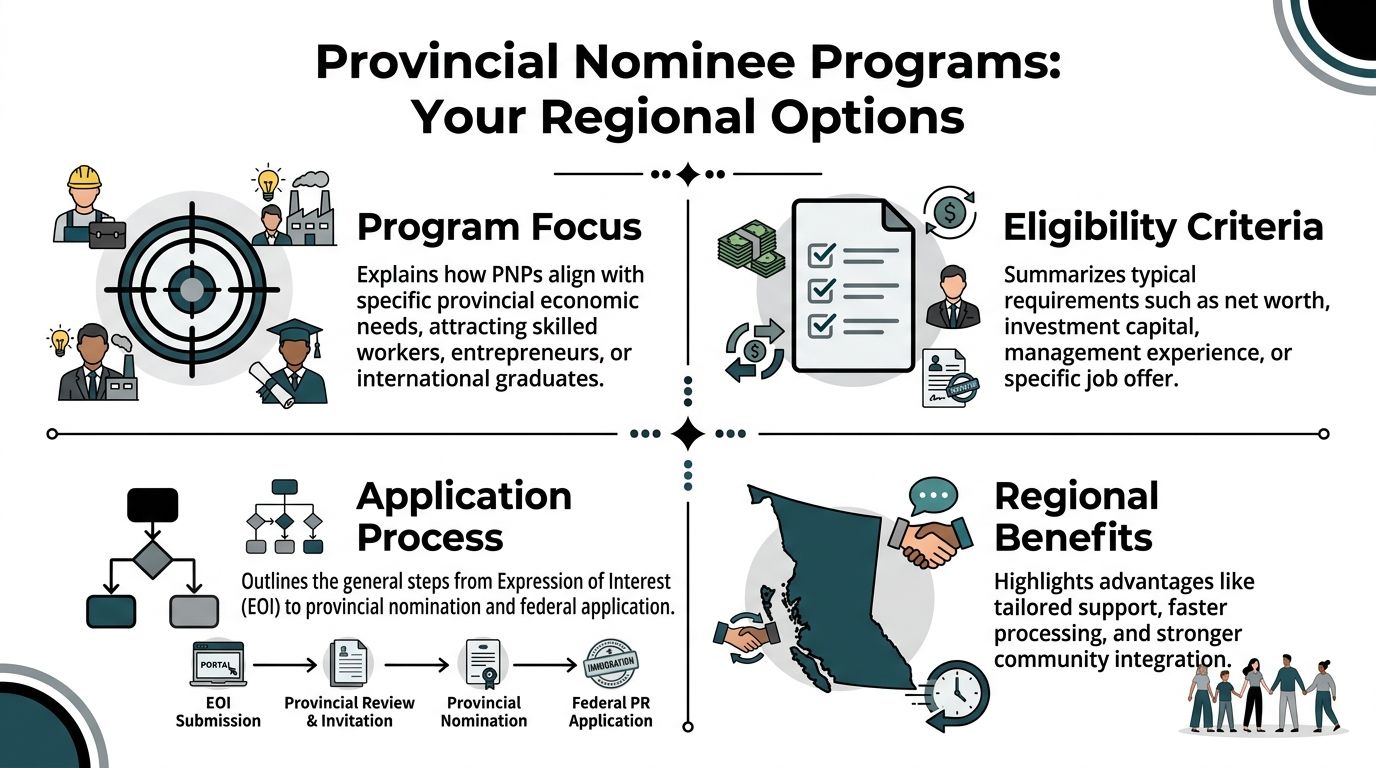
That’s why Provincial Nominee Programmes matter. They allow provinces to nominate business immigrants whose plans align with local needs. For many investors, this is the practical middle ground between a demanding federal innovation route and Quebec’s high-bar passive option.
Why PNPs matter more now
Following the pause of the federal Start-Up Visa in late 2025, UK investors have shifted towards Provincial Nominee Programmes. Streams such as those in British Columbia or Ontario typically require a net worth of £250,000 to £500,000 and a commitment to create local jobs. Applicants also face a 40% rejection rate when the letter of support or business plan is not strong enough or the proposal fails the novelty test, based on the verified trend data provided in the brief.
That should change how you prepare. In PNP cases, mediocre planning gets punished.
How regional strategy changes the file
Provincial programmes are less about abstract innovation and more about local fit. A province asks practical questions:
- Will this business operate in the province?
- Will it create jobs locally?
- Does the applicant have management experience?
- Is the business plan realistic for that market?
- Does the applicant intend to settle there?
Those questions sound basic, but they expose weak files very quickly.
A London-based investor who says they want to live in Ontario while submitting a business plan designed for Vancouver’s market dynamics isn’t showing alignment. Nor is an applicant who claims to support a regional hospitality or housing strategy but has no operating expertise.
British Columbia and Ontario versus smaller markets
British Columbia and Ontario get attention because they are commercially familiar. Investors know Vancouver and Toronto. They understand deep buyer pools, established legal infrastructure, and broad service economies.
But that familiarity also creates crowding. Stronger applicants don’t just ask where they’d like to live. They ask where their business case is strongest.
Smaller or less obvious provinces can offer a better strategic fit when:
- Competition is lower
- The province actively needs your sector
- Your business can integrate into a regional economy
- Your settlement narrative is believable
For some global investors, that trade-off resembles the difference between a mature gateway city and an emerging regional market. One offers familiarity. The other may offer more room if you’re prepared to build properly.
If you want a useful contrast in how residence strategies differ internationally, this comparison point on https://www.worldpropertyinvestor.com/permanent-residence-new-zealand/ is worth reviewing.
A practical comparison
| Consideration | BC or Ontario entrepreneur style route | Smaller provincial route |
|---|---|---|
| Market familiarity | High | Lower for many foreign investors |
| Competition for attention | Often stronger | Can be more targeted |
| Settlement narrative needed | Essential | Essential |
| Business localisation | Important | Usually decisive |
Investor’s lens: Don’t choose a province because it’s famous. Choose it because your business can survive there and your file can prove that.
What tends to work
The best provincial applications are grounded in local reality. They use local advisers, regional demand assumptions, and a business plan that doesn’t read like a recycled international template.
What doesn’t work is treating the province as a visa sponsor of convenience. Provinces are looking for commitment, not tourism with paperwork.
The Quebec Investor Programme A Passive Route
Quebec remains the closest thing Canada has offered to a classic passive investor route. It is also one of the most misunderstood.
Some applicants see “passive investment” and assume that means easy. It doesn’t. The programme is capital-heavy, document-heavy, and language-sensitive.
The financial and personal threshold
The Quebec Investor Immigration Program requires candidates to have a legally acquired net worth of at least CAD 2 million and make a five-year, interest-free investment of CAD 1 million, plus a non-refundable CAD 200,000 contribution. It also requires French proficiency equivalent to Quebec Scale Level 7, and language failures contributed to a 40% rejection rate in pre-suspension data, according to Henley & Partners’ Canada residence by investment overview.
That combination matters. This is not a route for applicants who merely have enough assets on paper. It is for applicants who can evidence lawful wealth, management experience, education, and French proficiency.
Why high-net-worth applicants still choose it
The attraction is obvious. Unlike founder-led routes, Quebec does not require you to build and run a venture-backed company in the Canadian market. For some families, especially those with substantial global business interests elsewhere, that makes the route conceptually cleaner.
The model suits applicants who prefer:
- Capital commitment over operational execution
- Predictability over start-up risk
- A structured route rather than a founder pitch
- A clearer separation between immigration and day-to-day business operations
That said, “passive” only describes the investment profile. It does not describe the preparation.
Practical checklist before you proceed
A serious QIIP candidate should validate five issues early:
Net worth evidence
Your balance sheet must be provable. Audited records, ownership history, and lawful source explanations matter.Management background
The programme expects real managerial experience, not nominal titles in a family structure.French readiness
Many otherwise strong applicants frequently fail in this regard. If French is weak, the file may not be viable.Liquidity planning
The investment mechanics must fit your broader portfolio and cash-flow needs.Settlement intent
Your move to Canada has to work as a family and tax decision, not just an immigration file.
The costly mistake is assuming wealth can compensate for weak French. In Quebec’s investor route, it can’t.
Common errors that sink otherwise good files
The usual problems are avoidable:
- Treating French as an afterthought: This is one of the fastest ways to undermine an expensive application.
- Using poorly organised source-of-funds material: Wealth that cannot be traced cleanly creates unnecessary risk.
- Confusing passive investment with passive preparation: The government still expects a disciplined, documented application.
- Ignoring family relocation reality: Schooling, tax residence, banking, and timing all need planning.
For some investors, QIIP is the best route because it fits their profile exactly. For others, it is a trap because they focus on the passive capital element and ignore the language barrier that sits right at the centre of the programme.
Application Checklist And Common Pitfalls To Avoid
A strong application is built long before submission. The winning files usually look boring from the outside. They are organised, consistent, and heavily documented.
Weak files look ambitious but uneven. The story sounds good. The evidence doesn’t.

The practical checklist
Most business immigration cases need some version of the following:
- Identity and civil records: Passports, family documents, and status documents must be consistent across the file.
- Proof of funds: Asset ownership, banking records, and source-of-funds material need to be clear and coherent.
- Business documents: Plans, financial assumptions, ownership charts, and management records need to match the route chosen.
- Language evidence: If the programme requires language ability, test planning should happen early.
- Settlement planning: Housing, schooling, cash reserves, and relocation timing should be thought through, not improvised.
- Professional coordination: Immigration counsel, tax advisers, and corporate advisers should work from the same fact pattern.
Recent IRCC updates emphasise stricter due diligence on the separation of capital. Entrepreneurs must prove they have personal settlement funds meeting the Low Income Cut-Off for a 52-week period, entirely separate from committed business investment capital, according to the verified IRCC policy summary in the brief.
That rule changes how financially adept applicants structure liquidity. You can’t blur personal support funds and business capital and expect the file to pass comfortably.
Where applicants lose control
The most common mistakes aren’t dramatic. They are cumulative.
A business plan may be plausible, but the revenue assumptions are unsupported. Source-of-funds papers may exist, but the chain of ownership is incomplete. A province may invite an application, but the candidate’s settlement narrative sounds borrowed.
These are the patterns that trigger delay, challenge, or refusal.
A quick risk screen
| Problem | Why it hurts |
|---|---|
| Incomplete source-of-funds trail | Due diligence becomes harder and credibility drops |
| Generic business plan | Officers can see it wasn’t built for the province or route |
| Weak language preparation | Eligibility can fail even where wealth is strong |
| Capital commingling | Financial compliance concerns arise immediately |
| No operational realism | The business looks invented for immigration |
Bring the same discipline to immigration due diligence that you’d bring to a property acquisition. You wouldn’t buy on a weak title trail. Don’t file on a weak money trail.
Family, logistics, and timing
Investors often focus on approval and ignore landing. That is a mistake. Moving to Canada affects healthcare planning, tax advice, schooling choices, banking access, and time-on-the-ground commitments.
For a wider relocation preparation list, What Do You Need to Move to Canada: A 2026 Checklist is a useful practical companion to the immigration side.
The cleanest applications are built by applicants who treat immigration as a full relocation project, not a single form-filing exercise.
Frequently Asked Questions For Investor Immigrants
Can my spouse and children usually be included?
In practice, investor and entrepreneur routes are commonly approached as family moves, but eligibility and inclusion depend on the specific programme and application structure. Family planning should be handled at the start, especially where schooling, settlement funds, and relocation timing matter.
How much time do I need to spend in Canada after approval?
To maintain permanent resident status, you must be physically present in Canada for at least 730 days out of every five-year period, based on the verified residency rule in the brief. That obligation matters for all investor immigrants and is separate from any citizenship timetable.
If I buy a property after I arrive, does that help preserve status?
No. Owning property doesn’t replace the physical presence rule. A title deed may support your lifestyle and investment strategy, but it won’t satisfy residency compliance on its own.
Can I finance the investment with borrowed money?
That depends on the route, the structure, and how funds are documented. The main issue is not just whether borrowing exists, but whether the capital trail is lawful, transparent, and acceptable under programme rules and due diligence review.
Do I need to stay in the same province forever under a provincial route?
Applicants should take provincial intention seriously. If you apply through a province, your business plan and settlement narrative must align with that province. Treating a provincial stream as a shortcut into another market creates obvious credibility issues.
Is Canada better than a classic golden visa jurisdiction for property investors?
It depends on the objective. If you want direct property-linked residence, Canada usually isn’t the natural first choice. If you want a business-based route into a large, stable economy and then plan to build a property footprint from there, the analysis changes. For contrast, this overview of https://www.worldpropertyinvestor.com/malta-golden-visa/ shows how different some residence models can be.
What is the biggest misconception?
That wealth alone solves everything. In Canada, investors still need the right route, the right evidence, and the right operational or language profile. Capital helps. It doesn’t override programme design.
If you’re comparing Canada with other residency and property markets, World Property Investor publishes country guides, market comparisons, yield breakdowns, and practical research to help you assess where a residence strategy and a property strategy effectively fit together.