
For global property investors, Malta’s cost of living is not merely a lifestyle metric—it is a core driver of potential investment returns. On average, the cost of living in Malta is 15-18% lower than in the United Kingdom, a fundamental economic factor that attracts expatriates, skilled professionals, and digital nomads seeking a high-quality, affordable European base.
This relative affordability directly fuels rental demand and supports long-term property valuations, making it a critical component for calculating return on investment (ROI).
An Investor's Overview of Malta's Living Costs

Analysing daily expenses in Malta is fundamental market research for a property investor. When tenants are not financially strained by high living costs, their disposable income increases.
This translates into consistent rental payments, lower void periods, and the ability to attract high-calibre tenants. Such financial stability underpins sustainable rental demand and, ultimately, capital appreciation.
This guide provides a breakdown of the key financial data from an investor's perspective, focusing on the metrics that shape the island's property market fundamentals.
Core Financial Components for Analysis
To build a robust investment case, it is essential to understand how various costs influence both tenant affordability and net returns. This level of due diligence distinguishes a speculative purchase from a strategic, data-driven acquisition.
Key areas for analysis include:
- Housing Costs: A detailed comparison of rental versus purchase prices in key districts, providing the raw data required to calculate gross rental yields accurately.
- Recurring Expenses: An analysis of utilities, groceries, and transport costs, which directly impact a tenant's budget and their capacity to afford rent.
- Taxation and Fees: An overview of property taxes, stamp duty, and Malta's advantageous tax residency schemes that can significantly enhance net ROI.
- Regional Variations: A comparison between established prime markets like Sliema and emerging opportunities like Gozo, identifying where different investment strategies may be deployed.
A firm grasp of these elements provides a clear, data-driven picture of the market's fundamentals. This is an essential approach for any serious buyer, a topic we cover in our comprehensive guide for property investors.
Malta vs UK Monthly Cost of Living at a Glance (EUR)
A side-by-side comparison with a major market like the UK highlights Malta's financial advantage. The table below, with data from sources including Numbeo, offers a snapshot of typical monthly expenditure for a single person.
| Expense Category | Estimated Cost in Malta (€) | Estimated Cost in UK (€) | Approximate Difference (%) |
|---|---|---|---|
| 1-Bed Flat (City Centre) | €950 | €1,200 | -21% |
| Basic Utilities (85m²) | €110 | €250 | -56% |
| Monthly Transport Pass | €26 | €80 | -68% |
| Groceries (Monthly Avg.) | €350 | €400 | -13% |
| Meal at Mid-Range Restaurant | €70 | €75 | -7% |
| Total (Excluding Rent) | €556 | €805 | -31% |
| Total (Including Rent) | €1,506 | €2,005 | -25% |
The savings are most pronounced in essential categories like utilities and transport. This frees up significant disposable income for tenants, a considerable advantage for landlords. While average salaries in Malta are lower than in the UK, the substantially reduced cost of living creates a financially stable environment attractive to UK expatriates and international professionals who constitute a large segment of the rental market.
A Deep Dive into Maltese Housing Costs

Housing is the largest single expense for tenants and the core of an investor's asset performance. The Maltese property market is robust, consistently fuelled by an influx of foreign professionals, digital nomads, and retirees drawn by the lifestyle and advantageous tax regime.
This dynamic creates a deep and predictable rental market, particularly in sought-after districts. Consequently, property in Malta is not merely shelter; it is a high-performing asset class. Success depends on understanding the nuances between regions and property types to maximise returns on capital.
Rental Yields in Established vs Emerging Markets
Rental yield—annual rental income as a percentage of the property's value—is the primary metric for strategic assessment. In Malta, yields vary significantly between prime, established hubs and quieter, emerging markets.
Prime locations such as Sliema and St. Julian's are the epicentre of expatriate and business life. They offer proximity to commercial centres, amenities, and entertainment, commanding the highest rents. Here, investors can expect gross rental yields averaging between 3% and 5%. Although the capital entry point is higher, the tenant pool is deep, reliable, and comprises high-earning professionals, keeping vacancy rates low.
In contrast, Gozo represents an emerging market. Property prices are considerably lower, a factor that can push gross yields into the 5% to 7% range. The trade-off is a different tenant demographic—typically individuals seeking a more tranquil, traditional Maltese lifestyle. Rental demand is growing steadily but lacks the persistent intensity of the central hubs.
Key Takeaway: The choice is a classic risk-reward balance. Sliema offers lower but more stable, 'blue-chip' returns. Gozo provides higher potential yields but with a less predictable tenant flow, requiring a different asset management strategy.
Average Property and Rental Prices
To perform accurate financial modelling, investors require hard data. In Malta, prices are heavily influenced by location, sea views, build quality, and proximity to amenities. Below is a snapshot of typical costs in key investment zones.
Typical Rental Costs (Monthly)
- 1-Bedroom Flat: In central hotspots like Sliema or Gzira, achievable rents are €900 – €1,200. In Gozo or less central parts of Malta, this falls to €600 – €800.
- 3-Bedroom Family Home: A modern family-sized apartment in a prime location commands €1,600 – €2,500. The same property in Gozo would likely achieve €1,000 – €1,400.
Typical Purchase Prices (Per Square Metre)
- Prime Central (Sliema, St. Julian's): Prices average between €4,000 and €6,500 per square metre. Luxury seafront properties can exceed this range.
- Gozo & Southern Malta: The entry point is more accessible, typically ranging from €2,000 to €3,500 per square metre.
This price differential is the primary driver of the yield gap. A lower acquisition cost in Gozo means rental income represents a larger percentage of the initial investment.
Factoring in Associated Purchase Costs
A common error for new investors is focusing solely on the property's list price. To calculate the true net return, all mandatory fees and ongoing costs must be accounted for in financial forecasts.
The key associated costs to include in your analysis are:
- Stamp Duty: The largest transactional cost, set at 5% of the property's purchase price.
- Notary Fees: Legal fees generally range between 1% and 2.5% of the property value.
- Agency Fees: In Malta, the seller typically covers the estate agent's commission, but it is prudent to confirm this arrangement.
- Ongoing Maintenance: A conservative budget of 1% of the property's value annually is recommended for maintenance and repairs.
These expenses directly impact net yield and must be factored into calculations from the outset. For a more granular breakdown, our guide on financing an investment property examines how to structure a purchase for optimal financial performance.
Breaking Down Daily and Recurring Expenses
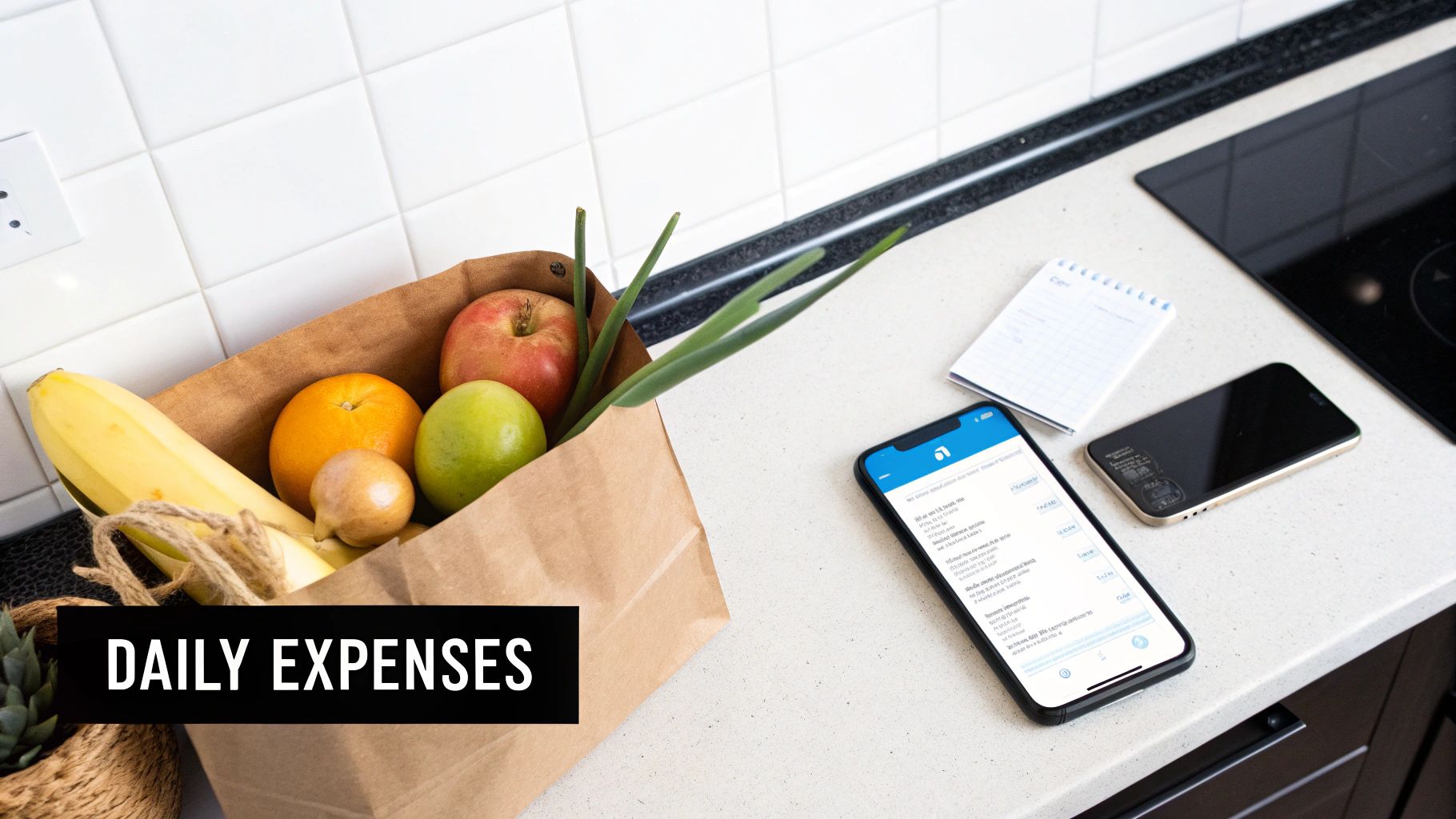
Beyond headline property prices, the true measure of a location’s affordability lies in its day-to-day costs. For a property investor, these figures directly shape a tenant's disposable income and, by extension, rental security.
When a tenant is not financially pressured by high utility bills or transport costs, their ability to meet rental obligations is enhanced. A thorough analysis of these non-property expenses provides a real-world picture of the financial pressures tenants face, which is vital for setting appropriate rental rates and assessing investment risk.
Estimated Monthly Recurring Expenses in Malta
The following table provides a baseline for a typical household budget (excluding rent), illustrating the disposable income potential for singles, couples, and families after covering essential costs.
| Expense Category | Single Person (€) | Couple (€) | Family of Four (€) |
|---|---|---|---|
| Utilities (Electricity, Water) | 80 – 150 | 100 – 180 | 150 – 250 |
| Internet | 30 – 60 | 30 – 60 | 40 – 70 |
| Groceries | 300 – 400 | 500 – 650 | 700 – 900 |
| Transport (Public) | 20 – 30 | 40 – 60 | 80 – 120 |
| Healthcare (Private Insurance) | 40 – 80 | 80 – 160 | 150 – 300 |
| Total (Excluding Rent) | €470 – €720 | €750 – €1,110 | €1,120 – €1,640 |
These figures are estimates and will vary based on lifestyle and consumption habits, particularly for families factoring in international school fees. They provide a crucial framework for evaluating rental affordability across different tenant demographics.
Utilities: Electricity, Water and Internet
In Malta, utility costs are moderate compared to other Western European nations. For a standard 85-square-metre apartment, a combined monthly bill for electricity and water typically falls between €80 and €150. This figure increases during summer months due to air conditioning usage.
Internet infrastructure is a key strength. Malta was one of the first EU countries with nationwide 5G coverage, offering high-quality, competitively priced services. For professionals and digital nomads—a core rental market segment—this is a significant advantage. A high-speed fibre package costs between €30 and €60 per month.
Groceries and Daily Consumables
Food represents good value in Malta. Despite a reliance on imports, grocery prices remain reasonable. A single person can budget approximately €300 to €400 per month for groceries.
Shopping choices impact costs:
- Supermarkets: Offer a wide range of international brands at a premium.
- Local Markets: Provide fresh, seasonal produce at lower prices, enabling residents to manage their food budget effectively.
Dining out is also affordable. A meal at an inexpensive restaurant costs around 25% less than in the US or UK, although prices are higher in prime tourist locations like the Valletta waterfront.
Transport: Public vs Private Ownership
Transport is an area where significant savings can be made. Malta’s compact size facilitates easy transit, and the choice between public and private transport has a major impact on monthly expenditure.
Car ownership in Malta is comparatively expensive due to purchase price, high insurance premiums, annual road tax, and parking challenges.
In contrast, the public transport system is efficient and highly cost-effective. A monthly Tallinja Card for the bus network offers unlimited travel for a low fixed fee, making it the preferred option for most residents. This low-cost mobility frees up a substantial portion of a tenant’s budget. For a detailed breakdown of how various taxes impact your bottom line, you can understand property taxes with our comprehensive guide.
Healthcare and Education Costs
Malta’s healthcare system is ranked among the best globally. While EU nationals have access to the public system, non-EU residents typically require private health insurance to secure residency. Private cover is competitively priced, ensuring access to high-quality care is affordable.
For families, schooling is a primary consideration. Malta offers three options:
- State Schools: Free for all residents.
- Church Schools: Free tuition, with parents expected to make donations and cover supply costs.
- Independent & International Schools: These carry substantial tuition fees and represent a major budgetary item.
For investors targeting the family rental market, understanding the cost of international schooling is non-negotiable, as it directly influences a family's rental affordability.
Understanding Regional Cost Variations
While the national cost of living in Malta provides a compelling baseline, successful property investment hinges on understanding its diverse regional markets. The differences in property prices, rental demand, and tenant profiles between a bustling coastal hub and a tranquil village are substantial.
For an investor, location selection is akin to choosing a micro-economy. The rental demand drivers in the business district of St. Julian's are fundamentally different from those in the serene landscape of Gozo. Matching the property type and location to the correct tenant pool is critical to achieving strategic objectives.
Prime Markets: Sliema and St Julian's
Sliema and St. Julian's are Malta's commercial and social powerhouses. These areas are magnets for expatriates, particularly professionals in the iGaming, finance, and technology sectors. Consequently, rental demand is consistently high, driven by tenants with strong, reliable incomes.
This demand underpins higher property values and rental rates. An investor can expect shorter vacancy periods and a steady stream of high-calibre tenants. The trade-off is a higher cost of entry, which typically results in gross rental yields between 3% and 5%. While not the highest on the island, these returns are supported by solid market fundamentals and lower risk, characteristic of a 'blue-chip' property investment.
The Capital: Valletta, A Traditional Hub
Valletta, Malta's historic capital and a UNESCO World Heritage site, offers a distinct investment proposition. Its unique charm attracts a mix of long-term residents, tourists, and professionals affiliated with government and cultural institutions. The property stock is often older, rich in character, and subject to stricter planning regulations.
The cost of entry in Valletta can be lower than in Sliema, but potential renovation costs for historic properties must be factored into any financial analysis. Rental demand is stable, appealing to tenants who prioritise cultural immersion over modern amenities. This market is less about rapid capital growth and more about owning a unique asset in a prestigious, historically significant location.
Gozo: The Emerging Opportunity
For investors seeking growth and higher yields, Gozo presents a compelling alternative. Malta's sister island is defined by a relaxed pace of life and rural landscapes, appealing to retirees, artists, and remote workers.
Key Takeaway: The primary attraction of Gozo is its significantly lower cost of entry. Property prices can be 30-40% cheaper than in prime mainland locations. This lower acquisition cost directly translates into higher potential rental yields, often in the 5% to 7% range.
The risk profile is different. While demand is growing, it is more seasonal and less concentrated than in the mainland business hubs. However, for investors willing to cater to the long-stay 'lifestyle' tenant, Gozo offers the potential for superior cash flow and long-term capital appreciation as its popularity increases. Understanding how to select the right area is crucial, a topic we explore in our guide on the importance of location in real estate investment success.
How Living Costs Impact Investor ROI
Understanding Malta's cost of living is essential for translating market data into a concrete investment strategy. A tenant’s budget dictates rental ceilings, guides property selection, and ultimately shapes your return on investment (ROI).
When living costs are lower, tenants have more disposable income. This financial capacity is a significant advantage for landlords, as it directly affects a tenant's ability to afford quality housing and meet rental obligations consistently. That stability is the foundation of a successful buy-to-let portfolio.
From Daily Expenses to Net Yields
The link between everyday costs and investment returns is direct. When expenses like utilities, transport, and groceries are manageable, tenants are not financially over-extended. This creates a healthier rental market where landlords can set competitive, profitable rates.
This dynamic provides a strategic edge, enabling investors to attract a higher calibre of tenant—professionals and families who value quality and can afford it. This, in turn, leads to reduced property wear and lower vacancy rates. Over the long term, this stability translates into higher net yields and predictable cash flow.
Key Takeaway: Malta's affordability is not just a lifestyle benefit for residents; it is a fundamental economic driver that underpins the stability and profitability of its rental market. A tenant with healthy disposable income is a low-risk, high-value asset for any landlord.
Sample Monthly Budgets in Malta
To illustrate how these factors converge, the following are three typical monthly budget models. These combine data on housing, utilities, and daily living to provide a clear picture of what tenants can realistically afford.
1. The Single Professional (Living in Sliema)
This individual likely works in a high-demand sector like iGaming or finance and requires a modern apartment with good amenities and a simple commute.
- Rent (1-Bed Flat): €1,000
- Utilities & Internet: €140
- Groceries & Dining Out: €500
- Transport (Bus Pass & Occasional Taxi): €60
- Health Insurance & Leisure: €200
- Total Monthly Estimate: €1,900
2. The Couple (Living in a Central Area like Gzira)
This could be two working professionals seeking a blend of convenience and lifestyle.
- Rent (2-Bed Flat): €1,350
- Utilities & Internet: €180
- Groceries & Dining Out: €750
- Transport (One Car & Public Transport): €250
- Health Insurance & Leisure: €350
- Total Monthly Estimate: €2,880
The following graphic provides a simplified visual representation of Malta's key regions, highlighting the distinct character of each investment destination.

This contrast between Sliema's modern environment, Valletta's historic grandeur, and Gozo's tranquil pace underscores the diverse investment opportunities across the islands.
The Family Budget: A Deeper Look
For families, the financial equation is more complex, with education and larger living spaces as primary considerations. Nonetheless, Malta offers compelling value compared to many other Western European countries.
Family living expenses are noticeably lower than in the UK. A family of four in Malta typically requires €2,600 to €3,100 per month excluding rent. Rent for a family-sized three-bedroom flat ranges from €1,200 to €1,660 per month, depending on location. Utilities, groceries, private health insurance, and internet add another €1,000 to €1,500 monthly.
This compares favourably to the UK, where a similar family might expect to spend around €3,345 monthly before rent. Malta’s more stable consumer price inflation also facilitates long-term budgeting for families. Further insights can be found at sources like imin-malta.com.
By understanding these detailed budgets, investors can accurately assess the rental market's capacity and set rates that are both attractive to tenants and profitable. For a complete guide on financial modelling, see our article on how to calculate return on investment (ROI) for real estate.
Answering Your Key Investment Questions
This final section addresses common questions from investors, summarising the key data from our analysis to provide direct, practical insights into budgeting, tax, and the financial realities that shape the cost of living in Malta.
What Is a Realistic Monthly Budget for a Comfortable Lifestyle in Malta?
A realistic monthly budget is determined by lifestyle and location. The difference between a prime coastal hub and a quiet village in Gozo is significant.
As a general guide:
- A single professional in a desirable area like Sliema or St. Julian's should budget for €1,800–€2,200 per month, including rent.
- A couple would typically require €2,500–€3,000 for a good standard of living in a central location.
- A family of four should anticipate monthly outgoings of €3,500–€4,500. This figure accounts for a larger home and potential international school fees.
These figures can be reduced by choosing to live in less central areas of Malta or on the more affordable island of Gozo.
How Do Taxes in Malta Affect Overall Living Costs for Foreign Investors?
Malta’s tax system is a primary attraction for foreign investors and positively impacts the net cost of living. The country offers several advantageous residency schemes, such as the Malta Permanent Residence Programme (MPRP).
The main benefits stem from a progressive income tax system with rates from 0% to 35%. For non-domiciled residents, tax is generally levied only on Maltese-source income and capital gains, plus any foreign income remitted to Malta.
Key Takeaway: Compared to the UK and other European nations, the absence of council tax, inheritance tax, or wealth tax is a significant advantage. This structure substantially lowers the overall financial burden on residents, freeing up capital for investment or spending.
This favourable tax environment is a core component of Malta's value proposition for high-net-worth individuals and serious investors.
Are Utility and Internet Costs Expensive in Malta?
Utility costs in Malta are moderate and predictable. For a standard apartment, expect to pay between €80 and €150 per month for water and electricity combined. This figure will rise during summer months due to air conditioning usage.
High-speed fibre internet is widely available and competitively priced. Major providers like GO and Melita offer packages typically costing between €30 and €60 per month. While not the cheapest in Europe, these rates are reasonable for the high quality of service—a key factor for the large number of remote workers and professionals renting property on the island.
Is It More Cost-Effective to Use Public Transport or Own a Car?
For most residents, using Malta’s public transport system is significantly more cost-effective than owning a private car. The island is served by an extensive and efficient bus network, and the monthly Tallinja Card makes travel exceptionally affordable.
In contrast, car ownership involves substantial costs that can inflate monthly expenditure, including:
- The initial purchase price of the vehicle.
- High insurance premiums, particularly for new residents.
- Annual road tax and fuel costs.
- Parking challenges in densely populated areas.
While a car offers convenience, relying on public transport and ride-sharing services is a much lower and more predictable expense. This saving contributes directly to a lower overall cost of living.
At World Property Investor, we provide the in-depth analysis you need to make informed decisions in global real estate markets. From rental yields in emerging European hubs to tax strategies in established destinations, our guides are designed to help you invest with confidence. Explore our expert insights and data-driven content at https://www.worldpropertyinvestor.com.