
For the global property investor, the phrase ‘countries with no taxes’ often evokes images of sun-drenched beaches and effortless wealth. While the appeal is undeniable, a successful investment strategy requires moving beyond these headlines and focusing on long-term fundamentals. A zero-tax policy on personal income is just one part of a much larger financial puzzle. True success lies in understanding the complete picture before committing capital to an overseas property market.
This guide provides a practical analysis of the world's leading low-tax and zero-tax jurisdictions for property investment. We will dissect the reality of investing in these locations, examining not only the absence of personal income tax but also the critical details that directly impact returns. This includes a close look at property-specific tax rules, residency and citizenship requirements, local rental market dynamics, and crucial compliance caveats that every investor must know.
From established financial hubs like the United Arab Emirates and Monaco to emerging Caribbean contenders such as the Cayman Islands and Antigua, we offer the data-driven insights needed to compare markets effectively. This article is not about chasing loopholes; it is about building a robust, tax-efficient global portfolio grounded in tangible market realities. You will gain a clear understanding of which jurisdictions offer genuine advantages for your property investment goals, enabling you to make informed decisions with confidence and clarity.
1. United Arab Emirates (UAE)
The United Arab Emirates stands out as one of the world's most prominent tax-free jurisdictions, making it a primary destination for property investors. The core appeal lies in its complete absence of personal income tax, meaning residents retain 100% of their earnings from salaries, capital gains, and rental income. This policy, combined with a dynamic and maturing real estate market, positions the UAE as a top choice among countries with no taxes.
Property Tax Rules and Market Implications
While there is no annual property tax, investors must factor in a one-time Dubai Land Department (DLD) registration fee, currently set at 4% of the property value, plus administrative fees. Abu Dhabi charges a 2% transfer fee. For rental properties, Dubai municipalities levy a 5% housing fee on the annual rental value, which is typically passed on to the tenant and collected through utility bills. This structure keeps ongoing holding costs exceptionally low, directly boosting net rental yields for investors.
The market offers diverse opportunities, from the high-end luxury villas on Palm Jumeirah to the bustling residential-commercial mix in Downtown Dubai and Business Bay. These established areas demonstrate consistent rental demand and capital appreciation, with net yields in prime Dubai locations ranging from 5-7% according to recent market analysis. Abu Dhabi’s Saadiyat Island, a cultural and residential hub, presents another prime investment corridor.
Residency and Practical Steps
The UAE offers several property-linked visa options. Investing a minimum of AED 750,000 (approx. £165,000) can qualify an investor for a renewable 2-year residency visa. A larger investment of AED 2 million (approx. £440,000) grants eligibility for the coveted 10-year Golden Visa, providing long-term stability.
Key Takeaway: Before purchasing, verify the property is in a designated freehold zone where foreigners are permitted to own the title outright. Retain local legal counsel to navigate the purchase process and ensure all contracts and title deeds are correctly registered with the relevant authorities.
For those exploring zero-tax property investment, you can learn more about countries with no personal income tax to compare global options.
2. Bahrain
As a growing financial hub in the Gulf, Bahrain presents a compelling case for property investors seeking tax efficiency. The kingdom charges no personal income tax, capital gains tax, or inheritance tax, allowing investors to retain the entirety of their rental income and profits from property sales. This makes it a strong contender among countries with no taxes, offering a more accessible and less volatile alternative to larger regional markets.
Property Tax Rules and Market Implications
Bahrain imposes a one-time stamp duty of 2% of the property's value upon transfer, reduced to 1.7% if paid within 60 days of the transaction date. Additionally, a 1% municipal tax is levied on the property's assessed value annually, but this is often minimal. For rental properties, municipalities charge a 10% fee on the annual rental value, which is usually included in the tenant's utility bills, keeping the direct holding costs for landlords low.
The property market provides opportunities in designated freehold zones where non-GCC nationals can own property. Key areas include the Amwaj Islands, a waterfront development popular with international buyers, and the Seef District, a commercial and residential hub. Manama's financial district drives consistent demand for corporate housing, with rental yields in these areas typically around 6-8%, according to local real estate data.
Residency and Practical Steps
Bahrain's Self-Sponsorship Residence Permit is available to foreign property owners. An investment of at least BHD 50,000 (approx. £105,000) in a property located in a designated tourist zone can qualify an investor for a renewable residency visa. A larger investment of BHD 200,000 (approx. £420,000) makes the owner and their immediate family eligible for a 10-year Golden Residency Visa, offering greater long-term security.
Key Takeaway: Before investing, it is crucial to confirm that the property is situated within a designated freehold zone. Engage a reputable local real estate agent and legal professional to guide you through the purchase process, verify ownership regulations, and ensure all contracts are correctly registered with the Survey and Land Registration Bureau.
For investors comparing different markets, you can explore some of the best countries for property investment to assess global opportunities.
3. Qatar
With one of the world's highest GDPs per capita, Qatar presents a compelling case for property investors. The nation's wealth, driven by its vast natural gas reserves, fuels strong rental demand from a prosperous expatriate workforce. Central to its appeal is the complete absence of personal income tax, capital gains tax, and inheritance tax, ensuring investors retain all profits from their property ventures. This favourable tax regime makes Qatar a strong contender among countries with no taxes.
Property Tax Rules and Market Implications
Qatar does not impose annual property taxes on real estate. The primary transaction cost is a registration fee, typically 0.25% of the property value, payable upon transfer of ownership. For landlords, the absence of tax on rental income directly translates to higher net yields. This financial advantage is amplified by recent regulatory changes that have expanded foreign ownership opportunities into more designated freehold zones, moving beyond just leasehold options.
Investment hotspots include Lusail City, a futuristic metropolis built for the 2022 FIFA World Cup, offering modern infrastructure and strong rental appeal. The Pearl-Qatar remains an exclusive man-made island development, while areas like West Bay and Msheireb Downtown Doha provide a mix of luxury apartments and prime commercial space, attracting high-earning professionals. Due to high salaries, rental yields can be robust, often exceeding 6% in in-demand areas.
Residency and Practical Steps
Qatar's property-linked residency programme offers a clear pathway for investors. A real estate investment of at least QAR 730,000 (approx. £160,000) qualifies the owner for a temporary residency permit, renewable as long as they retain the property. For a more permanent solution, an investment of QAR 3.65 million (approx. £800,000) grants the owner and their family permanent residency status, which includes benefits like access to state healthcare and education services.
Key Takeaway: Foreign ownership is restricted to designated freehold and leasehold areas. It is critical to work with an accredited real estate agent and legal professional to verify a property's eligibility and navigate the sponsorship and registration requirements before committing to a purchase.
4. Oman
Oman is emerging as a compelling, more traditional alternative in the Gulf for property investment. Its cornerstone appeal is the complete absence of personal income tax, allowing residents to keep all earnings from employment and investments. This fiscal advantage, combined with stable governance and competitive property prices, positions Oman as an attractive choice among countries with no taxes for investors seeking a more conservative market with strong fundamentals.
Property Tax Rules and Market Implications
Oman maintains a straightforward and investor-friendly property tax environment. There are no annual property taxes on real estate. Upon purchase, a one-time property registration fee of 3% of the purchase price is levied by the Ministry of Housing and Urban Planning. This minimalist tax structure significantly reduces ongoing ownership costs, directly contributing to higher net rental yields for buy-to-let investors.
The market offers diverse opportunities, particularly in Integrated Tourism Complexes (ITCs) where foreign ownership is permitted. Muscat's established residential areas like Al Mouj and Muscat Hills offer reliable rental demand from a large expatriate community, with yields typically ranging from 5-7%. For long-term growth, investors are looking towards major infrastructure projects, such as the Duqm Special Economic Zone, which are expected to drive housing demand.
Residency and Practical Steps
Oman's government has introduced policies to attract foreign investment through real estate. Property ownership within designated ITCs grants the owner and their immediate family residency rights for the duration of ownership. This provides a clear and stable pathway to residency without a specified minimum investment value, though property prices in ITCs typically start from around OMR 50,000 (approx. £105,000). The residency is automatically renewable as long as the property is held.
Key Takeaway: Foreign ownership is restricted to ITCs, so it is crucial to verify a property's freehold status before committing. Engaging a local solicitor is essential to review the Sale and Purchase Agreement (SPA) and ensure the title deed is correctly registered, safeguarding your investment.
5. Monaco
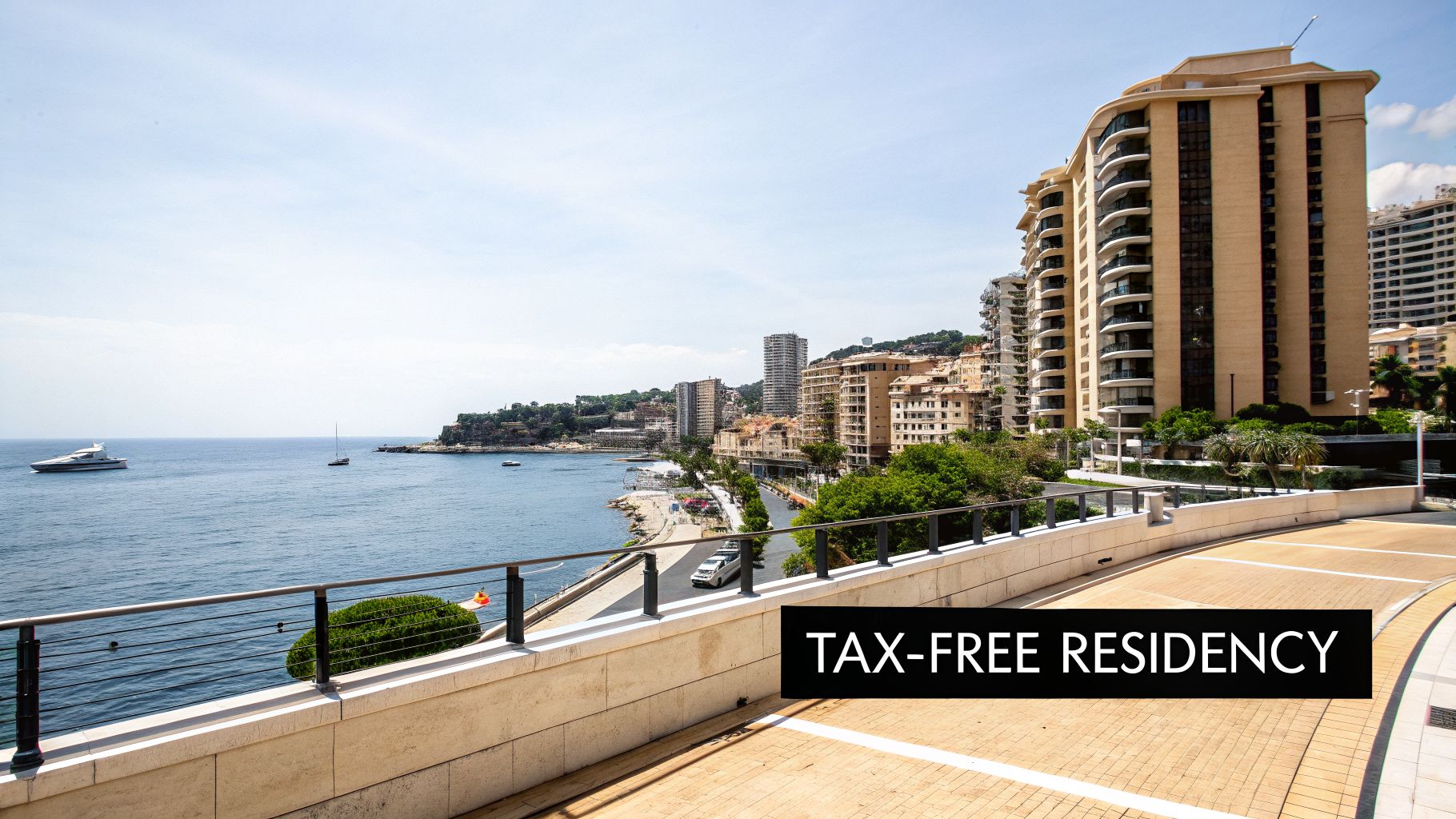
Monaco is renowned as Europe’s premier luxury property market, offering complete exemption from personal income tax, capital gains tax, and wealth tax for its residents. This tax-free status, combined with its political stability and glamorous Mediterranean lifestyle, makes it a magnet for ultra-high-net-worth individuals. For property investors, Monaco represents a unique opportunity for capital preservation in one of the world's most exclusive real estate environments, solidifying its place among the top countries with no taxes.
Property Tax Rules and Market Implications
Monaco does not levy annual property taxes. The primary transaction cost is a registration duty and notary fee, which totals approximately 6% of the property value for resale properties. For new builds, a 20% Value Added Tax (VAT) is applied, which is typically factored into the purchase price. Rental income is subject to a 1% tax, which is exceptionally low compared to global standards.
The market is defined by scarcity and prestige, with districts like Monte Carlo and Larvotto commanding some of the highest prices per square metre globally. The focus here is less on rental yield, which is often a modest 1-2%, and more on long-term capital preservation and the lifestyle benefits associated with ownership. For example, a two-bedroom apartment in a prime location can easily exceed €10 million, offering stability rather than high ROI.
Residency and Practical Steps
Gaining residency in Monaco is a rigorous process, requiring proof of significant financial self-sufficiency. Applicants must either deposit at least €500,000 in a Monegasque bank account, form a local business employing a minimum number of staff, or purchase property. While there is no minimum property value specified, the market realities mean any purchase will be a substantial investment. A physical presence of at least three months per year is also required to maintain residency status.
Key Takeaway: Given its unique legal framework and close ties to France, prospective investors must engage Monaco-based legal counsel specialising in residency and property law. It is also crucial to coordinate with French tax advisors to understand any cross-border implications, particularly for those with existing assets or business interests in France.
For a deeper dive into the specific financial obligations, you can explore the details of the Monaco tax rate and its implications for residents and investors.
6. Cayman Islands
The Cayman Islands are a premier Caribbean destination for property investors, known for a sophisticated financial sector and a complete absence of personal income tax, capital gains tax, and inheritance tax. This tax neutrality, combined with a stable government operating under English common law, makes it an exceptionally secure and appealing jurisdiction. Its status as one of the leading countries with no taxes is a fundamental driver of its mature and high-value real estate market.
Property Tax Rules and Market Implications
Unlike many jurisdictions, the Cayman Islands levies no annual property tax, a significant advantage for long-term holders. The primary cost is a one-time Stamp Duty on property transfers, set at 7.5% of the property’s market value. This upfront cost is considerable, but the lack of ongoing property taxes enhances net rental yields and simplifies ownership.
The property market is well-established, with prime opportunities concentrated in Grand Cayman. The world-famous Seven Mile Beach area is a hub for luxury condominiums with strong short-term rental demand from tourism, where a two-bedroom unit can generate substantial annual income. Other key areas include George Town, offering a mix of commercial and residential properties, and the quieter, high-end residential communities in Cayman Kai. Rental yields for long-term lets typically hover around 4-5%.
Residency and Practical Steps
The Cayman Islands offers clear pathways to residency through property investment. Investing a minimum of CI$1 million (approximately £950,000), with at least CI$500,000 in developed real estate, can qualify an individual for a Certificate of Permanent Residence for Persons of Independent Means. This provides long-term stability without requiring a significant time commitment on the islands. For a more detailed look at global investment visas, you can explore options for investor residency here.
Key Takeaway: When budgeting for a purchase, account for total transaction costs of 7-9%, which includes the Stamp Duty plus legal and agent fees. It is also critical to secure robust hurricane insurance, as this is a mandatory and significant ongoing expense in the region. Always engage a local lawyer to navigate the purchase and ensure compliance.
7. Turks and Caicos Islands
The Turks and Caicos Islands (TCI) are cementing their reputation as a premier Caribbean destination for high-net-worth investors seeking both luxury living and significant tax advantages. As a British Overseas Territory, the islands offer a stable political and economic environment with no personal income tax, no capital gains tax, and no inheritance tax. This tax-neutral framework makes it one of the most attractive countries with no taxes for individuals aiming to preserve wealth while investing in a burgeoning luxury property market.
Property Tax Rules and Market Implications
Unlike many jurisdictions, the TCI does not levy an annual property tax. The primary tax incurred is a one-time Stamp Duty on property transactions, which is calculated on a sliding scale up to 10% for properties valued over $500,000. While this is a significant upfront cost, the absence of recurring property taxes greatly enhances the long-term profitability of rental investments by minimising holding expenses.
The market is heavily concentrated on the main island of Providenciales, particularly in the world-renowned Grace Bay area. This region offers prime beachfront condominiums and luxury villas that command high rental rates from a strong tourism market, with gross rental yields on short-term lets often exceeding 8-10%. Emerging areas like South Caicos and waterfront communities in Leeward are presenting new opportunities for capital appreciation as infrastructure develops.
Residency and Practical Steps
The TCI offers several pathways to residency through property investment. Purchasing a property valued at a minimum of $300,000 can make an investor eligible for a renewable residency permit. A more substantial investment of at least $1 million in property or a local business can qualify an individual for a Permanent Residence Certificate (PRC), which can eventually lead to British Overseas Territories Citizenship.
Key Takeaway: Transaction costs in the TCI can be high, often reaching 10-15% of the purchase price when including Stamp Duty and legal fees. It is essential to work with a local lawyer experienced in TCI property law to navigate conveyancing and thoroughly vet developer reputations, especially for off-plan purchases.
8. Vanuatu
The Pacific island nation of Vanuatu is rapidly gaining attention from property investors for its status as a pure tax haven. It levies no personal income tax, no capital gains tax, no wealth tax, and no inheritance tax. This complete absence of direct personal taxation makes it a compelling choice among countries with no taxes, especially for those seeking a tropical lifestyle combined with financial efficiency.
Property Tax Rules and Market Implications
While Vanuatu is free from income taxes, property ownership does involve some costs. There is no annual property tax, but a 2% stamp duty and a 5% registration fee are payable on property transfers. Value Added Tax (VAT), currently at 15%, may also apply to new developments. These one-off costs are relatively low, preserving capital upon acquisition. For rental properties, the key benefit is that 100% of rental income is retained by the owner.
The property market is concentrated around the main island of Efate, particularly in the capital, Port Vila, and on Espiritu Santo. Investment opportunities range from waterfront apartments in Port Vila to tourism-focused resort developments. The market is developing, and investors should prioritise established projects with a solid track record to mitigate risks associated with an emerging jurisdiction. Given the focus on tourism, short-term rental yields can be attractive, but are subject to seasonal fluctuations.
Residency and Practical Steps
Vanuatu is famous for its Citizenship by Investment (CBI) programme, one of the fastest in the world. While it can be obtained through a non-refundable donation, property investment is also a pathway. A minimum property purchase of USD $200,000 (approx. £158,000) can qualify an applicant for citizenship, offering visa-free travel to over 100 countries. This dual benefit of acquiring a tangible asset and a second passport is a primary driver for investors.
Key Takeaway: Due to its developing legal framework, engaging experienced local legal counsel specialising in Pacific jurisdictions is non-negotiable. Thoroughly vet developers, scrutinise land leases (most land is leased, not freehold), and budget conservatively for maintenance, as sourcing materials and services can be challenging in a remote island location.
9. British Virgin Islands (BVI)
The British Virgin Islands (BVI) presents a compelling Caribbean option for property investors, combining its status as a zero-income-tax jurisdiction with a mature, transparent legal framework based on English common law. The complete absence of personal income tax, capital gains tax, and inheritance tax makes it a standout among countries with no taxes. This stability attracts investors seeking both tax efficiency and strong legal protections.
Property Tax Rules and Market Implications
Property owners in the BVI are subject to a modest annual property tax, calculated at 1.5% of the assessed annual rental value of the property, not its capital value. This keeps ongoing holding costs relatively low. However, transaction costs are significant. Non-belongers (non-citizens) face a Stamp Duty of 12% on the purchase price or market value, whichever is higher. While a high entry barrier, the subsequent lack of income tax on rental earnings can deliver strong long-term returns.
The market is defined by its high-end focus. Prime opportunities include waterfront properties in Road Town on Tortola and luxury hillside developments on Virgin Gorda. These areas cater to a mix of long-term expatriate professionals and the high-demand tourism sector, providing stable rental demand. Yields are typically modest, around 3-4%, reflecting the market's focus on capital preservation over high cash flow.
Residency and Practical Steps
Purchasing property in the BVI does not automatically confer residency rights. Foreign investors must obtain a Non-Belonger Land Holding Licence (NBLHL) before purchasing property, a process that requires a detailed application and can take several months. For residency, one must apply separately through the immigration department, typically based on employment or significant economic contribution. Gaining 'Belonger' status is a lengthy and challenging process, so investors should plan based on non-resident ownership rules.
Key Takeaway: Budget for high upfront transaction costs, which can reach 15% or more of the purchase price when including Stamp Duty, legal fees, and licence applications. It is essential to work exclusively with BVI-licensed real estate agents and attorneys to navigate the NBLHL process and ensure all legal requirements are met correctly.
10. Antigua and Barbuda
Antigua and Barbuda presents a compelling proposition for property investors by combining a Caribbean lifestyle with a favourable tax regime. The nation has no personal income tax, capital gains tax, or inheritance tax for residents, positioning it as an attractive base for wealth preservation. This tax efficiency, paired with its renowned Citizenship by Investment (CBI) programme, makes it a noteworthy contender among countries with no taxes for those seeking both a second passport and a real estate asset.
Property Tax Rules and Market Implications
While personal income is untaxed, property owners are subject to an annual property tax, calculated based on the assessed rental value of the property. Rates are relatively modest, ensuring holding costs do not significantly erode returns. On purchase, buyers must account for a one-time stamp duty and a non-citizen landholding licence fee, which can total around 7.5% to 12.5% of the property's value.
Investment opportunities are concentrated in high-end tourism and residential zones. Key areas include the Jolly Harbour marina, the luxury resort projects in Dickenson Bay, and emerging developments near the capital, St. John’s. These locations benefit from steady tourist demand, which supports the short-term holiday let market. For example, a villa in a managed resort can generate gross yields of 5-7% while offering personal use benefits.
Residency and Practical Steps
The most direct route to residency and citizenship is through the Citizenship by Investment programme. A qualifying real estate investment, currently a minimum of USD $200,000 in an approved project, can grant an investor, their spouse, and dependents citizenship within a few months. This provides visa-free travel to over 150 countries, including the UK and the Schengen Area.
Key Takeaway: Due diligence is critical when investing through the CBI programme. Thoroughly vet the developer’s track record and the project's completion history. Engage experienced local legal counsel to navigate the property acquisition and citizenship application processes simultaneously, ensuring all compliance requirements are met.
For investors exploring this route, you can learn more about citizenship by investment programmes to compare options and understand the legal frameworks involved.
Top 10 No-Tax Countries Comparison
| Jurisdiction | 🔄 Implementation complexity | ⚡ Resource requirements | ⭐📊 Expected outcomes | 💡 Ideal use cases | ⭐ Key advantages |
|---|---|---|---|---|---|
| United Arab Emirates (UAE) | Moderate — established freehold zones and visa-linked rules | High capital — premium prices, 20–30% down, transaction fees | Strong appreciation in prime areas; rental yields ~5–7% | Residency + yield seekers; international rental market plays | Tax-free personal income, world-class infrastructure, residency pathways |
| Bahrain | Low–Moderate — simpler market but restricted freehold zones | Lower capital than UAE — more affordable entry points | Stable returns with good yields; yields ~6–8% | Cost-sensitive Gulf exposure; banking/financial hub access | Tax-free income, lower prices, emerging rental demand |
| Qatar | Moderate–High — limited freehold zones and bureaucratic steps | High capital — premium pricing and selective opportunities | Premium rents due to high expat incomes; yields often >6% | High-income expat rentals; long-term infrastructure plays (Lusail) | Tax-free income, government-backed megaprojects, affluent tenant base |
| Oman | Low–Moderate — designated freehold areas (ITCs), less mature regs | Moderate capital — cheaper than major Gulf peers | Steady yields (~5–7%); longer-term appreciation potential | Long-horizon value investors; tourism-linked rental strategies | Lowest entry prices among Gulf options; political stability; tourism growth |
| Monaco | High — strict residency, regulatory and banking hurdles | Very high capital — ultra-luxury pricing and upkeep costs | Capital preservation; minimal yield (~1-2%); high prestige value | UHNW residence, capital preservation, lifestyle investment | No personal income tax, unmatched luxury, political/legal stability |
| Cayman Islands | Moderate — mature legal processes and clear ownership rules | High capital — insurance, conveyancing, and high transaction costs | Stable capital preservation; low long-term yields (~4–5%) | US-aligned investors seeking legal familiarity and tax efficiency | No income/capital gains tax, strong common-law protections |
| Turks and Caicos Islands | Moderate — developer-led growth with evolving regs | High capital — beachfront premiums, management costs | Tourism-driven yields (short-term >8%); appreciation upside | Short-term rental / tourism-focused beach investments | Tax-free income, strong tourism appeal, growth runway |
| Vanuatu | High — underdeveloped legal frameworks; vetting required | Low–Moderate capital — plus citizenship program fees | Higher risk/return; limited liquidity; lifestyle and citizenship benefits | Citizenship-by-investment seekers; adventurous tropical investors | Tax-free income, citizenship options, affordable entry prices |
| British Virgin Islands (BVI) | Moderate — well-regulated under British common law | High capital — limited inventory and transaction costs | Stable capital; low yields (~3–4%); mature market transparency | Conservative investors seeking common-law protections | No income/capital gains tax, robust legal and regulatory framework |
| Antigua and Barbuda | Moderate–High — emerging market and citizenship paperwork | Moderate capital — citizenship-linked thresholds (USD 200k+) | Emerging yields (~5–7%); citizenship premium to valuation | Citizenship seekers and tourism rental investors | Tax-free income, citizenship-by-investment options, growing tourism |
Final Verdict: Weaving Tax-Efficiency into Your Global Portfolio
The journey through the world's tax-free havens reveals a compelling, yet complex, landscape for the global property investor. From the dynamic, high-yield rental markets of the United Arab Emirates and Qatar to the established capital preservation hubs of Monaco and the Cayman Islands, the opportunities are as varied as the jurisdictions themselves. This article has detailed ten distinct destinations, each presenting a unique proposition built on the foundation of zero personal income tax.
However, the most critical lesson is that the term 'tax-free' is a starting point, not a conclusion. A successful investment strategy in these territories demands a sophisticated understanding that goes far beyond the initial appeal of fiscal freedom. Investors must meticulously evaluate the entire tax ecosystem. The absence of income tax in Bahrain or Oman, for instance, is balanced by specific property transaction fees and municipal taxes. Likewise, the idyllic lifestyle offered in Antigua and Barbuda is coupled with the realities of navigating emerging property markets, where due diligence is paramount.
Key Takeaways for Your Investment Strategy
The core insight for any investor considering these countries with no taxes is the need for a personalised, goal-oriented approach.
- For High-Yield Seekers: The robust rental demand and established infrastructure in the UAE, Qatar, and Bahrain offer strong potential for consistent cash flow. Your focus should be on micro-location analysis, understanding service charges, and anticipating future supply dynamics.
- For Capital Preservation and Stability: Monaco and the Cayman Islands represent the gold standard. Here, the investment is not just in property but in political stability, a secure legal framework, and a high-quality lifestyle. The entry costs are substantial, but so is the security they offer high-net-worth portfolios.
- For Citizenship and Growth Potential: Emerging jurisdictions like Antigua and Barbuda or Vanuatu present unique opportunities to pair a tangible asset with a second passport. These are plays that require extensive on-the-ground research, a trusted local legal team, and an understanding of the long-term value of citizenship.
Practical Next Steps and The Bigger Picture
Before making any commitments, your path forward should be structured and deliberate. The initial excitement of a zero-tax environment must be tempered with methodical planning. First, define your primary objective: Is it rental income, capital growth, a lifestyle change, or a second passport? Second, conduct a deep analysis of residency and citizenship requirements. As we've seen, obtaining residency in Monaco is a fundamentally different undertaking than participating in Antigua and Barbuda's Citizenship by Investment Programme.
The true value of investing in a no-tax country is unlocked when its specific benefits are correctly aligned with your personal financial goals and your tax obligations in your home country. A misstep can negate the very advantages you seek.
Ultimately, mastering this niche of global property investment is about more than just tax avoidance. It's about strategic tax optimisation. It involves building a resilient, geographically diversified portfolio where each asset plays a distinct role. A property in the UAE might generate strong, tax-free rental income, while a stable asset in the Cayman Islands acts as a long-term store of value. Understanding and acting upon these distinctions is what separates a speculative gamble from a calculated, wealth-building strategy. These jurisdictions offer powerful tools, but it is the investor's skill in using them that determines the final outcome.
Ready to move from research to action? The world of international property is complex, but the right data and analysis can make all the difference. For deep-dive market reports, due diligence checklists, and expert insights on the jurisdictions covered here and beyond, explore the resources at World Property Investor. We provide the tools and intelligence serious investors need to build a successful global portfolio.