
Investing in property overseas is more than acquiring a holiday home. For a growing number of global investors, it represents a calculated strategy to build long-term wealth, diversify risk, and access growth opportunities unavailable in their domestic market. It is about diversifying a portfolio in a tangible way that extends beyond traditional stocks and shares, providing a foothold in different economies.
Why Astute Investors Diversify with Overseas Property
Looking beyond one's home market for real estate is no longer a niche strategy reserved for the ultra-wealthy. It is a prudent decision made by serious investors seeking superior returns and a more resilient portfolio. By purchasing property abroad, you decouple a portion of your wealth from the economic fluctuations of a single country. This strategy can protect your capital from localised recessions, political instability, or sudden interest rate changes.
This global approach opens up a world of possibilities. An investor might find significantly higher rental yields in a thriving European city than could be achieved locally, or benefit from capital growth in an emerging tourist destination. The motivations vary, but the objective remains consistent: to optimise returns and secure a stronger financial future.
Tapping into Global Growth and Yields
At its core, the primary driver for investing in overseas property is the pursuit of superior financial returns. Some markets offer robust stability, while certain emerging economies can deliver exceptional growth. The United Kingdom, for example, possesses a transparent legal system and a resilient economy, making it a magnet for international capital.
Data from established economic bodies confirms this trend. In the first half of a recent fiscal year, overseas investors were reportedly responsible for a significant 64% of all UK commercial property investment, committing £12.2 billion to the market. This substantial inflow of capital, particularly from North America, demonstrates the confidence global investors place in mature, reliable markets for long-term security.
To identify where the next wave of growth may materialise, review our guide on the top emerging property investment markets.
Strategic Motivations for International Investment
Every investor has distinct objectives, but the core advantages of owning property abroad typically fall into several key categories. Identifying which of these aligns with your financial plan is the first step in determining if an international investment is a suitable strategy.
A well-chosen international property is more than just an asset; it's a strategic hedge against domestic market volatility and a gateway to global economic growth. It diversifies not just your portfolio, but also your exposure to different currencies, legal systems, and economic trajectories.
The table below outlines the main strategic drivers that persuade investors to look beyond their own borders.
Key Motivations for Investing in Overseas Property
This table summarises the primary strategic drivers behind international property investment, providing a clear overview of why investors select specific markets to achieve their financial goals.
| Motivation | Description | Example Market |
|---|---|---|
| Portfolio Diversification | Spreading investment risk across different economies, currencies, and property cycles to reduce reliance on a single market's performance. | Spain |
| Higher Rental Yields | Accessing markets where the ratio of rental income to property value is significantly higher than in the investor's home country. | Portugal |
| Capital Appreciation | Investing in areas with strong economic growth, infrastructure development, or increasing demand that promises significant property value growth over time. | UAE (Dubai) |
| Lifestyle & Personal Use | Acquiring a property for personal use, such as a holiday home or future retirement location, that can also generate rental income. | France |
| Currency Hedging | Holding assets in a stable foreign currency (e.g., USD, CHF, GBP) to protect wealth against devaluation of the investor's home currency. | United Kingdom |
Understanding these motivations helps to frame your search. Whether you are pursuing high yields in Lisbon or banking on long-term stability in London, clarifying your "why" is the foundation of a successful overseas investment.
How to Select Your Ideal Investment Market
Deciding where to invest is the single most important decision an overseas property investor will make. This choice dictates potential returns, risk exposure, and the complexity of the acquisition process. Success depends not on glossy brochures, but on a rigorous, data-driven analysis of market fundamentals.
The key is to balance the predictable, lower-yield stability of established markets against the higher-risk, higher-reward profile of emerging economies. An investor must understand the underlying economic and demographic trends that genuinely determine a property market's long-term health.
Established versus Emerging Markets
Established markets—such as major cities in the UK, Germany, or Spain—offer transparency, robust legal frameworks, and political stability. These are mature markets with extensive transactional data that is readily accessible. A city like Manchester in the UK, for instance, benefits from consistent government investment in infrastructure and a large student population, ensuring a reliable stream of tenants and predictable rental yields. The trade-off is typically lower capital growth potential and higher entry prices.
Conversely, emerging markets in regions like Southeast Asia or the UAE can offer the potential for rapid growth. A coastal development in a burgeoning tourist area might promise much higher returns as new infrastructure is completed and international interest increases. However, this comes with greater risk, including currency volatility, less predictable legal systems, and the possibility of political instability. An investor's personal risk tolerance is the ultimate determinant of which path is appropriate.
The core of market selection is matching a country's economic trajectory and risk profile with your personal investment goals. A hands-off investor seeking stable income will analyse a market very differently from an investor chasing rapid capital appreciation.
Analysing Key Economic Indicators
A robust market analysis is built upon several key pillars of data. Learning to interpret these indicators allows an investor to look past short-term market noise and identify markets with sustainable, long-term fundamentals for growth.
- GDP Growth: A country's Gross Domestic Product (GDP) is a primary indicator of its economic health. Consistent GDP growth, particularly when it outpaces that of your home country, signals an expanding economy where wages and consumer spending are likely to rise, thereby boosting housing demand.
- Population and Demographics: Growing populations, especially in urban centres, create sustained demand for housing. Key trends to monitor include urbanisation, a rising middle class, and a significant cohort of young professionals.
- Infrastructure Investment: When governments and private entities invest heavily in new infrastructure—such as transport links, airports, and digital networks—it acts as a powerful catalyst for property values. A new metro line can transform a suburb's investment potential almost overnight.
- Political and Economic Stability: A stable government and predictable economic policy are non-negotiable. Look for countries with a strong rule of law, clear regulations on foreign ownership, and a history of economic resilience.
The following process flow illustrates the core decision-making framework, helping you balance risk, yield, and growth potential.
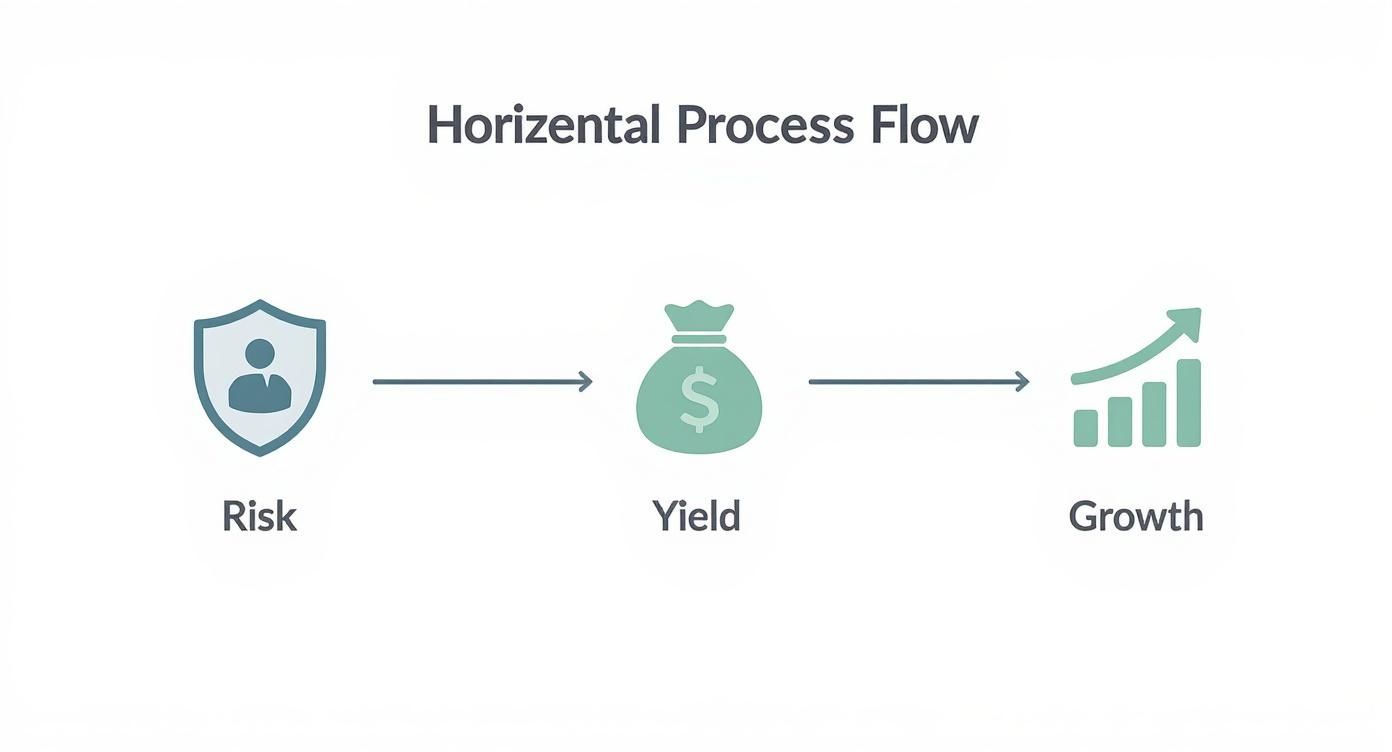
This visual reinforces the essential balancing act: an investor must weigh the level of risk they are willing to accept in the pursuit of specific yield and growth outcomes.
Putting It All Together: A Real-World Scenario
Let us imagine you are comparing two potential markets.
Market A (Established): A two-bedroom flat in a well-connected London suburb. It offers a modest net rental yield of circa 3.5%. The market is stable, politically secure, and highly liquid, but significant short-term capital growth is unlikely. The acquisition process is transparent and securing finance is straightforward.
Market B (Emerging): An off-plan villa in a developing coastal region of Portugal. The developer projects potential rental yields of 7-8% upon completion, driven by tourism. The local government is investing heavily in new roads and expanding a nearby airport. However, currency fluctuations pose a risk, and the legalities of an off-plan purchase are more complex.
Neither option is definitively "better"—the right choice depends entirely on your investment objectives.
If your priority is wealth preservation and a steady, low-risk income stream, London is the logical choice. However, if you have a higher risk tolerance and are targeting capital growth alongside strong yields, the Portuguese villa becomes a more attractive proposition. To sharpen your ability to spot value, you can learn more about how to find undervalued properties in hot markets in our detailed guide. This analytical approach ensures your decision is based on strategy, not speculation.
Navigating Due Diligence and Foreign Legal Systems

Once you have identified a market that appears promising on paper, the real work begins. This is the due diligence phase, and it is the single most important step for protecting your capital. A thorough process builds a solid foundation for your investment; a poor one is tantamount to gambling.
Due diligence is a methodical process of investigation. It is how you verify the facts, uncover hidden risks, and ensure the property you intend to purchase is exactly as represented, free from costly surprises.
Attempting to manage this process alone from thousands of miles away is a high-risk strategy. The bedrock of any successful overseas purchase is a trusted, independent team on the ground. This is non-negotiable. Your team must work exclusively for you, with no affiliations to the seller or developer. Their loyalty must be 100% yours.
Assembling Your Local Professional Team
Consider your on-the-ground team as your eyes, ears, and legal guardians. Each professional has a distinct, vital role in protecting your investment. Insist on professionals who are fluent in English and can demonstrate experience in working with foreign investors.
- Independent Solicitor: This is your most critical appointment. They will conduct legal checks, verify the property title is clean, scrutinise contracts, and ensure the transaction complies with local laws. Their sole function is to protect your legal interests.
- Chartered Surveyor: A surveyor provides an impartial, expert assessment of the building’s physical condition. They are trained to identify structural issues, defects, or essential repairs that could create significant unforeseen costs and impact the property's value.
- Local Tax Advisor: Property tax laws vary dramatically between countries. A specialist advisor will outline your obligations—from purchase taxes and annual property taxes to the capital gains tax you will face upon exit. This foresight prevents costly surprises. To gain a better understanding, consult our guide on how to understand property taxes for your investment.
Understanding Different Legal Frameworks
Property law is not universal. Legal systems globally generally fall into two main categories, and understanding the distinction is fundamental to knowing the rights you are acquiring.
Common Law Systems: Found in countries such as the UK, Australia, and Canada, this system is built on judicial precedent. Property rights are typically well-defined and robustly protected, offering a high degree of security. The conveyancing process is usually transparent and thorough.
Civil Law Systems: This system is prevalent across most of Europe (e.g., France, Spain, and Germany) and relies on codified statutes. A notary often plays a central, state-appointed role in property transactions, and their function can differ significantly from that of a solicitor in a common law country.
The strength and transparency of a country's legal system is a direct indicator of investment security. A market with a clear and enforceable title registration system provides a foundational layer of protection for foreign capital.
A Comprehensive Legal Due Diligence Checklist
Your solicitor will lead the legal checks, but you should maintain a firm grasp of their investigations. This enables you to ask pertinent questions and remain fully informed.
A thorough checklist will always include:
- Title Verification: Confirming the seller possesses the legal right to sell and that the title is "clean"—free from claims, liens, or unresolved ownership disputes.
- Planning Permissions: Checking that the property, including any extensions or alterations, was constructed with the correct local authority permissions. A lack of consent can lead to fines or even a demolition order.
- Zoning and Land Use Regulations: Ensuring the property's current use (e.g., residential, short-term let) complies with local zoning laws and verifying any restrictions that might impede future plans.
- Access Rights: Confirming you have legal, undisputed rights of access to the property. This is particularly crucial for rural or land-locked plots.
- Debt and Liability Checks: Investigating whether any outstanding debts (such as unpaid utility bills or community fees) are attached to the property itself, as these can sometimes transfer to the new owner.
The UK as a Case Study in Legal Security
The United Kingdom provides an excellent example of a secure legal system. Its common law framework, overseen by His Majesty's Land Registry, offers a state-backed guarantee of title. Ownership is clear, transparent, and legally protected, which eliminates a significant amount of risk for an investor.
This legal security is a primary reason why overseas buyers continue to invest in the UK residential market. While economic recovery and stable inflation are contributing factors, the UK’s transparent legal framework remains a powerful draw for investors seeking a safe haven for their capital. This should serve as a benchmark when evaluating less transparent markets.
Financing Your Purchase and Managing Currency Risk
Securing finance is often a significant hurdle in an overseas property acquisition. A sound financing strategy not only makes the purchase possible but also directly influences long-term returns and risk exposure. The decision requires a clear-eyed assessment of the available options and the unique challenges of a cross-border transaction.
Navigating this landscape involves choosing between a local mortgage in the target country, approaching an international lender, or using a cash-based route such as releasing equity from your existing property portfolio. Each path has distinct pros and cons, and the optimal choice will depend on your financial circumstances, the investment country, and your personal risk appetite.
Exploring Your Primary Funding Routes
Your financing approach shapes the entire deal structure. Understanding the benefits and drawbacks of each method is the first step toward a robust investment.
- Local Mortgage in the Target Country: Applying for a mortgage from a bank where you are buying can be a prudent move. They possess deep knowledge of the local market and their lending criteria are tailored to it. The challenge for a non-resident can be a slow, bureaucratic process, often requiring a substantial deposit (typically 30-40%) and extensive documentation.
- International Lender or Private Bank: Major international banks may offer mortgages to existing clients for overseas purchases. This can streamline the process, as they are already familiar with your financial history. However, these services are often aimed at high-net-worth individuals, and the loan-to-value ratios may be less generous than those of a local lender.
- Cash Purchase or Equity Release: Using cash is the most straightforward route, eliminating mortgage applications and interest payments. Many investors achieve this by releasing equity from their primary residence or other properties. While this offers speed and simplicity, it concentrates risk in your existing assets and forgoes the potential benefits of leveraging borrowed capital.
The Critical Role of Currency Management
When you invest in overseas property, you are operating in at least two currencies. This immediately introduces currency risk—the possibility that exchange rate fluctuations could erode your investment's value. A sudden fall in the local currency against your home currency could inflate mortgage payments or reduce the value of your rental income overnight.
For instance, imagine a mortgage on a Spanish property of €1,000 per month. If the exchange rate moves from £1 = €1.20 to £1 = €1.10, the monthly payment in sterling increases from £833 to £909. This directly impacts your cash flow and net yield, purely due to currency movements.
Effective currency risk management is not about speculating on rate movements; it is about creating certainty. By locking in rates for future payments, you can protect your cash flow and budget with confidence, removing a major source of volatility from your investment.
Practical Strategies to Mitigate Currency Risk
Ignoring currency risk is an unnecessary gamble. Professional investors use specific financial tools to shield themselves from adverse currency market movements. These strategies are accessible to individual investors and are vital for protecting returns. For a more detailed look, our article on financing an investment property offers further context.
The two primary tools investors use to manage this risk are:
- Forward Contracts: This is the most common strategy. A forward contract allows you to lock in an exchange rate for a future transaction, typically for up to two years. If you are buying an off-plan property, for example, you could use a forward contract to fix the exchange rate for your final payment, ensuring you know its exact cost in your home currency.
- Currency Options: A currency option grants you the right, but not the obligation, to buy or sell a currency at a pre-agreed rate on a future date. This provides protection against downside risk while allowing you to benefit if the exchange rate moves in your favour. It offers more flexibility than a forward contract but usually involves an upfront premium.
By integrating these strategies into your financial planning, you convert currency exposure from an unknown variable into a manageable cost. This disciplined approach is a hallmark of successful international property investing.
Crunching the Numbers and Managing from a Distance

Successful overseas property investment depends on two core elements: accurate financial projections from the outset and a robust plan for managing the asset remotely. A firm grasp of the financials is non-negotiable; it is the only way to compare different opportunities on a like-for-like basis and stress-test an investment's potential profitability.
Equally critical are the logistics of remote management. A well-managed property can generate a steady, reliable income with minimal involvement. Conversely, neglecting this aspect can quickly turn a promising asset into a source of stress and unforeseen expenditure.
Mastering the Numbers: Gross vs. Net Yields
The first metric any investor learns is rental yield. It is a simple measure of annual rental income relative to the property’s value, but it is vital to distinguish between gross and net figures. One tells a story; the other reveals the truth.
Gross Rental Yield is a preliminary calculation:
(Annual Rental Income / Property Purchase Price) x 100 = Gross Yield %
For a £300,000 property generating £1,500 per month in rent (£18,000 annually), the gross yield is 6%. While useful for an initial comparison, this figure is fundamentally misleading as it ignores the real-world costs of ownership.
Calculating Your True Return: Net Yield
This is the essential calculation. Net Rental Yield provides a far more accurate picture of an investment's performance. It accounts for all operational expenses that will reduce your income, thereby revealing your actual cash flow.
The formula is more detailed:
(Annual Rental Income - Annual Operating Costs) / Total Investment Cost) x 100 = Net Yield %
"Annual Operating Costs" are not minor details; they are essential outgoings that must be budgeted for.
- Management Fees: Typically 8-12% of monthly rent for a reputable agent.
- Maintenance and Repairs: A prudent investor budgets around 1% of the property's value annually.
- Insurance: Landlord and building insurance are non-negotiable.
- Service Charges or HOA Fees: Standard for apartment blocks and managed communities.
- Void Periods: It is wise to budget for at least one month of vacancy per year.
- Local Property Taxes: These vary significantly between countries and even municipalities.
Factoring in these costs is the only way to determine the true profitability of an investment. For a deeper analysis of these calculations, consult our detailed guide on how to calculate your return on investment for real estate.
How Different Property Sectors Perform
The type of property you acquire will significantly influence its yield profile. In the UK, for instance, credible market analysis shows the real estate market delivered a strong 8.1% total return over the 12 months to February in a recent fiscal year. The build-to-rent (BtR) sector has been a standout performer, attracting over £5 billion in investment during that period—a 13% increase year-on-year, according to major economic bodies. You can find more insights on the UK property market outlook on aberdeeninvestments.com.
An investment's success is determined not by its gross potential but by its net performance after all costs are accounted for. Meticulous budgeting and realistic yield calculations are the foundations of a profitable overseas portfolio.
The Essentials of Remote Property Management
Once you take ownership, effective remote management is what transforms your property from a liability into a truly passive investment. The cornerstone of this is appointing a first-class local letting and management agent. This is not an area for compromise—a proficient agent is worth their fee many times over.
When vetting potential agents, ensure you:
- Verify Credentials: Check they are properly licensed and members of a professional body.
- Check Reviews: Seek feedback from other landlords, particularly fellow overseas investors.
- Analyse Their Marketing: Evaluate how they present properties online. A strong digital presence is crucial for minimising void periods.
- Clarify All Fees: Obtain a full breakdown of their fee structure, from tenant-finding charges and management percentages to their charges for arranging repairs.
A professional agent acts as your representative on the ground. They handle everything from screening tenants and collecting rent to managing emergency repairs and ensuring compliance with local regulations. Ultimately, they provide the peace of mind that makes a hands-off investment viable.
Your Top Questions on Overseas Property Investing
As you move from broad research to practical considerations, specific questions will arise. This section addresses common queries that investors face before committing, covering everything from tax obligations to the realities of remote ownership.
This serves as a quick-reference guide to address those final details, providing the confidence to move forward with a comprehensive understanding.
How Is Rental Income from a Foreign Property Taxed?
As a UK resident, you are generally taxed on your worldwide income. This means any rental income from an overseas property must be declared to HM Revenue & Customs (HMRC) on your self-assessment tax return.
Crucially, you will almost certainly also be required to pay tax on that income in the country where the property is located. To prevent double taxation, the UK has double-taxation treaties with many countries. These agreements allow you to claim Foreign Tax Credit Relief (FTCR), which typically reduces your UK tax liability by the amount of tax already paid overseas.
Meticulous record-keeping of income, expenses, and foreign taxes paid is non-negotiable. Professional tax advice is essential to ensure compliance in both jurisdictions and to optimise the use of available reliefs.
What Expenses Can I Deduct Against Foreign Rental Income?
Similar to a UK buy-to-let property, you can deduct allowable expenses from your rental income to reduce your taxable profit. The guiding principle is that these costs must be incurred "wholly and exclusively" for the purpose of renting out the property.
Common deductible expenses typically include:
- Property management and letting agent fees
- Maintenance and repair costs (but not capital improvements)
- Landlord insurance premiums
- Mortgage interest (though rules on relief can vary)
- Utility bills and local property taxes paid by the landlord
It is vital to remember that tax rules are not universal. While mortgage interest is deductible in many countries, for example, the method of calculating relief may differ. Always verify the specific regulations in the host country and how they align with HMRC guidelines.
How Does Depreciation Work for Overseas Properties?
Depreciation is a tax deduction that accounts for the "wear and tear" of a property over its useful life, and the rules vary significantly between countries.
The US, for example, has a formal system where an investor can depreciate the value of a foreign residential property's structure over a 30-year period under its Alternative Depreciation System. This allows them to deduct a portion of the property's cost from their taxable income each year.
The UK tax system, however, does not generally permit depreciation on residential property in this manner. Instead, relief is given for the actual expenditure on repairs and maintenance. Understanding this distinction is vital for accurate financial modelling.
An investor's biggest mistake is assuming their home country's tax rules apply abroad. Each jurisdiction has its own framework for deductions, depreciation, and capital gains, making local expertise indispensable for accurate financial forecasting.
What Happens When I Sell My Overseas Property?
Upon selling an overseas property, you will likely be liable for Capital Gains Tax (CGT) in two jurisdictions: the country where the property is located and the UK. As with rental income, double-taxation treaties are designed to prevent you from being taxed twice on the same gain.
The gain is calculated by subtracting the original purchase price (plus associated costs like legal fees and stamp duty) from the sale price. This gain must be declared to HMRC. You can then typically offset the CGT paid in the foreign country against your UK CGT liability. Currency fluctuations can also significantly impact the final gain or loss when converting funds back to sterling, adding another layer of complexity.
At World Property Investor, we provide the data-driven guides and in-depth market analysis you need to navigate these complexities with confidence. Explore our resources to compare global markets and build your international portfolio on a foundation of expert knowledge. Visit us at https://www.worldpropertyinvestor.com to start your research today.