
Investing in property is not a speculative venture; it is a business. Long-term success is achieved by treating it as such from the outset. The focus must be on long-term wealth creation through consistent rental income and capital appreciation. A disciplined approach transforms ambition into a viable financial strategy.
Building Your Foundation for Property Investment

Successful property investment is not about short-term 'flips'. It is the strategic acquisition of assets that generate a reliable income stream and appreciate in value over time. It is a proven method for building sustainable wealth, but it demands a robust foundation built on clear objectives and financial realism.
Before analysing any listing, define your strategic purpose. Are you seeking to supplement retirement income, generate passive cash flow, or achieve complete financial independence? Your primary objective will dictate every subsequent decision, from asset class to geographical focus.
Defining Your Goals and Mindset
A successful investor operates with the mindset of a business owner: analytical, patient, and dispassionate. This involves removing emotion from financial decisions and acknowledging that property is a long-term asset class. This disciplined approach allows you to navigate market cycles without making reactive, costly errors.
To establish your foundation, you must:
- Set clear financial targets: Quantify your objectives. For example, "My goal is to generate £1,000 per month in net rental income within five years."
- Decide on your long-term vision: Determine the desired scale of your portfolio. Will two high-performing assets suffice, or is the goal a large, diversified portfolio?
- Adopt a business framework: This is non-negotiable. It requires meticulous record-keeping, comprehensive budgeting for all potential costs, and the early assembly of a professional team (solicitor, accountant, mortgage broker).
The core principle is simple: a successful property portfolio is run like a business, not a hobby. Every decision must be underpinned by data, diligence, and a clear understanding of your financial objectives and risk tolerance.
Understanding Your Risk Tolerance
All investments carry inherent risk. A candid self-assessment of your tolerance for financial risk is essential.
Are you comfortable employing higher levels of leverage to pursue greater returns, or do you favour a more conservative, low-debt strategy? Consider your response to a void period (an unoccupied property) or an unexpected capital expenditure, such as a boiler replacement. This self-analysis is the bedrock of a sustainable and profitable investment strategy.
Understanding the UK Property Market
A thorough understanding of the market landscape is a prerequisite for investment. The UK property market is not a monolith; it is a complex mosaic of regional and local markets, each with distinct economic drivers and performance characteristics.
Fundamentally, the market operates on the principle of supply and demand. For decades, UK housing construction has not kept pace with population growth. This structural undersupply, consistently documented by bodies like the Office for National Statistics (ONS), provides a powerful long-term support for property values.
However, a comprehensive analysis must also account for the key factors driving demand.
Key Market Drivers to Watch
These drivers are the vital signs of market health. An ability to interpret them provides a framework for evaluating any potential investment.
- Interest Rates: The Bank of England's base rate is the primary determinant of mortgage costs. Lower rates reduce borrowing costs, typically stimulating demand and supporting prices. Conversely, higher rates increase borrowing costs, which can moderate market activity.
- Economic Health: A robust economy with low unemployment fosters consumer confidence and financial capacity for property acquisition. Regional economic data is critical; a city with diverse, growing industries and strong job creation will almost certainly exhibit a healthy housing market.
- Government Policy: Fiscal and regulatory changes, such as adjustments to Stamp Duty Land Tax (SDLT) or housing support schemes, can have an immediate and significant market impact. Staying informed of government policy via sources like Gov.uk is essential.
A key metric for assessing market value is the house price-to-earnings ratio. This compares the average property price in a given area to the average local salary. A high ratio may indicate an over-extended market, while a lower ratio can suggest better value and greater potential for capital appreciation.
Established vs Emerging Markets
Location is the single most significant determinant of investment returns. For a global investor, the choice often lies between established, high-value markets and emerging, high-growth urban centres.
London, for example, is an established global hub. It offers exceptional stability and liquidity but demands a very high capital entry point. Consequently, rental yields are often compressed, making it a challenging market for new investors focused on cash flow.
In contrast, cities such as Manchester and Liverpool represent emerging markets. Characterised by significant regeneration, growing professional populations, and infrastructure investment, they offer compelling advantages:
- Lower entry costs: Capital is deployed more efficiently.
- Higher rental yields: The relationship between property price and rental income is typically more favourable.
- Stronger capital growth potential: As these economies mature, there is often greater scope for value appreciation.
The following table provides a high-level comparison.
UK Property Market Snapshot: Established vs Emerging Cities
| Metric | London (Established) | Manchester (Emerging) | Liverpool (Emerging) |
|---|---|---|---|
| Average Property Price | High (£500,000+) | Moderate (£200,000–£300,000) | Low (£150,000–£250,000) |
| Typical Rental Yield | 3-4% | 5-7% | 6-8% |
| Capital Growth Potential | Stable, moderate | High | High |
| Key Strengths | Global hub, stability, liquidity | Regeneration, tech/media hub | Affordability, waterfront investment |
| Best For | Wealth preservation, low-risk | Balanced growth and yield | High-yield focus |
The optimal strategy depends on your objectives. London is suited for capital preservation, while cities like Manchester and Liverpool offer a more dynamic combination of rental income and growth potential.
How to Finance Your First Investment Property
Securing appropriate financing is a critical step for new investors. Understanding a lender's perspective is key. A mortgage for an investment property is fundamentally different from a residential home loan. Lenders assess a buy-to-let (BTL) application as a commercial proposition, with a stringent focus on the asset's income-generating potential.
Residential vs Buy-to-Let Mortgages
The primary distinction is between a residential mortgage (for a property you occupy) and a buy-to-let (BTL) mortgage (for a property you intend to rent out). Utilising the incorrect product can constitute mortgage fraud.
Key differences include:
- Larger Deposit: While a residential mortgage may require a 5-10% deposit, BTL lenders mandate a larger capital contribution. Expect to provide a deposit of at least 25% of the property's value.
- Higher Interest Rates and Fees: BTL mortgage rates are typically higher than residential rates to reflect the perceived increase in risk. Arrangement fees can also be more substantial.
- Interest-Only Options: Many investors opt for an interest-only BTL mortgage. Monthly payments cover only the interest, not the principal loan amount. This structure improves monthly cash flow. The capital is repaid at the end of the term, typically through sale or refinancing.
How Lenders Assess Your Application
A BTL mortgage application pivots on the property’s rental potential, not solely on your personal income. Lenders must be satisfied that the rental income will comfortably service the mortgage debt.
This is verified using two primary calculations:
- Interest Cover Ratio (ICR): Lenders require the gross monthly rent to exceed the monthly mortgage interest payment by a set margin, typically between 125% and 145%. For a mortgage interest payment of £500 per month, the required rental income would be between £625 and £725.
- Stress Test: The loan is also "stress tested" against a notional higher interest rate (e.g., 5.5% or higher), irrespective of the actual product rate. This ensures the investment remains viable even if interest rates rise significantly.
The chart below illustrates the comparative performance of residential property, underscoring its appeal.
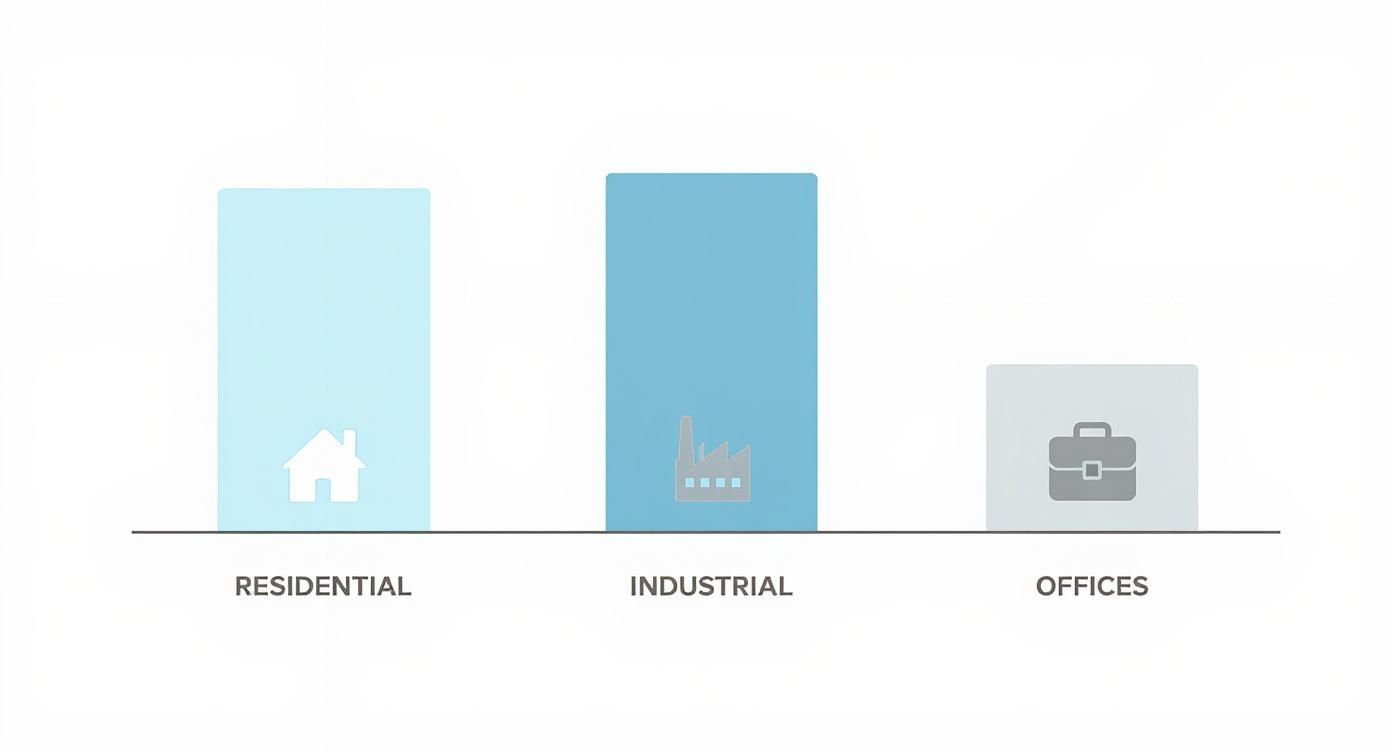
While industrial assets have shown strong performance, the residential sector provides stable, competitive returns, often with lower volatility.
Preparing for Your Mortgage Application
Thorough preparation is paramount for a successful application. Before engaging with a lender or broker, ensure your financial affairs are in order. Review your credit file with agencies like Experian or Equifax and rectify any inaccuracies.
Compile all necessary documentation, including proof of income, recent bank statements, and details of existing liabilities. For a comprehensive overview, refer to our guide on financing an investment property.
Data from the Bank of England confirms that lenders are actively providing finance to qualified applicants.
Key Takeaway: Lenders are assessing the viability of the investment itself, not just your personal circumstances. A strong application demonstrates both your personal financial stability and the property's robust income-generating potential.
Alternative Financing and Using a Broker
While BTL mortgages are the standard route, other options exist. Bridging loans, for example, are short-term financing solutions suitable for auction purchases where funds are required rapidly. They carry higher interest rates and are generally used by experienced investors with a clearly defined exit strategy.
For most beginners, engaging a specialist mortgage broker is a prudent decision. An experienced broker has access to a wider range of products and understands the specific underwriting criteria of different lenders. They can structure your application effectively, saving you time and securing more favourable terms.
Crunching the Numbers: Returns, Risks, and Reality
This is the transition from theory to practice. Building a profitable portfolio requires the ability to analyse an investment opportunity using objective financial metrics. The process centres on calculating potential returns while rigorously assessing financial risks before committing capital.
The two most critical metrics are rental yield and Return on Investment (ROI). Mastering these calculations provides a data-driven framework for comparing properties and identifying financially sound investments.
Getting to Grips with Rental Yield
Rental yield is a percentage that expresses the annual rental return relative to the property's value. It is a primary indicator of an asset's income-generating efficiency. It is crucial to distinguish between the two types.
- Gross Yield: A preliminary, high-level calculation. It is the total annual rent divided by the purchase price, multiplied by 100. It is useful for initial, rapid comparisons.
- Net Yield: The definitive measure of profitability. It accounts for all operational expenditures, providing an accurate representation of the actual return. This figure should guide all investment decisions.
Consider a property purchased for £200,000, generating a monthly rent of £950 (annual rent of £11,400).
The gross yield is: (£11,400 ÷ £200,000) x 100 = 5.7%.
This is a useful starting point, but it does not reflect the true performance.
To truly understand an investment, you have to move beyond the headline rental figure. Your net yield is the most honest measure of profitability because it reflects the true cash flow after all the bills are paid.
Calculating Your True Net Yield
To determine net yield, all foreseeable operating costs must be deducted from the gross annual rent. These are standard business expenses that require accurate budgeting.
Common costs include:
- Letting agent fees (typically 10-15% of gross rent)
- Maintenance and repairs (a prudent budget is 1% of the property’s value annually)
- Landlord insurance
- Service charges and ground rent (for leasehold properties)
- Void periods (budgeting for one month of vacancy per year is a sensible precaution)
Revisiting the £200,000 property with these costs factored in:
Sample Net Rental Yield Calculation
| Item | Annual Cost (£) |
|---|---|
| Letting Agent Fees (12%) | 1,368 |
| Maintenance Fund | 2,000 |
| Insurance & Safety Checks | 400 |
| Void Period (1 month) | 950 |
| Total Annual Costs | 4,718 |
Deducting these costs from the annual rent: £11,400 – £4,718 = £6,682. This is your net annual profit.
The net yield is: (£6,682 ÷ £200,000) x 100 = 3.34%.
This more sober figure demonstrates the critical importance of thorough due diligence, as it is significantly lower than the 5.7% gross yield.
Understanding Your Return on Investment (ROI)
While yield measures income against the property’s total value, ROI measures profit against the actual cash invested. This is where the use of mortgage finance—known as leverage—demonstrates its power to amplify returns. For a detailed analysis, learn how to calculate Return on Investment (ROI) for real estate in our guide.
Using the same £200,000 property, a 25% deposit equates to a £50,000 cash investment. Adding £5,000 for acquisition costs (stamp duty, legal fees) brings your total cash outlay to £55,000.
Your annual net profit is £6,682. The ROI is calculated as: (Net Profit ÷ Total Cash Invested) x 100.
Therefore: (£6,682 ÷ £55,000) x 100 = 12.15% ROI.
This metric reveals that for every pound of your own capital invested, you generate an annual return of over 12%. It powerfully illustrates how leverage can transform a modest net yield into a highly attractive return on capital.
Navigating Your Legal and Tax Obligations
Becoming a landlord is a professional enterprise with significant legal and tax responsibilities. A comprehensive understanding of these obligations is essential for operating a compliant, efficient, and profitable investment portfolio.
This is not an area for approximation; penalties for non-compliance can be severe. Adhering to professional standards protects you, your tenants, and your investment. The following are the essential legal and financial duties for any UK property investor.
Your Core Legal Duties as a Landlord
A series of non-negotiable legal requirements must be met before a tenancy commences. These regulations exist to ensure tenant safety and fair practice. Failure to comply can result in substantial fines and may compromise your legal ability to regain possession of the property.
Key requirements include:
- Tenant Deposit Protection: A tenant's deposit must be protected in a government-approved scheme within 30 days of receipt. You must also provide the tenant with the prescribed information detailing where the deposit is held.
- Gas and Electrical Safety: All gas appliances must be inspected annually by a Gas Safe registered engineer, with a certificate provided to the tenant. Similarly, the property's electrical installations require inspection and testing by a qualified electrician at least every five years.
- Energy Performance Certificate (EPC): A property must have a valid EPC with a minimum rating of 'E' before it can be marketed for rent. Tenants must be provided with a copy.
Legal compliance is the foundation of a sustainable property business. These regulations are not administrative burdens but essential safeguards. They build tenant trust and mitigate significant financial and legal risk.
Understanding Your Tax Obligations
Rental income is subject to tax. Managing your tax affairs correctly is fundamental to profitability. For global investors in UK property, there are three primary taxes to understand.
Income Tax is payable on rental profits. Your profit is the total rental income less allowable expenses, which include mortgage interest, letting agent fees, and maintenance costs. This income must be declared annually via a Self-Assessment tax return. Our guide to understand property taxes for global investors provides further detail.
Stamp Duty Land Tax (SDLT) is paid upon acquisition. In England and Northern Ireland, the purchase of an additional property typically incurs a 3% surcharge on top of the standard SDLT rates.
Capital Gains Tax (CGT) is levied on the profit ("gain") when you sell an investment property. An annual tax-free allowance is available, but any gain above this threshold is taxable.
Personal Name or Limited Company?
A critical strategic decision is whether to own property in your personal name or through a limited company. This choice has significant tax implications.
For individuals, a measure known as Section 24 restricts mortgage interest tax relief. You can no longer deduct the full financing costs as a business expense. Instead, you receive a tax credit equivalent to the basic rate of income tax (20%).
This has made corporate ownership more attractive, particularly for higher-rate taxpayers, as a limited company can still deduct all finance costs as a legitimate business expense. However, operating a company involves additional administrative costs and complexities.
Seeking professional advice from a qualified tax advisor and solicitor is essential to determine the most tax-efficient ownership structure for your individual circumstances.
Your Step-by-Step Guide to Buying an Investment Property
With your finances arranged and market research complete, the next phase is the acquisition process. This chronological roadmap guides you from the initial search to completion, providing a structured process to mitigate common errors.
The initial phase requires a strategic, active search. Engage with local estate agents who specialise in investment property and provide them with your specific acquisition criteria. This proactive approach often provides access to opportunities before they reach the open market. Our guide on how to find undervalued properties in hot markets details advanced strategies for identifying value.
From Viewing to Offer
Viewing a property as an investor requires a methodical and objective assessment, distinct from viewing a potential home. The focus is on identifying issues that could impact financial returns.
During viewings, assess for:
- Structural Red Flags: Look for signs of damp (e.g., peeling paint, musty odours), significant cracks, or roof defects. These issues often incur the highest remediation costs.
- Condition of Key Systems: Evaluate the age and condition of the boiler, plumbing, and electrical systems. Replacement represents a major capital expense.
- Neighbourhood Quality: Observe the condition of adjacent properties and the overall upkeep of the area. This provides insight into the location's long-term stability.
Once a suitable property is identified, a formal offer is made via the estate agent. Your offer must be based on your own financial analysis and comparable sales data, not the asking price. Be prepared to negotiate, but never exceed the maximum price supported by your calculations.
Navigating the Conveyancing Process
Upon acceptance of your offer, the legal process of conveyancing begins. You must instruct a solicitor to manage the legal transfer of ownership. Your solicitor will conduct searches to identify potential issues such as planning disputes or flood risks.
The UK House Price Index, a credible source for market data, provides essential context for valuation. Ensuring your offer aligns with current market realities, as documented by such official sources, is a critical part of due diligence.
Concurrently, you will finalise your mortgage application. The lender will conduct its own valuation survey before issuing a formal mortgage offer. Once this is received and all legal checks are satisfactory, contracts are exchanged, and the deposit is paid, legally committing you to the purchase.
The final step is completion, the date on which the remaining funds are transferred and you take legal ownership of your first investment property.
Common Questions from New Property Investors
Entering the property investment market for the first time raises valid questions. This section provides clear, actionable answers to the most common queries from beginners to help you proceed with confidence.
How Much Capital is Required to Start?
While there is no single figure, the largest initial outlay is the deposit. In the UK, most BTL lenders require a minimum deposit of 25% of the property’s value.
However, the deposit is only part of the initial capital requirement. You must also budget for acquisition costs, which can be substantial. These typically include:
- Stamp Duty Land Tax (SDLT): This is often the largest transactional cost, particularly given the surcharge on additional properties.
- Solicitor's Fees: Legal costs for conveyancing and professional advice.
- Mortgage Arrangement Fees: Charged by the lender for originating the loan.
As a prudent rule of thumb, budget an additional 5-6% of the purchase price to cover these associated costs.
Should I Invest Locally or Further Afield?
Investing in your local market offers the advantage of familiarity. You possess inherent knowledge of the area, rental demand, and the local economy. This can significantly reduce research time and mitigate risk. The disadvantage is that a geographically restricted search may overlook markets with superior yields or stronger growth prospects.
Investing further afield can unlock markets with lower entry points and more robust rental returns. Success in a remote market is contingent on either appointing a highly reliable local letting and management agent or committing to exceptionally thorough due diligence on the target area before making an offer.
Your first investment should be based on sound fundamentals, not convenience. Whether the optimal asset is five miles away or two hundred, the financial case must be robust. Never allow geography alone to dictate a suboptimal investment decision.