
You're probably in one of two positions right now. You either already own a rental property and assume your existing insurance is “good enough”, or you're comparing policies and wondering whether landlord liability insurance is just another line item eating into yield.
That's the wrong frame.
For a landlord, liability cover isn't mainly about policy features. It's about protecting equity, income, and future borrowing power when a routine defect turns into a legal claim. A loose stair carpet, a broken handrail, a leaking pipe, a slipped roof tile. None of these looks dramatic until someone is injured, a neighbour's flat is damaged, or solicitors get involved.
In established markets such as the UK, that risk sits inside a dense legal and regulatory system. In newer or less formal markets, the wording, enforcement, and claim handling can be less predictable. In both cases, the investor mistake is the same. People focus on premium price before they understand exposure.
Why Liability Insurance Is Your Most Critical Asset
A landlord can survive a boiler replacement. A landlord can budget for a void period. What damages a portfolio is a liability event that reaches beyond the property itself and starts threatening other assets.
Take a simple example. A tenant reports a loose floorboard. It isn't fixed promptly. Someone trips, suffers a serious injury, and alleges negligence. At that point, the argument isn't about maintenance inconvenience. It's about legal liability, defence costs, damages, and whether your insurer accepts the claim at all.
The policy isn't the protection. Valid cover is
Many landlords still think that having any landlord policy means they're protected. That assumption is dangerous.
Between 2019 and 2021, the proportion of UK landlord liability insurance claims paid out collapsed from 68% to just 8.6%. With claims surging to £125,500 in 2021, insurers rejected over £114,000 in submitted claims, highlighting a critical shift in the reliability of this coverage (Landlord Today on falling landlord insurance payouts).
That figure changes the conversation. The crucial issue isn't merely whether you bought landlord liability insurance. It's whether you bought the right cover, disclosed the right facts, met the conditions, and kept the evidence needed to support a claim.
Practical rule: Treat liability insurance as a claims process you must prepare for in advance, not as a certificate you file away after renewal.
Where landlords misjudge the risk
The most common mistake is confusing buildings insurance with liability protection. Buildings cover deals with the structure and insured physical damage. Liability cover responds when a tenant, visitor, contractor, or passer-by alleges that your property, or your failure to maintain it, caused injury or property damage.
That distinction matters because one negligence claim can move far beyond annual rental profit. It can affect refinancing, force asset sales, and distract management attention across the rest of the portfolio.
Security and prevention help, but they don't replace insurance. On mixed-use or higher-risk sites, practical upgrades such as access control, alarms, and incident records can strengthen risk management before a claim ever starts. For landlords with commercial elements or shared access areas, Securitec Security for commercial security is the kind of operational resource worth reviewing alongside the insurance file.
Why this matters more in mature markets
In a mature market like the UK, tenant rights, documentation standards, and legal accountability are well developed. That usually means clearer obligations, but it also means clearer pathways for claims. Investors who built portfolios when cover was cheaper and underwriting was looser often haven't adjusted to that change.
The result is a disconnect. Landlords think they have protection because they pay a premium. In practice, poor wording, low limits, weak records, or undeclared risks can leave them effectively uninsured when it matters most.
Decoding Landlord Liability What Is Actually Covered
Most policies are sold with broad language that sounds reassuring. What matters is the actual structure of cover. For landlords, the core areas are usually property owners' liability, employers' liability, and legal expenses.
A good policy doesn't just sit there in case of disaster. It should match how you operate the property.
To make the moving parts clearer, this visual gives a useful simplified map of common liability components:
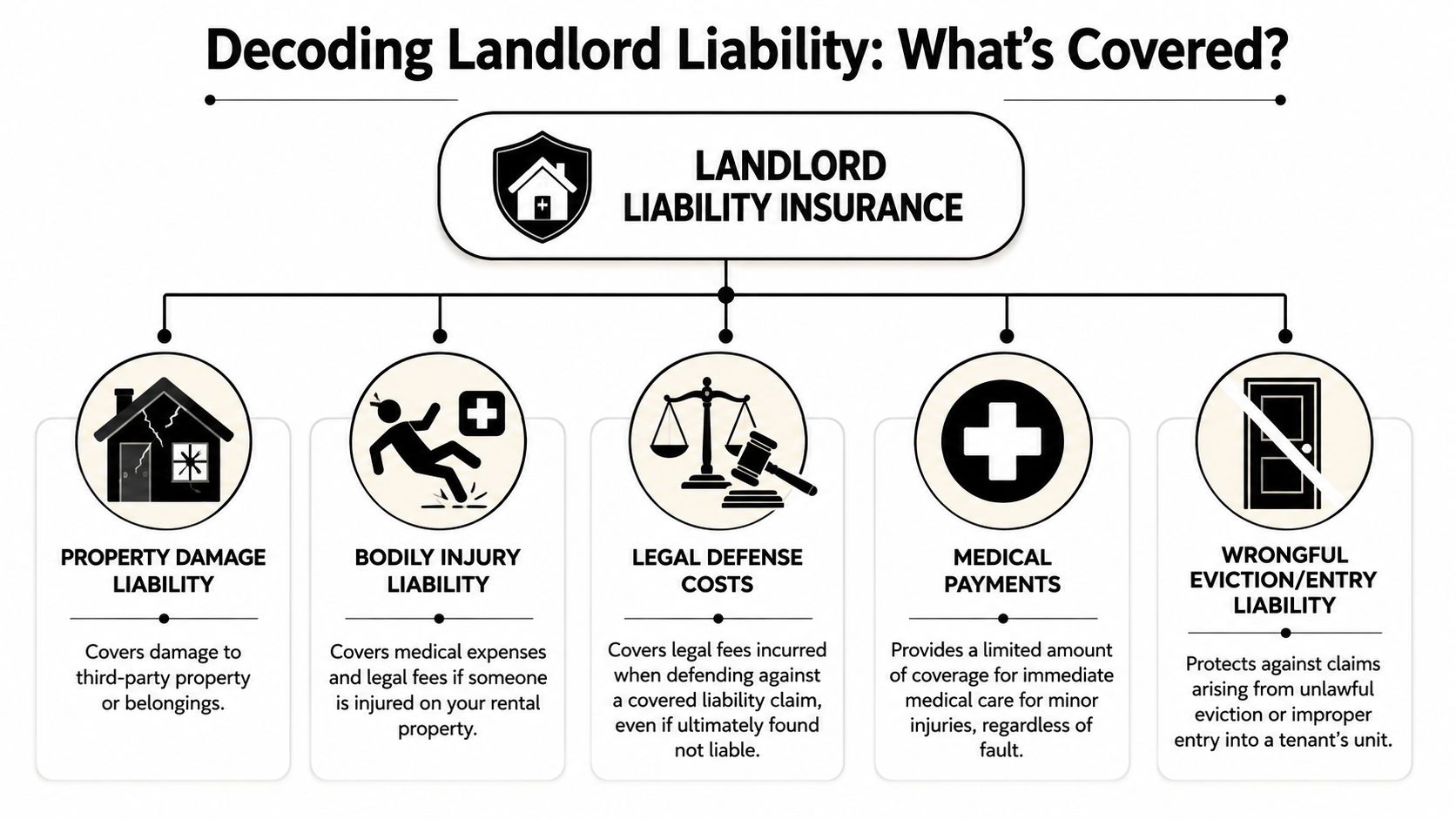
Property owners' liability
This is the cover most landlords mean when they talk about landlord liability insurance. It protects you if a third party alleges that your property, or your negligence in managing it, caused injury or damage.
A “third party” can include:
- Tenants who suffer injury from a defect in the property
- Guests or visitors who slip, fall, or are hurt in a common area
- Contractors attending the property for repairs or inspections
- Neighbours or members of the public affected by an incident linked to your building
The claim could involve a broken paving slab, a leaking appliance, unsafe stairs, loose guttering, or debris falling from the property. In practical terms, this is the cover that stands between a maintenance failure and a direct hit to your balance sheet.
Landlords running furnished short stays or seasonal accommodation should pay particular attention here because guest turnover, contractor access, and occupancy patterns can change the risk profile. If that's part of your model, it's worth comparing specialist options alongside standard cover through a broader holiday let insurance comparison guide.
Employers' liability
Many small landlords encounter problems at this stage.
An essential but often-missed detail for 'DIY' landlords is that Employer's Liability is legally mandatory in the UK if you hire anyone, even a part-time cleaner. Non-compliance can result in fines up to £2,500 per day, and the law requires a minimum cover of £5 million (PassREf on liability insurance for landlords).
That means the moment you directly hire help for cleaning, gardening, maintenance, or caretaker duties, you may have moved from “landlord” to “employer” in the eyes of the law.
If you pay someone to work on your rental business on a regular basis, don't assume casual means exempt.
The practical trap is obvious. Many landlords don't see themselves as employers because they only use part-time help or informal arrangements. Insurers and regulators won't necessarily see it that way.
Legal expenses cover
Liability claims don't always begin with a dramatic accident. Sometimes the first sign is a solicitor's letter, an allegation over habitability, or a dispute that escalates through possession or enforcement channels.
Legal expenses cover is vital. It can support defence costs and related legal work that would otherwise come straight out of rental income or reserves. Even where a landlord ultimately succeeds, the cost of getting there can be painful.
For readers who prefer a walkthrough format, this video gives a useful primer before you read policy wording in detail:
What a well-structured policy does in practice
At minimum, a serious landlord policy should align with the property type, occupancy model, and operational reality of the asset.
Look for these basics:
- Correct occupancy disclosure so the insurer knows whether it's a single let, HMO, short-let, or mixed-use setup
- Appropriate liability sections rather than assuming a generic package covers every scenario
- Legal support that reflects today's more contested landlord environment
- No hidden mismatch between who does the work and whether employers' liability is required
A policy is only as good as the way it matches the actual business operations.
Common Exclusions and Real-World Claim Scenarios
The fastest way to misunderstand landlord liability insurance is to assume it covers every bad outcome connected to a rental property. It doesn't.
Policies are built around defined liability events. They aren't a maintenance contract, a substitute for buildings insurance, or a guarantee that every dispute will be paid.
This summary visual captures the logic of common exclusions:
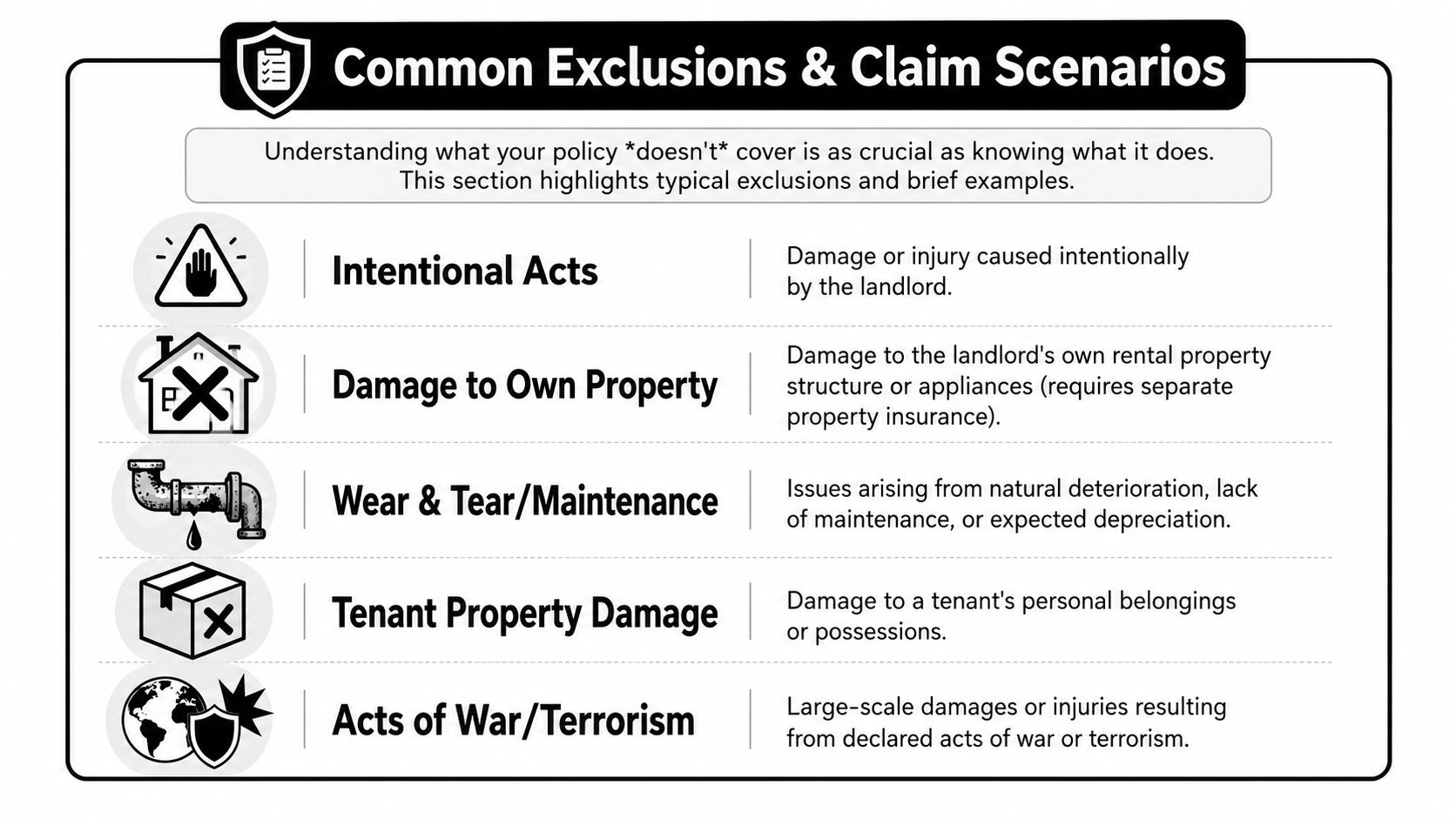
What landlord liability insurance usually won't cover
Several exclusions come up repeatedly in practice.
- Damage to your own building. That usually sits under buildings insurance, not liability cover.
- Wear and tear. A carpet worn thin over time or gradual deterioration in pipework is a maintenance issue.
- Deliberate or reckless acts. If the landlord intentionally causes damage or knowingly ignores a serious issue, insurers may challenge the claim.
- Tenant belongings as a default category. Damage to a tenant's personal possessions often falls outside landlord liability unless a specific legal liability is established and accepted.
- Major exceptional events such as war-related exclusions, depending on the policy wording.
That's why investors need to separate three things clearly: property damage to the asset, liability to other people, and business interruption or rent loss. They overlap operationally, but they don't sit in the same section of the policy.
For broader thinking on income disruption after a serious loss, For The Public Adjusters' claim support is a useful reference point because many landlords only discover the difference between liability cover and rent-related cover after a claim has already started.
Three scenarios that show how liability cover works
A policy becomes easier to value when you map it against actual incidents.
A guest slips on an icy path
A tenant's visitor arrives in winter, slips on an untreated access path, and suffers a serious injury. The issue quickly turns into a negligence question. Was the path part of the landlord's responsibility? Was there a maintenance system? Were inspections documented?
If the answer is yes and the policy is properly structured, landlord liability insurance may respond to legal defence and any covered settlement. If the answer is no, the landlord may end up funding the dispute personally.
A leak damages the flat below
A pipe in your rental flat fails and water escapes into the property beneath. The downstairs owner claims for damaged ceilings, electrics, flooring, and decorations. The conflict usually isn't just about the leak. It's about whether your ownership and maintenance obligations created liability to a third party.
That scenario often catches newer investors because they assume “water damage” always means buildings insurance. It may not. The legal issue can sit in the liability section if another party alleges your property caused their loss.
If you're carrying out refurbishment or system upgrades, this risk also increases during works, handovers, and contractor coordination. That's one reason disciplined investors treat renovation project management as part of risk control, not just cost control.
A roof tile falls onto a pedestrian
A tile becomes loose, falls from the roofline, and injures someone passing the building. In the UK, this is exactly the sort of event that can lead to scrutiny of inspection history, maintenance records, and whether the defect should have been identified earlier.
Policies tend to respond best to sudden events backed by good records. They respond worst to preventable hazards with no paper trail.
The real return on investment
The ROI on liability cover rarely shows up as a profit line. It shows up as avoided loss.
When a claim is valid and documented, the policy can preserve cash reserves and stop one incident from contaminating the rest of the portfolio. When the cover is poor, exclusions become expensive lessons.
How to Choose Coverage Limits and Analyse Costs
Choosing the limit of indemnity is one of the few insurance decisions where the maths is unusually clear. The downside of under-insuring is large. The extra premium for stronger protection is often small.
For UK landlords, the market has moved on from the old idea that £1 million is enough for everyone.
The current baseline
The market standard for UK landlord liability cover is now a minimum of £2 million for residential properties and £5 million for HMOs. The premium uplift to increase cover from £1 million to £5 million is often under £20 per year, a negligible cost when serious injury awards frequently exceed £1 million (Total Landlord Insurance on landlord liability limits).
That cost-benefit analysis is hard to argue against. If a landlord is already paying for specialist cover, saving less than £20 per year to accept materially lower protection doesn't stand up as a rational portfolio decision.
Recommended Minimum Landlord Liability Limits 2026
| Property Type | Risk Profile | Recommended Minimum Liability Limit |
|---|---|---|
| Standard residential property | Lower relative complexity, but still exposed to tenant and visitor injury claims | £2 million |
| HMO | Higher-risk occupancy and management profile | £5 million |
| Short-let or holiday-style accommodation | Higher guest turnover and operational risk | £5 million |
| Flat above commercial premises | Added third-party and mixed-use exposure | £5 million |
Why higher limits make sense
A liability claim is not just compensation. It can include legal costs, expert reports, and the wider expense of defending the matter. Once you understand that serious injury claims can move well beyond a straightforward medical bill, the higher limit becomes the sensible default.
This matters even more on geared portfolios. A landlord with multiple financed properties is more exposed than an owner looking at a single asset in isolation. One uninsured or underinsured claim can weaken debt service capacity and reduce flexibility on future acquisitions.
Investment lens: insurance cost should be assessed against downside volatility, not against whether you expect to claim this year.
What drives the premium
Exact pricing varies by insurer and risk appetite, but the practical drivers are familiar:
- Property type. HMOs, short-lets, and mixed-use assets usually attract closer underwriting scrutiny.
- Location. Dense urban settings, shared access, and higher foot traffic can change exposure.
- Tenant profile. Different occupancy models produce different patterns of wear, supervision, and incident risk.
- Claims history and condition. Properties with unresolved defects or weak maintenance records are harder to place well.
The broader insurance budget matters to yield analysis too. If you're reviewing acquisition costs or refurbishment assumptions, a wider due diligence pass through building survey costs can help identify defects that later become liability issues.
Cost in context
For investors, insurance should sit inside net yield thinking, not outside it. A premium is a business expense that protects income and capital. The more relevant question isn't “How cheaply can I insure this?” It's “What level of retained risk am I accepting to save a relatively small annual amount?”
On that basis, under-insuring usually isn't prudent. It's false economy.
Navigating Liability Across Global Property Markets
A landlord buying in Manchester, Dubai, Lisbon, or Bangkok is still buying exposure to people, buildings, and legal systems. What changes is how clearly that exposure is defined and how reliably insurance responds.
In a mature market such as the UK, liability risk usually sits inside a well-developed framework of landlord duties, safety obligations, lender expectations, and insurer wording. In many emerging markets, the practical risk can be just as real, but the route from incident to claim may be less standardised.
This side-by-side visual captures that distinction:
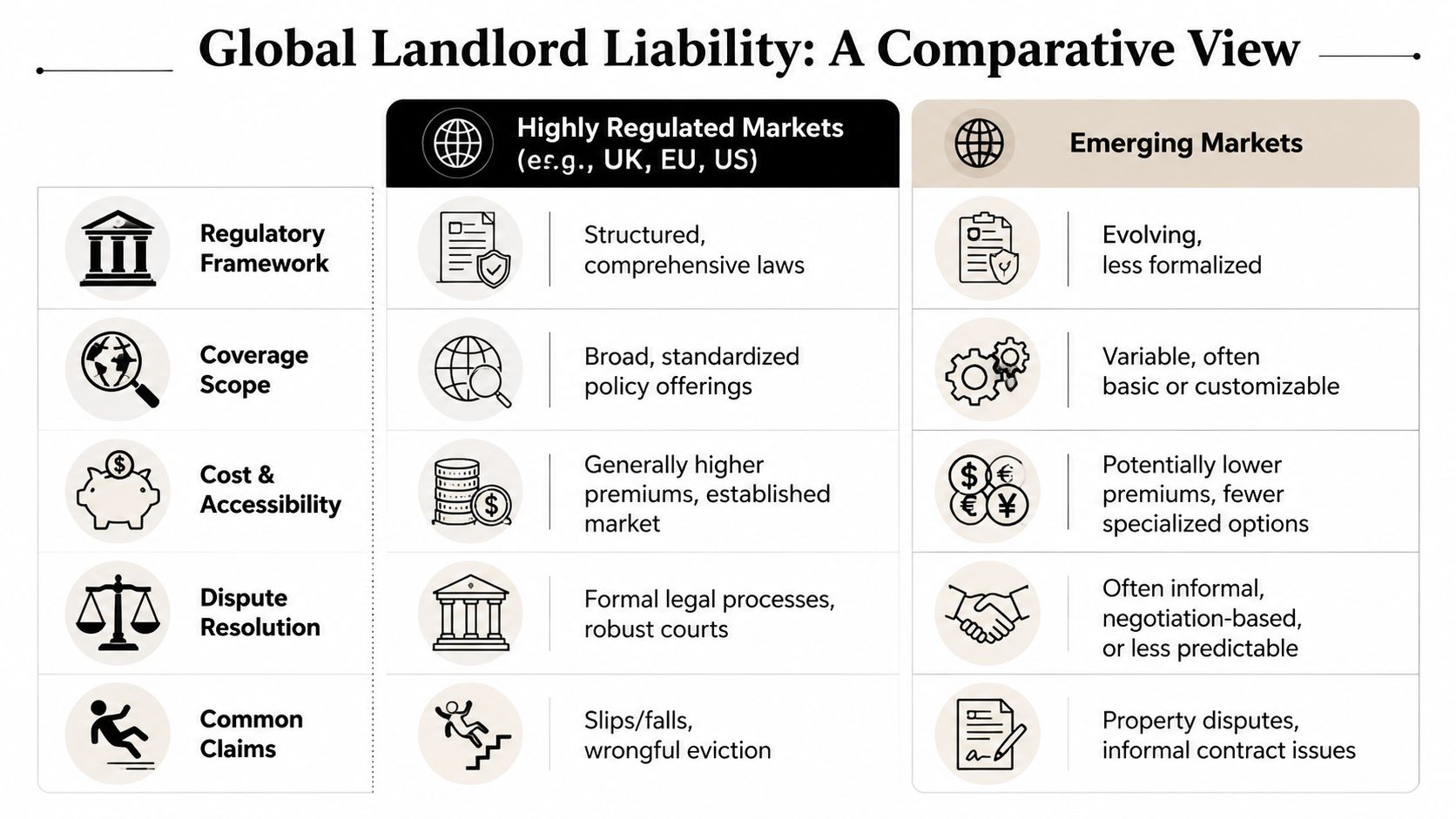
Mature markets usually offer clearer rules
In the UK and similar established environments, investors benefit from a stronger legal architecture. Government guidance, court processes, local housing enforcement, and lender requirements create a more legible operating environment. The trade-off is that obligations are easier to enforce and documentation standards matter more.
That usually means better product availability as well. Policy wording tends to be broader, specialist underwriting is easier to find, and there is more consistency between brokers, insurers, and legal advisers.
Emerging markets can be harder to read
In parts of Southeast Asia, Eastern Europe, and the Middle East, the practical challenge often isn't that liability risk disappears. It's that policy scope, local enforcement, and dispute resolution can be less predictable.
You may find:
- Basic insurance products with narrow wording
- Heavier reliance on broker interpretation rather than standardised cover
- Informal dispute resolution instead of a clear litigation pathway
- Different expectations around maintenance responsibility, building management, and third-party claims
That doesn't make these markets uninvestable. It changes due diligence. A strong gross yield means less if local cover has major blind spots or if a building manager's obligations are unclear.
What global investors should do
When I assess an overseas market, I don't start with premium price. I start with enforceability and operating reality.
Use a local property lawyer, confirm who carries responsibility in common areas, and ask the insurer to define exactly how tenant injury, third-party damage, and defence costs are handled in that jurisdiction. If the asset is held through a company or local nominee structure, check whether the insured party aligns with ownership and management documents.
For cross-border acquisitions, specialist legal input matters because local practice can diverge sharply from investor assumptions. A capable international real estate lawyer can often identify liability gaps before you exchange contracts.
In emerging markets, weak documentation and vague management responsibilities create more problems than premium cost.
The comparison that matters
Established markets usually present higher compliance pressure but clearer insurance logic. Emerging markets may offer stronger yield stories or lower entry costs, but they often require deeper legal and insurance verification.
The prudent investor doesn't assume one system is safer. The prudent investor assumes each market hides risk in a different place.
Your Investor Checklist for Buying and Reviewing Your Policy
The landlords who handle claims best usually do the boring work early. They inspect, document, disclose, and review. The landlords who struggle often have a policy document but very little supporting evidence.
This checklist graphic is a good summary to keep in your renewal file:
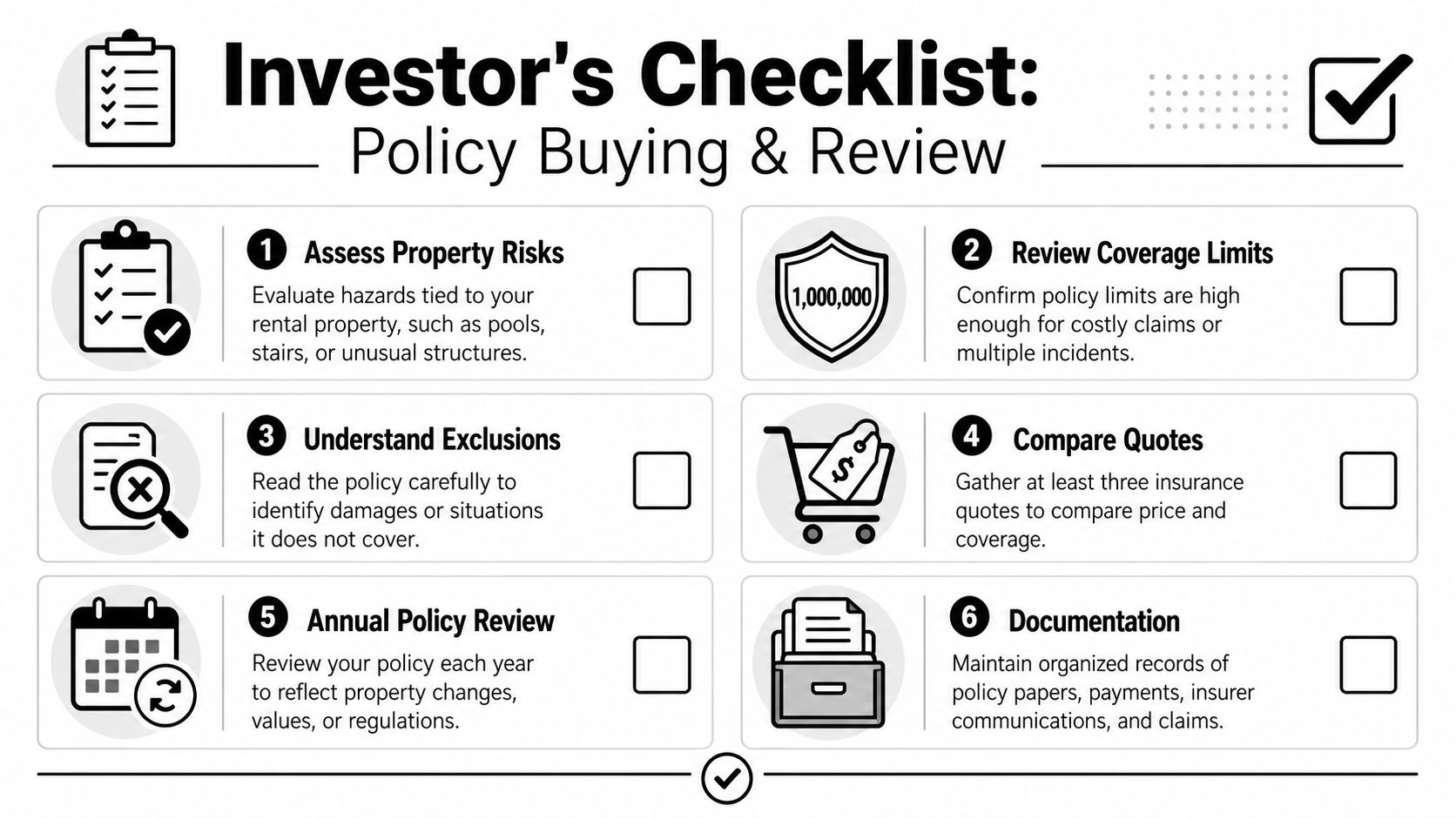
Start every tenancy with evidence
To ensure liability coverage is valid, UK landlords must conduct and document a risk assessment for every new tenancy, covering areas like flooring, roofing, and furnishings. These records, along with evidence from mid-term inspections and mandatory safety checks, are critical evidence in the event of a claim (Alan Boswell on public liability for landlords).
That single point is more important than many landlords realise. If a claim turns on maintenance, your records become part of the defence.
Use a simple operating file for each property that includes:
- Tenancy-start risk assessment covering floors, stairs, ceilings, roofing, windows, external paths, and supplied furnishings
- Photos dated and stored clearly so condition can be evidenced later
- Gas and electrical documents kept together and easy to retrieve
- Mid-term inspection notes signed where appropriate and linked to any remedial work
Review the policy against the real asset
At purchase and at each renewal, check whether the policy still matches how the property is used.
A useful review sequence looks like this:
- Confirm the occupancy model. Standard let, HMO, short-let, mixed-use, or flat above commercial space all affect risk.
- Check who works for you. If you directly hire anyone, revisit employers' liability immediately.
- Read exclusions line by line. Don't rely on the summary page.
- Stress-test the limit. Ask whether the indemnity would still look adequate in a severe injury claim.
- Update improvements and risk changes. Roof works, extensions, layout changes, and altered access arrangements should all be disclosed.
If you use managing agents, don't assume their involvement replaces your own obligations. Good landlords still keep oversight, records, and annual reviews. If you're delegating operations, compare standards across reputable property management companies in the UK and make sure their inspection and reporting practices support your insurance position.
Don't ignore building fabric and fire exposure
Many liability disputes start with defects that were physically visible before the incident. Roof condition, drainage failures, loose materials, and neglected external areas are repeated sources of trouble.
For example, if you're reviewing refurbishment specifications or replacement materials, practical building guidance such as this overview of a Class A fire rating roof can be useful as part of broader asset-risk thinking. The point isn't to chase product hype. It's to understand how material choices affect maintenance risk, fire resilience, and insurability.
Good insurance buying starts with good property management. The file and the fabric have to match.
The habits that actually work
Some landlords shop by premium and forget the policy for a year. That approach works until the first serious incident.
What works better is disciplined repetition:
- Annual review tied to renewal, tenancy changes, and any refurbishment
- Immediate disclosure when the use of the property changes
- Consistent documentation after inspections, complaints, and repairs
- A broker or insurer who answers technical questions clearly, not just cheaply
Landlord liability insurance does its job when the policy is strong, the records are organised, and the landlord treats risk management as part of investing rather than an administrative nuisance.
World Property Investor helps you compare property markets, assess risks, and make better buying decisions across the UK and internationally. Explore more in-depth guides, market analysis, and investor research at World Property Investor.