
Investing in overseas property is a strategic method for diversifying a portfolio and unlocking new income streams, but it demands a disciplined approach. Haphazard decisions lead to unnecessary risk. This overseas property guide provides a practical framework for navigating international markets, moving beyond generic advice to deliver actionable insights for astute investors.
Building Your Investment Framework

Venturing into international property requires more than just identifying an attractive asset; it is about constructing a resilient, diversified portfolio grounded in robust market fundamentals. Success is the product of a methodical approach that balances potential returns with calculated risks, whether considering a prime asset in a stable European capital or a high-growth opportunity in an emerging economy.
This guide serves as a strategic blueprint. It equips you with the essential tools for market analysis, legal due diligence, and financial risk management. Our objective is to provide a clear roadmap, clarifying the core principles that seasoned investors utilise to build and expand their global property portfolios.
Defining Investment Objectives
The foundational step, before any market analysis, is to define your investment objectives with precision. Are you targeting long-term capital appreciation, consistent rental income, or a hybrid of both? Your answer will dictate market selection and asset strategy.
Key parameters to establish:
- Investment Horizon: Is this a short-term acquisition (three to five years) or a long-term strategic holding (a decade or more)?
- Risk Tolerance: What is your capacity to withstand currency fluctuations, political shifts, or less transparent legal frameworks?
- Financial Capacity: Determine your total budget, accounting not just for the purchase price but also for acquisition taxes, legal fees, and ongoing maintenance costs.
A clearly defined strategy is your compass in the global market. Without it, an investor is susceptible to market hype rather than focusing on opportunities aligned with their long-term financial goals.
Understanding Core Market Fundamentals
At its core, property investment is governed by supply and demand. The challenge is to accurately interpret the drivers of these forces in a foreign market. Focus on markets with strong economic fundamentals, including consistent GDP growth, positive demographic trends, and increasing foreign direct investment (FDI).
Government data from credible bodies, such as the Office for National Statistics (ONS) in the UK or equivalent local authorities, can reveal trends in population growth and economic output—key indicators of future housing demand. Furthermore, significant infrastructure projects, like new transport networks or technology hubs, often act as powerful catalysts for localised property value appreciation.
For a broader perspective on investment methodologies, explore more resources on global property investment. A focus on these long-term fundamentals builds a resilient portfolio positioned for sustainable growth, not speculative gains.
How to Analyse International Property Markets

Before committing capital, a thorough market 'health check' is imperative. This process involves moving beyond superficial property listings to scrutinise the economic indicators and local dynamics that distinguish a calculated investment from a speculative gamble.
Employ a dual-lens approach. First, a wide-angle view to assess the macro-economic and political climate of the country. Second, a micro-level focus on the specific city or neighbourhood. Both are required to build a compelling investment case and identify genuine opportunities.
Macro-Economic Analysis
A secure property investment must be underpinned by a stable and growing economy. A country with consistent economic expansion provides a far safer environment for capital than one prone to volatility. Begin by examining key indicators from credible sources like the nation's central bank or national statistics office.
Key metrics to scrutinise:
- GDP Growth: Is the country's Gross Domestic Product (GDP) on a stable, upward trajectory? A healthy economy correlates with rising incomes and supports property price growth.
- Political Stability: Favour countries with transparent legal systems and a history of protecting private property rights. Political instability is a significant deterrent for international investors.
- Currency Stability: A volatile local currency can erode rental income and the capital value of your asset upon repatriation. Analyse its historical performance against your home currency.
- Foreign Ownership Legislation: This is a critical initial check. Some nations impose strict restrictions on what non-residents can purchase. Verify these laws before proceeding.
For example, the United Kingdom is known for its open policy, with official reports from bodies like Gov.uk consistently highlighting its position as a leading destination for foreign direct investment, with minimal restrictions on foreign property ownership. This legal transparency offers a significant degree of security for international capital.
Micro-Level Analysis
While a stable national economy provides the foundation, superior returns are often generated at the local level. This requires granular analysis of supply and demand dynamics within a specific city or district. A rising national economic tide does not lift all assets equally.
Your micro-analysis must focus on the direct drivers of rental yields and capital growth. These details determine an individual property's profitability.
A thriving national economy is a prerequisite, but a new underground line or the arrival of a major corporate headquarters can have a far more immediate and profound impact on a specific property's value and rental demand.
Drilling down into these local drivers is what distinguishes a successful investment. A university city, for instance, offers a consistent pool of student tenants. A coastal resort may deliver high but seasonal holiday let income. To delve deeper, consult our guide on how to determine a property’s investment potential.
Analysing Rental Yields and Capital Growth
Return on investment (ROI) is derived from two primary sources: rental income and capital growth. It is rare to find a market that excels in both simultaneously; therefore, clarity on your primary objective is crucial.
- Rental Yield: The annual rental income expressed as a percentage of the property’s value. Emerging markets often offer higher yields, but this frequently comes with elevated risk.
- Capital Growth: The increase in the property’s market value over time. Established, prime city-centre locations typically offer lower yields but more reliable, long-term capital appreciation.
The gross rental yield is calculated with a simple formula: (Annual Rental Income / Property Purchase Price) x 100.
For a property purchased at £250,000 generating £15,000 in annual rent, the gross yield is 6%. This fundamental calculation is an essential tool for comparing opportunities across different international markets.
Established Versus Emerging Markets
A primary strategic decision for an overseas investor is whether to allocate capital to an established, mature market or to an emerging one. This choice fundamentally shapes the risk-return profile of the investment.
There is no universally correct answer. The decision must align with your investment goals, risk tolerance, and intended holding period. The comparison is akin to choosing between a stable, blue-chip stock and a high-potential growth stock; both can be profitable, but their performance characteristics and risk profiles differ significantly.
The Appeal of Established Markets
Established markets, such as the UK, Germany, or Canada, represent the bedrock of global property investment. They are characterised by stability, legal transparency, and high liquidity, meaning assets can typically be sold without significant delay or price depreciation. These markets are anchored by robust legal frameworks and predictable economic cycles, providing a secure environment for capital preservation.
This stability attracts significant international capital. For example, data from major economic bodies consistently shows the UK as a top destination for overseas buyers. Its transparent legal system and deep pool of professional services offer a high degree of investor security. You can find more data on this trend in reports covering foreign investment in UK real estate.
However, this security comes at a price. Property values are already high, resulting in lower rental yields and more moderate capital growth potential. The explosive growth phases in these markets occurred decades ago; today's performance is characterised by steady, incremental appreciation.
The High-Growth Potential of Emerging Markets
In contrast, emerging markets—such as certain economies in Southeast Asia, Eastern Europe, or Latin America—offer the potential for significantly higher returns. Rapid urbanisation, a growing middle class, and inflows of foreign investment can fuel substantial capital growth over a relatively short period.
Rental yields are also often higher. Lower entry prices mean capital can be deployed more efficiently, acquiring larger or better-located properties than would be possible in established markets. This is a considerable advantage for investors focused on generating strong monthly cash flow.
An investment in an emerging market is a strategic allocation towards its future growth. You are investing in the thesis that economic development and infrastructure improvements will drive up property values, but this potential is invariably balanced by a higher degree of uncertainty.
The higher potential rewards are accompanied by greater risks that must be carefully managed:
- Political Instability: Abrupt policy changes can alter property laws and negatively impact investor sentiment.
- Currency Volatility: Sharp devaluations in the local currency can significantly reduce rental income and capital value when repatriated.
- Legal Complexity: Property laws may be less defined or inconsistently enforced, complicating the acquisition and ownership process.
- Lower Liquidity: The pool of potential buyers may be smaller, potentially extending the time required to exit the investment.
For investors interested in these high-growth opportunities, we offer a detailed analysis in our guide to the top 7 emerging property investment markets.
Investment Profile: Established vs Emerging Markets
Choosing between these two market types requires a clear understanding of the trade-offs. The table below provides a concise comparison to help align your strategy with the appropriate market profile.
| Factor | Established Markets (e.g., UK, Germany, Canada) | Emerging Markets (e.g., Turkey, Parts of SE Asia) |
|---|---|---|
| Capital Growth | Slower, more predictable appreciation. | Higher potential for rapid growth. |
| Rental Yield | Generally lower (2-4% is common). | Often higher (5-10%+ is achievable). |
| Risk Profile | Low political, legal, and currency risk. | Higher risk across all categories. |
| Liquidity | High; properties are easier to buy and sell. | Can be low; selling may take longer. |
| Market Transparency | Excellent; reliable data and legal processes. | Variable; due diligence can be challenging. |
| Entry Costs | High purchase prices and associated costs. | Lower property prices and potentially lower costs. |
Ultimately, the choice depends on your investment strategy. A conservative investor focused on wealth preservation will likely favour an established market, while an investor with a higher risk tolerance seeking greater returns may find the potential of an emerging market compelling.
Navigating Foreign Legal and Tax Regulations
Understanding a country’s legal and tax systems is not a procedural formality; it is the absolute foundation of a secure overseas property investment. An opportunity that appears attractive on paper can quickly become unviable if undermined by unforeseen ownership restrictions or punitive tax liabilities.
This due diligence is non-negotiable. It is the primary mechanism for protecting your capital from costly errors. Every jurisdiction operates under its own rules, and a common mistake is to assume processes mirror those in the UK.
The Legal Framework
A primary hurdle is often foreign ownership restrictions. While many countries welcome overseas investment, others impose strict controls. For example, some may restrict foreign ownership to specific designated zones, require a local business partner, or limit purchases to new-build properties only.
Engaging an independent, local lawyer is therefore essential. Never rely on the solicitor recommended by the seller or developer, as their primary duty may not be to you. An independent lawyer acts as your fiduciary, responsible for verifying title deeds, checking for encumbrances, and navigating local bureaucracy on your behalf.
Your local legal advisor is your most critical partner. Their role is to ensure the purchase is legally sound, the title is clean, and there are no adverse clauses in the contract. Budgeting for high-calibre, independent legal advice is a prudent investment.
It is also vital to understand the type of ownership being acquired:
- Freehold: The highest form of ownership, granting you ownership of the property and the land it occupies in perpetuity. This is common in jurisdictions like the UK.
- Leasehold: Ownership of the right to use a property for a fixed term, often 99 or 999 years. At the lease's end, ownership reverts to the freeholder. This is common for apartments and in certain countries, particularly across Asia.
Demystifying Tax Liabilities
Beyond the purchase price, a range of taxes will impact your net returns. These costs vary dramatically between countries, and accurate forecasting is essential for calculating your potential ROI.
Common taxes include:
- Stamp Duty or Transfer Tax: A government tax levied on the purchase, which can range from less than 1% to over 10% of the property’s value.
- Annual Property Taxes: An ongoing local tax, similar to UK council tax, used to fund municipal services.
- Capital Gains Tax (CGT): A tax on the profit realised upon selling the property. Rates, rules, and exemptions vary significantly.
- Rental Income Tax: Income generated from letting the property is almost always taxable in the jurisdiction where the property is located.
The Role of Double Taxation Treaties
A key concern for overseas investors is being taxed on the same income twice—once in the host country and again in the UK. Double Taxation Treaties (DTTs) are designed to prevent this. The UK has such agreements with over 130 countries.
A DTT typically allows tax paid abroad on rental income or capital gains to be credited against your UK tax liability on that same income. For instance, if you paid £2,000 in tax on Spanish rental income, that amount can usually be offset against the tax owed to HMRC. For a more detailed examination, you can understand property taxes for overseas investments in our dedicated guide.
These treaties are complex. It is always advisable to seek guidance from a tax professional specialising in international and expatriate tax matters to ensure full compliance and optimisation.
Financing Your Purchase and Managing Currency Risk
Securing the right property is only part of the process. The method of financing and subsequent currency management are critical determinants of an investment's success. Understanding these financial mechanics is fundamental to protecting your capital.
Your financing strategy will be shaped by your personal financial situation, the country of purchase, and the lending criteria of local banks for foreign nationals.
Core Financing Options
There are three primary financing routes for overseas buyers:
- Cash Purchase: Using existing funds is the simplest and fastest method. It eliminates mortgage applications and interest payments and strengthens your negotiating position. The main drawback is the concentration of a large amount of capital in a single, illiquid asset.
- Equity Release from a UK Property: Remortgaging a UK home can be an effective way to raise capital at a competitive interest rate within a familiar financial system. However, this places your primary residence at risk if repayments are not met.
- Local Mortgage: Obtaining a mortgage from a bank in the host country ties the debt directly to the asset. Be prepared for stringent lending criteria for non-residents, including higher interest rates and substantial deposit requirements, often 30-40% of the property's value.
For a more detailed analysis of these methods, our guide on financing an investment property provides further strategic insights.
Managing Currency Fluctuation: A Critical Risk
Currency risk is one of the most significant and frequently overlooked risks in overseas property investment. Exchange rate movements can have a substantial financial impact at every stage of the process.
For example, if you agree to purchase a property for €250,000 when the exchange rate is £1 = €1.15, the sterling cost is £217,391. If, by the time of completion, the pound weakens to £1 = €1.10, the cost increases to £227,272. This represents a loss of nearly £10,000 before you even take possession.
Currency risk impacts the initial purchase, ongoing mortgage payments (if in a foreign currency), the value of repatriated rental income, and the final proceeds upon sale.
Practical Strategies to Mitigate Currency Volatility
Fortunately, strategies exist to manage this risk. The first step is to use a specialist currency broker instead of a high-street bank. Brokers offer more competitive exchange rates and lower fees, but more importantly, they provide risk management tools.
A key tool is the forward contract. This allows you to lock in an exchange rate today for a transaction that will occur in the future. By securing a rate for your final payment in three months' time, for example, you achieve certainty over the final cost in your home currency, insulating you from adverse market movements. This simple strategy provides budget certainty and can save thousands of pounds.
Your Step-by-Step International Buying Checklist
This section consolidates the principles of our overseas property guide into a practical, chronological checklist to structure your acquisition process and ensure a successful outcome.
Phase 1: Initial Planning and Research
Diligent preparation is the bedrock of a sound investment. Before viewing properties, define your strategy and establish a clear financial picture.
- Define Investment Goals: Clarify your objective. Is it primarily for capital growth, rental income, or personal use with ancillary rental potential? Your goal will determine the ideal market and property type.
- Assess Finances: Calculate your total budget, including the purchase price, legal fees, taxes, and a contingency fund of at least 10%. If financing is required, secure an 'Agreement in Principle' from a lender early on.
- Conduct Macro Research: Shortlist two to three countries. Investigate their economic stability, foreign ownership laws, and typical rental yields. Use official sources like national statistics offices and central banks for credible data.
Phase 2: Building Your Professional Team
You cannot invest successfully overseas in isolation. Assembling a team of independent, trusted professionals is a necessity to protect your interests.
- Independent Solicitor: Appoint a local, bilingual lawyer specialising in property law for foreign investors. Critically, do not use the solicitor recommended by the seller or developer.
- Tax Advisor: Engage an advisor with expertise in both UK and the host country's tax legislation to clarify your obligations regarding income tax, capital gains, and inheritance.
- Currency Specialist: Open an account with a currency broker at the start of your search. Discuss using tools like forward contracts to lock in an exchange rate and mitigate currency risk.
The infographic below illustrates how exchange rate risk can impact your purchase and how hedging strategies can protect your capital.
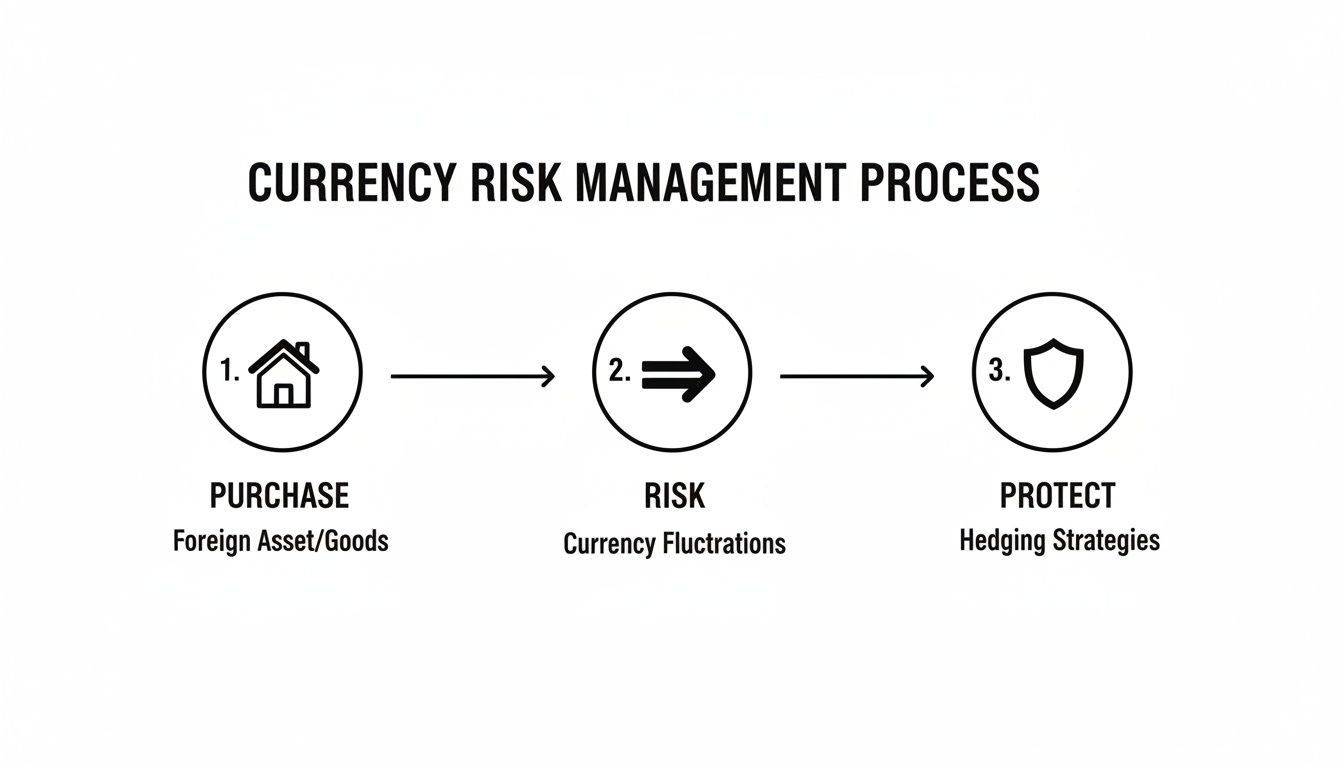
Proactive currency management is a crucial shield against market volatility.
Phase 3: The Purchase and Due Diligence Process
With your professional team in place, you can proceed with the transaction, confident that all details will be meticulously scrutinised.
Due diligence is your final safety net. It is the methodical process of verifying every legal and physical aspect of the property before you are contractually committed.
- Conduct Due Diligence: Your solicitor will verify the property's title (Title Deed), check for any outstanding debts or charges (liens), and confirm that all planning permissions are in order.
- Make a Formal Offer: Submit your offer via your solicitor. Upon acceptance, you will typically sign a preliminary contract and pay a reservation deposit to secure the property.
- Finalise Contracts and Transfer Funds: Following satisfactory due diligence, you will sign the final deed of sale, often before a Public Notary. The balance of funds is then transferred via your currency specialist.
- Post-Purchase Management: Arrange property insurance, transfer utilities into your name, and, if letting, appoint a local agent to manage the property and tenancy.
Frequently Asked Questions About Buying Property Abroad
First-time overseas property investment inevitably raises practical questions. This section addresses the most common queries from new international investors.
How Do I Find Reliable Professionals Abroad?
Sourcing a trustworthy team—solicitors, tax advisors, and agents—is a critical step. Do not rely on professionals recommended by the seller or developer, whose interests may not align with yours.
Instead, seek independent recommendations from professional bodies, such as the local law society. Expat forums can also provide candid feedback from individuals with direct experience. Always verify credentials and ensure they have specific expertise in handling transactions for non-residents.
What Are the Most Common Hidden Costs?
The advertised price is merely the starting point. Prudent investors budget an additional 10-15% of the property’s value to cover transaction costs. These typically include:
- Legal Fees: For your independent solicitor's due diligence and conveyancing work.
- Notary Fees: For the public official who witnesses and registers the sale.
- Transfer Taxes: Often called Stamp Duty, with rates varying significantly by country.
- Mortgage Arrangement Fees: Charged by local banks for setting up the loan.
- Ongoing Costs: Remember to factor in annual property taxes, building insurance, and service charges for communal areas in apartment complexes.
How Can I Effectively Manage a Property from Afar?
Effective remote management depends on a reliable local team. For a rental property, a professional letting and management agent is non-negotiable. They handle tenant sourcing, rent collection, and maintenance.
Your management agent is your operational partner. Their fee, typically 10-15% of the monthly rent, is an investment in the smooth operation and long-term value preservation of your asset.
For a holiday home, a property manager can oversee security, cleaning, and upkeep. Modern technology, including video calls and online management portals, also facilitates effective remote oversight.
Do I Need to Report My Overseas Property to HMRC?
The simple ownership of an overseas property does not typically need to be reported to HMRC. However, any income generated from it absolutely does.
All rental income must be declared on your annual UK self-assessment tax return. Likewise, upon sale, any capital gain must be reported. As previously noted, Double Taxation Treaties generally allow you to offset tax paid in the host country against your UK tax liability, preventing double taxation.
At World Property Investor, we provide the in-depth analysis and practical guides you need to make confident decisions in global real estate. Explore our resources to compare markets and build your international portfolio. https://www.worldpropertyinvestor.com