
You've found the right flat, negotiated a strong price, and lined up financing. Then the conveyancer's quote lands, and the number is higher than expected once searches, VAT, and leasehold checks are added. For an international buyer, that's often the first moment the true acquisition cost becomes visible.

That gap matters because property conveyancing costs are not admin noise. They feed directly into cash flow, net yield, and the amount of capital tied up before a property can earn a return. In England and Wales, Property Solvers' 2026 survey of 100 law firms found the average freehold purchase fee was £1,389.87 including VAT, up from £1,265.65 in early 2024, which is an increase of about 9.8% over two years according to Today's Conveyancer's fee-trend report.
That rise is easy to miss if you only look at the purchase price. It becomes far more relevant when you are comparing a regional buy-to-let in the UK with a flat in London, or an overseas apartment where legal fees, taxes, and notary charges are structured differently.
If you're also mapping taxes alongside legal fees, this stamp duty guide is worth keeping open in another tab.
Introduction Beyond the Purchase Price
A buyer usually falls in love with the deal first, not the paperwork. A city view, a tenant-ready flat, or a house in the right school catchment can make the purchase feel straightforward. The legal side then opens the door to searches, ID checks, transfer fees, VAT, and leasehold extras that were not obvious when the offer was agreed.
That is why property conveyancing costs deserve the same attention as mortgage rates and rental yield. A purchase can look attractive on paper and still miss the budget if legal fees, taxes, and disbursements take a bigger share than expected. For a cross-border buyer, the risk is higher because fee structures vary by market, and the cheapest headline quote is rarely the final bill.
Why the number keeps moving
The core issue is not just that the price changes. It is that the bill often reflects more work than a buyer expects, especially where the title is complicated, the property is leasehold, or the local process relies on extra checks and registrations. International investors feel that difference quickly because the transaction budget has to cover the lawyer's work, local taxes, search fees, and any market-specific filing costs from the start.
For an overseas buyer, the practical lesson is simple. Set the budget from the all-in number, not from a marketing quote that looks neat on a comparison page. The gap between expectation and invoice is where most surprises happen.
Practical rule: if the legal bill looks small enough to ignore, it probably is not the full bill.
The good news is that the cost is manageable once you know what drives it. Legal work, title investigation, searches, tax, and registration are not mysterious, they are just often bundled in a way that hides the true total until late in the process. If you are also mapping tax exposure alongside legal fees, the guide on what stamp duty means for property buyers is a useful companion, and in some markets, understanding tax liens on property matters just as much as the conveyancer's fee itself.
What Is Property Conveyancing
Conveyancing is the legal process that moves ownership from seller to buyer. In practice, it is a legal health check on the property before money changes hands. The lawyer checks title, identifies restrictions, verifies the seller's authority to sell, investigates search results, and makes sure the buyer can take clean ownership.
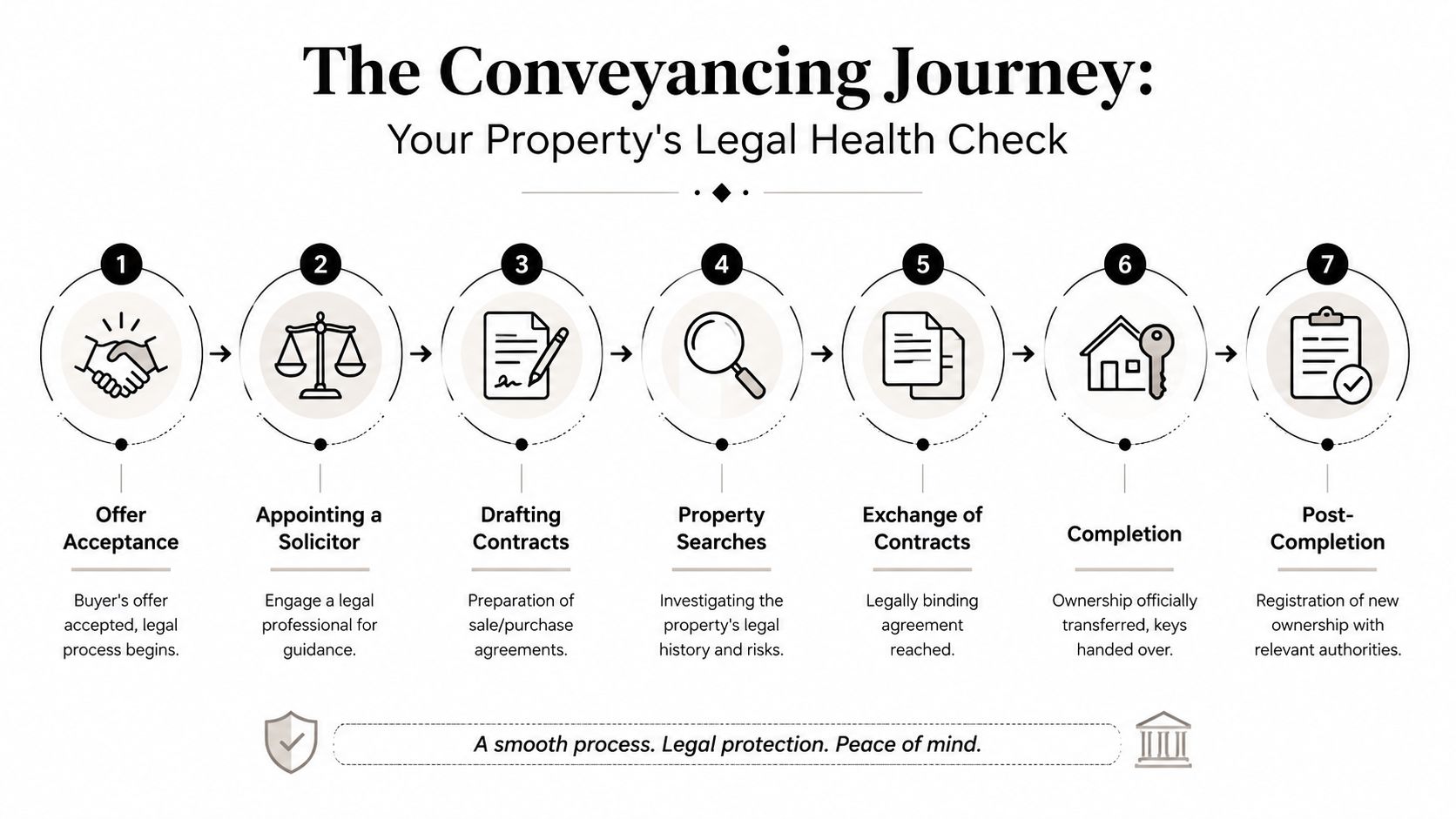
In England and Wales, that work is usually done by a solicitor or a licensed conveyancer. In civil-law markets, a notary can play a much larger role, sometimes handling authentication, completion mechanics, and registration support as part of the local legal system. The job title changes from country to country, but the core purpose stays the same, protecting the buyer from title defects, undisclosed obligations, and registration problems.
The stages that matter
The journey usually starts once the offer is accepted. The legal professional is then instructed, documents are requested, searches are ordered, and the contract pack is reviewed. If the title raises issues, they have to be resolved before exchange or completion.
One part that international buyers often overlook is that property law does not end at the contract. Registration, lender requirements, and title restrictions can create friction after completion too. If a title issue is complicated enough, it can affect refinance, resale, or even later transfer, which is why understanding tax liens on property is a useful habit for buyers who regularly move across jurisdictions.
The best conveyancer is not the one who sounds quickest on the phone. It's the one who spots the issue before it becomes a cost.
For a cross-border transaction, legal competence matters as much as price. Choosing an international real estate lawyer is about knowing who can handle title, tax, lender communication, and local compliance without leaving gaps between jurisdictions.
The point is straightforward. Conveyancing is not paperwork after the deal, it is the deal's legal foundation. When the foundation is weak or incomplete, every later step becomes more expensive.
Deconstructing Your Conveyancing Bill Fees vs Disbursements
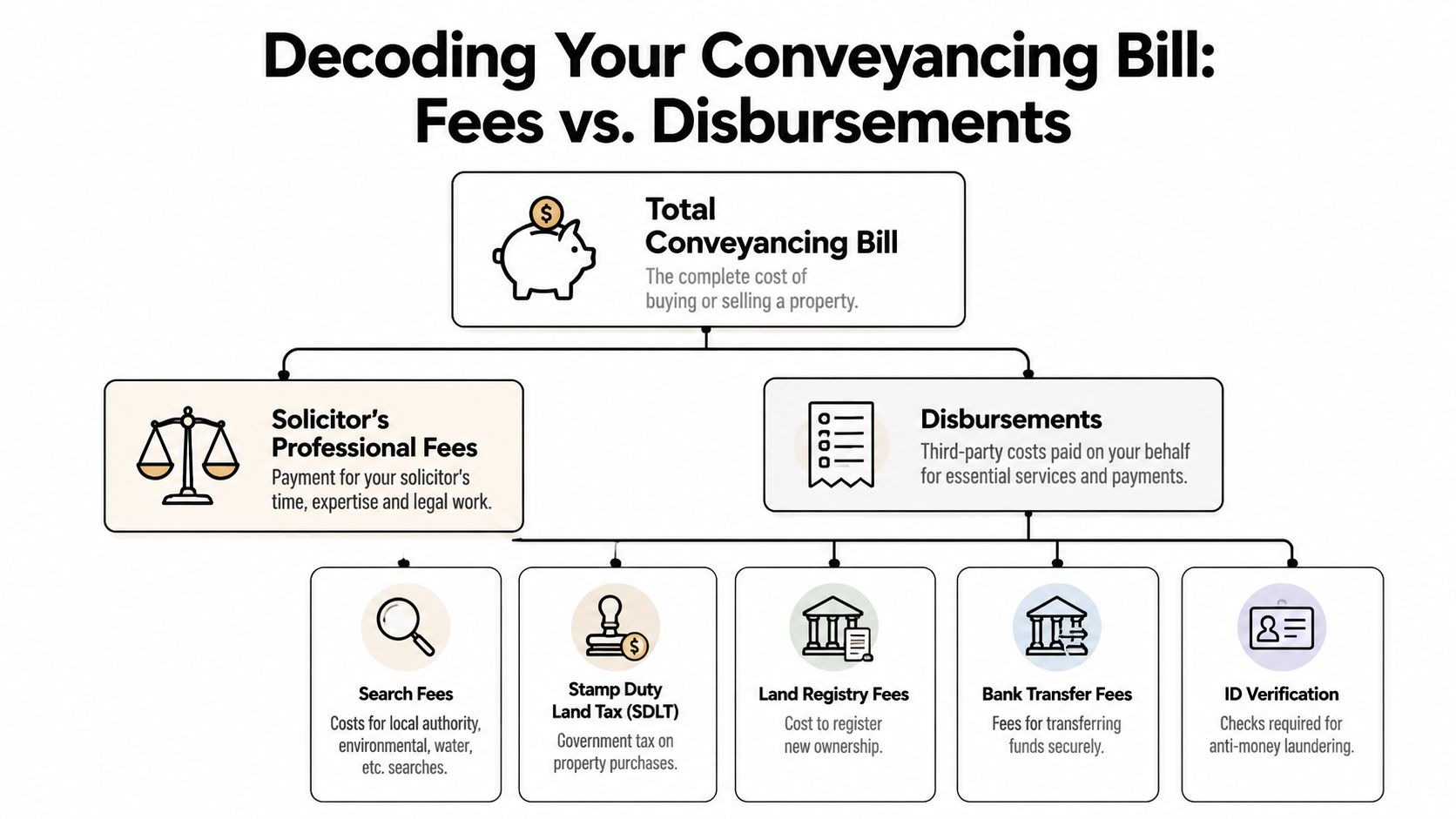
The bill usually splits into two broad buckets, the lawyer's fee and the disbursements. The professional fee pays for legal judgment, document review, negotiation, correspondence, and completion work. Disbursements are the third-party charges the firm pays out on your behalf, then passes through to you.
Professional fees are only part of the story
In 2025/26, professional fees are typically about £600 to £2,000 depending on how complex the transaction is, while disbursements such as searches, Land Registry fees, and identity checks commonly add £270 to £900 on a residential purchase, according to Accounts for Lawyers. If the property is leasehold, the extra legal work can add £200 to £600 more because the lawyer has to review lease terms, management information, and third-party requirements.
That is why comparing fee headlines in isolation is misleading. A firm quoting a low base fee can still be more expensive than a firm quoting a higher inclusive fee if one bundles charges transparently and the other layers them in later.
Leasehold changes the economics
Leasehold is where many investors underestimate the work. In England and Wales, Property Solvers' 2026 survey found average fees of £1,389.87 for a freehold purchase and £1,743.48 for a leasehold purchase, a premium of roughly 25%, according to Property Solvers. That extra cost reflects the realities of lease review, managing-agent liaison, and additional title checks.
For investors buying flats, especially in urban markets, that difference can matter as much as a slight change in mortgage rate. It's not only the amount, it's the timing too, because leasehold enquiries can slow completion and delay rental income.
The hidden pass-through costs
Disbursements are the quiet budget breaker. Searches, transfer fees, registration costs, and ID verification are common, but they aren't always listed with enough clarity. Some quotes also exclude VAT, which creates a misleadingly low starting figure that looks competitive until the final bill arrives.
A practical quote should show each cost line by line. If it doesn't, you don't know whether you are comparing the same service.
This building survey cost guide is useful alongside the legal quote, because the smartest investors budget for legal, survey, and tax costs together rather than in separate silos.
Investor takeaway: the cheapest fee is not the cheapest transaction if it hides the real completion cost.
For buyers looking at the overall bill, the right question is not “what is the solicitor charging?” It's “what will I pay to complete this title cleanly, on time, and without avoidable requisitions?”
Conveyancing Costs Around the World A Comparison
The biggest mistake international investors make is assuming legal transaction costs scale the same way in every market. They don't. Some countries lean heavily on notaries and registration charges, others rely more on solicitor-led due diligence, and some add transfer taxes that dominate the bill.
The UK is a useful baseline because the legal fee itself is only part of the transaction cost. At the national average home price of £267,100, conveyancing fees are roughly £1,200 to £1,500, while at an average London price of £680,000 they rise to about £1,700 for freehold and £1,900 for leasehold, according to Zoopla's fee guide. That shows how higher-value markets carry larger absolute costs even when the legal process is broadly familiar.
A comparative investor view
| Country | Average total cost (% of property value) | Key components |
|---|---|---|
| UK | Moderate, usually below the most tax-heavy markets | Solicitor fee, searches, registration, transfer taxes |
| Spain | Higher than the UK in many purchases | Notary, registry, legal review, transfer taxes |
| Portugal | Typically material for buyers | Legal fees, notary, registration, taxes |
| France | Often structurally higher than common-law markets | Notary-led completion, registration, taxes |
| USA | Varies sharply by state | Title work, escrow, recording, state and local taxes |
| Dubai | Usually lower than tax-heavy European markets, but still transaction-specific | Registration, agent and legal costs |
| Australia | Moderate to significant depending on state | Legal fees, searches, title registration, transfer duty |
The table above is a practical comparison framework, not a fixed tariff sheet. Local tax rules, tenure, lender requirements, and whether you are buying new-build or resale can change the total materially.
Why the totals differ
The structure of the legal system drives much of the price difference. In some markets, the notary is central to completion and registration, which adds a layer of formal cost but can simplify process control. In others, buyer-side legal work is more detailed and more advisory, which means you pay more for investigation and negotiation rather than authentication.
Taxes matter even more. A market can look cheap on legal fees and still be expensive overall once transfer taxes are added. That is why investors should compare total transaction cost, not just the legal line item.
For overseas buyers, the practical benchmark is the all-in acquisition cost as a share of capital deployed. If a market consumes more cash at completion, the rental yield has to work harder to compensate.
This guide to overseas property stamp duty is a useful companion when you are comparing countries with very different transfer-tax regimes.
Budgeting for Conveyancing A Practical Framework
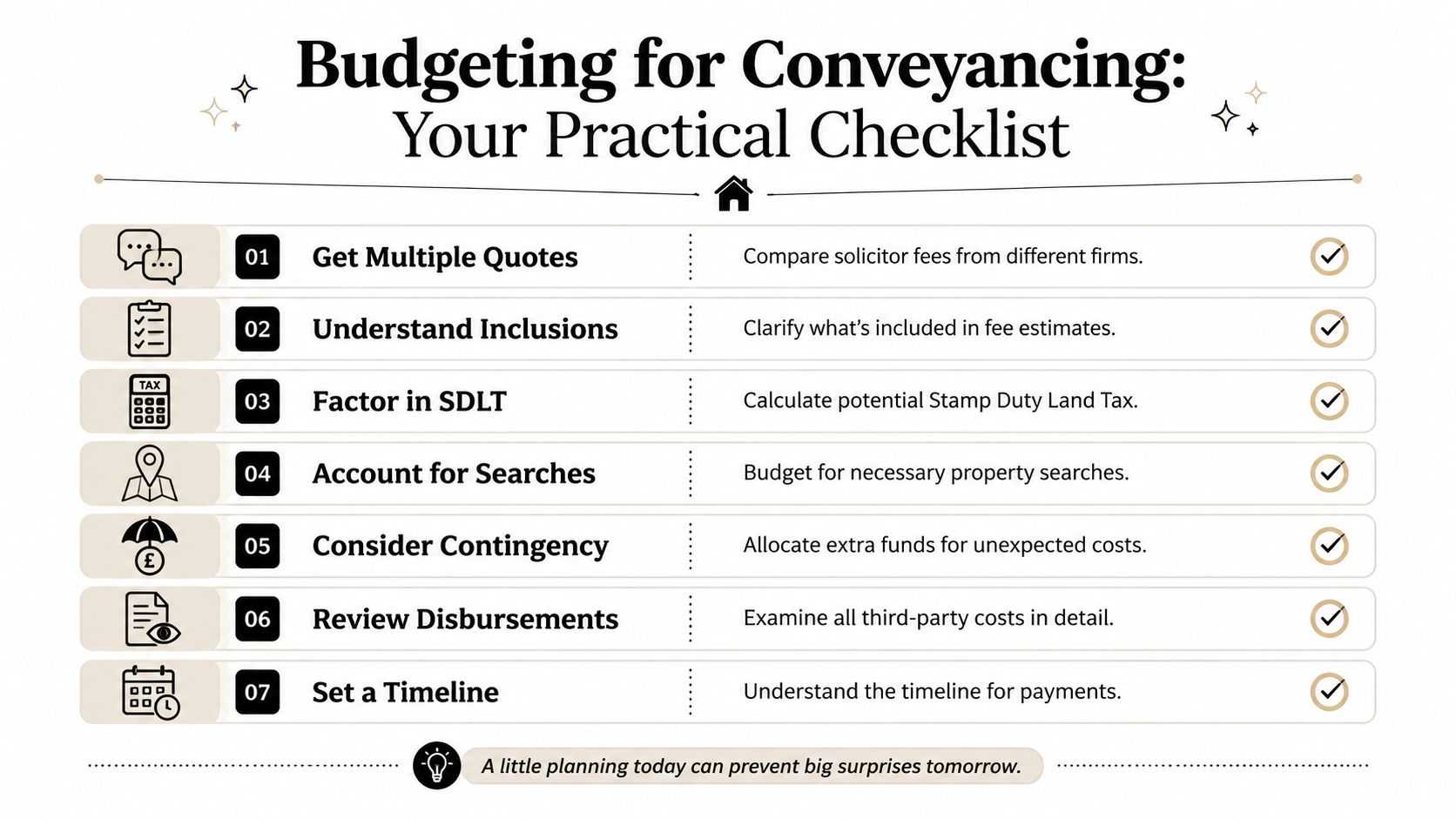
A reliable budget starts with a full quote, not a teaser rate. The quote should separate professional fees, VAT, searches, registration, and any leasehold extras so you can see where the money is going. If the firm cannot explain the bill clearly, it will probably not manage the transaction clearly either.
How to stop a quote from misleading you
The simplest defence is to request an itemised, all-inclusive estimate in writing. Ask whether the figure includes VAT, searches, bank transfer fees, ID checks, leasehold enquiries, and any charge for dealing with the lender. If something is “subject to review”, assume it may rise.
The HomeOwners Alliance notes that some guides quote conveyancing fees from £500 to £1,150, but disbursements can add £700 or more, and the average combined purchase and sale cost in early 2026 was £2,440, according to their fee guide. That gap is exactly why investors should treat headline “from” prices with caution.
A sensible budget should also leave room for the inevitable friction points. Search delays, leasehold document requests, lender follow-up, and AML checks can all increase admin time, even if they don't always increase the base fee.
Budgeting rule: the quote you trust is the one that explains what happens when the transaction gets messy.
A practical budgeting method
Use the quote as your floor, not your ceiling. Then add a contingency for legal and administrative costs, especially if the property is leasehold, newly built, or part of a complex title structure. That extra room matters because international buyers often face more documentation and more follow-up than local cash buyers.
The most effective budgeting habit is to compare the full completion cost against expected rent or resale margin before you commit. If the legal bill meaningfully compresses your return, you may still proceed, but you should do so with eyes open.
For investors, the goal is not to find the cheapest number. It is to find the most honest number.
Your Checklist for Instructing a Conveyancer
The right conveyancer should reduce uncertainty, not create more of it. A low fee means little if the firm has no process for international clients, slow response times, or weak handling of title quirks. When the transaction crosses borders, the questions you ask before instruction matter as much as the quote itself.
The freehold versus leasehold distinction is worth revisiting before you instruct anyone, because the tenure often changes the legal workload more than buyers expect.
Questions worth asking before you sign
- International experience: How often do you act for overseas buyers, and who will handle the file day to day?
- Quote clarity: Does your fee include VAT, searches, ID checks, and lender work, or will those appear later?
- Leasehold handling: If the property is a flat, what extra charges apply for lease review and managing-agent enquiries?
- Communication rhythm: How quickly do you usually reply, and do you offer email, phone, and secure portal updates?
- Insurance cover: What level of professional indemnity insurance do you carry?
- Cross-border knowledge: Are you familiar with foreign-source funds, lender checks, and document verification for non-resident buyers?
- Title issues: How do you deal with restrictive entries, missing documents, or unusual title conditions?
What the answers should tell you
You are looking for more than politeness. You want evidence that the firm understands the pressure points in an international transaction. A good conveyancer should be able to explain the likely process, identify where delays tend to happen, and flag extra work before it becomes a surprise invoice.
If the answers are vague, keep looking. The right adviser will sound specific, because they know exactly where the friction lives.
A competent firm doesn't promise that nothing will go wrong. It shows you how it handles things when they do.
Conclusion Investing with Confidence
A buyer who fixes the offer price but ignores the legal bill can still miss the budget by a wide margin. The practical move is to work from the all-in transaction cost, not the headline solicitor fee. Separate legal fees from disbursements, allow for leasehold add-ons, and compare each market on the same basis, because that is the only way the numbers stay useful.
The key lesson is simple. Property conveyancing costs change by tenure, by market, and by how the quote is built. A London flat, a regional freehold house, and a purchase in a notary-led market overseas all carry different cost patterns, so the right budgeting method changes with the deal.
For international investors, this belongs inside return analysis. If the total completion cost is modelled properly, ROI and yield assumptions are more realistic, capital planning is tighter, and the negotiating position is stronger. It also reduces the risk of treating taxes, searches, lease work, and registry charges as afterthoughts.
If you are comparing countries, deal structures, or solicitor quotes, visit World Property Investor for practical guides that help you budget accurately and invest with more confidence.