
A common failure point for overseas investors appears after the offer is accepted, not before. The purchase price works, the rental appraisal looks fine, and finance is available. Then SDLT has to be funded in cash at completion, and capital that was meant for works, contingency, or the next acquisition is absorbed by tax instead.
That is why a stamp duty on btl calculator belongs at the start of the underwriting process. For a non-UK resident buyer, the distinction is sharper because SDLT is not just a standard additional dwelling cost. Residency status can create a separate surcharge, and that changes the all-in entry price, the expected yield on day one, and the rate at which a portfolio can scale.
Many UK property guides describe buy-to-let SDLT as if every investor faced the same framework. International buyers do not. They may be assessing a UK acquisition against alternatives in Dubai, Singapore, Portugal, or selected US states, where transfer taxes, annual holding costs, and residency rules interact very differently. In that comparison, UK SDLT is not a side issue. It is part of return attribution.
It also affects ownership structuring. A buyer considering a personal acquisition, a company purchase, or a second-home position alongside an existing holding needs to model the tax correctly before committing. The interaction with the UK’s higher rates for additional dwellings is relevant if the investor already owns residential property elsewhere. For context on that wider issue, see our guide to second home tax implications.
A good calculator helps answer a simple portfolio question. How much cash is leaving the deal before the first tenant moves in, and what does that do to net returns? For international investors, that is the right starting point.
Understanding Your Upfront Investment Costs
The most expensive SDLT mistake isn’t overpaying by a small margin. It’s approving the wrong deal because your acquisition model understated the entry cost.
For an international investor, the UK buying process has enough moving parts. Exchange risk, legal fees, mortgage structuring, management costs, and local compliance all compete for attention. SDLT sits at the front of that queue because it’s immediate, cash-funded, and non-trivial.
Why stamp duty changes the deal before the first tenant moves in
Unlike ongoing landlord taxes, SDLT affects your portfolio at the point of purchase. That means it changes:
- Your required cash deposit, because tax must usually be funded alongside acquisition costs
- Your effective entry yield, because the tax increases total capital employed
- Your portfolio pace, because one large SDLT bill can delay the next purchase
- Your exit maths, because higher entry costs raise the return hurdle
Many investors think in terms of purchase price only. Savvy investors think in terms of all-in basis. SDLT is one of the largest reasons those two numbers diverge.
Practical rule: If your model doesn’t include SDLT before you assess yield, you’re not evaluating the investment. You’re evaluating the asking price.
The UK’s surcharge regime has made that distinction unavoidable. Since the 2016 policy shift, serious investors have had to become much more exact about tax modelling. That’s also why buyers comparing a letting asset with a lifestyle purchase need to separate the tax treatment of each. If you’re weighing personal-use ownership alongside investment ownership, the broader second home tax implications are just as important as the rental numbers.
Why calculators now sit at the centre of due diligence
A proper SDLT calculator helps you answer the question that matters most at acquisition stage: how much cash leaves the business on completion, and what does that do to returns?
For UK residents, that’s important. For non-UK residents, it’s essential because the wrong residency assumption can distort the cost base before the asset has generated any income.
The Interactive UK Buy-to-Let Stamp Duty Calculator
Use the calculator before you negotiate, not after. The right sequence is simple: price the property, identify whether the purchase counts as an additional dwelling, check residency status, then review the tax breakdown against your expected yield and financing plan.

What to enter
Most UK buy-to-let calculators ask for three core inputs. The wording varies, but the logic is consistent.
Property purchase price
Enter the agreed price, not your target bid and not a rounded estimate. SDLT is banded, so the exact number matters.Is this an additional property
For most BTL investors, the answer is yes. If you own a dwelling anywhere in the world and you’re buying another residential property in England or Northern Ireland as an investment, that’s the starting position for higher rates.Are you a non-UK resident
Often, buyers make an error here. A domestic calculator can produce a clean answer that still understates your liability if it doesn’t account for the extra non-resident charge where applicable.
What first-time buyer status doesn’t change
A common misunderstanding comes from buyers who are new to property ownership but want their first purchase to be a rental investment. In practice, first-time buyer relief is not the lens to start with for a BTL acquisition. What matters is whether the purchase is an additional residential property and whether non-resident rules apply.
That’s why you shouldn’t rely on a generic homebuyer tool if you’re analysing an investment deal. If you want a broad reference point for how transfer taxes are approached in different markets, this generic stamp duty calculator is useful as a comparative resource, but UK BTL underwriting needs a UK-specific SDLT approach.
How to read the result
A good stamp duty on btl calculator should show more than one total. It should break the tax into layers so you can see what is driving the bill.
Look for:
- The tax by band, so you can verify the progressive calculation
- The additional property element, because that’s the core investor surcharge
- Any non-resident element, if the tool supports it
- The total SDLT due, which must feed into your all-in acquisition cost
If a calculator gives you only a final number with no band-by-band explanation, treat it as a rough guide, not a filing tool.
How to use the output in your deal model
Once you have the SDLT estimate, feed it straight into your acquisition spreadsheet. Then test:
- Cashflow resilience if borrowing costs rise
- Net yield sensitivity after all entry costs
- ROI timing based on refurbishment, letting period, and expected stabilisation
- Opportunity cost versus deploying that same capital into a different market or a second smaller UK asset
If you’re still at the early filtering stage, pair the SDLT result with a rental yield calculator before you spend time on deeper due diligence. That combination tells you quickly whether the property deserves more work.
Deconstructing UK Stamp Duty for Property Investors
A Singapore-based investor agrees a £400,000 buy-to-let purchase in Manchester, then discovers at exchange that the tax bill is higher than the domestic figure used in the original model. That error does not change rental demand or mortgage pricing, but it does cut day-one liquidity and lowers projected equity returns.
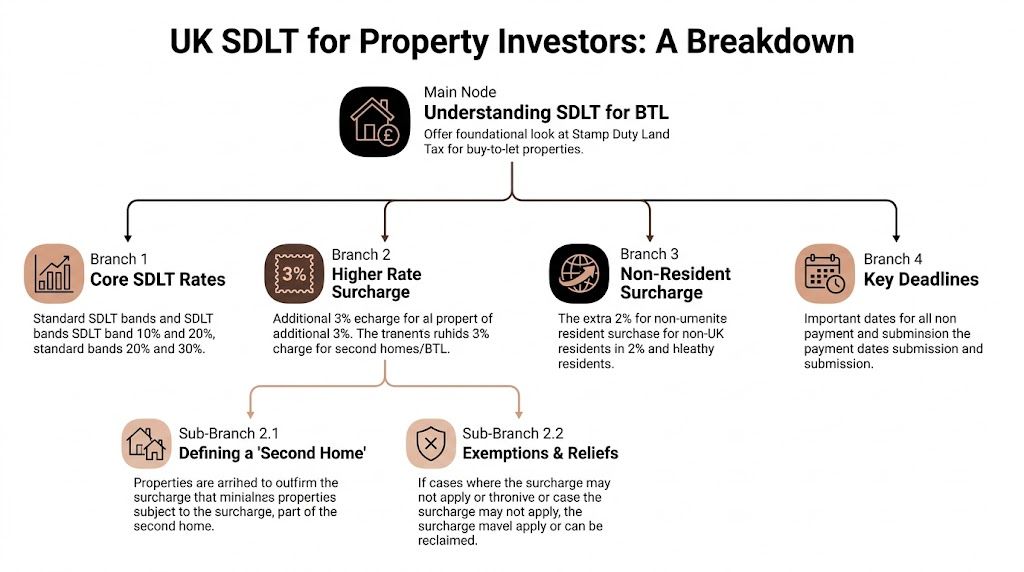
SDLT in England and Northern Ireland works on a progressive basis. Different portions of the purchase price are taxed at different rates. For overseas investors, the calculation becomes more sensitive because the answer depends not only on price, but also on whether the asset counts as an additional dwelling and whether the buyer meets the SDLT non-residence test.
The core structure
Three questions determine most investor SDLT outcomes:
- Is the property in England or Northern Ireland?
- Is it an additional residential property?
- Is the buyer a non-UK resident for SDLT purposes?
The jurisdiction point comes first because Scotland and Wales do not use SDLT. They operate different taxes, with different bands and different reliefs. This distinction matters when comparing Manchester with Cardiff, or Edinburgh with Birmingham, because the tax mechanics are not interchangeable.
The second question drives the higher-rate treatment that usually applies to investment acquisitions. If you need to distinguish an investment purchase from owner-occupation for tax and lending purposes, this explanation of the buy-to-let definition is a useful starting point.
Current buy-to-let rates in England and Northern Ireland
From 1 April 2025, higher rates for additional dwellings add 5 percentage points to the standard residential SDLT bands, as set out in the Gov.uk guidance on residential property rates. For a standard buy-to-let purchase, that produces these effective rates:
| Property Value Bracket | Standard Residential Rate | Buy-to-Let / Second Home Rate |
|---|---|---|
| Up to £125,000 | 0% | 5% |
| £125,001 to £250,000 | 2% | 7% |
| £250,001 to £925,000 | 5% | 10% |
| £925,001 to £1.5 million | 10% | 15% |
| Above £1.5 million | 12% | 17% |
The rates are progressive. On a £400,000 purchase, only the slice above £250,000 is taxed at 10%. The lower slices remain in the 5% and 7% bands.
For investors used to flat transfer taxes in other markets, that matters. UK entry tax does not rise in a straight line, so small changes in purchase price near a band threshold can alter cash required at completion without changing the underlying investment thesis.
What the surcharge does to capital outlay
The higher-rate surcharge has a direct effect on deployable capital. A buy-to-let buyer at £400,000 pays more SDLT than an owner-occupier at the same price under the same residential rate structure on Gov.uk. The gap is not an accounting detail. It is cash that cannot be used for refurbishment, vacancy reserves, debt reduction, or a second acquisition.
That is one reason overseas investors should model SDLT at portfolio level, not just deal level. If an investor acquires several lower-value regional assets rather than one prime London unit, the aggregate SDLT cost can absorb a meaningful share of equity capital, especially where each purchase attracts higher rates.
On an international portfolio model, SDLT functions as immediate basis cost. It reduces initial cash-on-cash return until rent growth or capital appreciation offsets the entry tax.
The non-resident complication
Non-UK residents can face a further 2 percentage point surcharge in the circumstances covered by HMRC’s rules on non-UK resident SDLT rates for residential property. On this point, many generic calculators fall short. Some tools calculate only the additional dwelling surcharge and omit the residency layer entirely.
For an international investor, that omission can distort underwriting in two ways. First, it understates completion cash. Second, it inflates projected return on equity because the denominator is wrong from day one.
The residency test itself also needs care. It is not enough to assume that holding through a company or using a UK managing agent removes the issue. SDLT residence is determined under specific statutory rules, and those rules should be checked before exchange.
England and Northern Ireland are not the whole UK
A common error in cross-border acquisitions is treating “UK stamp duty” as a single national tax. It is not.
- England and Northern Ireland use SDLT
- Wales uses LTT
- Scotland uses LBTT
That creates a practical screening issue for global investors. A city-by-city comparison of gross yield is incomplete if transfer taxes sit on different legal frameworks. Cardiff and Glasgow may offer attractive income metrics, but the acquisition tax analysis must be rebuilt for the local regime rather than copied from an England-based SDLT calculator.
Why the calculator still needs human review
A calculator can process rates accurately once the facts are correct. It cannot reliably classify the transaction facts for you.
That matters in cases involving mixed-use treatment, replacement of a main residence, multiple dwellings, linked transactions, or uncertain residence status. Experienced investors usually get the arithmetic from the tool, then verify the legal assumptions separately before committing capital.
Worked Examples Across Different Investment Scenarios
A Singapore-based investor and a UK-based investor can agree the same purchase price for the same rental property and still face different completion cash requirements. That difference matters because SDLT is paid upfront, before the asset produces any income, and it changes the amount of capital left for refurbishment, debt service buffers, or the next acquisition.

Scenario one. UK resident buying a London flat
A UK-resident investor acquires a London flat for £295,000 as an additional residential property.
Using the residential surcharge bands already outlined earlier in the article, the SDLT works progressively across the price slices. On that basis, the tax bill comes to about £20,450.
That is a meaningful entry cost relative to the equity many landlords deploy on a mid-market flat. If the investor planned a 25% deposit, SDLT would absorb a large part of the initial cash commitment on top of legal fees, valuation costs, and any immediate works. The effect is simple. The property needs either stronger rent, faster capital growth, or a longer hold period to reach the same target return.
Scenario two. Non-resident investor buying in Manchester
A non-UK resident buyer acquires a Manchester buy-to-let for £400,000.
The domestic additional-property SDLT charge is substantial at this level. If the buyer also falls within the non-resident rules, the surcharge increases the upfront tax further. For an overseas investor, that extra amount does not improve rent, reduce void risk, or increase resale value. It raises the capital tied up on day one. International comparisons often go wrong at this point. An investor may compare Manchester’s gross yield with yields in Dubai, Lisbon, or Atlanta and conclude that the UK asset screens well. The more relevant comparison is net capital efficiency after entry taxes. If two markets offer similar income but one requires more dead capital at completion, the reinvestment timeline changes across the whole portfolio.
Scenario three. Portfolio buyer using a company structure
An experienced investor buys a £600,000 residential buy-to-let through a limited company.
The progressive calculation set out in the methodology published by Landlord Studio gives £12,500 on the first £250,000 and £35,000 on the remaining £350,000. Total SDLT is £47,500.
The company wrapper does not remove SDLT. It changes ownership and tax planning elsewhere, but the acquisition tax still has to be funded in cash at completion. For portfolio buyers, that creates a sequencing issue. A large SDLT bill on asset one can delay asset two, even if the lender remains willing to advance funds.
For that reason, serious buyers model SDLT into total acquisition basis rather than treating it as an incidental fee. The cleaner approach is to include it in your entry cost and test returns against the fully loaded cash outlay using a framework such as this guide on how to calculate return on investment property.
Scenario four. Mixed-use purchase with a different tax outcome
A buyer acquires a £600,000 property that includes both residential and commercial elements.
If the facts support mixed-use treatment, the SDLT result can differ significantly from a standard residential buy-to-let purchase. The same price point that produced £47,500 in the previous example may fall much lower under non-residential rates. The legal classification drives the outcome.
That changes the investment case in several ways:
- Lower transaction tax, if the property qualifies for mixed-use treatment
- Different underwriting assumptions, because value may come from reconfiguration rather than straightforward rental income
- Different finance terms, since some lenders treat commercial exposure differently
- Higher execution risk, because an incorrect classification can be expensive to unwind later
For overseas investors, mixed-use assets can look attractive because they may reduce upfront tax drag. The trade-off is complexity. Lower SDLT is only beneficial if the asset still fits the financing, management, and exit profile of the wider portfolio.
What the examples show
The purchase price is one variable. SDLT also depends on residency, ownership profile, and asset classification.
That matters more for non-UK residents than many standard guides suggest. A domestic investor may view SDLT as a large but contained entry cost on a single deal. An international investor has to judge the same tax as part of a broader capital allocation decision across jurisdictions, currencies, and acquisition pipelines.
Common calculation errors investors still make
The errors are usually in the assumptions, not the arithmetic:
- Using an England and Northern Ireland SDLT output for a property in Wales or Scotland
- Applying one rate to the full purchase price instead of using progressive bands
- Ignoring non-resident status and understating completion cash
- Assuming a company purchase avoids the higher residential rates
- Treating a mixed-use asset as if it were ordinary residential buy-to-let without checking the facts
A calculator is useful for initial screening. Portfolio decisions need a more exact reading of the transaction facts, especially where non-UK residence or unusual property use can shift the tax result.
Strategic Tax Considerations for Global Investors
A Singapore-based investor exchanges on a £1 million London flat, expecting SDLT to be a large but manageable line item. At completion, the non-UK resident surcharge adds another £20,000. That sum does nothing for rental income, debt service coverage, or resale value. It raises the amount of capital tied up on day one.
A single-property calculator output is the starting point. International investors need to test SDLT at portfolio level, because the tax affects acquisition pacing, target returns, and how UK allocations compare with other markets competing for the same capital.

Non-resident surcharge and capital efficiency
For residential buy-to-let purchases in England and Northern Ireland, non-UK residents can face a 2% SDLT surcharge on top of the standard rates and the higher rates for additional dwellings, based on the rules set out by Gov.uk. On higher-value purchases, that materially increases entry cost. On a £1 million acquisition, the surcharge alone adds £20,000.
The financial effect is straightforward. More equity is trapped at completion, the payback period on acquisition costs lengthens, and the hurdle rate for the investment rises.
This matters more in a multi-asset strategy. If an overseas investor plans to buy three or four UK properties over a cycle, repeated SDLT charges can reduce how quickly capital is recycled into the next purchase. The result is lower portfolio agility, especially where exchange rates or debt pricing are moving against the investor.
Cross-border market comparison
International buyers rarely assess the UK in isolation. They compare it with markets such as Spain, Portugal, the UAE, or their domestic market, where acquisition taxes, legal certainty, financing depth, and landlord regulation differ significantly.
The relevant comparison is not headline tax alone. It is net return after entry costs, financing, void risk, compliance friction, and exit tax. A market with lower transfer taxes can still produce weaker portfolio outcomes if enforcement is inconsistent, financial backing is scarce, or tenant law limits income recovery. By contrast, the UK often retains appeal because legal title, lender processes, and rental demand are easier to assess, even when SDLT is expensive.
That trade-off deserves explicit modelling, not intuition. Tax-Compass is one example of a specialist resource investors use when comparing cross-border tax exposure alongside UK acquisition costs.
Holding period decides how painful SDLT is
High SDLT can be absorbed over time, but only if the asset produces durable income and the business plan is long enough for the upfront tax to dilute across several years of returns.
The pressure is greatest in three situations:
- Low-yield assets, where rent takes longer to recover acquisition costs
- Short holding periods, where sale proceeds must cover a large unrecovered tax outlay
- Refinance-led strategies, where investors expect early balance-sheet flexibility after purchase
For non-UK residents, this often changes asset selection. A prime flat with modest yield may still work for wealth preservation. It is less persuasive for income-focused investors who need the property to clear a higher effective entry hurdle than a UK-resident buyer would face.
SDLT should be analysed with the exit, not before it
Acquisition tax is only one side of the return calculation. Disposal taxes, remittance rules in the investor's home jurisdiction, and reporting obligations can alter the true after-tax outcome just as much as SDLT does at purchase.
That is why experienced investors model entry and exit together. If you hold assets across several countries, the wider issue is not only what SDLT costs today, but how UK profits and gains interact with the rest of your tax position. This overview of capital gains tax on foreign property is a useful starting point for that broader analysis.
Beyond the Calculator When to Seek Professional Advice
A calculator helps you price a straightforward purchase. Cross-border investors rarely have straightforward purchases.
The gap usually appears where SDLT depends on legal characterisation rather than a simple purchase price. Gov.uk rate tables are clear on the tax bands, but they do not decide whether a property is mixed-use, whether Multiple Dwellings Relief is in point, or whether a buyer meets the non-UK resident tests at the effective date of transaction. For an overseas investor acquiring through a company, trust, or family structure, those questions can change the cash required at completion and the projected return on equity.
Mixed-use is the clearest example. If part of the asset is non-residential, SDLT can fall materially compared with a standard residential buy-to-let outcome. The difference is large enough to affect bid discipline, debt sizing, and whether the deal still meets the portfolio hurdle rate after tax. A calculator cannot verify the facts. Your solicitor and tax adviser need to.
Situations where advice usually pays for itself
Professional input is most useful where the SDLT answer depends on evidence, timing, or structure rather than arithmetic:
- Mixed-use classification. Shops with flats above, semi-commercial blocks, land with operational use, or properties with storage and office space need careful analysis against HMRC practice.
- Portfolio and multiple dwelling acquisitions. Relief claims, allocation of consideration, and transaction sequencing can alter the SDLT result across the whole purchase, not just one unit.
- Non-UK resident surcharge questions. The surcharge can turn on day-count facts and completion timing. International investors close to the statutory thresholds should test residency early, using the rules set out on Gov.uk.
- Replacement of a main residence. Refund eligibility and surcharge treatment often depend on exact chronology and beneficial ownership.
- Company, trust, or family office structures. The ownership vehicle may suit governance or succession planning, but the SDLT position still needs to be examined alongside ATED, corporation tax, and home-jurisdiction reporting.
- Connected-party transfers or restructurings. Market value rules can apply even where the cash price is low or nil.
For non-UK residents, the commercial point is simple. An SDLT error is not only a filing issue. It changes the amount of capital trapped on day one, and that affects capital efficiency across the wider portfolio.
Advice should therefore be judged against the downside it removes. Overpaying SDLT reduces net yield immediately. Underpaying can lead to interest, penalties, delayed refinancing, and extra diligence on a later sale. In a multi-country portfolio, that friction matters because UK acquisition costs are high relative to many other markets, particularly once the additional property rates and non-resident surcharge are layered in.
A useful adviser does more than confirm the number. They test the facts, document the filing position, and show how the SDLT treatment interacts with the investor's holding structure and exit plan. If you want a starting point for specialist UK tax support, Tax-Compass is one resource to review alongside your conveyancer and transaction adviser.
Use calculators to screen deals. Use advisers where classification, residency, or structure can change the post-tax return.