
Ask any seasoned property investor "what is a good rental yield?", and they will likely tell you it depends. While a gross yield in the UK of between 5% and 8% is often considered a healthy target, that figure means very little without context.
A good yield is contingent on your investment strategy, appetite for risk and, most importantly, the property's location and local market fundamentals.
What Exactly is Rental Yield?
Rental yield is a performance metric that measures your annual rental income as a percentage of your property's value. It shows how effectively your asset is generating income, before factoring in capital growth.
For a global investor, understanding yield is the first step towards making a sound, data-led decision. If you are just starting out, our beginner's guide to real estate investing covers more of these foundational concepts.
Yield is typically calculated in two ways:
- Gross Yield: This is the high-level calculation. It is your total annual rent divided by the property's purchase price, offering a quick method to compare different properties or areas.
- Net Yield: This is the more accurate measure. Net yield accounts for all operational costs of owning a rental property—such as maintenance, insurance, letting agent fees, and potential void periods. It reveals your true pre-tax profit.
The Inverse Relationship Between Price and Yield
A fundamental principle for investors to grasp is the inverse link between property prices and rental yields. Where property values are high, even a substantial rental income can produce a modest yield. Conversely, lower-priced properties can generate impressive yields from moderate rents.
This explains why certain UK regions consistently outperform others on this metric. According to government data from the Office for National Statistics (ONS), London commands the highest rents in the country, but its exceptionally high property prices suppress its average yields.
In contrast, regions like the North East of England often deliver stronger rental yields due to more accessible purchase prices, making them attractive to income-focused investors.
A good rental yield is a reflection of a balance between rental income, property value, and local market strength. A figure that signals a prime investment in Manchester would be an unrealistic expectation in central London, highlighting the critical importance of regional context.
Setting Realistic Expectations: Established vs. Emerging Markets
For global investors assessing the UK market, it is crucial to look beyond a single headline figure. The distinction between established and emerging markets is key.
A property in an emerging area might offer a headline-grabbing yield of 9%, but this could be accompanied by higher risks, such as economic volatility or less predictable tenant demand. An established market like London might only offer 3-4%, but investors are buying into the security of strong capital growth potential and a deep, resilient rental market.
Ultimately, your own investment goals determine what "good" truly means.
How To Calculate Your True Rental Yield
To determine if a rental yield is genuinely good, you must move beyond headline figures and calculate the real return. While a gross yield provides a quick comparison, it is the net yield and cash-on-cash return that truly reveal an investment's financial performance.
Mastering these three simple calculations is fundamental for any serious investor.
This simple visualisation shows the relationship between a property's price, the rent it generates, and the resulting yield.
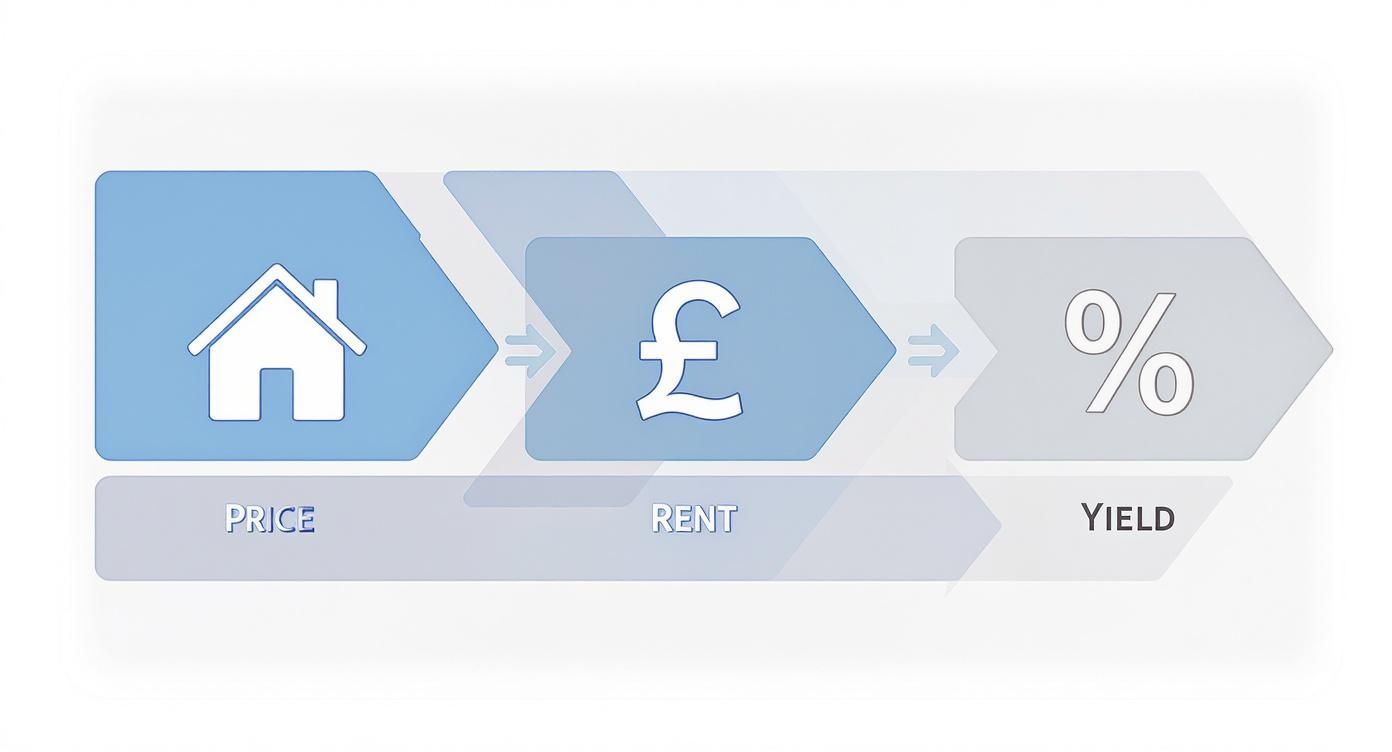
As you can see, the final yield percentage is a direct result of the interplay between the purchase price and the annual rent it can command.
Gross Yield: The Starting Point
Gross yield is the most straightforward metric, offering an initial snapshot of a property's potential. However, it is a blunt instrument.
Because it ignores all operational costs, it is only useful for initial, high-level comparisons between different properties or cities. It is not the figure upon which to base a final investment decision.
The formula is simple:
(Annual Rental Income / Property Value) x 100 = Gross Yield %
For example, a flat in Liverpool is purchased for £200,000. It rents for £1,000 a month, generating an annual income of £12,000.
The calculation is: (£12,000 / £200,000) x 100 = 6.0% Gross Yield. This is a solid starting figure, but it does not tell the whole story.
Net Yield: The Realistic Return
Net yield provides a far more accurate picture of profitability by subtracting all expenses associated with owning and managing a rental property. This figure reflects your true pre-tax income.
The formula factors in these essential costs:
((Annual Rental Income – Annual Operating Costs) / Property Value) x 100 = Net Yield %
These operating costs are crucial and can significantly reduce your headline yield. They must be accounted for. Common expenses include:
- Letting Agent Fees: Typically 8-12% of monthly rent.
- Landlord Insurance: Essential cover for the building and liability.
- Maintenance and Repairs: Prudent investors budget around 1% of the property’s value annually for upkeep.
- Void Periods: A buffer for when the property is empty. One month's rent per year is a safe estimate.
- Service Charges and Ground Rent: Standard costs for leasehold properties.
Applying these to our Liverpool flat example, we can estimate annual costs:
- Letting Agent Fees (10%): £1,200
- Insurance: £300
- Maintenance Fund: £1,000
- Void Period (2 weeks): £500
- Total Annual Costs: £3,000
The net yield calculation is now: ((£12,000 – £3,000) / £200,000) x 100 = 4.5% Net Yield.
Suddenly, that 6% gross yield looks very different. This is why net yield is the metric that truly matters for understanding a property's income potential.
| Metric | Calculation/Value (Gross) | Calculation/Value (Net) |
|---|---|---|
| Annual Rental Income | £12,000 | £12,000 |
| Annual Operating Costs | £0 (ignored) | £3,000 |
| Net Rental Income | £12,000 | £9,000 |
| Property Value | £200,000 | £200,000 |
| Calculation | (£12,000 / £200,000) x 100 | (£9,000 / £200,000) x 100 |
| Final Yield | 6.0% | 4.5% |
This comparison demonstrates why relying on gross yield alone is a fundamental error. Real-world costs reduce the return significantly, providing a much more sober and realistic forecast.
Cash-on-Cash Return: The Leveraged Metric
For any investor using a mortgage, the cash-on-cash return is arguably the most important metric. It measures the return specifically on the actual capital you have invested, not the property's total value.
This calculation reveals how hard your deposit and other upfront costs are truly working for you.
The formula is:
(Annual Pre-Tax Cash Flow / Total Cash Invested) x 100 = Cash-on-Cash Return %
Building on our Liverpool flat example: it was purchased for £200,000 with a £50,000 deposit (a 75% loan-to-value mortgage). Other initial costs, such as Stamp Duty and legal fees, totalled £7,000.
Therefore, your Total Cash Invested is £57,000.
Your annual mortgage payments on the £150,000 loan at a 4.5% interest-only rate are £6,750.
Your annual pre-tax cash flow is your net rental income minus mortgage payments: £9,000 (Net Income) – £6,750 (Mortgage) = £2,250.
Finally, your cash-on-cash return is: (£2,250 / £57,000) x 100 = 3.95%. This is your true return on the capital you have personally deployed.
For a deeper analysis of this and other key metrics, you can learn more about how to calculate return on investment (ROI) for real estate in our detailed guide.
Regional Yields and Property Type Benchmarks
Calculating a yield is one thing; understanding what constitutes a good one in practice is another. A yield considered exceptional in one city might be average in another, making location-specific benchmarks essential for any serious investor.

It is a mistake to view the UK property market as a single entity. It is a collection of distinct regional markets, each with its own economic drivers, tenant demographics, and balance between property prices and rental income. This directly shapes the returns an investor can expect.
Established Versus Emerging Markets
The fundamental trade-off in UK property investment often comes down to a choice between the established, high-value markets of London and the South East, and the high-yield potential found in cities across the North and the Midlands.
- London and the South East: Characterised by exceptionally high property prices, this region typically offers lower rental yields, often in the 3-4% range. Investors here are generally focused on long-term stability and the potential for strong capital appreciation.
- Northern Cities (e.g., Manchester, Liverpool, Leeds): These areas present a more balanced profile. With lower entry prices and strong rental demand from students and young professionals, gross yields frequently sit in the 6-8% range, making them a prime target for investors prioritising cash flow.
Data from sources such as the HomeLet Rental Index and property portals consistently shows this regional divergence. For example, some postcodes in cities like Liverpool, Glasgow, and Newcastle regularly report yields above 7%, while prime central London postcodes struggle to exceed 3.5%.
How Property Type Shapes Your Return
Beyond geography, the type of property you invest in has a significant impact on your potential return. A standard two-bedroom flat will perform differently from a specialist asset like student accommodation. A critical step is identifying which of the best buy-to-let locations are a good fit for your chosen property type.
A key takeaway for investors is that higher yields almost always correlate with higher management intensity. The question is not just "what is a good rental yield?" but "how much active management am I prepared to undertake to achieve it?"
Let's compare two common property types.
Standard Two-Bedroom Flat
A typical buy-to-let investment, this asset is relatively straightforward to manage and appeals to a broad tenant base.
- Typical Gross Yield: 5-7% in regional cities.
- Management Intensity: Low to moderate.
- Risks: Susceptible to general market fluctuations and void periods.
House in Multiple Occupation (HMO)
An HMO is a property rented out by at least three people from more than one household who share facilities. They are common in university cities.
- Typical Gross Yield: 8-12% or higher.
- Management Intensity: High. HMOs require specialist licensing, stricter safety regulations, and more active management of multiple tenancies.
- Risks: Higher tenant turnover, increased wear and tear, and complex regulatory hurdles.
Choosing the right property type and location is about aligning the investment's characteristics with your personal goals. For strong monthly income, an HMO in a university city could be an excellent choice. For a more passive investment balancing income and growth, a traditional flat may be a better fit.
More Than a Number: What a Yield Figure Really Tells You
A strong net yield is an excellent starting point, but it is far from the whole story. A headline percentage on its own does not make a good investment; it is a single data point in a much larger picture. To truly understand if a rental yield is ‘good’, you must interpret it in the context of your strategy, the local market, and the balance between income and growth.
For most investors, the decision comes down to a trade-off: immediate cash flow (high yield) or long-term wealth creation (capital growth). These two goals often pull in opposite directions.
The Trade-Off Between Yield and Capital Growth
A flat in a prime central London location might offer a net yield of only 3-4%. On paper, this seems less appealing than a property in a northern city boasting a 7% net yield.
However, the London asset is prized for its potential for strong, stable capital growth over decades, driven by global demand and chronic undersupply. The lower yield is the price of perceived security and long-term appreciation.
Conversely, the high-yield property provides excellent monthly income, perfect for investors needing positive cash flow from day one. Its potential for rapid capital growth, however, may be less certain than in an established prime market. There is no right or wrong answer; the ‘better’ investment is the one that aligns with your strategy.
An unusually high rental yield, particularly one above 10%, should be met with caution. It can often be a red flag for underlying risks, such as a declining neighbourhood, a property requiring significant capital expenditure, or volatile tenant demand.
Looking Past the Percentage to Market Fundamentals
A yield figure is static; the property market is not. To make an informed decision, you must investigate the local economic landscape that underpins that yield. Ask critical questions about what will sustain—and grow—your rental income long-term.
Key factors to analyse include:
- The Local Economy: Is the area supported by a diverse range of industries and a growing job market? The presence of major employers, universities, or significant infrastructure projects signals future stability and rental demand.
- Target Tenant Profile: Who are you renting to? Students, young professionals, and families have different needs and levels of reliability. A stable tenant base is the best defence against costly void periods.
- Future Development: Investigate local council plans. Are regeneration projects on the horizon that could boost property values? Conversely, are large new housing developments planned that could flood the rental market and suppress rents?
Official ONS data shows that UK private rental prices have been rising steadily. This rental growth, when combined with more modest house price inflation, can shift yield dynamics quickly. This highlights the need to view any yield figure in the context of a fast-changing market. Discover more insights about the UK residential rental market on Statista.com.
Ultimately, a truly ‘good’ rental yield is one that is not just profitable today but is sustainable for the future—backed by solid economic fundamentals that will protect your investment for years to come.
How Tax And Regulations Affect Your Real Return
Calculating your net yield is a crucial step, but it only gets you halfway to understanding your investment's true profitability. The final deductions come from the tax authorities. A yield that looks excellent on paper can shrink dramatically once tax is applied, making this a critical part of your financial modelling.
For global investors, understanding the UK's property tax landscape is fundamental. The only figure that truly matters is your post-tax return.
The Impact Of Income Tax On Rental Profits
In the UK, profit from renting property is treated as taxable income. It is added to your other earnings to determine your income tax band. For the 2024/2025 tax year, the rates are 20% (basic rate), 40% (higher rate), and 45% (additional rate).
This means a landlord in a higher tax bracket will retain significantly less of their rental profit than someone in a lower one, even with identical net yields. Your personal tax situation directly shapes an investment's viability.
A significant recent change for individual landlords is the restriction on mortgage interest relief, known as 'Section 24'. Previously, all mortgage interest could be deducted from rental income before calculating tax.
Now, this relief is capped at a 20% tax credit on mortgage interest payments. This change severely impacts higher-rate (40%) and additional-rate (45%) taxpayers, increasing their tax liability and reducing their final returns.
Capital Taxes And Transaction Costs
Beyond annual income tax, investors must plan for significant one-off taxes that impact the overall return on investment.
Three key taxes to consider are:
- Stamp Duty Land Tax (SDLT): This is paid when buying a property in England and Northern Ireland. Investors buying a second home or buy-to-let property must pay a 3% surcharge on top of standard SDLT rates.
- Capital Gains Tax (CGT): When an investment property is sold, CGT is payable on the profit from its increase in value. For residential property, higher-rate taxpayers currently pay 24% on gains.
- Corporation Tax: Many investors purchase property through a limited company. This can mitigate the Section 24 mortgage relief restrictions, as companies can still deduct finance costs as a business expense. However, the company’s profits are subject to Corporation Tax, which currently stands at 25%.
These liabilities are complex. You can understand property taxes in much more detail with our comprehensive guide. A 'good' rental yield is one that remains strong after all these unavoidable deductions have been accounted for.
Bringing It All Together: A Framework for Good Decisions
Understanding rental yield is about building a reliable framework to assess any potential investment with clarity. The core lesson is that there is no universal "good" rental yield. The right figure is always relative to your financial strategy.
An investor seeking immediate, predictable monthly income will naturally target higher-yield properties. This might mean focusing on northern UK cities where lower purchase prices make yields of 6-8% achievable. In contrast, an investor focused on long-term wealth creation through capital growth might be satisfied with a 3-4% yield in a prime London borough, relying on the property’s value appreciation over time.
Your Actionable Investment Checklist
To properly assess an opportunity, look past the headline gross yield figure often advertised by agents. A prudent investor’s analysis always centres on the metrics that reflect real-world profit.
Prioritise net yield to see what you will actually earn after all operational costs are paid. If you are using a mortgage, the cash-on-cash return is even more important, as it reveals how hard your own invested capital is working. These numbers provide an honest financial picture. You can sharpen these skills by learning how to determine a property's investment potential with our in-depth guide.
A successful investment is built on thorough due diligence, not just a promising headline yield. A realistic, well-researched return, backed by solid market fundamentals, is the cornerstone of a profitable property portfolio.
Consolidating Your Knowledge
Ultimately, your framework must connect the numbers with the on-the-ground reality. A good rental yield is one that is sustainable, supported by a strong local economy, consistent tenant demand, and a clear-eyed view of the risks involved.
Always investigate the fundamentals:
- Location Due Diligence: What are the local employment rates, infrastructure projects, and population trends? Is the area growing or stagnating?
- Property Type Suitability: Does the property match the local tenant demographic? Is it geared towards students, young professionals, or families?
- Full Cost Accounting: Have you factored in everything? From initial stamp duty and legal fees to ongoing maintenance, taxes, and potential void periods.
By combining meticulous financial analysis with a deep understanding of the market, you move from being a hopeful buyer to a strategic investor. This approach empowers you to look beyond a simple percentage and confidently identify investments that align with your long-term goals.
Common Questions About Rental Yield
Even with a firm grasp of the calculations, practical questions often arise. Here are clear answers to the queries we hear most often from investors.
Is a 4% Rental Yield Too Low for a UK Property?
A 4% net yield is not inherently bad, but its suitability depends entirely on your strategy and the property's location. The key question is: what is the primary objective of this investment?
In a prime market like central London or Cambridge, a 4% yield can be acceptable. Here, the investment case is heavily weighted towards long-term capital growth. For investors focused on wealth preservation and appreciation, this lower income return is a reasonable trade-off.
However, in a regional city where yields of 6-7% are the norm, that same 4% is unlikely to be sufficient for an investor seeking monthly cash flow. After mortgage payments, taxes, and running costs, there may be little to no profit remaining.
How Can I Increase My Property's Rental Yield?
Boosting your yield involves two primary levers: increasing rental income or reducing operating costs.
Here are some practical methods:
- Add Tangible Value: Refurbishing a dated property can significantly increase its rental value. A modern kitchen, an updated bathroom, or even adding a bedroom via a loft conversion can command a higher rent.
- Consider Specialist Lets: Converting a property into a House in Multiple Occupation (HMO) can dramatically increase rental income. This requires more management and navigating local authority licensing, but it is a proven route to double-digit gross yields.
- Manage Costs Efficiently: This is a key discipline of professional investors. Regularly review your buy-to-let mortgage to secure a better rate, shop around for landlord insurance, and focus on retaining good tenants to minimise costly void periods. Every pound saved drops directly to your bottom line.
Does Rental Yield Include Capital Growth?
No, and this is a crucial distinction. Rental yield is purely a measure of income return. It shows how the property is performing today based on the rent it generates. It completely ignores any change in the property's market value.
To see the complete picture, you must look at Total Return.
Total Return = (Net Rental Income + Capital Growth) / Total Investment Cost
A successful property strategy balances both elements. Yield provides the cash flow to sustain the investment month-to-month. Capital growth builds your wealth over the long term. Focusing on only one provides a distorted view of an asset's true performance.
At World Property Investor, we provide the data-driven guides and market analysis you need to compare global investment opportunities, from high-yield emerging cities to stable, prime markets. Explore our in-depth country guides to find your next investment.