
A good rental yield provides a straightforward measure of a property’s annual income as a percentage of its value. For most developed markets, a net yield between 5% and 8% is considered a strong performance.
However, context is paramount. A 4% net yield in a stable, high-growth capital city like London, supported by strong capital appreciation, may prove a superior long-term investment to an 8% yield in a market with declining economic fundamentals.
Defining a Good Rental Yield For Your Portfolio
Understanding rental yield is the first step in evaluating any buy-to-let investment. It serves as a rapid metric to compare opportunities and gauge an asset's income-generating efficiency.
Of course, the headline figure only tells part of the story. True insight is gained by distinguishing between the two primary types of yield.
Gross Yield vs Net Yield
Every serious investor must understand the critical difference between these two metrics:
- Gross Rental Yield: This is the total annual rent divided by the property's purchase price. It is useful for quick, high-level comparisons but ignores all operational costs.
- Net Rental Yield: This is the annual rent minus all operating expenses, divided by the purchase price. This figure represents the actual return an investor receives after accounting for mortgage interest, insurance, maintenance, void periods, and management fees.
A property might be advertised with an attractive 8% gross yield, yet once operational expenditures are factored in, the net figure could fall to 4% or less. This disparity is why it is essential to determine a property’s true investment potential.
This table provides a benchmark for assessing yields in different market contexts:
| Yield Percentage (Net) | Performance Category | Typical Market Characteristics |
|---|---|---|
| 2–4% | Below Average | Prime, high-value locations with strong capital growth potential but low immediate income. Often found in established global cities. |
| 4–6% | Average to Good | Stable, mature markets with a healthy balance of rental income and potential for steady capital appreciation. |
| 6–8% | Very Good | Strong cash-flow properties, often located in secondary cities or regeneration areas with robust rental demand. |
| 8%+ | Excellent | Typically found in emerging markets or specialised assets (e.g., HMOs). Offers high income but may carry higher risk. |
Use these benchmarks to quickly assess where a property or market falls on the performance scale.
What Is A Good Benchmark Today?
For investors focused on the UK, achieving a net yield above 5% is generally a strong result, delivering reliable cash flow that outperforms returns in prime central London. According to the Office for National Statistics (ONS), the median gross rental yield across England is approximately 4.88%, though this varies significantly by region. For deeper analysis, official data from sources like the UK rental trends on tradingeconomics.com provides valuable context.
Ultimately, the 'right' yield is one that aligns with an investor's strategic goals—whether that is stable income from a high-yield market or long-term wealth creation through capital appreciation in a prime location.
Gross Yield vs Net Yield: The Metric That Truly Matters
New investors are often drawn to a high gross rental yield. It is simple to calculate and frequently used in marketing materials. However, it represents income before the real-world costs of property ownership are deducted.
The calculation for gross yield is straightforward:
Gross Rental Yield = (Annual Rental Income / Property Purchase Price) x 100
For example, a flat in Manchester purchased for £200,000 generating £1,000 per month in rent (£12,000 annually) has a 6.0% gross yield. This appears solid on paper, but it is not the return an investor will actually retain. For that, one must calculate the net yield.
This visual flow shows the journey from a simple, on-paper number to a true measure of profitability.
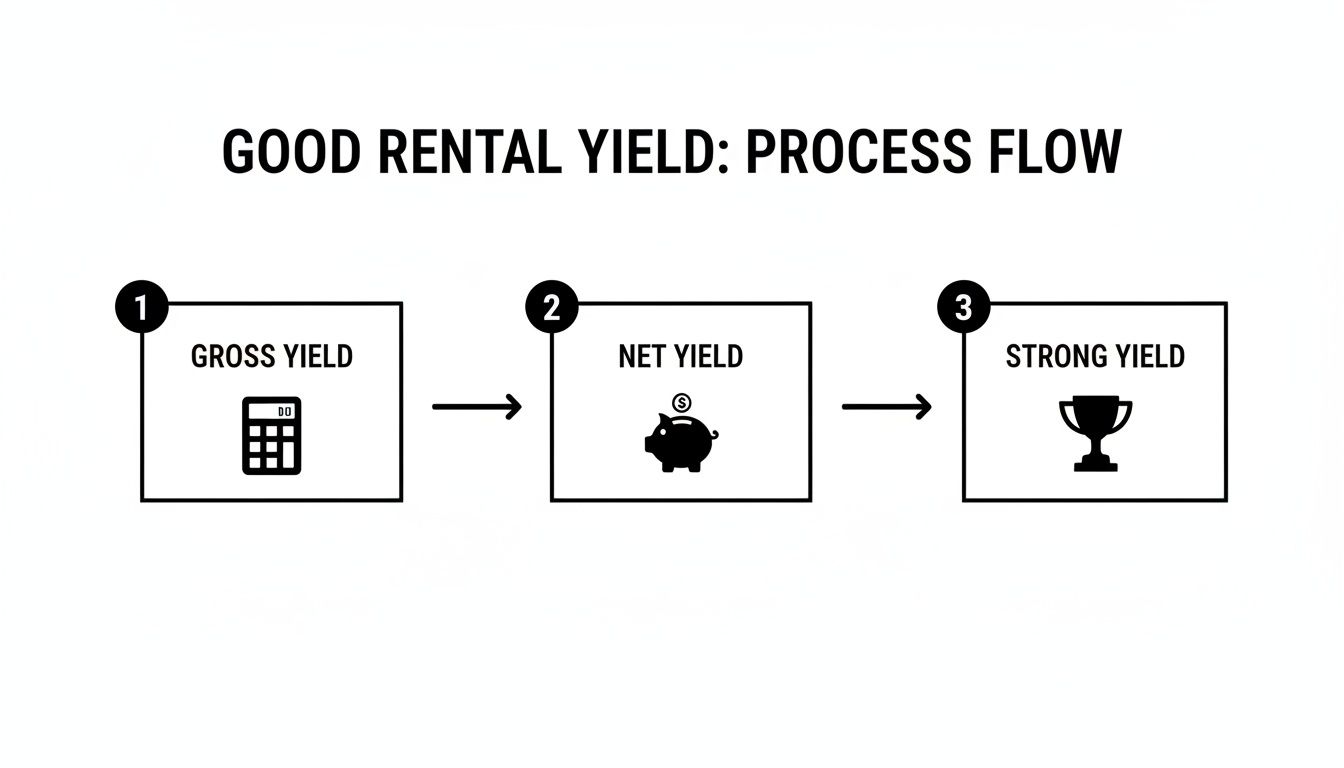
As you can see, moving from the basic gross figure to a refined net yield is what separates a decent investment from a genuinely strong one.
Understanding Net Rental Yield
Net rental yield is the definitive measure of a property's profitability. It reflects the true cash flow after all operating expenses have been deducted and is the only figure that confirms an investment's financial viability.
The formula is more detailed but essential for accurate analysis:
Net Rental Yield = ([Annual Rental Income – Annual Operating Costs] / Property Purchase Price) x 100
These operating costs are non-negotiable and have a significant impact on an investor's bottom line. Overlooking them can quickly turn a promising investment into a financial liability.
What Are Typical Operating Costs?
To calculate an accurate net yield, you must subtract a range of annual expenses from the gross rental income. These costs vary based on the property's age, location, and condition, but typically include:
- Mortgage Interest: The interest portion of your mortgage payments. Capital repayment is not an operating expense as it builds equity.
- Insurance: Buildings and landlord insurance are essential to protect the asset.
- Maintenance and Repairs: A prudent budget is 1% of the property’s value annually. For a £200,000 property, this is £2,000.
- Letting Agent and Management Fees: Typically 8-15% of the monthly rent for tenant sourcing and property management.
- Void Periods: It is wise to factor in at least one month of vacancy per year between tenancies.
- Service Charges and Ground Rent: Standard for leasehold properties such as flats.
- Taxes: Income tax on rental profits, which is dependent on your personal tax circumstances.
A Practical Example: Gross vs Net
Let's return to our £200,000 Manchester flat, which generates £12,000 in annual rent, giving it a 6.0% gross yield. Now, we will factor in the operating costs to calculate the net yield.
- Mortgage Interest (4.5% on a £150,000 loan): £6,750
- Landlord Insurance: £300
- Maintenance Fund (1% of value): £2,000
- Management Fees (10% of rent): £1,200
- Service Charge & Ground Rent: £1,500
The total annual operating costs amount to £11,750.
Now, we subtract this from the annual rent: £12,000 – £11,750 = £250. This is your net annual income. The difference is stark and highlights the importance of this calculation.
The net yield is therefore: (£250 / £200,000) x 100 = 0.125%.
The investment that appeared to deliver a healthy 6.0% return is, in reality, barely breaking even. This dramatic shift demonstrates why understanding the difference between gross and net yield is a fundamental principle of property investment.
Remember, while yield is a powerful tool for measuring income, it is only one component of return. To gain a complete overview, you must also know how to calculate the total return on investment (ROI) for real estate, which incorporates capital growth.
Key Factors That Influence Rental Yields Globally
Rental yields are determined by a complex interplay of economic, demographic, and political forces. Understanding these drivers is crucial for making informed investment decisions rather than merely chasing a headline figure.

The most fundamental relationship is that between property prices and rental growth. When property values rise faster than rents, yields are compressed. Conversely, if rents increase while prices remain stable, yields improve.
This dynamic explains why prime global cities often have lower yields. High investor demand has pushed up values to a point where immediate rental returns appear modest relative to the capital invested.
Economic Health And Job Markets
A region's economic vitality is the primary driver of rental demand. A strong, diverse job market acts as a magnet for new residents, all requiring accommodation. When assessing a potential market, look for clear indicators of economic strength.
- Job Growth: The presence of expanding sectors like technology, healthcare, and logistics indicates a growing workforce and sustainable rental demand.
- Wage Levels: Rising salaries increase tenants' capacity to pay higher rents, allowing landlords to improve yields.
- Economic Diversity: A city with a broad mix of industries is more resilient to economic shocks than one reliant on a single employer, ensuring more stable rental demand.
Locations with major universities or hospitals tend to exhibit robust rental demand due to the constant inflow of students and professionals, which underpins healthy yields.
Demographics And Population Trends
Population trends and demographic profiles are also highly influential. A city with a large population of young professionals will see high demand for one and two-bedroom flats near business districts and transport links.
For investors, the key takeaway is that population growth directly fuels rental demand. Cities attracting new residents are more likely to have low vacancy rates and upward pressure on rents—the cornerstones of a good rental yield.
In contrast, an area popular with retirees will likely have less tenant turnover but steady demand for smaller, low-maintenance properties. Understanding these local nuances allows you to align your investment with the target demographic, maximising occupancy and income.
Government Policy And Regulation
Government intervention can significantly impact the investment landscape and your net rental yield. Policies relating to taxation, tenant rights, and housing supply can all alter market dynamics.
For example, while London's average yields may seem low, this is often counterbalanced by strong rental growth. ONS data from late 2024 showed London rents increasing at one of the fastest rates in the country. You can explore further analysis of UK property performance on globalpropertyguide.com.
When conducting due diligence, pay close attention to these key policy areas:
- Taxation: Changes to income tax, capital gains tax, or stamp duty can substantially affect your net returns. It is vital to understand property taxes in your target market.
- Rental Regulations: Rules governing rent controls, eviction processes, and tenant rights vary significantly between jurisdictions. Stricter regulations can increase risk and reduce profitability.
- Housing Supply: Government policies that either encourage or restrict new construction will influence the supply-demand balance, impacting both rents and property values.
How Do Rental Yields Compare in Major Global Markets?
Theoretical knowledge is valuable, but understanding yields requires seeing them in the context of real-world markets. A yield considered excellent in a stable, mature city might be merely average in a high-growth emerging market.
This section provides a practical overview of rental yields across several key international markets, allowing you to benchmark opportunities and identify locations that align with your investment strategy.
The United Kingdom: Established vs. Emerging Yields
The UK property market is highly fragmented. In London, strong capital growth potential is offset by high property prices, which compress gross yields to a modest 4-5%.
In contrast, major regional cities like Manchester, Liverpool, and Glasgow consistently deliver more attractive gross yields, often in the 6-8% range. This is driven by more affordable property prices combined with robust rental demand from large student populations and a growing cohort of young professionals.
Investor Takeaway: Look beyond national averages. The UK's strength for yield-focused investment lies in its regional economic hubs. Granular analysis of specific postcodes within these cities is essential, as yields can vary significantly between neighbourhoods.
For a deeper analysis, explore our guide to the best buy-to-let locations in the UK and abroad.
Spain: Established Tourist Market
Spain remains a popular destination for international investors, offering a blend of lifestyle appeal and solid rental income. The market is primarily fuelled by tourism and a large expatriate community, creating reliable demand for both short and long-term rentals.
In major cities like Madrid and Barcelona, gross rental yields typically range from 4% to 5.5%. In tourist-heavy coastal regions, such as the Costa del Sol, returns can be higher, though investors must account for seasonal fluctuations in demand.
- Key Driver: Tourism and a large expatriate community.
- Note for Foreign Investors: Spain applies a non-resident income tax to rental earnings, which must be factored into net yield calculations.
Dubai: A High-Yield Emerging Hub
Dubai's property market is unique, driven almost entirely by its large expatriate population and its status as a global business centre. This creates a dynamic rental market where demand is closely tied to economic growth.
Gross rental yields here are highly attractive, often ranging from 6% to 9% in popular communities. The absence of income tax on rental earnings means gross and net yields are much closer than in other markets. However, investors must be aware of the market's cyclical nature and factor in substantial service charges for apartment buildings.
- Key Driver: Expatriate workforce and global business activity.
- Note for Foreign Investors: While there is no rental income tax, high service charges can significantly impact net returns.
Portugal: Growth in an Emerging EU Market
Portugal has emerged as a top investment destination, driven by a booming tourism sector and popular residency-by-investment programmes. This has fuelled significant demand in the rental market, particularly in Lisbon, Porto, and the Algarve.
In Lisbon and Porto, gross rental yields generally fall within the 4-6% range. The Algarve can deliver higher yields from short-term lets, but this comes with more intensive management and seasonal income fluctuations. Foreign investors must be aware of Portugal’s rental income tax and local regulations governing holiday lets.
- Key Driver: Tourism and foreign investment schemes.
- Note for Foreign Investors: Regulations for short-term lets (Alojamento Local) exist and must be adhered to.
International Rental Yield Comparison
This overview demonstrates that a 'good' rental yield is relative to its market. The table below summarises the key differences.
| Country/City | Average Gross Yield Range | Key Economic Driver | Note for Foreign Investors |
|---|---|---|---|
| UK (Regional) | 6% – 8% | Student populations, job growth | Yields vary significantly by city; London is much lower. |
| Spain (Coastal) | 5% – 7% | Tourism, expat lifestyle | Income is often seasonal; non-resident taxes apply. |
| Dubai | 6% – 9% | Expat workforce, business hub | No rental income tax, but high service charges are common. |
| Portugal | 4% – 6% | Tourism, foreign investment | Regulations for short-term lets (Alojamento Local) exist. |
The choice between the high yields of an emerging market like Dubai or the stability of a regional UK city depends on an investor's personal strategy and risk appetite.
Actionable Strategies to Boost Your Rental Yield
A good rental yield is not just found; it is actively created and optimised. While market forces set a baseline, astute investors can add value and streamline operations to enhance their returns.
This can be achieved through two primary avenues: increasing rental income and decreasing operating expenses.

This proactive approach transforms a passive landlord into a value-adding investor. Each strategic improvement has a direct impact on your net yield.
Driving Up Your Rental Income
The most direct way to improve your yield is to make your property more desirable, allowing you to command a higher rent. Targeted, cost-effective upgrades often deliver the best return on investment.
Consider these high-impact improvements:
- Modernise Kitchens and Bathrooms: These rooms significantly influence tenant decisions. Simple upgrades like new hardware, a modern backsplash, or an updated shower screen can add significant perceived value.
- Add In-Demand Amenities: Depending on the target tenant, features such as a dishwasher, washer-dryer, or high-speed fibre broadband can justify a rent increase.
- Furnish for a Niche Market: For students, young professionals, or corporate lets, offering a well-furnished property can significantly boost rental income and attract tenants willing to pay a premium for convenience.
For investors with more capital, converting a large property into a House in Multiple Occupation (HMO) can dramatically increase rental income by letting individual rooms. While this requires navigating stricter regulations, successful HMOs can deliver gross yields well into double digits.
Systematically Reducing Operating Expenses
The second powerful lever for boosting your net yield is reducing running costs. Every pound saved on expenses is a pound added directly to your profit.
An investor's true profit is not just what they earn, but what they keep. By focusing on efficient operations and cost control, you can protect and enhance your net yield, even in a flat rental market.
A proactive approach to cost management is a hallmark of a professional landlord.
Smart Financial and Maintenance Tactics
Begin with your financing. Regularly reviewing your buy-to-let mortgage can reveal significant savings. If interest rates have fallen or your equity has increased, refinancing could lower your monthly payments. Our guide on financing an investment property offers detailed insights.
Next, implement a proactive maintenance schedule rather than a reactive one.
- Annual Boiler Service: Prevents costly emergency repairs and extends the unit's lifespan.
- Regular Gutter Clearing: Avoids expensive repairs for damp caused by blockages.
- Appliance Checks: Simple maintenance can prevent major issues and costly replacements.
This preventative strategy not only saves money but also fosters a better relationship with tenants, which can reduce costly void periods.
Looking Beyond Yield to See the Full Investment Picture
Focusing solely on rental yield can be a dangerously narrow approach. The true measure of a property's performance is its Total Return, which combines both income (yield) and capital appreciation (growth).
A property generates returns in two ways: rental yield provides regular cash flow, while capital appreciation—the increase in the property’s market value over time—builds long-term wealth.
A balanced strategy must consider both. A high-yield property in a stagnant market might provide good monthly income but do little to increase your net worth. Conversely, a lower-yielding property in a high-growth area could generate far greater overall returns upon sale.
Total Return: The Real Measure of Success
To calculate total return, you add your net rental income to the capital gain over a specific period. This provides a complete picture of the investment's performance.
Consider two properties over five years:
- Property A (High Yield): A flat bought for £150,000 with a 7% net yield, generating £10,500 in net income annually. In a slow market, its value increases by only £15,000.
- Property B (Growth Focus): A flat bought for £300,000 with a 4% net yield, generating £12,000 in net income annually. In a high-growth area, its value increases by £75,000.
While Property A offered a better immediate yield, Property B delivered a much higher total return once capital appreciation was included.
Balancing Cash Flow with Long-Term Growth
The optimal mix of yield and growth depends on your personal investment goals. Are you seeking immediate income or building long-term wealth for retirement?
An investor’s strategy must align with their financial objectives. High-yield properties are excellent for generating cash flow now, while high-growth properties are vehicles for long-term wealth creation. The most robust portfolios often contain a strategic mix of both.
Recent ONS figures have shown UK annual rental growth hitting 9.0% in late 2024, demonstrating how independently rental income and capital values can move. For detailed data, investors can explore the official UK private rent and house price indices.
Ultimately, understanding what constitutes a good rental yield is just the first step. True investment mastery comes from looking beyond this single metric to build a strategy that delivers both immediate income and lasting capital growth.
Your Questions Answered
Here are clear, practical answers to common questions from global property investors.
Is a Higher Rental Yield Always Better?
Not necessarily. An unusually high yield can be a red flag, potentially indicating a property in a less desirable area with poor prospects for capital growth or one that struggles to attract reliable tenants. The most successful investors seek a balance between a healthy yield and the quality of the asset and its location.
How Does Inflation Affect My Rental Yield?
Inflation presents both opportunities and challenges. It often allows for rent increases, which can boost your nominal yield. However, it also drives up operating costs such as maintenance and insurance. If rent increases do not keep pace with these rising expenses, your net yield can be eroded. Historically, property is considered an effective hedge against inflation as both rental income and property values tend to rise over the long term.
What Is the Difference Between Rental Yield and ROI?
This is a critical distinction. Rental yield measures the annual income a property generates relative to its purchase price or market value. It is a snapshot of its income-producing efficiency.
Return on Investment (ROI) provides a more comprehensive measure of performance. It calculates your total profit (net income plus capital growth) against the actual capital you invested—your deposit, acquisition costs, and renovation expenses. ROI offers the most accurate view of how your own capital has performed.
At World Property Investor, we provide the in-depth analysis and global market comparisons you need to invest with confidence. Explore our expert guides to find your next high-performing property investment.
Learn more at World Property Investor