
For global investors seeking high-yield opportunities, property investments in Liverpool present a compelling case. The city strikes a rare balance, blending affordable property prices with the potential for strong, sustainable returns. This positions it as a standout alternative to overheated markets like London, where high entry costs can severely compress profit margins.
Why Liverpool Is a Top Choice for Property Investors

Liverpool's appeal is not based on market hype; it is built on a solid foundation of economic and demographic drivers. Unlike many major UK cities, it combines high rental yields with property prices that remain accessible. This creates a powerful formula for generating both monthly cash flow and long-term capital appreciation.
This unique market dynamic makes Liverpool an attractive entry point for first-time international investors and a strategic addition for seasoned portfolio holders seeking to diversify away from more expensive locations. The city's property market is fuelled by a potent mix of factors that ensure sustainable demand and value appreciation.
- Strong and Consistent Rental Demand: A large student population of over 70,000, coupled with a growing number of young professionals moving to the city, creates a deep and reliable tenant pool. For landlords, this translates into minimal void periods and consistent rental income.
- Affordable Entry Points: Property prices in Liverpool remain significantly lower than in nearby Manchester or southern cities like London. This allows investors to acquire assets with less upfront capital, freeing up cash for further portfolio expansion.
- High Rental Yields: Gross rental yields in many Liverpool postcodes comfortably outperform the national average, often reaching between 6% and 8%. Such returns are increasingly difficult to achieve in other established UK markets.
- Major Regeneration Projects: Billions of pounds are being invested into transformative projects like Liverpool Waters and the Knowledge Quarter. This investment directly boosts property values and increases the desirability of surrounding areas for tenants.
The table below provides a snapshot of the key data points that make Liverpool's market attractive.
Liverpool Property Investment Snapshot 2026
| Metric | Value/Figure | Significance for Investors |
|---|---|---|
| Average House Price | £182,000 | Highly affordable entry point compared to other major UK cities. |
| Annual Price Growth | +6.5% (Jan 2026) | Demonstrates strong, ongoing capital appreciation potential. |
| 5-Year Price Growth | +34% | Shows a track record of sustained long-term growth and market resilience. |
| Average Gross Yield | 6% – 8% | Delivers robust rental returns that support strong cash flow. |
| Student Population | 70,000+ | Underpins a deep and consistent rental market, reducing vacancy risk. |
These figures present a clear narrative: Liverpool offers a rare combination of affordability, strong rental income, and proven capital growth.
The Financial Case for Liverpool
For data-driven investors, the numbers speak for themselves. The contrast between Liverpool and other UK cities is stark, particularly regarding the capital required for entry. While London property prices can be prohibitive, Liverpool offers a much more accessible market without sacrificing growth prospects.
Property prices in Liverpool remain remarkably affordable. The Office for National Statistics (ONS) confirmed this trend in its January 2026 report, noting an average house price of just £182,000. This figure represents a 6.5% increase from the previous year, indicating healthy growth.
Over a longer timeframe, the performance is even more impressive, with prices up 34% over five years. This affordability, paired with a strong history of growth, makes Liverpool a compelling proposition for capital appreciation. You can explore more about how these wider trends are shaping the market in our guide on property investment in 2025.
The investment thesis is straightforward: acquire property in a city with a robust rental market and a clear path for capital growth. Liverpool delivers on both fronts, offering a balanced risk-reward profile that is increasingly difficult to find elsewhere.
This combination of factors makes a strong, data-backed case for why property investments in Liverpool should be on every serious investor's radar.
Understanding Liverpool's Market Fundamentals
Prudent property investment is built on solid foundations, not temporary market hype. For any investor considering Liverpool, it is essential to look beyond headline figures and understand the economic and demographic forces fuelling its growth. The city is undergoing a genuine economic renaissance, creating a robust environment for long-term capital growth and reliable rental income.
This transformation is driven by targeted investment in key sectors such as life sciences, digital media, and advanced logistics, which are creating a wave of high-quality, skilled jobs. This economic shift acts as a magnet for a talented workforce, which in turn drives demand for quality rental accommodation, particularly from young professionals.
Economic and Demographic Drivers
Liverpool’s economic engine is powered by a potent mix of academic strength and commercial innovation. The city is home to several major universities, including the prestigious University of Liverpool, which collectively host a student population of over 70,000. This creates a deep, consistent, and remarkably recession-resilient demand for rental properties, particularly in postcodes near the main campuses.
A key strength for investors is the city's impressive graduate retention rate. A significant number of graduates now choose to stay and build their careers in Liverpool, transitioning from student tenants into young professional renters. This constant flow ensures demand remains high across a range of property types, from student HMOs to city centre apartments.
The real strength of the Liverpool market lies in its ability to both attract and retain talent. This dual dynamic creates a self-sustaining cycle of rental demand that underpins the stability of property investments here, reducing void periods and supporting consistent rental growth.
Furthermore, the city’s affordability adds another layer of appeal. According to ONS data, the average house price in Liverpool was approximately £182,000 in early 2026. This, combined with a healthy price-to-earnings ratio of just 4.82, means property remains accessible to a broad tenant base—a stark contrast to the overheated southern markets. To understand how these metrics shape your potential profit, our guide on how to calculate return on an investment property provides a detailed breakdown.
Regeneration and Infrastructure Impact
Perhaps the most visible indicator of Liverpool's forward momentum is the scale of its regeneration projects. Billions of pounds are being invested to transform entire districts, having a direct and measurable impact on property values and rental demand in surrounding areas. These are not merely cosmetic upgrades; they are fundamental changes to the city's economic geography.
Two standout projects anchor this transformation:
- Liverpool Waters: A monumental £5.5 billion project set to completely revitalise 60 hectares of the city’s historic docklands. It is creating a world-class, mixed-use waterfront with new homes, offices, and leisure facilities, reshaping the city's entire northern fringe.
- The Knowledge Quarter: A £2 billion initiative cementing Liverpool’s status as a global leader in science, health, and technology. This innovation hub is a magnet for highly skilled professionals and academics, generating intense demand for nearby premium rental housing.
Other major schemes, such as the new Everton F.C. stadium at Bramley-Moore Dock and the emergence of the trendy Baltic Triangle as a creative and digital district, add to this momentum. For an investor, acquiring property near these regeneration zones offers a clear pathway to capital appreciation. It is a market fundamental: major infrastructure improvements almost always lead to higher desirability and, consequently, higher property values and rents.
Identifying the Highest Rental Yields Across Liverpool
For any seasoned property investor, one metric cuts through the noise: rental yield. It is the clearest measure of an asset's performance, showing the annual rental income as a percentage of the property's cost. In Liverpool, yields are consistently strong, but the true opportunity is revealed when analysing the market at a postcode level.
Unlocking the best returns is not a secret formula. It is about matching the right property type with the right tenant demographic in a specific neighbourhood. A sleek city-centre flat and a terraced house near the university are different investment products; they attract different tenants and produce different returns. Understanding this local dynamic is what separates an average investment from a high-performing one.
Established Versus Emerging Investment Areas
Liverpool's property market can be viewed as having two distinct segments: the prime, established postcodes and the up-and-coming, high-yield neighbourhoods.
Established Markets (e.g., L1, L2, L3): These are the city centre and waterfront hotspots. They offer a sense of security, with consistent demand from young professionals and proximity to premium amenities. While property prices are higher here, investors are buying into stability and can expect lower void periods and strong long-term growth prospects.
Emerging Markets (e.g., L4, L6, L7): Moving further from the city core often reveals the most attractive yields. Lower entry prices are a major draw, and demand is fierce from students, families, and renters seeking better value. Many of these areas are adjacent to major regeneration zones, adding a layer of potential for future capital growth.
The economic engine driving demand across both segments is undeniable. The city's job market, student population, and development pipeline create a powerful foundation for the rental sector.
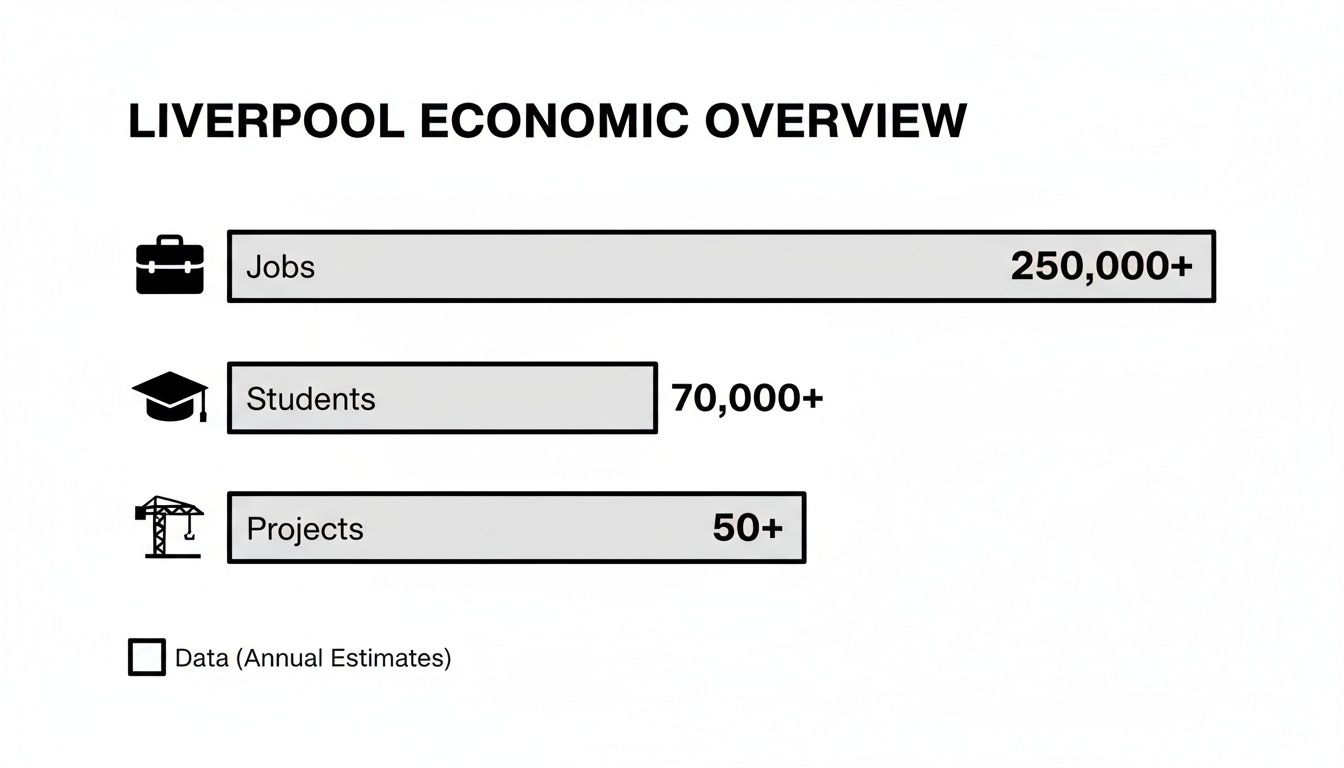
With over 250,000 jobs, 70,000 students, and more than 50 major projects underway, the demand for rental homes is not a temporary trend—it is built into the city’s economic fabric.
A Postcode-by-Postcode Yield Analysis
Let's examine the data to see where the most rewarding opportunities lie. Liverpool has long been a standout performer for investors chasing high rental yields that significantly exceed the national average. While the rest of the UK averages around 3.2%, it is common to see Liverpool postcodes achieving 6%, 7%, or even higher.
For example, the L7 postcode, popular with students and medical staff, can offer yields around 7.2% on properties with an average price of £165,800. In L4, an average price of £134,965 can generate a 7.3% yield—ideal for investors focused on immediate cash flow. Even prime city-centre postcodes like L1 (with 5.7% yields on £186,272 prices) and L3 (at 6.3%) deliver solid returns, buoyed by ongoing regeneration that maintains high tenant demand.
Key Takeaway: The relationship between property price and yield is critical. Cheaper properties do not automatically guarantee better returns. The savviest investors find the sweet spot: balancing an affordable purchase price with an area's rental demand and potential for future growth.
Before committing to any investment, it is crucial to run the numbers. You can model different scenarios using our simple rental yield calculator to forecast a specific property's potential performance.
Liverpool Rental Yield Comparison by Postcode
A side-by-side comparison brings the different postcode strategies to life. As shown below, a short move away from the city centre can have a dramatic impact on potential returns.
| Postcode | Neighbourhood Focus | Average Property Price (2026) | Average Monthly Rent | Gross Rental Yield (%) | Primary Tenant Demographic |
|---|---|---|---|---|---|
| L1 | City Centre, Ropewalks | £186,272 | £883 | 5.7% | Young Professionals, Short-Term Lets |
| L3 | Waterfront, Vauxhall | £195,500 | £1,026 | 6.3% | Professionals, Corporate Tenants |
| L4 | Anfield | £134,965 | £820 | 7.3% | Families, Local Workers |
| L7 | Edge Hill, Kensington | £165,800 | £995 | 7.2% | Students, Medical Staff |
The data is clear: by shifting focus just outside the prime city core to areas like L4 or L7, investors can often secure a much higher gross yield. This is because the drop in property prices is typically more significant than the corresponding fall in rental income, creating a mathematical advantage for yield-focused investors.
Ultimately, the right choice depends on your investment strategy—whether you prioritise the long-term stability of the city centre or aim to maximise monthly cash flow in one of Liverpool’s exciting emerging neighbourhoods.
Choosing the Right Investment Strategy for You

There is no single “best” way to invest in Liverpool’s property market. The optimal strategy depends entirely on your investment goals, risk appetite, and desired level of active management.
The city’s diverse market supports several distinct strategies, each with its own advantages and challenges. Understanding how these approaches function in a real-world context allows you to align your capital with the one that best fits your investment thesis.
Standard Buy-to-Let for Long-Term Income
The classic buy-to-rent investment model is the bedrock of many property portfolios, and it thrives in Liverpool. The strategy is simple: purchase a property and let it to a single household on a long-term contract, typically for six to twelve months or more. Its appeal lies in its relative simplicity and the dual potential for monthly rental income and long-term capital growth.
Two or three-bedroom terraced houses in areas like L4 (Anfield) or L6 (Tuebrook) are prime targets for this strategy. They are affordable to acquire and in high demand from local families and workers, which helps to minimise void periods. While the monthly cash flow per unit is lower than with an HMO, the management required is also significantly less. This approach is ideal for investors seeking a stable, lower-maintenance asset.
Houses in Multiple Occupation for Maximum Cash Flow
A House in Multiple Occupation (HMO) is a property rented out room-by-room to at least three people who are not from a single household but share facilities like a kitchen and bathroom. For investors willing to take on more complexity, HMOs offer a way to significantly boost rental yields.
This strategy is particularly effective in Liverpool due to its large student population. By letting a property on a per-room basis, you can often generate a total monthly rent that is far higher than what could be achieved from a single household. Areas near the University of Liverpool and Liverpool John Moores University, such as L7 (Edge Hill) and Kensington, are ideal for student HMOs.
Investor Insight: While HMOs can produce impressive cash flow, they are subject to stricter regulations. Any property with five or more tenants requires a mandatory HMO licence from Liverpool City Council, which involves meeting specific safety and amenity standards. It is crucial to factor in the costs of any conversion work, licensing, and higher management overheads.
Purpose-Built Student Accommodation (PBSA) for Passive Income
For those seeking a more hands-off way to tap into the lucrative student market, Purpose-Built Student Accommodation (PBSA) is an excellent option. This involves purchasing an individual studio or a room within a "cluster flat" in a large, professionally managed student development.
These blocks are typically located in prime city-centre spots like L1 or near the Knowledge Quarter, offering students high-end amenities such as gyms, cinemas, and social spaces. The day-to-day management, from finding tenants to handling maintenance, is taken care of by the building operator in exchange for a service charge. While yields may be slightly lower than a self-managed HMO, PBSA offers a passive investment that is perfect for overseas investors.
Short-Term Lets to Capitalise on Tourism
Liverpool’s status as a major tourist destination—fuelled by its musical heritage, cultural attractions, and world-famous football clubs—creates a booming market for short-term lets. Platforms like Airbnb allow property owners to rent out their flats or houses on a nightly basis, often achieving a much higher rate than a standard long-term rental.
Properties in the city centre (L1, L2) and near Anfield or Goodison Park stadiums are prime candidates for this strategy. A well-located one or two-bedroom apartment can generate significant income during peak seasons, football matches, and major events like the Grand National. However, this is by far the most management-intensive strategy, requiring constant guest communication, cleaning, and maintenance. Income can also be seasonal, and investors must be aware of local council regulations.
Navigating UK Property Rules for International Investors
Investing in UK property from another country is more straightforward than many assume. The UK has one of the most open property markets in the world, with very few restrictions on foreign ownership. This accessibility is a key reason why cities like Liverpool attract a global mix of investors.
Whether buying as an individual living abroad or through an international company, you have the same legal rights to own property as a British citizen. The main differences lie in taxation and financing, which require careful planning.
Understanding Key Taxes for Overseas Investors
For any international investor, there are three main UK taxes to understand. This is crucial for accurately calculating your net returns and ensuring compliance with HM Revenue & Customs (HMRC).
Stamp Duty Land Tax (SDLT): This tax is paid upon purchase. While all buyers pay SDLT, non-UK residents are subject to a 2% surcharge on top of the standard rates. This means your entry costs will be slightly higher than for a UK resident buying the same property.
Income Tax: Profit earned from renting out your Liverpool property is taxable in the UK. Under the Non-Resident Landlord Scheme (NRLS), your letting agent will typically deduct basic rate tax from your rent before remitting it to you, unless you receive specific approval from HMRC to receive the gross amount.
Capital Gains Tax (CGT): When you sell the property, you will be liable for UK CGT on any profit (the "gain"). This is calculated by subtracting the original purchase price and allowable costs from the final sale price. It is vital to keep detailed records of all purchase-related costs to minimise your future tax liability.
Investor Takeaway: Tax planning is not an afterthought; it is an integral part of your initial strategy. The structure of your purchase—whether as an individual or through a limited company—can have a significant impact on your overall tax liability, particularly if you plan to build a portfolio.
Structuring Your Purchase and Securing Finance
The way you choose to own your property affects both your tax liability and your ability to secure a mortgage. Many international investors now buy through a UK-registered limited company as it can offer significant tax benefits, particularly regarding mortgage interest relief. However, this route comes with its own administrative and reporting requirements.
Obtaining a buy-to-let mortgage as an overseas investor is achievable, but it involves a more specialist segment of the lending market. Lenders will almost always require a larger deposit, typically in the range of 25-30% of the property’s value, and will conduct thorough affordability and anti-money laundering checks.
Assembling the right professional team from the outset is non-negotiable:
- Mortgage Broker: Engage a broker who specialises in non-resident mortgages. They have access to the right lenders and know how to package an application for success.
- Solicitor: You will need a UK-based solicitor to handle the conveyancing—the legal side of the transaction—from conducting searches to officially transferring ownership.
- Letting Agent: A reputable local agent in Liverpool is your representative on the ground. They will find suitable tenants, manage the property, and ensure compliance with all UK rental laws.
It is also crucial to understand the type of ownership. In Liverpool, many flats are sold on a leasehold basis, while most houses are freehold. This has a major impact on your rights and ongoing responsibilities. For a full breakdown, see our guide on the differences between leasehold and freehold ownership.
Your Practical Next Steps for Investing in Liverpool
Market data and analysis are only useful if they are translated into action. The fundamentals show that Liverpool offers a rare combination of affordable property, strong rental yields, and a clear path for future growth. Now is the time to move from theory to implementation.
Success in this market is not about timing it perfectly; it is about building a robust plan based on the fundamentals we have covered—the city’s ongoing regeneration, its high graduate retention rate, and the deep, diverse pool of tenants. This is your roadmap to securing your first investment.
An Investor’s Checklist for Getting Started
This checklist breaks down the journey into simple, manageable steps to guide you from research to ownership.
Define Your Strategy: What do you want this investment to achieve? Are you chasing maximum cash flow with an HMO in L7, or do you prefer the long-term stability of a two-bedroom terrace in a family-friendly suburb? Your personal goals will dictate your search.
Conduct Due Diligence: Go beyond postcodes to analyse streets. Use online tools to check local transport links, schools, and amenities. Research recent sold prices and current rental listings for comparable properties to verify that your financial projections are realistic.
Assemble Your Professional Team: For any investor, particularly if you are not local, your professional team is critical. You need a mortgage broker who understands the non-resident market, a diligent solicitor for legal work, and a trusted local letting agent to manage the property.
Arrange Your Finances: Before making any offers, secure a Decision in Principle (DIP) from a mortgage lender. A DIP demonstrates to sellers that you are a serious buyer with the necessary funds, and it clarifies your exact budget.
Find and Secure Your Property: With your finances arranged, you can begin searching for a property that fits your strategy. Make offers based on data, not emotion, and be prepared to negotiate. Once your offer is accepted, your solicitor will guide you through the conveyancing process to completion.
Final Thoughts: The investment opportunity in Liverpool is tangible. The city's economic momentum and the structural undersupply of housing create a solid foundation for both rental income and long-term capital growth. By following a structured plan and acting with confidence, you can turn your Liverpool investment goals into a reality.
Frequently Asked Questions About Liverpool Property Investment
Entering any new market naturally raises questions. For investors considering Liverpool, obtaining clear, practical answers is the foundation of a confident strategy.
Here are answers to some of the most common queries from prospective investors.
Is Liverpool property still a good investment in 2026?
Yes. The core drivers underpinning Liverpool's investment case remain firmly in place. The city’s price-to-earnings ratio is a healthy 4.82, according to recent analysis, indicating that property remains affordable relative to local incomes. This is a key sign of a sustainable market, not an asset bubble.
When this affordability is paired with strong rental demand, which saw rents rise by 8.3% in the last year alone (as per major property portals), the case for investment is powerful. While the rapid price surges of previous years may have moderated, the market is now characterised by steady, sustainable growth. With major projects like the new Everton F.C. stadium and Liverpool Waters creating jobs and enhancing the city's appeal, the long-term outlook remains positive.
What is the best property type for a beginner investor?
For a first-time investor, particularly one based overseas, a standard two or three-bedroom terraced house in an area with proven tenant demand is a prudent choice. Postcodes such as L4 (Anfield) or L6 (Tuebrook) are excellent examples; they offer affordable entry points and are consistently popular with local families and workers.
This strategy is far simpler to manage than an HMO and provides more predictable income than a short-term let. It offers an ideal balance of rental income, capital growth potential, and manageable landlord responsibilities, making it a perfect first step into the Liverpool market.
How will local council regulations affect my investment?
The most significant regulation to be aware of is HMO licensing. If you plan to rent a property to five or more unrelated individuals, Liverpool City Council requires a mandatory licence. This involves your property meeting specific standards for room sizes, fire safety, and amenities. You must factor these compliance costs into your financial calculations if an HMO is your chosen strategy.
Additionally, be aware of Article 4 Directions, which are in place in certain areas to restrict the conversion of family homes into small HMOs without full planning permission. Before making an offer, your first step should be to check the specific rules for your target postcode directly with the council. This due diligence protects your investment and ensures legal compliance.
At World Property Investor, we provide the data and analysis you need to make informed decisions in global real estate markets. Explore our in-depth city guides and investment strategies at https://www.worldpropertyinvestor.com.