
For global investors evaluating the UK property market in 2025, the landscape is one of nuanced opportunity. While broad economic headlines may suggest caution, a granular analysis of market data reveals a picture of quiet resilience and distinct sectoral divergence. High-demand sectors, notably industrial logistics and Build-to-Rent, continue to outperform traditional commercial assets, presenting a compelling case for the informed investor.
The UK Property Investment Landscape in 2025
Following a period of recalibration, the UK property market is entering a phase of stability and more predictable growth, making it an attractive proposition for those with a long-term outlook. Key drivers, such as moderating inflation and a more settled interest rate environment, are fostering renewed confidence. This stability provides a solid foundation for making a strategic property investment in 2025.

However, this is not a story of uniform growth. Success in the current climate demands a sophisticated strategy focused on specific sectors and regions where market fundamentals are exceptionally strong.
Shifting Sector Performance
The most significant trend is the clear divergence in performance between property sectors. While the traditional office market continues to navigate the long-term impacts of flexible working, other areas are thriving on the back of powerful structural shifts.
- Industrial and Logistics: This sector continues its strong performance, fuelled by the permanent shift to e-commerce and the corresponding need for modern, efficient supply chains. Demand for well-located warehousing and distribution centres remains robust.
- Residential Build-to-Rent (BtR): A structural housing shortage, coupled with higher borrowing costs making home ownership less accessible, has deepened the pool of tenants. This makes purpose-built, high-quality rental accommodation a highly attractive and defensive asset class.
This divergence underscores a key takeaway for 2025: investment focus must shift beyond legacy asset classes. Superior returns will be found in sectors aligned with contemporary economic and demographic trends.
Key Takeaway: A successful 2025 UK property strategy lies in understanding that while the overall market is steadying, exceptional returns will be found in assets that solve a structural need—whether it is a logistics hub for online retail or a high-quality rental home for a young professional.
To provide a clearer picture, the following snapshot illustrates how key metrics are shaping up across the main sectors.
UK Property Market Snapshot 2025
This table offers a high-level summary of key performance indicators across different UK property sectors, based on recent market analysis and forecasts for 2025.
| Metric | All Property | Industrial Sector | Residential Sector | Office Sector |
|---|---|---|---|---|
| Capital Value Growth (YoY) | +1.2% | +4.5% | +2.8% | -2.1% |
| Rental Growth (YoY) | +2.5% | +6.1% | +4.9% | +0.5% |
| Vacancy Rate | 6.8% | 3.2% (record low) | 2.5% (acute shortage) | 9.5% (rising) |
| Investor Sentiment | Cautiously Optimistic | Very Strong | Very Strong | Weak / Selective |
Source: Aggregated data from major property consultancies and market analysts.
The data clearly illustrates the relative strength of the industrial and residential sectors, which are demonstrating robust rental and capital growth driven by fundamental supply-and-demand imbalances. The office sector, in contrast, continues to face headwinds.
A Market Poised for Growth
Looking ahead, the UK property market is positioned for sustained expansion. Projections from market analysts indicate a 5.3% compound annual growth rate (CAGR) between 2025 and 2030.
This growth is expected to lift total market revenues from USD 121.7 billion in 2024 to an estimated USD 166.0 billion by the end of the decade, with the residential segment leading this expansion. You can find more details on these UK market growth projections.
This forecast is supported by data from official bodies like the Office for National Statistics (ONS), which consistently highlights the UK's persistent housing demand. When these powerful, long-term demand drivers are combined with stabilising economic conditions, the outlook is promising for investors who deploy capital wisely.
Understanding the Economic Forces Shaping UK Property
To invest successfully, one must understand the 'why' behind market movements. It is not enough to know that prices are rising; one must grasp the fundamental economic forces driving that growth. For any investment in 2025, this requires looking past the headlines and into the core data that shapes value, demand, and profitability across the UK.
These forces act like currents in an ocean. Understanding them allows an investor to navigate the market with confidence. Let us break down the key drivers to monitor.
Interest Rates and Inflation: The Investor's Compass
The Bank of England's decisions on interest rates are arguably the most direct influence on the property market. Changes to the base rate immediately impact mortgage affordability for homebuyers and financing costs for investors. Throughout 2024, rates began to stabilise after a period of sharp increases, creating a more predictable borrowing environment for 2025.
Inflation trends are equally important, as they dictate real returns. While high inflation erodes the value of cash, property has historically served as a reliable hedge. As UK inflation, reported by the ONS, continues its downward trend from previous peaks, the real (inflation-adjusted) growth in property values and rental income becomes more attractive.
Key Takeaway: The ideal scenario for an investor is a 'Goldilocks' economy—not too hot, not too cold. This means interest rates low enough to encourage borrowing but sufficient to keep inflation in check, creating a stable foundation for capital appreciation and rental yield growth.
Demographic Shifts: The Engine of Demand
At its heart, property economics comes down to supply and demand. In the UK, demographic trends are the primary engine of that demand. Two factors are particularly important for investors to understand.
- Persistent Net Migration: The UK continues to experience positive net migration. According to Gov.uk data, this influx of people—many of whom enter the rental market first—creates constant and growing demand for housing, especially in major urban centres.
- Ongoing Urbanisation: Young professionals and graduates continue to move to cities like Manchester, Birmingham, and Bristol for career opportunities. This trend fuels powerful demand for rental properties, particularly high-quality, centrally located apartments, which underpins the success of the Build-to-Rent sector.
This structural demand-supply imbalance is a core pillar of the UK property investment case. Unlike short-term economic fluctuations, this is a long-term trend providing fundamental support for both rental income and property values.
Government Policy and Housing Targets
Finally, government policy creates the regulatory landscape in which investors operate. National and local housing targets, for instance, can signal areas primed for development and infrastructure investment. The government's stated aim to build hundreds of thousands of new homes annually, while often falling short, indicates a commitment to supporting the construction and housing sectors.
For international investors, tax policies such as Stamp Duty Land Tax (SDLT) and Capital Gains Tax are critical. These rules directly impact the net return on an investment, so staying informed is essential for accurate financial modelling.
For broader insights into market dynamics, our comprehensive guides on property investment offer valuable context. These economic drivers are essential pieces of the puzzle for any successful property investment in 2025.
Where to Invest: Why Industrial and Residential Are Outperforming
As we look towards 2025, it is clear the property market is not moving monolithically. A distinct two-track market has emerged, with astute investors focusing on sectors with powerful, long-term demand drivers that transcend short-term market noise.
The standout performers are industrial logistics and residential Build-to-Rent (BtR). Both are thriving not due to speculation, but because they are intrinsically linked to the fundamental ways we now live and shop. While established asset classes like commercial offices face a period of uncertainty, these two sectors offer a clearer, more compelling investment case.
The Unstoppable Rise of the Industrial Sector
The e-commerce boom is a permanent feature of the modern economy. This structural shift has created an almost insatiable appetite for modern, well-located logistics hubs, warehouses, and distribution centres. As consumer expectations for rapid delivery times grow, companies are in a race to optimise their supply chains, placing these industrial properties at the heart of UK commerce.
This demand extends beyond large national distribution centres. There is a rapidly growing need for smaller, 'last-mile' logistics facilities located close to urban centres, which are essential for handling the final leg of a product’s journey. This opens up a diverse range of opportunities for 2025, from massive regional hubs to nimble, strategically placed urban depots.
The chart below illustrates how key forces like interest rates, inflation, and demand interact within the UK property market.
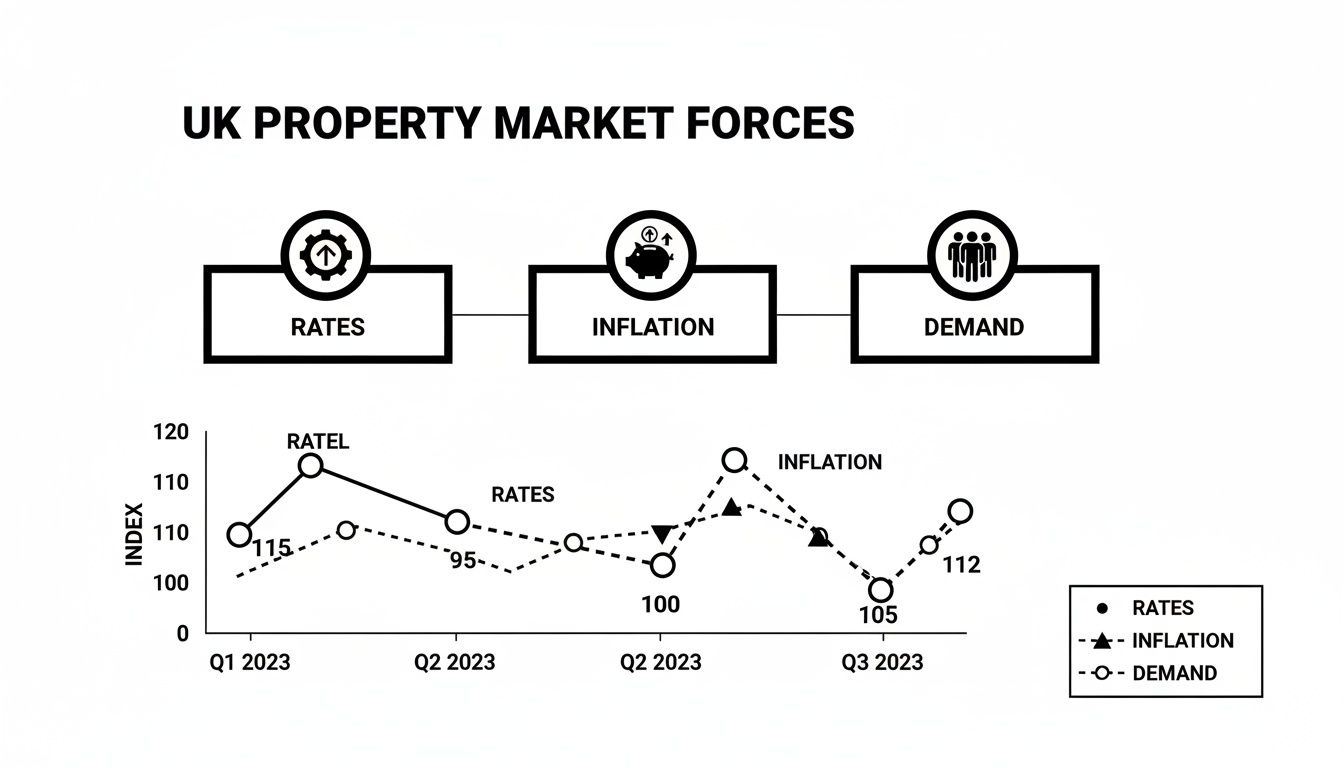
What this chart highlights is how resilient demand, particularly in sectors like industrial and residential, provides a strong counterbalance to wider economic pressures.
The data supports this thesis. Despite economic headwinds, the UK industrial sector surged by an impressive 5.2% in capital growth in the 12 months to May, according to market analysis. This performance contrasts with the all-property average of 2.7% and shines a light on the shifting dynamics in property investment. You can find more data on this trend in the UK real estate market outlook on aberdeeninvestments.com.
Residential Build-to-Rent: A Market Underpinned by Necessity
The other powerhouse sector is residential—specifically, Build-to-Rent (BtR). Its strength stems from a simple but powerful formula: a chronic undersupply of housing meeting a growing population of renters. With higher borrowing costs making it harder for many to purchase a home, more people are renting for longer periods.
This creates a deep and reliable tenant base for high-quality, professionally managed rental properties. Unlike the traditional buy-to-let market dominated by individual landlords, the BtR model delivers entire developments designed for renters, complete with modern amenities and a high level of service.
Key Takeaway: The core appeal of Build-to-Rent is its defensive nature. People will always need a place to live. In a market with a structural housing shortage, demand for quality rental accommodation remains consistently high, helping to insulate it from wider economic volatility.
For an investor, this translates into stable occupancy rates, predictable rental income, and solid potential for long-term capital growth. The BtR market is less about chasing short-term price appreciation and more about building a resilient, income-generating asset.
Comparing Established and Emerging Markets
When planning a 2025 strategy, it is useful to compare sectors.
- Industrial (Established high-growth): This sector delivers strong rental growth, often secured with long-term leases to corporate tenants, providing predictable income streams. Yields in prime locations are competitive, reflecting high investor demand.
- Residential BtR (Emerging prime): With BtR, investors gain highly granular and diversified income from hundreds of individual tenancies, significantly reducing vacancy risk. Rental growth is closely tied to wage inflation and local demand, both of which remain robust in key UK cities.
- Offices (Challenged/Transitional): The office sector is in a more difficult position. Vacancy rates have risen, and rental growth is flat in many secondary locations. While best-in-class, sustainable office space in prime city-centre locations is still performing well, the sector as a whole carries greater risk.
The data indicates that capital is flowing into sectors that serve a fundamental, non-discretionary need. Whether it is the logistics network that powers the digital economy or the high-quality homes a growing population requires, industrial and residential property offer the most compelling, data-backed opportunities for 2025.
Finding Growth Beyond London in Regional UK Hotspots
For decades, London was the undisputed centre of UK property investment, a magnet for global capital. However, for investors looking ahead to 2025, the most compelling growth stories are now unfolding in the UK's dynamic regional cities. Here, one can find a superior blend of affordability, stronger rental yields, and greater potential for capital appreciation.
While London's market retains its underlying strengths, its price growth has moderated. The real momentum has shifted north and to other key regional hubs. Cities like Manchester, Birmingham, and Leeds are no longer mere 'alternatives' to London; they are prime investment destinations powered by genuine economic growth, expanding populations, and transformative infrastructure projects.

Manchester: A Magnet for Talent and Capital
Manchester continues to lead the regional pack. Its booming tech and media sectors, combined with a large student population that often remains post-graduation, create deep and sustained demand for rental homes. Major regeneration schemes in areas like Salford Quays and the Northern Quarter continue to enhance its appeal.
Investors in Manchester can realistically expect gross rental yields between 5% and 7%—a figure now exceptionally difficult to achieve in London. This potent combination of strong rental income and consistent capital growth makes it a top choice for investors seeking balanced returns.
Birmingham: The HS2 Effect and Beyond
Birmingham, the UK's second-largest city, is another hotspot attracting significant investor interest. The anticipated arrival of High Speed 2 (HS2) rail is a genuine game-changer, set to reduce journey times to London and cement its position as a major business hub. This has already catalysed a wave of commercial and residential development.
The city's economy is also highly diverse, with strengths in finance, digital technology, and advanced manufacturing fuelling a resilient jobs market. That economic strength translates directly into a healthy rental market, with yields often matching or exceeding those found in Manchester.
Key Takeaway: The core principle for a successful regional strategy is simple: follow the infrastructure and the jobs. Cities experiencing significant government and private sector investment are creating high-value employment that attracts tenants, driving up both rental demand and property values for the long term.
Scotland's Surging Market Momentum
It is not just English cities that are performing strongly. The Scottish property market has shown remarkable resilience. ONS data makes this clear: while average UK house prices climbed a respectable 3.7% in the 12 months to June 2025, Scotland posted standout growth of 5.9%, with the average price reaching £192,000.
You can find more detail on these UK private rent and house price trends on ons.gov.uk.
To provide a clear perspective, here is how the nations compare.
Regional UK House Price Growth Comparison (Year to June 2025)
| Region | Average House Price | Annual Growth (%) |
|---|---|---|
| England | £312,000 | 3.6% |
| Wales | £218,000 | 2.5% |
| Scotland | £192,000 | 5.9% |
| Northern Ireland | £178,000 | 4.0% |
Source: Office for National Statistics (ONS).
This growth has been particularly strong in cities like Glasgow and Edinburgh, which benefit from world-class universities and thriving professional services sectors. While Scotland has its own legal system, it offers compelling value for investors who take the time to understand the local market.
Understanding the fundamental drivers of a specific area is paramount. Our guide on the importance of location in real estate investment success offers a deeper framework for evaluating these regional opportunities.
The shift towards regional UK cities is a fundamental rebalancing of the market. For global investors, the data is clear: the path to superior returns in 2025 lies in looking beyond the traditional London-centric approach and embracing the growth, yield, and potential of the UK's vibrant regional powerhouses.
A Practical Guide for International Investors
Investing in the UK property market from overseas presents a unique set of considerations. However, with a clear, structured plan, the process can be navigated efficiently and securely.
For any international buyer considering a property investment in 2025, understanding the UK's legal and financial regulations is the first and most critical step. This guide breaks down the essential elements, from ownership structures to tax obligations.
Success is not about complex financial engineering; it is about methodical, prudent planning. By tackling each stage with due care, an investor can mitigate common risks and position their investment for long-term success, even from a distance.
Choosing the Right Ownership Structure
One of the first decisions is how to legally own the property. This choice has significant implications for tax liability, personal liability, and future estate planning.
For most international investors, there are two primary routes.
-
Personal Ownership: Buying in your own name is the most direct approach. It is quicker and involves less administrative setup. The drawback is that personal assets are not legally separate from the investment property, and rental income is taxed at your personal rate.
-
Limited Company (SPV): This is a popular structure for serious investors. A UK-registered limited company, often called a Special Purpose Vehicle (SPV), is established specifically to hold the property. This creates a legal separation between personal finances and the investment and can be significantly more tax-efficient, especially for higher-rate taxpayers.
Key Takeaway: The choice between personal and company ownership is fundamental. A limited company often provides better tax planning options for portfolio landlords, particularly concerning mortgage interest relief, but it comes with added administrative duties like annual accounting and filings with Companies House.
Understanding Your UK Tax Obligations
As a non-resident landlord, you are subject to UK tax rules. Non-compliance can lead to significant penalties, so it is vital to understand your obligations from the outset. There are three key taxes to be aware of.
Stamp Duty Land Tax (SDLT)
This is the tax paid upon purchase. International buyers are subject to a 2% surcharge on top of the standard SDLT rates applicable to UK residents. This applies to all residential property purchases in England and Northern Ireland by non-UK residents.
Income Tax on Rental Profits
You will pay UK income tax on your net rental income—that is, rental earnings after deducting allowable expenses. If you reside abroad for over six months a year, your letting agent (or tenant) is legally required to deduct basic rate tax from the rent before payment. To avoid this, you must register for the Non-resident Landlord Scheme, which allows you to receive the gross rent and manage your own tax affairs via a self-assessment tax return.
Capital Gains Tax (CGT)
When you eventually sell the property, any profit (the "gain") is subject to UK Capital Gains Tax. The rates for residential property are higher than for other assets. It is crucial to keep meticulous records of all purchase costs and capital improvements, as these can be deducted to reduce your final tax liability.
Securing Finance and Conducting Due Diligence
Obtaining a mortgage as a non-resident can be more complex than for a UK resident. Many high-street banks are hesitant, but a healthy market of specialist lenders and private banks caters specifically to international investors.
Be prepared for some key differences:
- Larger Deposits: Lenders will almost certainly require a larger deposit from an overseas buyer. Expect to provide between 25% to 40% of the property's value.
- Stricter Affordability Checks: You will need to provide robust proof of income and identity, often translated into English and officially certified.
Proper due diligence is non-negotiable, particularly when you cannot physically inspect the property. This means engaging a reputable solicitor to handle the conveyancing, commissioning a thorough RICS survey to identify any structural issues, and researching the local rental market to ensure your yield forecasts are realistic.
For more insights, our complete guide on investing in overseas property provides a broader framework.
Building Your 2025 UK Property Investment Strategy
Translating market data into a real-world action plan is the crucial final step. A successful property investment in 2025 is not about chasing trends; it is about building a strategy based on solid, long-term fundamentals that align with your personal financial objectives.
The key takeaways are clear: the industrial and residential sectors are set to outperform, and the best growth is often found in the UK's regional cities, not just London. Property is a marathon, not a sprint. By focusing on assets that meet a genuine, structural need, you can build lasting wealth and remain insulated from short-term market noise.
Defining Your Investor Profile
The right strategy depends on your primary objective. Are you seeking a steady, passive income stream to supplement your earnings, or is your main goal long-term capital appreciation?
-
For the Income-Focused Investor: Your strategy should centre on high-yield buy-to-let properties in regional cities with deep and diverse rental demand. A two-bedroom flat near a major university or hospital in Manchester or Leeds is a prime example. The goal is a reliable 5-7% gross rental yield that delivers consistent cash flow.
-
For the Growth-Focused Investor: This approach suits those with a longer time horizon who are willing to trade immediate income for greater capital growth. This might involve purchasing a property in a major regeneration zone in a city like Birmingham, where significant infrastructure projects are poised to drive price appreciation over the next five to ten years.
Key Takeaway: A well-defined investment thesis acts as your compass. It dictates not only what you buy but where and why. Whether you are pursuing yield or growth, this clarity prevents reactive, off-strategy decisions.
Creating Your Action Plan
Once your investor profile is defined, it is time to execute. For international investors, a methodical, step-by-step approach is key to a successful purchase.
- Set a Clear Budget: Determine your total capital outlay. This includes the purchase price, Stamp Duty Land Tax (SDLT), legal fees, and a contingency fund for unexpected costs.
- Arrange Financing: Begin early by speaking to mortgage brokers who specialise in lending to non-residents. Our guide on financing investment property walks you through the steps for securing the right loan.
- Conduct Deep Due Diligence: Go granular. Research specific postcodes and even streets within your target city. Analyse local rental demand, vacancy rates, and recent comparable sales to validate your investment case.
- Assemble Your UK Team: Engage professionals early. Appoint a reputable solicitor, a letting agent with strong local knowledge, and an accountant who understands non-resident tax obligations before you make an offer.
This structured approach transforms your strategy from an idea into a tangible, executable plan, providing the confidence to build a resilient UK property portfolio.
Frequently Asked Questions
When assessing opportunities from across the globe, several key questions consistently arise. Here are straightforward answers to the queries we hear most often from international investors considering the UK property market for 2025.
Is 2025 a Good Time to Invest in UK Property?
Yes, 2025 represents a strategic window for discerning investors. The rapid price growth of recent years has moderated, but the market's core fundamentals remain robust. For example, all-property capital growth held at a steady 2.7% in the year to May 2025, which points to underlying resilience.
With inflation cooling and interest rates finding a more predictable level, there is less uncertainty. The key is selectivity. By focusing on high-demand niches like industrial logistics or the residential Build-to-Rent sector, investors can tap into long-term structural demand and sidestep weaker market segments.
What Are the Biggest Risks for Property Investors?
The primary risks for a property investment in 2025 are economic shifts and regulatory changes. An unexpected interest rate move from the Bank of England could impact financing costs and buyer confidence, although the current outlook is for stability.
Investors must also monitor evolving regulations in the private rented sector. Another risk is overpaying in a "hot" sector where prime yields have already tightened—this is where meticulous due diligence is essential. A sound risk management strategy is to diversify across strong regional cities rather than concentrating all capital in London.
Key Takeaway: For any international investor, the three main taxes to understand are Stamp Duty Land Tax (SDLT), Income Tax on rental profits, and Capital Gains Tax (CGT) upon sale. Each has specific rules for non-residents that can significantly impact net returns.
What UK Taxes Should Foreign Investors Know About?
There are three main taxes to have on your radar. First is Stamp Duty Land Tax (SDLT), which includes a 2% surcharge for overseas buyers on top of standard rates. Second is UK Income Tax on your net rental profits. Finally, there is Capital Gains Tax (CGT) to consider when you sell the property.
Structuring your purchase correctly from the outset—for instance, buying through a UK limited company—can significantly improve tax efficiency. Professional advice tailored to your personal circumstances is essential before making any commitments.
At World Property Investor, we provide the data-driven guides and market analysis you need to compare global property markets and invest with confidence. Explore our expert resources at https://www.worldpropertyinvestor.com.