
If you're looking at the United States as your next property market, you're probably weighing more than yield, financing and exit. You're also asking a bigger question. Can this capital help secure a long-term right to live in the country, not just own assets there?
That's where many investors get tripped up. An investment visa to USA isn't a property purchase scheme in the way some buyers expect. In practice, the visa decision sits at the junction of immigration law, business structuring, tax planning and asset selection. If you treat it as a simple real estate acquisition, you're far more likely to choose the wrong route.
Investing in More Than Just Property
The United States still attracts investors who want scale, legal depth and a broad range of commercial opportunities. But the immigration side is competitive. Historical demand for the EB-5 route has been substantial, with around 10,000 EB-5 visas available annually, and research cited by Visum USA's EB-5 overview notes that Chinese nationals received more than 70% of all EB-5 visas issued between 2010 and 2019.
That matters because it changes how you should think about the decision. This isn't just about finding a building or backing a development. It's about entering a quota-managed immigration category where timing, structure and documentation can be as important as the asset itself.
For property-focused investors, the first strategic shift is this. Your capital must usually do more than buy something that may appreciate. It must fit a visa framework that rewards enterprise, job creation and lawful source of funds.
Why property investors misread the opportunity
Many overseas buyers assume the US works like jurisdictions where real estate ownership itself can open a residency path. It doesn't work that way here. A flat in Miami, a buy-to-let in Texas or a portfolio of single-family rentals may be sensible investments, but they don't automatically create a qualifying immigration case.
Practical rule: In the US, immigration value usually comes from the structure around the investment, not from the fact that the asset is property.
That distinction becomes even sharper once you get into commercial projects. If your plan involves operating premises, leasing strategy and tenant risk, the commercial side needs proper scrutiny. For investors reviewing retail, office or mixed-use opportunities, a practical primer on negotiating commercial lease terms is useful because lease structure often drives business viability long before immigration paperwork is filed.
A good starting point is to compare the broader range of visa routes for investors before narrowing down to the US. It helps separate residency goals from property goals, which should always be analysed together but not confused.
What serious applicants do differently
They start with the end goal.
- Permanent residency first: They usually focus on immigrant categories rather than trying to force a property deal into the wrong visa.
- Operational involvement first: They look at business-led routes where management role matters.
- Family planning first: They assess schooling, tax residence and relocation timing alongside the investment itself.
That mindset leads directly to the two paths most investors compare.
Comparing the Two Main US Investment Visa Paths
Most investors deciding on an investment visa to USA end up comparing EB-5 and E-2. They sound similar from a distance. They are not.
The core difference is simple. EB-5 is an immigrant route aimed at permanent residency. E-2 is a non-immigrant route tied to running an active business. If you miss that distinction, everything downstream gets harder, including entity design, capital deployment and your expectations around time horizon.
Here is the high-level comparison.
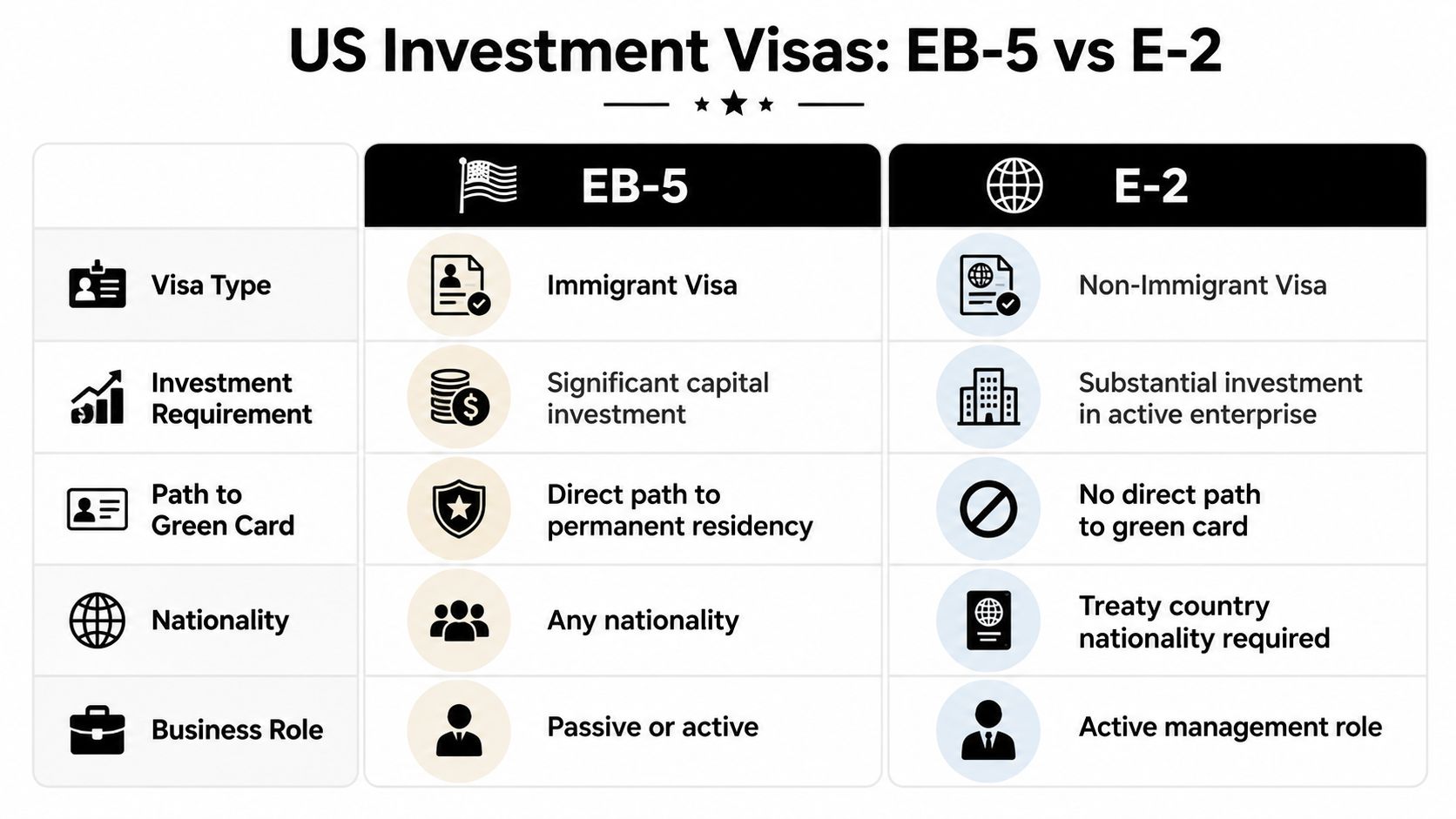
EB-5 vs E-2 Visa At a Glance
| Feature | EB-5 Immigrant Investor Visa | E-2 Treaty Investor Visa |
|---|---|---|
| Visa type | Immigrant visa | Non-immigrant visa |
| Main outcome | Path to permanent residency | Renewable status linked to business activity |
| Nationality | Open more broadly | Requires nationality from a treaty country |
| Investment approach | Capital into a qualifying commercial enterprise | Substantial investment in an active enterprise |
| Business role | Can be more passive in some structures | Requires active management or direction |
| Property angle | Often used via development or operating business structures | Works only where property is part of an active business |
For investors who compare global mobility routes side by side, it can also help to review how Canada investor visa requirements differ in philosophy. Canada and the US don't reward the same investor profile in the same way, especially where passive capital is concerned.
Which route suits which investor
EB-5 tends to fit the investor who wants a direct residency objective and is comfortable committing significant capital within a tightly regulated framework. In property terms, this usually means backing a qualifying commercial enterprise rather than buying personal holdings and waiting for appreciation.
E-2 suits the investor who wants flexibility and is prepared to operate a business. For property people, that usually means turning sector knowledge into an operating company, not just holding title to real estate.
The practical split often looks like this:
- You want a Green Card objective: EB-5 is the route people examine first.
- You want to move faster operationally and run a business: E-2 is often the first serious option.
- You want a passive real estate holding with immigration benefits: neither route is as straightforward as many expect.
A short visual overview helps if you're making the first-pass distinction:
The wrong visa choice usually starts with the wrong question. “What property can I buy?” is less useful than “What immigration outcome am I actually trying to secure?”
What often works and what usually doesn't
What works is alignment. If you want residency, use a residency-led strategy. If you want to build and run a US business, use a business-led strategy.
What usually doesn't is trying to retrofit a passive property purchase into a visa category built around enterprise. That's the recurring mistake.
The EB-5 Programme A Path to Permanent Residency
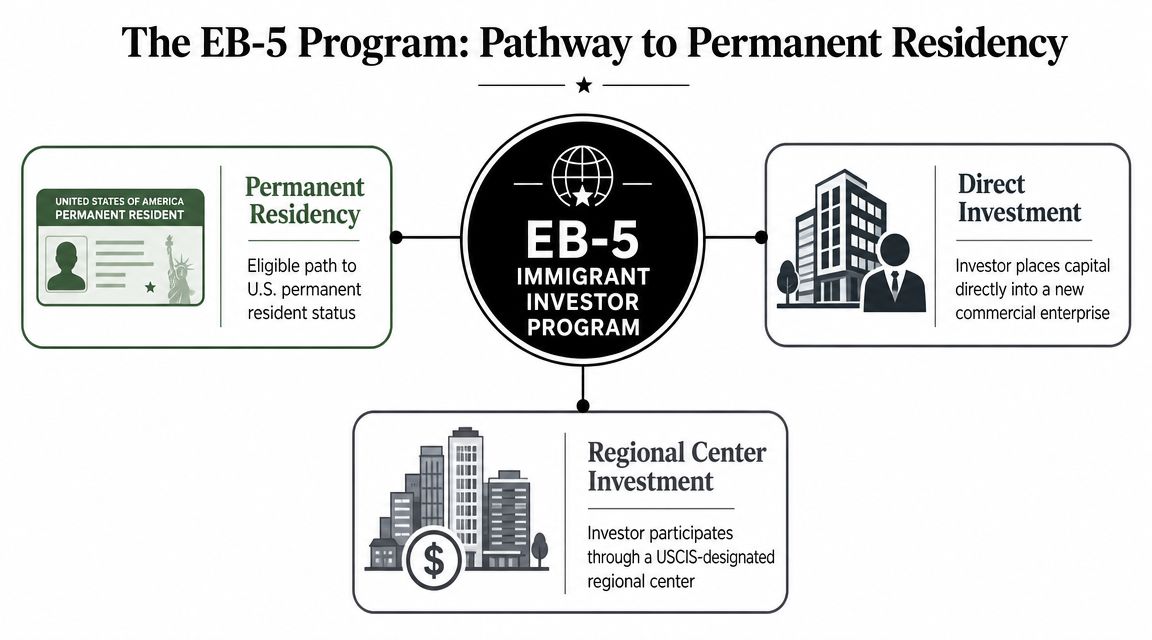
For investors focused on residency, EB-5 is the route that matters most. It has been a major gateway to US residency since it was created by the Immigration Act of 1990. Under the US State Department's guidance on immigrant investor visas, an investor must generally place capital into a qualifying commercial enterprise and create at least 10 full-time jobs for US workers within two years. The same guidance lists core documentation including Form DS-260, a valid passport, two 2×2 photos, civil documents, financial support evidence, and medical exam forms.
For property investors, the key phrase is qualifying commercial enterprise. The programme is not built around passive ownership. It is built around business activity and jobs.
How property fits into EB-5
Property can sit inside an EB-5 case, but usually in one of two forms:
Direct investment
You invest into your own qualifying business enterprise. If property is involved, it normally needs to be tied to the operating business itself. Think of a trading business with premises, or an operating hospitality asset where the enterprise employs people and creates jobs.
This route gives control, but it also puts more execution burden on the investor. You are closer to the hiring, business plan and compliance risk.
Regional Centre style investment
Many investors prefer professionally organised projects connected to larger developments. In practice, these often include hotels, mixed-use schemes, senior living, logistics or other commercial assets where the project is structured around job creation economics.
Many property investors feel more comfortable when the underlying asset looks familiar. But familiar isn't the same as simple. You still need to understand the capital stack, the developer's track record, the exit assumptions and the immigration logic.
The two rules investors underestimate
The first is capital at risk. If the arrangement looks like a guaranteed property return or a contractual buyback dressed up as immigration planning, that should trigger immediate caution. EB-5 doesn't reward capital that behaves like a protected deposit.
The second is job creation. That is the issue many real estate investors misunderstand. Owning a rental portfolio may generate income, but unless the structure meets the programme's job requirements through the enterprise, it won't solve the immigration test.
Investor lens: A strong EB-5 property deal is not just a good real estate story. It is a credible immigration case supported by a viable business plan.
What due diligence should focus on
Before capital moves, check three things hard:
- Project logic: Does the business support the required employment outcome?
- Manager quality: Who controls execution, reporting and investor communications?
- Exit realism: Is the capital return assumption commercially sensible, or mainly marketing language?
When clients approach EB-5 as both an immigration file and an underwriting exercise, the decision quality improves dramatically.
The E-2 Visa The Active Investor Route
The E-2 route appeals to people who don't want to place large capital into an immigration-led structure and wait passively. It is the practical option for investors who are ready to operate, direct and grow a US business.
The first filter is nationality. E-2 is available only to nationals of countries that have the relevant treaty relationship with the United States. If the nationality requirement isn't met, the route usually drops out before business planning even begins.
Why passive property ownership doesn't fit
Many property buyers often err in this regard. Buying and holding a residential unit, or even several units, is generally not the profile E-2 is designed for. The visa is centred on an active enterprise.
That means the property element has to sit inside a trading business. Viable examples can include:
- A property management company: especially if it has staff, systems and a clear service model.
- A renovation or redevelopment business: where the enterprise buys, improves and sells as an operating activity.
- A boutique hospitality business: where the property is part of the business, not the whole story.
Owning bricks and mortar may support the business. It doesn't replace the business.
What consular logic tends to favour
Decision-makers typically want to see that the enterprise is real, operational and capable of supporting more than a minimal lifestyle arrangement. In practice, the strongest E-2 cases usually show several things at once:
- committed capital already deployed into the business
- an operating plan that makes commercial sense
- the investor actively directing the enterprise
- a model that can employ people or at least scale beyond the owner
For investors who compare residency-linked property options internationally, the contrast with schemes such as the Portugal Golden Visa is useful. The Portuguese framework has historically attracted buyers looking for a different balance between capital placement and day-to-day operational involvement. The US E-2 route sits firmly on the active-management side.
If you want E-2, think like an operator. If you want to stay a passive landlord, think again.
When E-2 can be the smarter route
It can be the better fit when the investor already has a business model they understand. A developer moving into a small US construction operation, a hotel owner launching a managed lodging concept, or a real estate professional building a management platform may all be closer to E-2 than EB-5 in practical terms.
The trade-off is obvious. You gain flexibility and often a lower entry barrier in commercial terms, but you take on operating risk and you don't get a direct Green Card path from the visa itself.
Application Milestones Costs and Timelines
Most mistakes happen before filing. Investors rush to the asset, then try to retrofit the paperwork. The better sequence is the reverse. Start with eligibility, then source of funds, then project quality, then filing strategy.
For EB-5 specifically, the threshold point has changed, and many online articles still quote figures that are no longer current. Current guidance under the EB-5 Reform and Integrity Act of 2022, as summarised in this EB-5 visa reference, sets the minimum investment at $1,050,000, or $800,000 in a targeted employment area (TEA) or qualifying infrastructure project.
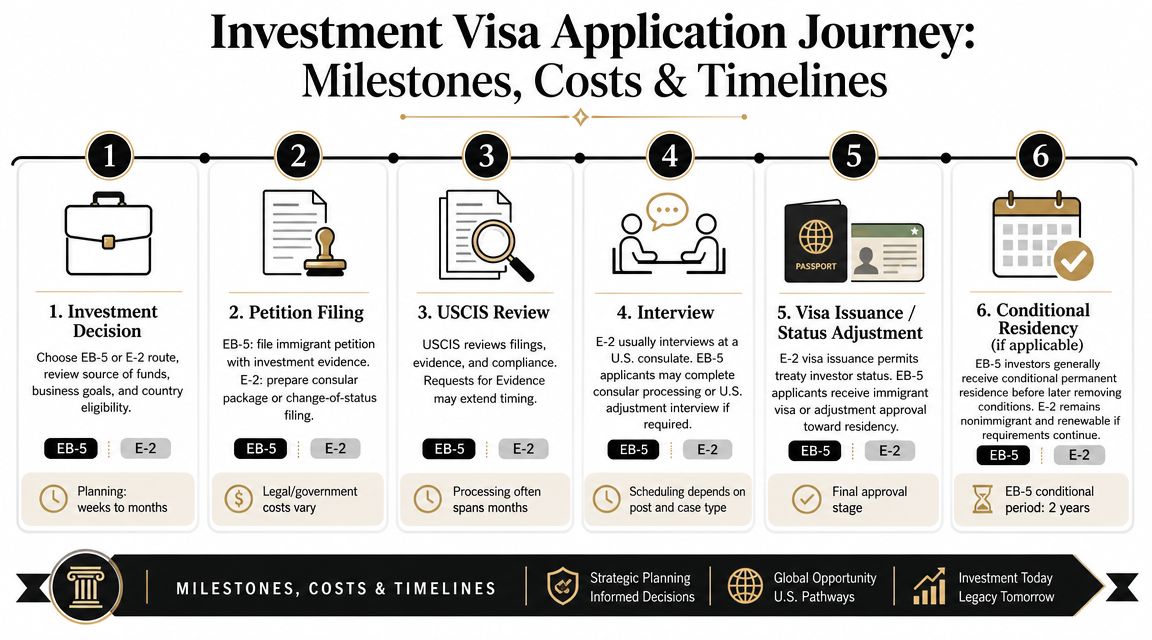
The milestone map that matters
1. Strategy selection
The investor decides at this stage whether the goal is permanent residency, temporary business-based status, or a staged approach. Treaty nationality, family plans, and tax residence should also be reviewed.
2. Deal and source-of-funds diligence
For property-led investors, this phase usually takes longer than expected. You need to document where the money came from and ensure the business or project structure supports the visa logic.
3. Petition filing
The forms differ by route, but the principle is the same. The filing only works if the legal case and the commercial case line up cleanly.
Critical point: Outdated investment figures don't just create confusion. They distort project selection and can cause investors to budget for the wrong strategy entirely.
4. Government review and interview
At this point, weak assumptions get exposed. Inconsistent documents, vague business plans and poorly explained capital trails often create avoidable problems.
5. Visa issuance or status adjustment
Approval is not the end of the commercial work. For investors, relocation, banking, entity administration, and operating discipline are then key.
6. Ongoing compliance
For EB-5 investors especially, the job isn't over after initial approval. The investment structure still needs to hold together as a real business proposition.
How to budget intelligently
A sensible budget includes more than the headline capital amount.
- Investment capital: This is the amount required by the relevant route.
- Professional fees: Immigration counsel, corporate counsel, tax advisers and project due diligence all matter.
- Operational reserves: Particularly important for E-2 businesses and direct EB-5 enterprises.
- Contingency: Cross-border applications rarely run perfectly from start to finish.
Many investors focus on the purchase or subscription amount and under-budget the professional and operational layer. That is one of the costliest planning errors in this field.
Common Pitfalls for Property Investors
The most expensive myth is also the most common one. Buying US property does not, by itself, qualify you for a US investment visa. Investors still arrive with the assumption that a residential purchase, or even a sizeable portfolio, can be converted into residency. In most cases, that belief collapses as soon as counsel reviews the structure.

Five mistakes that keep repeating
- Treating property ownership as immigration evidence: A strong asset doesn't automatically create a strong visa case.
- Ignoring source-of-funds rigour: If your capital trail is messy, the application gets harder fast.
- Choosing the wrong project wrapper: Investors sometimes buy into property-branded offerings without understanding whether the visa structure is sound.
- Underestimating processing uncertainty: Immigration planning rarely rewards impatience.
- Forgetting tax exposure: US residence can change your tax profile in ways that should be modelled early.
The Regional Centre trap
Some investors are drawn to a project because the property looks attractive. Nice branding, a recognisable city, polished brochures. None of that tells you enough.
The questions are harder. Who is responsible for execution? How credible is the business plan? How does the structure support the immigration objective? What happens if the commercial performance disappoints?
A glossy development pack can sell a property story. It can't fix a weak visa strategy.
Property investors need a location lens too
Even when the immigration structure is sound, market selection still matters. Liquidity, tenant depth, local employment drivers and development oversupply all affect risk. If you're assessing where wealthy demand clusters and where premium real estate capital tends to concentrate, a market snapshot of wealthy cities in the US can help frame the property side of the decision. It won't answer the visa question for you, but it will sharpen the market question.
The strongest investors keep the two analyses separate. One asks, “Does this satisfy immigration rules?” The other asks, “Would I back this market anyway?”
Your Investor Checklist and Final Thoughts
A good investment visa to USA strategy starts with honesty about your objective.
Ask yourself these questions first
- Do you want permanent residency, or a renewable business-based stay?
- Are you willing to run an operating business, or do you want a more hands-off structure?
- Does your nationality support the route you're considering?
- Can you document your capital cleanly from origin to transfer?
- Would this still be a sensible property or business investment if there were no visa attached?
If several answers are uncertain, pause before committing capital. Investors also shouldn't ignore alternatives such as business transfer routes for those who already own companies abroad. In some cases, they fit better than forcing a property-led strategy into EB-5 or E-2.
For the commercial side, disciplined underwriting matters as much as immigration advice. A framework for smarter property investment decisions can help investors stress-test assumptions before they commit funds. If you're comparing residency-linked options more broadly, World Property Investor also publishes guides on citizenship by investment that can help place the US route in a wider global context.
The right move is rarely the one that looks easiest at first glance. It's the one where immigration outcome, business structure and property fundamentals all point in the same direction.
If you're comparing markets, visa routes and property strategies across borders, World Property Investor is a useful place to continue your research. Use it to narrow your shortlist, understand how different countries treat investor migration, and approach advisers with a clearer brief before you commit capital.