
Buying a holiday let often feels like the hard part. It usually isn't.
Work begins in earnest after completion, when guests begin arriving, cleaners need paying, a boiler fails on a Sunday, and a local rule you barely noticed suddenly affects your licence, tax position, or booking calendar. That pressure multiplies when you live in another country and your property sits in a market you visit only a few times a year.
That's why holiday rental property management should be treated as an investment structure, not a housekeeping checklist. The investor who earns consistently isn't always the one with the best property. It's the one who builds the best operating system around that asset.
The Investor's Challenge Managing Holiday Lets from Afar
A common scenario looks like this. You've bought a cottage in Cornwall, a flat in London, or a coastal property in Portugal. The photos are strong, the location is proven, and the purchase made sense on paper. Then the daily realities arrive: check-in windows, linen logistics, guest questions at midnight, contractor no-shows, platform disputes, and rules that differ by council.
Distance turns small operational faults into expensive ones. A missed clean isn't just an inconvenience. It can trigger refunds, a weak review profile, and lower conversion across every booking platform. Remote ownership also limits your ability to verify what's really happening on the ground, which is why many investors underestimate management risk when comparing markets.
The opportunity is still compelling. In the UK, the holiday accommodation industry is projected to reach £4.2 billion in 2026, after growing at a 5.8% compound annual growth rate between 2021 and 2026, and that growth has been supported by domestic tourism spending that exceeded £25 billion by 2024, according to IBISWorld's UK holiday accommodation industry analysis. Growth attracts investors, but it also attracts stronger competition and more professional operators.
Why management structure matters more than most buyers expect
Established markets such as London, the Cotswolds, Cornwall, the Algarve, or parts of coastal Spain usually offer clearer demand patterns and deeper service networks. Emerging short-let locations can offer lower entry prices or less saturated supply, but they often come with patchier contractor pools, inconsistent guest expectations, or less mature compliance systems.
That matters because your management model has to fit the market.
Practical rule: The further you are from the property, the less you should rely on informal arrangements.
A local cleaner who “also keeps an eye on things” can work for a while. It rarely scales. It also doesn't create accountability when a guest complains about safety, access, or cleanliness.
For overseas buyers, the better starting point is to decide how the property will run before deciding how it will be marketed. If you're still evaluating UK acquisitions, this guide to buying UK property from overseas is a useful companion because financing, ownership structure, and management all affect each other.
The shift from landlord thinking to operator thinking
Long-term landlords can survive with slower decision-making. Holiday let operators can't. Pricing changes faster. Guest communication matters more. Operational standards are visible in public reviews. One weak month often isn't caused by demand alone. It's caused by delayed responses, poor housekeeping control, weak listing positioning, or the wrong management structure.
The right question isn't “Can I self-manage?” It's “Which model protects yield, reduces avoidable risk, and still gives me enough control?”
Laying the Foundations for Profit and Compliance
An overseas investor can buy the right property, furnish it well, and still end up with a weak holiday-let business if the legal and operating setup is wrong from day one.
That usually happens before launch. Owners focus on design, listing copy, and projected nightly rates, then leave tax treatment, planning rules, safety records, and insurance until the handover phase. By then, changing course is slower and more expensive.
For investors deciding between DIY, outsourced management, or a hybrid structure, this stage sets the limits of each model. If the property sits in a market with tighter local controls, lease restrictions, or more frequent inspections, self-management from abroad becomes harder to justify. If the setup is clean, documented, and assigned to named local parties, a hybrid approach often becomes realistic.
Start with the tax and rating position
The first question is simple. Will the property qualify and operate the way you have underwritten it?
In the UK, holiday-let tax and rating treatment depends in part on how the property is made available and used. HMRC's guidance on Furnished Holiday Lettings is the right starting point for checking the availability and letting conditions that have historically applied, and for understanding how personal use and low occupancy can affect assumptions.
That matters because many investors build year-one forecasts on peak-season income, then reserve long owner stays, delay launch dates, or accept a long renovation period. The spreadsheet still shows holiday-let returns. The actual operating position may not.
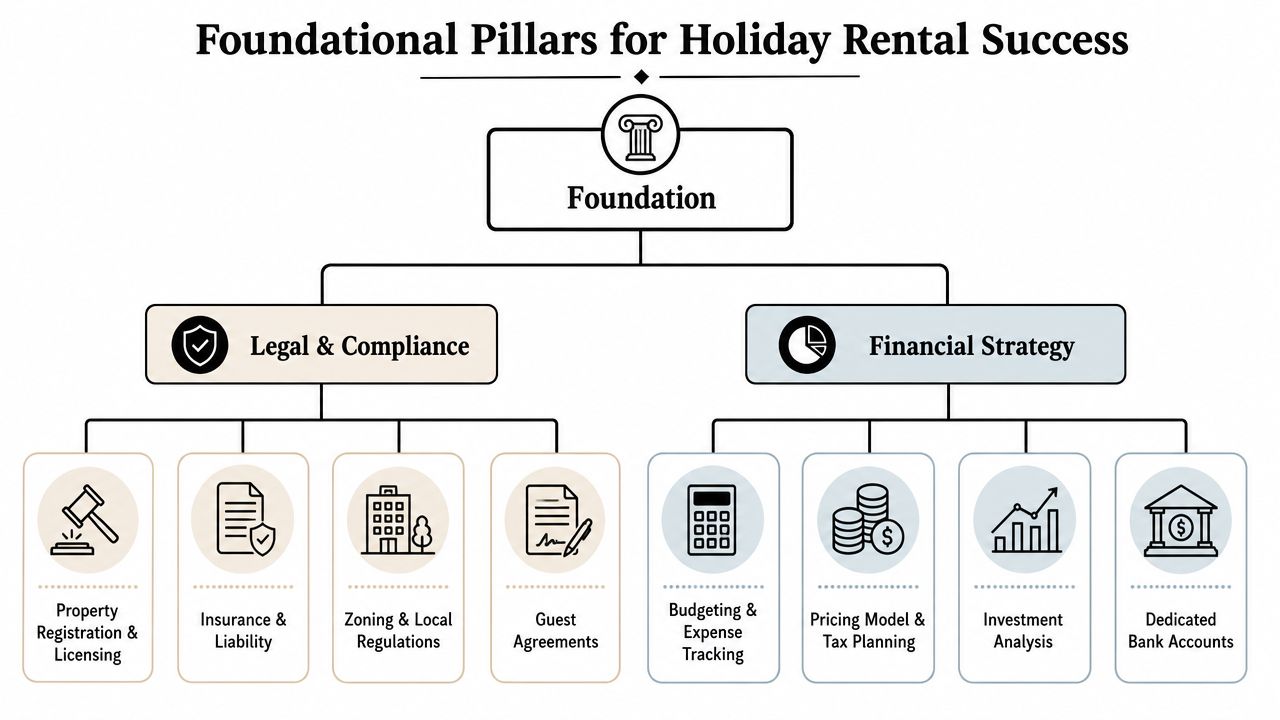
A remote owner should pressure-test three points before exchange or launch:
- whether the intended booking calendar is realistic
- whether owner use will reduce commercial letting flexibility
- whether the asset still works financially if it underperforms in year one
Local rules can reshape the business model
National tax rules do not protect you from local restrictions.
In London, short letting is subject to a well-known 90-night limit for temporary sleeping accommodation in many cases, and guidance from the UK government on short-term lets in London is a better reference point than relying on generic summaries. Outside London, planning position, building type, and local authority enforcement can still affect what you can do in practice.
In these instances, the management decision becomes commercial, not just administrative. A remote investor who buys a flat with lease limits, stricter building management, and uncertain planning position is not choosing between cheap self-management and expensive outsourcing. They are choosing between controlled execution and avoidable legal exposure.
A due diligence file should cover:
| Area | What to verify | Who should own it |
|---|---|---|
| Legal use | Planning status, local authority restrictions, permitted short-let activity | Investor and solicitor |
| Lease and title | Head lease terms, freeholder rules, lender conditions, building policies | Solicitor |
| Rating and tax | Expected treatment based on actual use and booking plan | Investor and accountant |
| Local execution | Who handles inspections, access, and urgent compliance issues on site | Owner, manager, or co-host |
A property can look attractive on a portal and still be structurally weak as a short-let investment if local rules narrow occupancy, delay licensing, or restrict guest use.
Safety and insurance protect revenue, not just compliance
Safety checks are part of yield protection.
A missed gas inspection, expired alarm record, or unclear fire equipment log does not just create legal risk. It can lead to cancelled bookings, guest complaints, insurance disputes, and platform problems at the worst possible time, usually during high season when replacement income is hardest to recover.
The right setup depends on your management model. A self-managing owner abroad needs a named local person who can verify inspections and deal with same-day issues. An outsourced manager should have those duties written into the agreement, with reporting dates and evidence standards. A hybrid model often works well when the owner controls insurance, approval thresholds, and compliance tracking, while a local operator handles physical checks and contractor access.
Insurance deserves the same level of scrutiny. Standard homeowner or buy-to-let cover often does not reflect guest turnover, accidental damage exposure, or income loss after an insured event. This holiday let insurance comparison guide is a useful starting point for reviewing policy wording, liability limits, exclusions, and loss-of-rent protection before you commit.
Build a compliance system that survives distance
Remote ownership fails at the point where paperwork becomes timing.
The issue is rarely that a document never existed. The issue is that a certificate expired between bookings, a cleaner noticed a hazard and no one escalated it, or a contractor attended without sending evidence back to the owner. Distance makes small gaps expensive.
Set up a live compliance register with five fields for every item: requirement, renewal date, document location, named responsible party, and escalation step if the deadline is missed. That system matters more than whether you keep the files in a spreadsheet, PMS, or specialist software.
If you hold multiple units or properties across jurisdictions, software can help reduce missed renewals and broken handoffs. Investors dealing with expanding portfolios often use tools built for managing real estate regulations, especially when different countries or local authorities require different records.
The goal is not more administration. The goal is control. When an investor knows exactly who owns each compliance task, DIY becomes a deliberate choice, outsourcing becomes measurable, and a hybrid model becomes much easier to run profitably from abroad.
Building Your Operational Engine for Flawless Stays
Operations are where amateur ownership becomes visible.
Guests don't see your underwriting model or tax planning. They see whether the check-in message arrived on time, whether the shower drains properly, and whether the property matches the listing. If those basics fail, yield usually follows.
Build repeatable standards first
A well-run holiday let doesn't rely on memory. It runs on checklists, templates, and named responsibilities.
That starts with housekeeping. Every turnover should have a room-by-room checklist, photo verification for key areas, linen control, consumables restocking, and a clear rule for reporting damage before the next guest arrives. Owners who want a practical benchmark for cleaner workflows can review this comprehensive Airbnb property cleaning advice and adapt the logic to their own property.

The strongest operators usually separate three jobs that small owners blur together:
- Cleaning: Reset the home to a measurable standard.
- Inspection: Confirm the clean was done and identify issues.
- Maintenance triage: Decide what needs same-day action and what can wait.
If one person does all three with no audit trail, errors get hidden until a guest complains.
Guest communication should feel personal, even when automated
Good communication isn't about sending more messages. It's about sending the right message at the right point in the stay.
A simple message stack usually includes booking confirmation, pre-arrival instructions, access details, a first-night check-in, checkout guidance, and a review request. Tools such as Hospitable, Guesty, Smoobu, Hostaway, and channel manager messaging systems can handle most of this. The mistake is to automate tone without automating clarity. Guests need practical information, not marketing language.
A reliable sequence should answer these questions before the guest asks them:
- Arrival clarity: Where do I park, how do I enter, and what if I'm delayed?
- House rules: What matters most in this specific property?
- Support route: Who responds if something stops working?
- Departure process: What am I expected to do before leaving?
Clear messages reduce complaints because guests know what to do before confusion starts.
Access and emergency response need local fail-safes
Remote owners often focus on bookings and neglect physical access. That's risky.
Smart locks are usually better than key handovers because they reduce lost-key incidents, support late arrivals, and create cleaner audit trails. But they still need backup. Batteries fail. Wi-Fi fails. Guests enter the wrong code repeatedly. A local contact must be able to solve access problems without waiting for you to wake up in another time zone.
The same applies to maintenance. You need named contractors, not “a plumber I used once”. Build a local bench covering plumbing, electrics, general repairs, appliance replacement, and emergency call-outs. Keep service expectations in writing. Define what counts as an emergency, who approves spend, and when you want photo evidence before work begins.
The listing has to match the operation
Many poor reviews begin with a mismatch, not a defect. The property may be acceptable, but the listing overpromised.
If the flat is on a busy road, say so and position it as central. If parking is tight, explain the vehicle size limit. If there are stairs, show them. Honest listing copy protects conversion quality because the wrong guest is expensive even when they pay full rate.
A practical operating stack often looks like this:
| Function | Typical tool or method | Why it matters |
|---|---|---|
| Messaging | Hospitable, Guesty, Hostaway | Faster responses and fewer missed details |
| Access | Smart lock with backup lockbox | Smoother arrivals |
| Cleaning control | Digital checklist and photo sign-off | Consistency between stays |
| Maintenance | Named local contractors | Faster issue resolution |
| Calendar sync | Channel manager | Prevents double bookings |
If you're still refining the broader guest journey and platform setup, this guide on how to start an Airbnb business helps frame the operational side before you scale.
Mastering Revenue Management for Maximum Yield
Most owners still think pricing means choosing a nightly rate. It doesn't. It means managing demand, lead time, seasonality, channel mix, restrictions, and guest type at the same time.
That's why two similar properties in the same location can deliver very different income.
Static pricing leaves money on the table
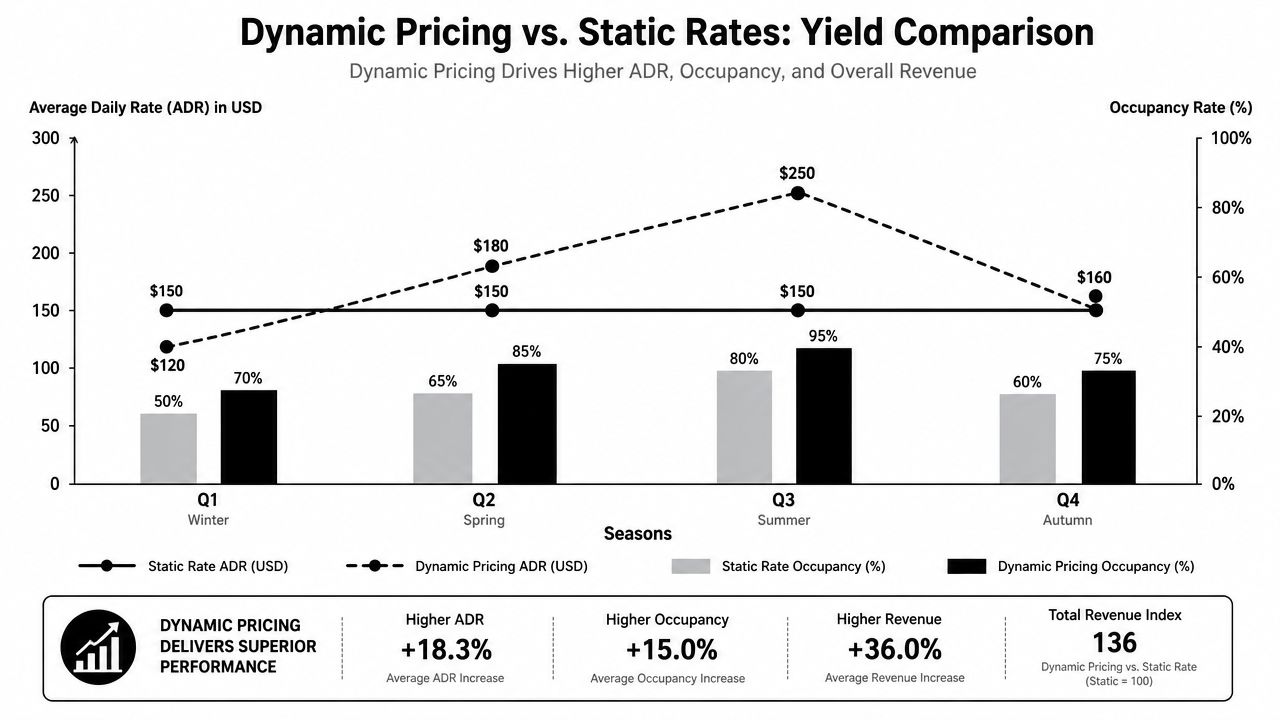
The UK's average vacation rental occupancy stood at 56% in 2025, behind Spain and Portugal at 60%, according to Rentals United's vacation rental statistics. The same market data notes that properties using high-frequency dynamic pricing achieve up to 30% higher occupancy than those using static rates, while listings using Multi-Rates on major platforms earned 3x more revenue.
That doesn't mean rates should rise. It means they should move. A winter weekday should not be priced like a summer weekend. A property with a weak booking pace inside the next two weeks should not use the same logic as one already filling peak dates months ahead.
For context, this visual shows the logic behind dynamic pricing.
Think like a hotelier, not a landlord
Hotels adjust price by date, demand pattern, cancellation flexibility, room type, and booking window. Holiday let investors should do the same.
A practical revenue framework usually includes:
- Base rate by season: Your starting point, not your final price.
- Lead-time rules: Increase or reduce rates depending on how far out the booking sits.
- Minimum stay controls: Tighten these during peak periods and relax them to fill gaps.
- Channel-specific settings: Different platforms attract different guest behaviour.
- Special-event overrides: Festivals, school holidays, and local events should never be left to generic software alone.
Here's the common failure point. Owners buy dynamic pricing software, connect it, and assume the tool solves strategy. It doesn't. The software needs floor prices, ceiling prices, local event awareness, and sensible manual overrides.
A useful benchmark for wider market context is this analysis of holiday let occupancy rates, especially if you're comparing mature leisure markets against newer destinations.
Rate diversification beats one-size-fits-all pricing
The strongest operators don't just vary nightly price. They vary offer structure.
That can include refundable and non-refundable rates, different minimum stays across channels, pet fees where appropriate, direct-booking incentives, or premium pricing around add-ons that are valued by the target guest. The point isn't to add random charges. It's to match pricing to real demand and booking behaviour.
This short video gives a useful introduction to revenue management thinking in practice.
Revenue habit: Review pace, occupancy, and pricing at least weekly. A holiday let priced once per season is usually under-managed.
Established and emerging markets need different pricing discipline
In established markets, there's usually enough booking data and competitor visibility to support tighter pricing decisions. In emerging markets, pricing often requires more manual judgement because demand patterns are less stable and competitor sets are weaker.
That doesn't make emerging markets unattractive. It means revenue management there depends more on local intelligence, owner discipline, and careful channel positioning.
The Critical Decision Self-Management vs Outsourcing
This is the decision that shapes everything else.
Most investors frame it too narrowly. They compare management fees against the idea of “doing it themselves”. A more accurate comparison is between operating models with different costs, control levels, failure points, and scalability.
Mintel's 2025 market report found that 34% of UK holiday let owners reside outside the UK, and that remote owners face a real guidance gap around regulation and tax obligations, as noted in Mintel's UK holiday rental property market report. That matters because a management model that works for a local owner with one property may be completely unsuitable for an international owner with limited time and no local support network.
What self-management actually means
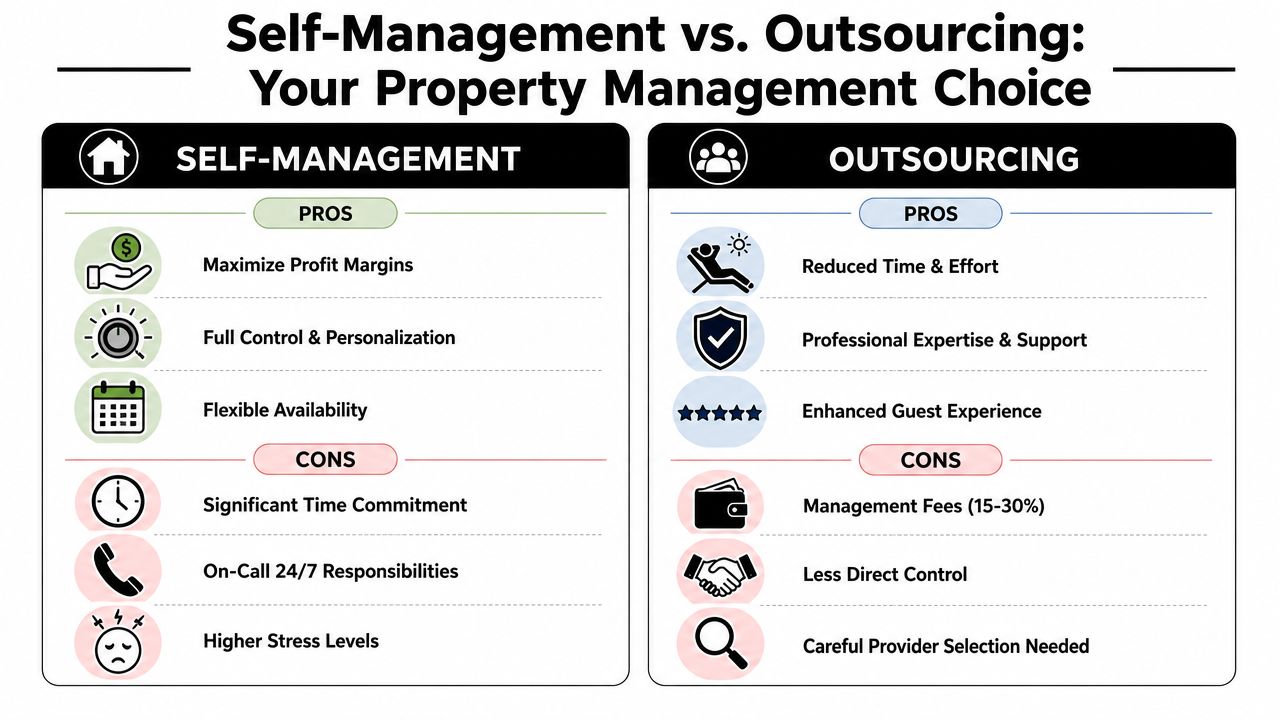
Self-management sounds efficient because it avoids a management fee. In practice, it means you are responsible for pricing, guest messaging, platform optimisation, cleaner oversight, issue resolution, contractor coordination, refunds, reviews, and compliance tracking.
That can work well when three conditions are true:
- You know the local market well.
- You have strong local contractors and a dependable cleaner.
- You're willing to be available outside normal working hours.
Self-management often suits an investor with one nearby property, high control preferences, and enough time to respond quickly. It becomes harder when the property is overseas or when the owner wants to scale.
Full-service outsourcing buys time and local execution
A strong local manager can handle ground operations, cleaner supervision, maintenance dispatch, guest support, and often pricing and channel management as well. That usually improves response times and reduces owner stress. It also lowers the risk that a small issue turns into a public review problem.
The trade-off is obvious. You give up part of the revenue and some direct control.
The infographic above refers to management fees of 15-30%. That figure appears only in the visual context provided, so the more important point in practice is qualitative: fees vary widely by market, service scope, and whether the manager controls bookings, cleaning, guest support, and maintenance mark-ups. Investors should read contracts carefully and test how “full service” is defined before signing.
The hybrid model often fits international investors best
Hybrid management is usually the most underrated option. The owner keeps control of strategy, pricing approval, and financial reporting, while a local team handles field operations.
That model works well when you want:
- Control over commercial decisions: You keep oversight of rates, owner stays, and capital spending.
- Local execution: Someone nearby manages cleans, inspections, guest emergencies, and contractor access.
- Scalability: Systems can expand across more than one property without making you permanently on-call.
Remote ownership usually fails at the handoff point between digital management and physical execution. Hybrid models solve that if roles are clear.
A practical decision table
| Decision factor | Self-management | Hybrid | Full outsourcing |
|---|---|---|---|
| Control | Highest | High | Lower |
| Time demand | Highest | Moderate | Lowest |
| Local presence needed | High | Moderate | Lower |
| Best for overseas owners | Usually weak fit | Often strong fit | Often strong fit |
| Scalability | Limited unless systems are strong | Good | Good if manager quality is high |
What to ask before choosing
Don't ask a manager only about fees. Ask how they operate when something goes wrong.
A serious due diligence list should include:
- Who handles after-hours calls?
- How are cleans checked?
- Do they use dynamic pricing tools or manual pricing?
- How quickly do they dispatch maintenance?
- What reporting does the owner receive?
- Who approves repair spend?
- How do they handle guest damage and dispute resolution?
The cheapest option often becomes the most expensive if standards slip, reviews soften, and occupancy drops.
Measuring Success Financials KPIs and Risk Mitigation
An overseas owner can post a fully booked August, see healthy cash coming in, and still end the year disappointed. The gap usually sits in the lines beneath revenue. Cleaning overruns, emergency repairs, platform commissions, off-season vacancies, and tax treatment decide whether the property performs like an investment or behaves like an expensive hobby.
Measure the asset the way you would measure any operating business. Start with revenue quality, then test whether the management structure you chose can protect margin month after month.
Gross yield helps with first-pass screening, but it is too blunt for management decisions. Net yield shows what the property contributes after the operating burden is paid. If you need a clearer framework for comparing the two, this guide to gross yield vs net yield sets out the difference well.
The KPI dashboard that matters
Three metrics give investors a fast read on whether the current setup is working:
- ADR: Average Daily Rate. This shows pricing power.
- Occupancy: The share of available nights sold.
- RevPAR: Revenue per Available Room. This shows whether rate and occupancy are working together.
Track them together, not in isolation.
High occupancy with weak RevPAR often points to underpricing, discounting, or a property that is busy but not efficient. Strong ADR with soft occupancy can signal overpricing, weak listing conversion, poor reviews, or an operational model that cannot support the rate being asked. For remote owners, these situations make the DIY versus outsourced question practical. If rates lag the market or reviews drift down, the issue is rarely just marketing. It is often execution on the ground.
One strong peak season month can hide a weak annual model.
The numbers that show whether management is earning its keep
Owners based abroad should go beyond headline booking income and review a tighter set of controls each month:
- Net operating margin: Income left after routine operating costs.
- Cost per stay: Cleaning, linen, consumables, and turnover labour per booking.
- Maintenance as a share of revenue: Rising figures often point to deferred capex or poor contractor control.
- Direct booking share: Useful if you want to reduce dependence on major platforms.
- Average review score and complaint rate: These affect future pricing power.
- Cash reserve coverage: Funds available for urgent repairs, replacements, and slower booking periods.
These metrics help you judge the management model, not just the property. A full-service manager on a higher fee can still be the better choice if they protect rate, reduce avoidable maintenance, and keep review scores high. A cheap local operator can destroy margin if standards slip and recovery work follows.
Tax treatment affects return, so fit-out decisions should be deliberate
Tax treatment can materially change net return, especially if the property qualifies for a regime designed for short-term furnished accommodation. In the UK, investors should review the rules applying to holiday let treatment and capital allowances with a qualified tax adviser before purchase and again before refurbishment.
That matters because furnishings, appliances, and fixtures are not only design choices. They shape guest appeal, replacement cycles, and tax efficiency. I regularly see overseas buyers overspend on visible finishes while underbudgeting for durable items that reduce maintenance calls and support better claims for allowable expenditure. The better approach is to model fit-out as part of the asset plan, not as a launch cost that disappears once the listing goes live.
Risk control protects income and exit value
The recurring risks are predictable. Guest damage, poor housekeeping, missed safety checks, unresolved maintenance, and weak documentation all show up first in operations and then in the financial results.
A workable mitigation plan includes:
- Clear booking rules and screening settings on each platform.
- Dated photo records after cleans and after check-out.
- Written approval thresholds for repairs and replacements.
- A reserve fund for urgent works and seasonal cash flow dips.
- Category tracking for repeat issues so root causes get fixed.
- Regular compliance reviews for insurance, licensing, and safety obligations.
Risk management also shapes resale value. Buyers and future managers pay more attention to documented systems, clean financial reporting, and compliance records than many owners expect. A holiday let with stable reviews, controlled costs, and organised records is easier to finance, easier to hand over, and easier to sell.