
Starting a successful Airbnb business is not a matter of luck. It is a calculated venture built on four essential pillars: rigorous market analysis, robust financial planning, strict legal compliance, and operational excellence. This framework separates the casual host from the professional, profitable property investor.
Treating this venture as a serious business from day one is the only viable path to building a sustainable, long-term asset.
Your Blueprint for a Profitable Short-Let Business
Launching a short-term rental business is fundamentally different from listing a spare room. For a global property investor, this is an active investment demanding a clear, structured plan. The key to success is to move beyond the notion of passive income and operate a genuine hospitality business built on a strong foundation. This guide provides that detailed roadmap, focusing on the fundamentals that drive consistent revenue and high returns.
Mastering these core components from the outset will prevent costly errors. Before considering property searches or interior design, it is vital to understand how these pillars function in unison to create a resilient and profitable enterprise.
The Four Pillars of Success
A high-performing short-term rental business is built on four critical areas of focus. Address these correctly, and the subsequent steps become logical and manageable.
- Data-Driven Market Analysis: This involves identifying high-yield locations by analysing key metrics such as Average Daily Rates (ADR), occupancy levels, and local demand drivers.
- Solid Financial Planning: You must secure appropriate financing, accurately forecast all expenditures, and understand the true operational costs, which extend far beyond the property purchase price.
- Strict Legal and Tax Compliance: This requires navigating the complex web of national and local regulations—from planning permissions in England to licensing schemes in Scotland—and ensuring your tax position is optimised.
- Operational Excellence: At its core, this is a hospitality business. Creating an outstanding guest experience through efficient systems for cleaning, communication, and maintenance is what generates five-star reviews and repeat bookings.
This structured approach forces a realistic evaluation of whether the demands of an active hospitality investment align with your financial goals. It provides a framework for making informed decisions at every stage, whether choosing a city like Edinburgh over a coastal town in Cornwall or determining your management strategy.
A crucial first step in any property venture is understanding the numbers. You can learn more about how to calculate return on investment for real estate in our detailed guide. Mastering these fundamentals is the first tangible step toward building a scalable and rewarding portfolio.
Analysing Markets and Choosing Your Location
A property's location is the single most significant factor determining the success of a short-term rental business. A correct decision provides the foundation for a profitable venture; a poor one, based on guesswork, leads to costly vacancies and disappointing returns. A serious investor does not guess; they employ a data-led approach.
Pinpointing a profitable area requires an analytical mindset. It involves a deep dive into the metrics that define supply, demand, and revenue potential in a given market. This skill separates the top 1% of hosts from the rest. This analytical rigour ensures your investment is built on solid ground, as the core principles of what makes a prime location for real estate investment directly drive occupancy rates and final ROI.
A profitable short-term rental business is built on four key pillars, beginning with analysis.
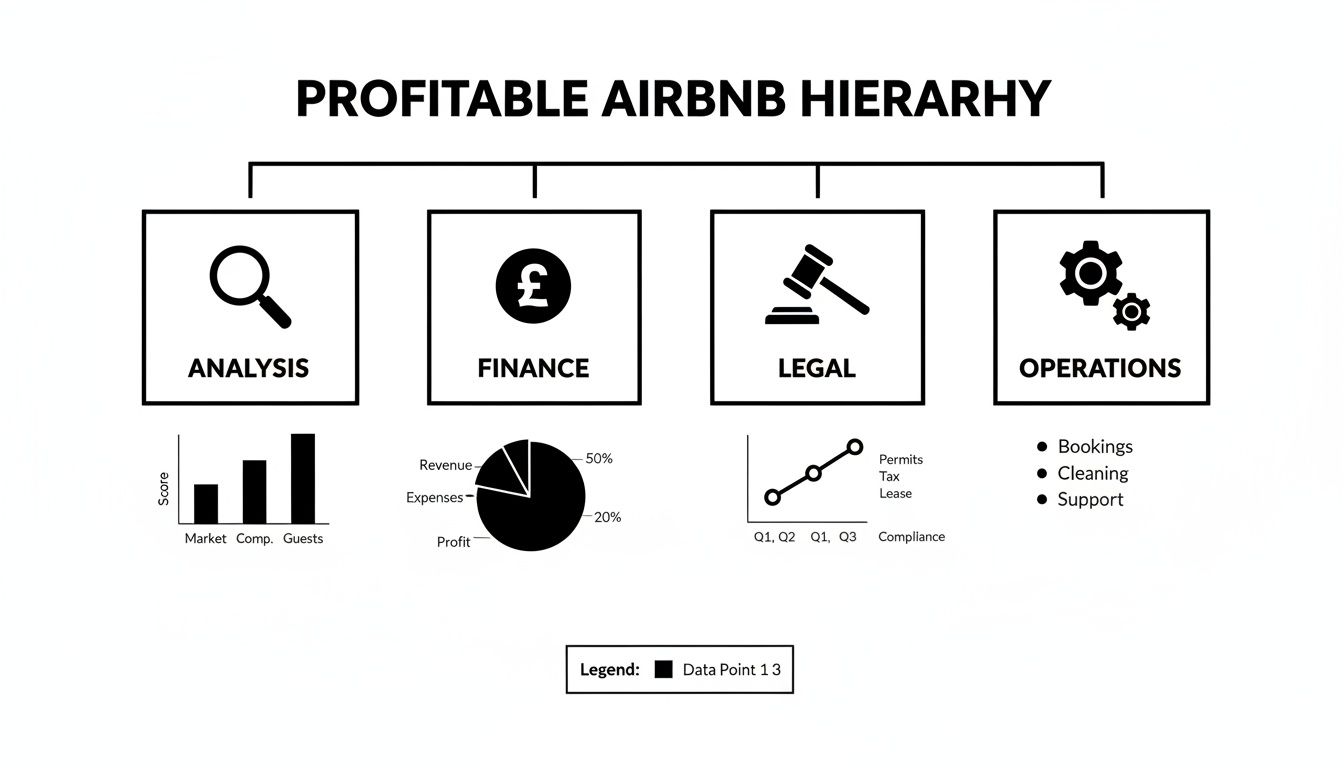
As the chart illustrates, market analysis directly shapes every subsequent financial, legal, and operational decision. An error in this initial step compromises the stability of the entire structure.
Established vs. Emerging Markets
The UK rental landscape comprises two distinct market types: established hotspots and emerging contenders. Prime markets such as central London, coastal Cornwall, and historic Edinburgh are popular for their proven high demand. The drawback is fierce competition and significant acquisition costs.
Conversely, emerging markets present a different opportunity. Consider towns bordering national parks, university cities with a growing conference trade, or areas undergoing regeneration. These locations can offer lower entry costs and the potential for higher yields but demand more thorough research to validate demand. The optimal strategy often lies in finding a balance between proven performance and untapped potential.
Interpreting Core Performance Metrics
To properly evaluate any market, you must become fluent in its core metrics. These figures provide an unbiased assessment of a location’s health and profitability.
- Average Daily Rate (ADR): This is the average rental income per booked night. A high ADR in a location like Bath or the Cotswolds indicates strong pricing power, often driven by tourism and local events.
- Occupancy Rate: This is the percentage of available nights that were booked. An area like York may have excellent occupancy in summer, but its off-season performance must be analysed to gain a complete picture.
- Revenue Per Available Room (RevPAR): This is the gold-standard metric in hospitality, calculated by multiplying ADR by the occupancy rate. It provides the most accurate snapshot of a property's revenue-generating capability.
A common error is to pursue a high ADR while ignoring a poor occupancy rate. A flat earning £300 per night but booked for only 40% of the time is significantly less profitable than one earning £180 per night with 85% occupancy. RevPAR provides clarity on true financial performance.
Urban vs. Rural Investment Dynamics
The choice between an urban or rural setting will fundamentally shape your business model. A city-centre flat in Manchester, for example, will attract business travellers and weekend visitors. They expect seamless self-check-in and proximity to transport links. Demand is often steadier year-round but can be sensitive to economic shifts affecting corporate travel.
In contrast, a cottage in the Peak District appeals to holidaymakers seeking a scenic escape. This market is intensely seasonal, with demand peaking during school holidays. The operational focus shifts to highlighting local hiking trails or providing family-friendly amenities such as a log burner. The pricing strategy must be far more dynamic to adapt to these seasonal swings.
UK Short-Term Rental Market Snapshot Key Metrics by Region
The UK's short-term rental market shows significant growth, but performance is highly localised. The table below, with data projections for May 2025, illustrates how key metrics vary by region, offering insight into potential investment opportunities.
| Region | Booked Nights (May 2025) | Average Daily Rate (ADR) | Market Dynamics & Investor Insight |
|---|---|---|---|
| London | 1,200,000 | £185 | High demand driven by international tourism and business. Competition is fierce, but prime properties in central zones command premium rates. |
| Cornwall | 850,000 | £160 | A primary holiday destination. Highly seasonal, with significant summer peaks. Success is linked to coastal proximity and family-friendly features. |
| Edinburgh | 600,000 | £145 | Year-round demand from tourism, bolstered by major events like the Fringe Festival. Regulatory changes are a key factor to monitor. |
| Manchester | 450,000 | £110 | A strong, balanced market with demand from business, sport, and tourism. Less seasonal volatility offers more predictable cash flow. |
| Peak District | 300,000 | £130 | Growing demand for rural escapes. Success hinges on property character and access to outdoor activities. Vulnerable to weather-related downturns. |
This data highlights that while hotspots like London and Cornwall see the highest volume, emerging urban centres like Manchester offer a compelling blend of affordability and consistent demand. The key takeaway for any investor is to look beyond headline figures and understand the specific demand drivers of a region.
Navigating UK Laws, Financing and Taxes
Once a promising market has been identified, the detailed work begins. This phase involves navigating the legal and financial structures that are critical to the business's success. In the UK, regulations for short-term lets are a complex patchwork that varies by locality, and obtaining correct financial and tax advice is fundamental to profitability.
Many new investors make the costly mistake of treating compliance and finance as an afterthought. A solid grasp of these areas transforms a good location into a sustainable, legally sound investment. This is the bedrock of your Airbnb business, protecting you from fines, penalties, and unforeseen financial challenges.
Understanding UK Legal Obligations
There is no single set of rules for short-term rentals in the UK. Regulations that apply in one city may be entirely different in another, making local due diligence non-negotiable.
In London, for example, the "90-day rule" prohibits letting an entire property for more than 90 nights in a calendar year without planning permission. In Scotland, a mandatory licensing scheme is in place for all short-term lets. This requires hosts to meet specific safety standards and obtain a licence from their local authority to operate legally.
Beyond regional rules, you must comply with national health and safety regulations. These are legal duties designed to protect guests.
- Gas Safety: A Gas Safe registered engineer must conduct an annual gas safety check on any property with gas appliances.
- Fire Safety: You are legally required to adhere to fire safety regulations. This includes fitting smoke and carbon monoxide alarms, ensuring escape routes are clear, and providing equipment like fire extinguishers.
- Electrical Safety: An Electrical Installation Condition Report (EICR) is required at least every five years to certify that all fixed electrical installations are safe.
Securing the Right Property Finance
Financing a short-term let is different from obtaining a standard residential or buy-to-let mortgage. Most mainstream lenders have clauses that prohibit short-term letting, necessitating a specialist financial product.
A holiday let mortgage is specifically designed for this purpose. Lenders will assess the application based more on the property's projected rental income than on your personal salary. They almost always require a larger deposit, typically 25-30% of the property's value, and will want to see solid evidence of rental demand in the area. Our guide offers more detail on the nuances of financing an investment property and what lenders look for.
Securing a holiday let mortgage requires a robust business plan. Lenders will scrutinise your projected income, occupancy rates, and operational costs. They are not just lending on a property; they are investing in your business's viability.
Demystifying Tax for Short-Term Lets
Your tax obligations are a critical component of your financial planning. In the UK, the tax treatment of your property often depends on whether it qualifies as a Furnished Holiday Letting (FHL). Meeting FHL criteria can unlock significant tax advantages not available for standard long-term rentals.
To qualify as an FHL, a property must meet several conditions set by HMRC:
- It must be available for commercial letting for at least 210 days a year.
- It must be let for at least 105 days a year.
- It must not be occupied by long-term tenants for more than 155 days during the year.
Qualifying properties may benefit from Capital Gains Tax reliefs, tax-advantaged pension contributions, and capital allowances for furnishings.
However, the UK government announced in the Spring Budget 2024 that the FHL tax regime will be abolished from April 2025. This significant change will remove these tax advantages, aligning the tax treatment of short-term lets with that of long-term rentals. Investors must factor this policy shift into their financial models, as it will directly impact net profitability.
Property Setup and Listing Optimisation
With the market identified and finances arranged, the next stage is to convert an empty property into a five-star guest experience and an effective booking generator. This is where the investment transitions from a spreadsheet entry into a tangible hospitality business.
This stage requires a dual focus. First, create a physical space that is both appealing and photographs exceptionally well. Second, build a digital presence—your online listing—that captures the attention of your target guest and persuades them to book.
A stunning property is ineffective if it remains undiscovered, and a great listing will only lead to disappointment if the reality does not meet expectations. Both elements must be executed to a high standard to command premium rates and maintain high occupancy.

Furnishing for Aesthetics and Durability
Furnishing choices directly impact both income and expenses. The objective is to balance boutique hotel style, which justifies a premium price, with the durability required to withstand a constant flow of guests. Avoid personal clutter and cheap, flat-pack furniture that lacks longevity.
Adopt a hotelier's mindset. Invest in key items such as commercial-grade mattresses and a solid, comfortable sofa. A neutral, modern design palette looks clean, photographs well, and appeals to a broad audience. High-quality touches often make the difference: crisp, hotel-quality linens, effective blackout curtains, and a well-equipped kitchen.
A common error is to furnish a rental with leftover household items. This projects an amateur image and often leads to mediocre reviews. Every item in the property should be selected to enhance the guest experience and reinforce your brand's quality.
Creating a Listing That Converts
Your Airbnb listing is your most powerful marketing asset. It is not merely a description but a sales proposition. It must sell an experience, build trust, and generate excitement. This begins with the photography.
Poor-quality photos are the primary reason why good properties fail to attract bookings. Hire a professional photographer specialising in interiors. They possess the skills and equipment to make your space look bright, spacious, and inviting. The photo gallery should tell a visual story, guiding the potential guest through the property.
The title and description are equally important.
- Write a Compelling Headline: Instead of a generic "2-Bed Flat in York," use a more descriptive title like, “Historic Retreat by York Minster + Free Parking.” This immediately highlights unique selling points and addresses a common guest concern.
- Craft a Persuasive Description: Use short, scannable paragraphs and bullet points for amenities. Focus on the benefits, not just the features. Do not say "there is a balcony"; instead, write "enjoy your morning coffee on the sun-drenched balcony overlooking the city." Sell the experience.
A well-crafted listing is a strategic tool designed to convert interest into bookings. The difference between a basic effort and a professionally optimised one is stark, impacting everything from search ranking to nightly rates.
Listing Optimisation Checklist for Driving Bookings
| Listing Element | Basic Approach (Low Impact) | Optimised Approach (High Impact) | Expected Outcome |
|---|---|---|---|
| Photos | Phone snaps, poor lighting | Professional photography, styled shots | +30% higher click-through rate |
| Title | "2 Bed Apartment" | "Stylish City Centre Flat + Balcony & Fast WiFi" | Improved search ranking & visibility |
| Description | List of features (bed, TV) | Benefit-driven narrative, scannable format | Higher conversion, justifies premium rate |
| Amenities | Basic amenities ticked | All amenities listed, highlighting unique ones | Attracts specific guest types (e.g., business) |
| Reviews | Responds to some reviews | Responds to 100% of reviews quickly & professionally | Builds trust, boosts Superhost status |
| Profile | Minimal host information | Detailed profile, friendly photo, verified ID | Increases guest confidence & booking rate |
As the checklist demonstrates, optimising these elements drives tangible business results. Each improvement contributes to higher visibility, more bookings, and ultimately, increased revenue.
Dynamic Pricing: A Tool for Maximising Revenue
Pricing is not a static task. A "set it and forget it" approach guarantees lost revenue. An effective pricing strategy is dynamic, adjusting to seasonality, local events, and competitor activity.
There are two main options: manual pricing or automated tools. Manual pricing offers complete control but requires constant market monitoring. Automated tools like PriceLabs or Wheelhouse use algorithms to analyse market data and adjust rates automatically, saving significant time.
Data from London's short-term rental market highlights the importance of this. An AirROI analysis found that over 12 months, the top 10% of listings in London achieved 88% occupancy, whereas the median was only 49%. This gap is often attributable to hosts using optimised listings and dynamic pricing to capture peak demand, pushing average daily rates to £200–£210. Understanding these figures is vital for determining a property's true investment potential. The complete research is available in the AirROI report on the London market.
For most new hosts, a hybrid approach is effective. Use an automated tool for baseline pricing but intervene manually to increase rates for major local events such as concerts or conferences. This blend of automation and human oversight is key to remaining competitive and maximising revenue.
Mastering Operations and Guest Experience
An optimised listing secures the booking, but operational excellence earns five-star reviews and builds a profitable, sustainable business. Once a guest confirms their stay, your role shifts from marketer to hospitality manager. This involves creating systems for a seamless, professional, and memorable experience, converting first-time visitors into repeat customers.
A solid operational plan is the engine of your short-term rental business. It encompasses everything from cleaning schedules and guest communication to contingency plans for unforeseen issues. This is a non-negotiable foundation for any scalable venture.

Building Your Operational Playbook
The first task is to create a detailed playbook for every stage of the guest journey. This is a standardised system that ensures consistency, whether you manage the property yourself or employ a team.
Define clear standards for cleanliness and maintenance. A professional cleaning service is a prudent investment, but they require a detailed checklist from you to ensure nothing is missed. Establish a network of trusted tradespeople—a plumber, an electrician, a handyman—who can respond quickly to emergencies.
Systematise guest communication. Create message templates for key touchpoints:
- Booking Confirmation: Thank the guest and confirm essential details immediately.
- Pre-Arrival: Send clear check-in instructions 24 hours before arrival.
- Welcome Message: Check in a few hours after their arrival to ensure they are settled.
- Checkout Instructions: Provide a reminder of the process the night before departure.
This systematic approach saves time and projects a professional image, building guest confidence.
Choosing Your Management Model
As an investor, you must decide your level of personal involvement. Your choice of management model will directly affect your time commitment, operational costs, and net profit margin.
-
Self-Management: This model offers the highest profit potential by avoiding management fees but is the most time-intensive. You handle all guest communication, coordinate cleaning, and manage any issues. It is a viable option if you live locally and have the necessary time.
-
Co-Hosting: A co-host can manage specific tasks, such as guest messaging or turnovers, for a percentage of the booking revenue (typically 10-20%). This offers a middle ground, reducing your time commitment while keeping costs lower than full management.
-
Full-Service Property Management: This is the most hands-off approach. A professional company handles everything—from listing management and pricing to cleaning and guest services—for a fee of 20-30% or more of the gross revenue. This is ideal for remote investors or those managing a larger portfolio. You can find more on this in our guide to investing in overseas property, where professional management is often a necessity.
The decision to self-manage or hire a professional is a crucial financial one. Calculate the value of your own time. If managing the property yourself prevents you from focusing on acquiring your next investment, it may be a false economy.
The UK short-term rental market is increasingly competitive, making operational efficiency more critical than ever. As of May 2025, the UK had approximately 481,563 active listings, a 7% year-on-year increase in supply. While the Average Daily Rate (ADR) rose to around £309, this growth in supply has put pressure on occupancy in many areas. A flawless guest experience is vital to stand out.
This data proves that a listing alone is no longer sufficient; operational excellence is what secures bookings in a crowded market.
Common Questions About Starting an Airbnb Business
Embarking on a new property venture will inevitably raise questions. This section provides clear, straightforward answers to the most common queries from new hosts, offering the confidence needed to navigate the crucial early stages.
This is a practical reinforcement of the core principles covered, focusing on real-world challenges and opportunities.
How Much Capital is Genuinely Needed to Start?
The capital required varies significantly depending on your entry strategy. Purchasing a property is the most capital-intensive route. You will need a substantial deposit—often 25-30% for a holiday let mortgage—plus funds for stamp duty, legal fees, and furnishings. For a one-bedroom flat in many UK cities, this could amount to £50,000–£75,000 before any operational costs.
There are, however, leaner entry methods. Rental arbitrage, where a property is rented long-term and then sublet on Airbnb (with the landlord's explicit permission), drastically reduces upfront costs. Key outlays are the security deposit, first month's rent, and furnishing costs. A smaller property could potentially be launched for under £10,000.
The lowest barrier to entry is utilising a spare room in your own home. Initial costs can be minimal—a few hundred pounds for a quality mattress, linens, and a lock for the door. This is an excellent way to gain hosting experience with minimal financial risk.
Can This Business Really Be Managed Remotely?
Yes, an Airbnb business can be managed from anywhere in the world, provided you have robust systems and a reliable local team. Remote management is a common strategy, particularly for those investing in overseas property.
The key to success is building an "on-the-ground" support network. This is essential, not optional. Your team should include:
- A Professional Cleaning Service: A trusted team that can handle fast turnarounds and act as your local representatives, flagging maintenance issues promptly.
- A Trusted Handyman: A go-to person for minor emergencies who can respond quickly without your direct oversight.
- Smart Technology: This serves as your remote-control panel. A smart lock for keyless entry is invaluable. A smart thermostat helps manage energy costs, and external security cameras provide peace of mind.
Many investors eventually delegate all operations to a full-service property management company. They take a significant share of the revenue (often 20-30%), but they handle all aspects, turning your property into a genuinely hands-off investment.
What is a Realistic Income Expectation?
Your income potential is entirely dependent on your location. A well-managed flat in a tourist hotspot like Edinburgh or Bath can generate excellent returns, but expectations must be grounded in local data. National averages can be misleading; according to ONS data, UK household disposable income varies significantly by region, which directly impacts local tourism spending.
For instance, a cottage in Cornwall might generate over £40,000 annually, with the majority concentrated in the summer months. In contrast, an apartment in a business hub like Manchester could earn a steadier £2,500–£3,000 per month with less seasonal volatility.
The most significant error new investors make is confusing gross revenue with net profit. From your total booking income, you must subtract mortgage payments, platform fees (around 3%), management fees, insurance, utilities, cleaning, supplies, and a contingency fund for maintenance (budget 5-10% of revenue). Your real profit is what remains after all expenses are paid.
Before purchasing a property, use tools like AirDNA or PriceLabs to analyse competitor earnings in your target postcode. This data-driven approach provides a more accurate forecast than vague regional estimates and helps you build a realistic profit and loss statement. The objective is not a large headline revenue figure but a strong, predictable net yield.
At World Property Investor, we provide the in-depth analysis and market intelligence you need to make confident investment decisions across the globe. Explore our expert guides to find your next high-yield property opportunity at https://www.worldpropertyinvestor.com.