
A UK building survey can cost from £300 to over £1,500 for a detailed structural report on a high-value property, and the average RICS Level 2 survey costs around £560. If you're buying for yield, resale, or long-term capital growth, that fee isn't just a transaction cost. It's one of the few due diligence expenses that can directly protect your downside and strengthen your negotiating position.
Most investors reach this point after the exciting part. You've found the property, run the gross yield, checked comparable asking prices, and started to picture the exit. Then the uncomfortable question appears. What could be wrong that the photos, agent particulars, and video tour won't show?
That is where building survey costs need to be judged properly. Not as an annoying add-on, but as a controlled spend against hidden defects, weak pricing, and poor assumptions. In established markets, buyers often overpay because they under-invest in diligence. In emerging markets, they make the opposite mistake. They buy reports that exist on paper but don't materially reduce risk.
Your First Step in Property Due diligence
A serious investor treats the survey as the first operational test of the deal.
If a property only works when every visible feature is taken at face value, it's not a sound investment. A survey gives you an independent view of condition, maintenance exposure, and immediate repair risk before you commit more legal and financing costs. That matters whether you're buying a London flat, a converted terrace in the North West, or an older villa in a less transparent overseas market.
The practical value is simple. A strong report helps you separate cosmetic issues from structural concerns, urgent repairs from longer-term capex, and seller optimism from physical reality. It also gives your solicitor, mortgage lender, and contractor a clearer starting point. If you're already lining up legal support, it also helps to coordinate diligence early with an international real estate lawyer so legal review and physical inspection aren't working in isolation.
What investors often miss
Amateur buyers often assume the survey is there to confirm the purchase. Professional investors use it to challenge the purchase.
That mindset changes the question from "How much does a building survey cost?" to "What is this report likely to save me from?" Sometimes the saving is financial. Sometimes it's avoiding a weak asset altogether. Both outcomes improve portfolio quality.
Practical rule: If you can't visit regularly, your survey becomes more valuable, not less.
Roofing is a good example. Roof defects often sit in the grey area between visible wear and expensive future liability. A specialist resource like Residential roofing inspection is useful because investors need to understand what a general survey may flag versus what a focused follow-up inspection can clarify.
Where the real leverage starts
The survey is usually commissioned late enough that you're emotionally invested, but still early enough to renegotiate. That's a narrow window, and many buyers waste it.
Use the report to answer three questions fast:
- Is the quoted rent still realistic? Deferred maintenance can affect tenant appeal and void periods.
- Will near-term repairs change yield? A property with solid headline returns can become mediocre once remedial works are priced properly.
- Is the seller's asking price still defensible? If the building condition undermines value, your negotiation should reflect that.
Buyers who handle surveys well don't just avoid mistakes. They buy with cleaner numbers and fewer surprises after completion.
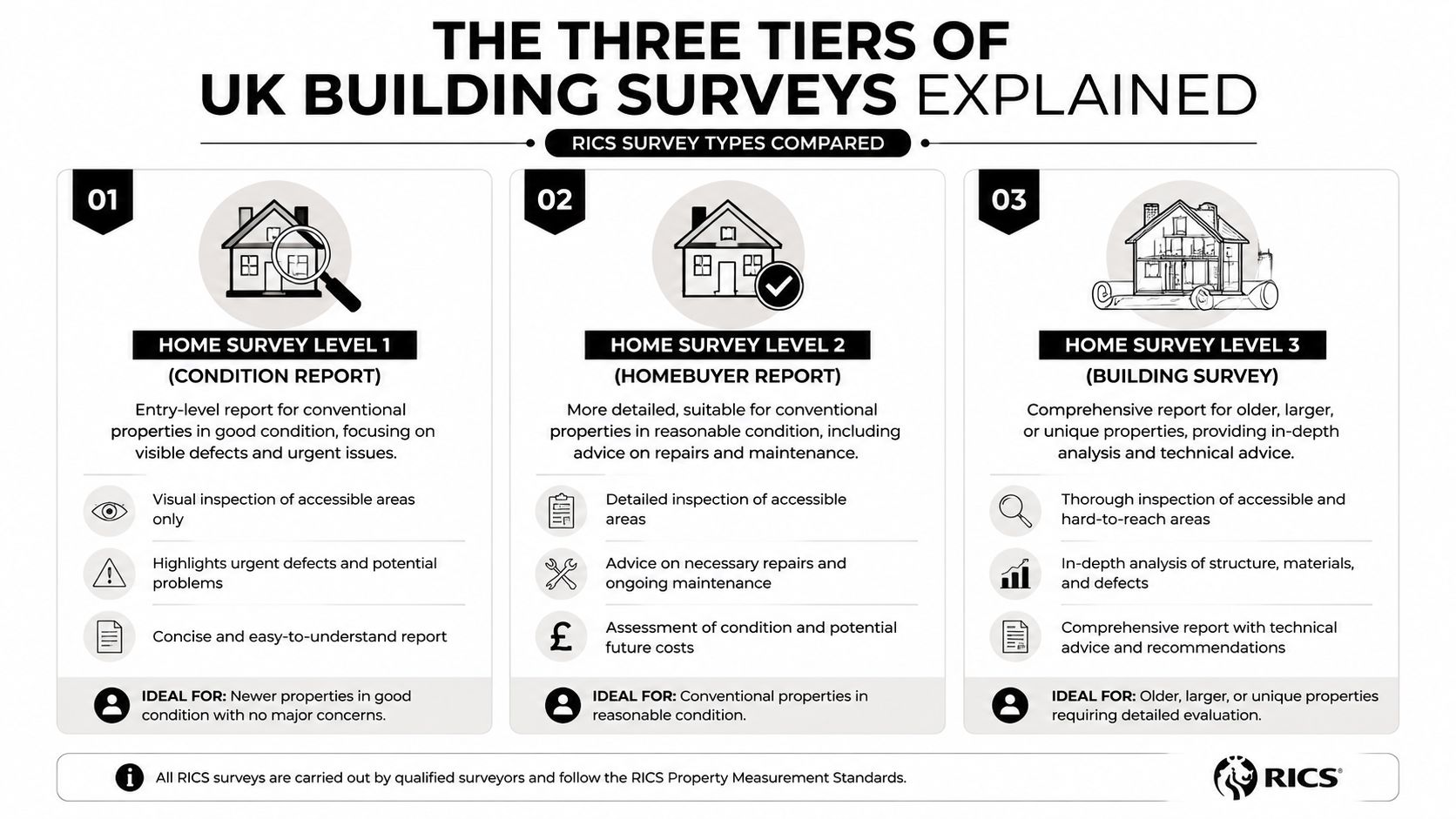
The Three Tiers of UK Building Surveys Explained
The UK market is unusually structured for residential surveys. That helps investors because the choice set is clear, even if the right answer varies by property type.
Level 1 for basic condition checking
A RICS Home Survey Level 1 is the lightest option. It suits straightforward, conventional properties that appear to be in good order and don't raise obvious red flags.
This isn't the report for an older building, unusual construction, or anything with signs of movement, damp history, or alterations. It gives a broad condition snapshot rather than detailed diagnosis. For investors, that means it's usually better suited to simple stock where the main objective is identifying visible issues and obvious urgency.
Level 2 for most standard investments
A RICS Home Survey Level 2 is often the practical middle ground. It is designed for conventional properties in reasonable condition and includes advice on repairs and maintenance.
The pricing data makes that middle-ground role clear. The average cost for a RICS Level 2 survey in the UK is £560, while a RICS Level 3 averages £786, with Level 2 rising to £734 for properties between £600,000 and £800,000 according to Surveyor Local's house survey cost comparison. For many investors buying modern or standard construction, this is the survey that balances cost, speed, and usable insight.
If you're also assessing tenure risk, pair that diligence with a clear understanding of freehold versus leasehold, because the survey tells you about the building, not the ownership structure behind it.
Level 3 for older, altered, or higher-risk properties
A RICS Level 3 building survey is the most detailed residential option. It is the right tool when the property is older, larger, materially altered, non-standard in construction, or too valuable to inspect lightly.
This is where investors buying period property, mixed-use residential stock, converted buildings, or houses with visible defects should focus. A Level 3 should go deeper on condition, likely causes, repair priorities, and technical concerns.
A good Level 3 doesn't just describe defects. It helps you decide what they mean for your pricing, financing, and holding strategy.
A simple comparison
| Survey level | Best suited to | What you get | Investor view |
|---|---|---|---|
| Level 1 | Conventional property in good condition | Basic condition overview | Useful only for low-complexity stock |
| Level 2 | Standard construction in reasonable condition | More detail on repairs and maintenance | Often the most cost-effective choice |
| Level 3 | Older, larger, altered, or unusual property | Detailed analysis and technical advice | Best for complex risk and negotiation |
The mistake isn't choosing the cheapest survey. The mistake is choosing a survey that's mismatched to the asset.
Decoding Building Survey Costs Key Price Factors
Survey quotes vary because the work varies. Investors get into trouble when they treat survey fees as generic and interchangeable.

Property value shapes the quote
In the UK, building survey costs in 2026 range from £300 to over £1,500. A £200,000 property will typically need a basic Level 1 survey costing around £400, while a £1 million property may require a full structural Level 3 survey costing upwards of £1,500, based on HomeOwners Alliance guidance on house survey costs.
Surveyors often use value as a proxy for liability and complexity. High-value assets also tend to justify deeper investigation because even modest defects can have larger pricing consequences.
Age, type, and layout affect time on site
A modern flat in a standard block is easier to inspect than a Victorian house with extensions, a loft conversion, and visible cracking. Complexity raises the time requirement and the professional judgement needed.
That's why two homes with similar asking prices can attract very different quotes. The surveyor isn't only pricing square footage. They're pricing uncertainty.
Location still matters
Regional fee differences are real. The same HomeOwners Alliance guidance notes that London and the South East command higher fees, with Level 3 surveys from £1,000 plus VAT in those markets. That matters when you're comparing established locations with stronger liquidity against lower-entry regional markets.
For budgeting, keep your diligence costs alongside your tax calculations rather than in a separate mental bucket. An investor who forgets transaction friction can make weak acquisition decisions. A stamp duty calculator on property is useful for seeing the survey in the context of the full entry cost.
The quote should match the scope
A survey fee only makes sense if you know what the surveyor is delivering. Many investors accept vague wording and compare quotes purely on headline price. That usually leads to weak reports.
A better approach is to ask for scope in writing. In project terms, you want deliverables, exclusions, and reporting depth to be explicit. If you want a useful model for that kind of clarity, this guide to creating a project SOW is a good reference point. The principle is the same. If the scope is loose, the output usually is too.
Don't compare survey quotes until you've compared survey scope.
A budgeting lens for investors
When I assess building survey costs, I split them into two categories:
- Decision cost. The fee paid to confirm whether the deal should proceed at all.
- Negotiation cost. The fee paid to obtain evidence that may improve your purchase price or contract position.
If the survey can't do either of those jobs, it isn't cheap. It's wasted spend.
Choosing the Right Survey and Avoiding Overspending
The most expensive survey isn't automatically the safest choice. The cheapest survey isn't automatically efficient. The right survey is the one that fits the construction, the age, and the investment plan.

Where buyers overspend
One of the most common mistakes in UK due diligence is buying a Level 3 report because it sounds more thorough. That instinct is understandable, especially for overseas buyers who can't inspect in person. But it can still be poor capital allocation.
According to MyJobQuote's guide to house surveying costs, Level 3 survey costs of £700 to £1,500+ are often quoted as fixed fees, while Level 2 surveys at £400 to £1,000 are frequently sufficient for standard constructions, leading to 30 to 40 per cent overspend when buyers assume the pricier option is automatically safer. The same source notes that a £400 Level 3 quote is often a cut and paste report, while a £750+ report is more likely to include actionable repair cost advice.
That last point matters more than the label on the report. A weak Level 3 can be less useful than a diligent Level 2.
A practical decision filter
Use the property itself, not your anxiety level, to choose the survey.
- Choose Level 2 if the property is standard construction, appears well maintained, and hasn't been heavily altered.
- Choose Level 3 if it's older, unusual, extended, converted, visibly defective, or likely to need substantial capital works.
- Pause and ask questions if a Level 3 quote looks exceptionally low. Cheap detail is often false detail.
A standard buy-to-let flat in a conventional development usually doesn't need maximum investigation. A period house with patchwork refurbishments usually does.
What a better buying process looks like
The strongest buyers ask the surveyor pre-instruction questions such as:
- Will the report comment on likely causes, not just symptoms?
- Will it identify urgent items separately from routine maintenance?
- Will it provide repair guidance that can support negotiation?
- What is excluded from inspection?
These questions tell you more than the fee does.
For a visual breakdown of how buyers approach survey choices, this overview is worth watching before you instruct:
What works and what doesn't
| Approach | What happens in practice |
|---|---|
| Buying Level 3 for every deal | You often spend more than necessary on standard stock |
| Buying the cheapest report available | You risk getting generic findings with little negotiation value |
| Matching survey level to asset complexity | You control diligence spend while still surfacing material risk |
Investor view: Spend for relevance, not reassurance.
That principle applies in every market. Risk reduction comes from fit and execution, not from buying the highest-tier product by default.
A Global Investor's Perspective on Property Surveys
International investors need to adjust their expectations fast when moving between markets. The UK has a relatively structured residential survey framework. Many other markets don't.

A buyer used to RICS terminology can assume every country offers the same hierarchy of inspection and reporting. It doesn't. In the US, buyers often rely on home inspections that vary by state, inspector, and transaction practice. In Spain, technical checks can interact with local building compliance and municipal realities. In some emerging markets, the process is more fragmented, with far less consistency in scope, professional standards, and follow-up liability.
That's why cross-border investors should judge the survey system itself as part of market risk. Major institutions such as Gov.uk, local housing authorities, and national statistics bodies can help with legal and market context, but they won't replace property-specific technical diligence.
Time on site tells you a lot
Inspection duration is one of the clearest indicators of effort. According to MoneySuperMarket's overview of home buyer surveys, Level 1 surveys take about one hour, Level 2 surveys take 90 minutes to four hours, and Level 3 inspections can last up to eight hours. The same source notes that larger, older properties in emerging markets with less standardised construction may incur fees 20 to 30 per cent higher than in established regions.
That doesn't mean emerging markets are bad investments. It means diligence often has to work harder because the underlying building stock, record-keeping, and professional ecosystem may be less standardised.
Established versus emerging markets
A simple comparison helps:
Established markets
- Clearer professional frameworks often make it easier to compare providers.
- Better transaction data can support pricing and exit analysis.
- More standardised stock may reduce inspection ambiguity.
Emerging markets
- Construction variation can increase technical uncertainty.
- Local practices may depend more heavily on personal networks and specialist referrals.
- Documentation gaps can force investors to do more independent verification.
If you're building a cross-border portfolio, treat survey quality as part of country selection, not just property selection. That is especially important when buying property overseas, where distance increases your reliance on third-party reporting.
In international deals, a mediocre report doesn't just miss defects. It widens the information gap between you and the local seller.
The professional investor's habit
Good global investors don't ask whether a survey is required. They ask whether local due diligence gives them enough confidence to price risk properly.
When the answer is no, they either deepen the inspection process or change the deal.
From Report to ROI Leveraging Survey Findings
A survey only creates value if you turn findings into action. Too many buyers read the report, feel uneasy, and then proceed on the same terms.
That is a wasted opportunity.
The report needs usable repair guidance
The most important question isn't whether defects exist. Most older properties will have defects. The primary issue is whether the report quantifies them well enough to support negotiation.
According to this discussion of Level 3 survey value and negotiation gaps, many buyers pay £1,100+ for Level 3 reports that still omit specific repair valuations, which makes it hard to judge whether the fee is recouped through a price reduction. The same source makes the key point that the value depends on the surveyor's diligence in providing useful cost guidance, not just the price paid for the report.
That is the dividing line between information and advantage.
A practical negotiation framework
Once the report arrives, work through it in order.
Separate urgent defects from routine wear
Damp staining, roofing failure, structural movement, drainage concerns, and unsafe electrics belong in a different category from cosmetic redecorating.Ask what affects income or finance
If a defect may delay letting, reduce tenant appeal, or trigger lender caution, it deserves immediate attention.Convert findings into cost items
If the report is vague, get contractor input quickly. On older stock, specialist references can help you sense-check recurring issues. For example, these Harrlie Plumbing tips for old properties are useful for spotting the kinds of plumbing defects that can shift a refurbishment budget.Present the adjustment clearly
Sellers respond better to a concise defect schedule than to alarm. List the issue, likely implication, and estimated remedy.
What to push back on
Not every issue deserves a price reduction. Focus on items that are material, evidence-backed, and hard to dismiss.
| Defect type | Negotiation value |
|---|---|
| Major roof, structure, damp, drainage, services issues | Strong, especially if repairs affect habitability or financing |
| Health and safety concerns | Strong, because delay and remedial costs are immediate |
| Routine ageing and minor maintenance | Usually weaker unless stacked across multiple items |
Ask for a reduction based on works that the next owner must realistically undertake, not on every imperfection in the report.
How to think about ROI
Survey ROI isn't complicated. If the report helps you avoid overpaying, reprices the deal, or stops you buying a weak asset, it has done its job.
A useful way to evaluate it is to compare:
- Survey fee paid
- Immediate price reduction negotiated
- Repair liability identified before exchange
- Future cash flow protected by avoiding under-budgeted works
If you want to model that properly, use a structured property return on investment calculation rather than looking at headline yield alone. A property can still look attractive on paper while hiding enough near-term capex to weaken real returns.
The disciplined investor's edge
The best investors don't use surveys to validate optimism. They use them to tighten assumptions.
That discipline shows up in every stage of the deal. Better offers. Cleaner renegotiation. Fewer nasty surprises after completion. More realistic yield forecasts. Stronger exits later.
A survey fee is small compared with the cost of buying the wrong property at the wrong price with the wrong repair budget.
World Property Investor helps buyers compare markets, assess risks, and make better cross-border property decisions with practical research on yields, taxes, legal structures, and local buying conditions. Explore more country guides, market analysis, and investor education at World Property Investor.