
You've found a market that still attracts serious global capital for the same reasons it always has, stable institutions, transparent title systems, and deep capital-city demand. The catch is that Australian property foreign ownership rules now decide the shape of the opportunity before price or yield ever do. If you start with the wrong asset, you can waste weeks on a deal that was never eligible in the first place.
That is why the post-2025 framework matters so much. It doesn't just block certain purchases, it channels foreign money towards new dwellings, off-the-plan stock, vacant land, and redevelopment that adds supply, which is the point of the policy under the FIRB framework residential land guidance. If you want a useful comparison of how tightly Australia sits against other markets, this legal & economic view of ownership is a good conceptual lens, and so is a country-by-country scan such as this foreign ownership restrictions overview.

Investing in Australian Property The Foreign Buyer Framework
A lot of overseas buyers start from the same place. Australia looks familiar, with stable institutions, clear title records, and housing stock that attracts global capital. The part that changes the deal is the Australian property foreign ownership rules, because they shape what can be bought before price, yield, or suburb ever matter. Start with the wrong asset, and you can spend weeks on a deal that was never eligible.
From 1 April 2025 to 31 March 2027, foreign investors are generally prohibited from buying established dwellings, with limited exceptions. New dwellings and vacant land remain the main residential pathways that can still be approved under the FIRB regime residential land guidance. The practical effect is straightforward. If the asset does not add housing supply, it is far more likely to be blocked.
Why the framework matters to deal selection
This framework is a market map as much as a compliance rule. Foreign capital is being channelled into specific asset classes, so the strongest opportunities are usually where policy and investment logic point in the same direction. If you search Australia like a resale-heavy market, you can waste time on stock that looks attractive on paper but is off-limits in practice.
That pushes serious buyers toward off-the-plan units, near-new stock, vacant land, and redevelopment sites. Those are the product types most likely to fit both the rules and the policy intent behind them. A practical buyer does not just ask whether an asset is appealing. The first question is whether it fits an approved foreign investment pathway.
The trade-off is real. New stock can offer access to the market, but it also brings settlement risk, construction risk, and different underwriting assumptions from an established home. Vacant land and redevelopment may be available, yet they often require a clearer plan, more patience, and tighter execution. Foreign investors who understand that difference can screen deals faster and avoid spending time on assets that will never clear approval.
For a useful benchmark on how restrictive this market sits relative to others, the World Property Investor's overview of foreign ownership restrictions helps place Australia in context. For a broader legal and economic frame on why ownership rules matter in practice, the legal & economic view of ownership is useful background before a search begins.
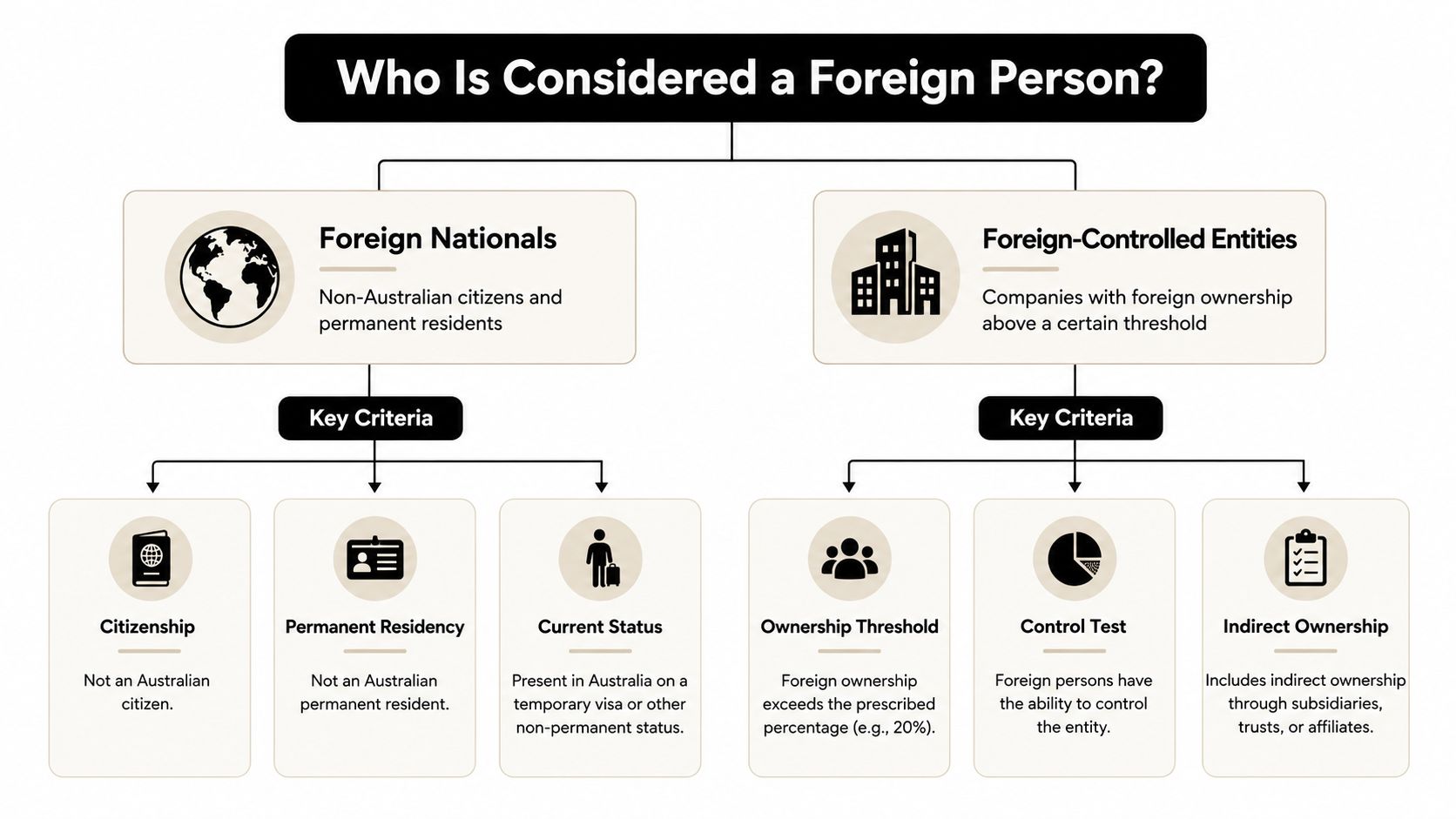
Who Is Considered a Foreign Person
The legal label matters more than nationality in casual conversation. Under Australian property rules, the key question is whether you count as a foreign person for investment purposes, because that determines whether you need approval, notification, or neither. Individuals, companies, and trusts can all fall inside the regime, so the answer is not always obvious from a passport alone.
Individuals, entities, and control tests
For individuals, the cleanest starting point is residency and citizenship status. A person who is not an Australian citizen or permanent resident is usually treated as foreign for these rules, although visa position and other legal details can change the analysis. Companies can also be foreign if they are foreign-controlled, and trusts may be caught when foreign beneficiaries or control rights are relevant, which is why ownership tracing matters so much.
That is why advisers spend so much time on beneficial ownership. A structure that looks local on the surface can still be foreign in substance if the underlying control sits offshore. If you want a plain-language explanation of that concept, this beneficial ownership guide is useful background before any deal is signed.
New Zealand citizens and Australian permanent residents often sit in a different position from other overseas buyers, but the exact treatment can depend on the asset and the statutory test being applied. The mistake I see most often is people assuming their visa, passport, or local company wrapper settles the question. It doesn't. The ownership chain has to be checked properly.
Self-check before you start searching
Use a simple filter before you inspect any property:
- Start with the person or entity: identify who will legally hold the asset, not just who funds it.
- Trace control rights: look through companies, trusts, and nominee arrangements to see who controls the purchase.
- Separate citizenship from residency: these are not the same thing in foreign investment analysis.
- Check whether the buyer is temporary or permanent in status: visa position can affect the outcome.
- Document the result: keep a written file, because the answer can affect both approval and reporting later.
If the structure is not clear on day one, the deal is not clear either. Fix the ownership map before you fix the property shortlist.
That discipline matters because the Australian regime is not built around informal judgement. It is built around defined categories, and those categories are what determine the rest of the process.
What Property Foreign Investors Can Buy
The market breaks neatly into red-light stock and green-light stock. Established dwellings sit in the red-light category, while new supply is where foreign capital is still directed. That split is practical, because it decides whether a transaction can proceed at all.
| Property Type | General Eligibility | Key Condition |
|---|---|---|
| Established dwelling | Generally not eligible | Foreign buyers are broadly banned from purchasing established homes during the current restriction period |
| New or near-new dwelling | Potentially eligible | Usually requires approval and must fit the residential investment framework |
| Off-the-plan property | Potentially eligible | Approval and contract structure need to align with the permitted pathway |
| Vacant land | Potentially eligible | The land must be tied to development and construction conditions |
| Redevelopment cases | Potentially eligible | The project must add to housing supply rather than simply recycle existing stock |
From 1 April 2025 to 30 June 2029, foreign persons are generally banned from buying established dwellings, although limited exceptions still apply, as set out in the ATO property rules. The same guidance says foreign investors can still seek approval for vacant land, new or near-new dwellings, off-the-plan property, and some redevelopment cases. That is the policy signal investors should read first, because it shows where capital can still be placed without running straight into a prohibition.
Where the opportunity sits
The policy logic is straightforward. Foreign capital is being steered toward assets that add to supply, not just compete for existing stock. In practice, that means the more usable opportunities are often in development sites, new apartment projects, and builder-led stock where completion, conditions, and documentation can be managed from the outset.
Vacant land can suit investors who have patience and a genuine development plan, but only if the construction pathway is realistic. If the project stalls, carrying costs and approval conditions start to work against the deal. Off-the-plan purchases can also fit, but they need closer due diligence on the developer, the contract timetable, and the likely settlement outcome.
Rule of thumb: if the asset creates new housing, the conversation usually gets easier. If it only transfers existing housing, the answer is usually no.
For a practical comparison of ownership structures, this freehold vs leasehold guide helps frame the rights attached to the asset type. That distinction matters on redevelopment and land-backed opportunities, because title structure can affect what you can do with the property.
Vacancy still matters. The regime continues the earlier vacancy-fee approach, so a foreign-held dwelling that is not occupied or made available for rent for at least six months in a 12-month period can attract an annual fee. That makes rental readiness part of the investment case, not something to sort out after settlement.
The FIRB Approval Process Step by Step
Foreign buyers often overcomplicate FIRB. In practice, the process is manageable if the file is prepared properly and the asset is eligible. The bigger risk is closing too early, or treating approval as a formality instead of a gate.
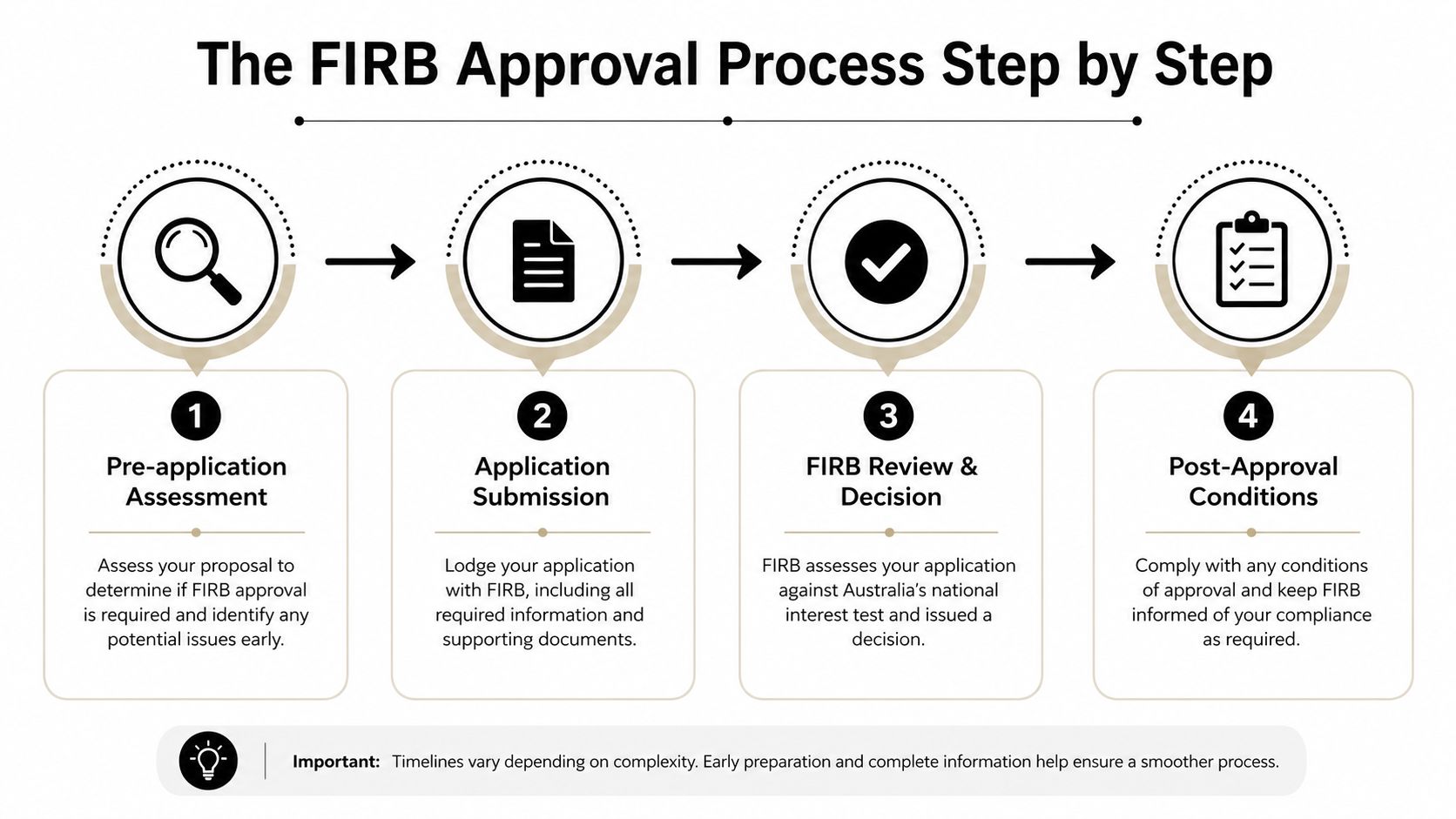
The sequence that usually works
- Confirm the asset type. Determine whether the property is established, new, off-the-plan, vacant land, or redevelopment-linked. If it sits in the banned category, stop there.
- Prepare the application. You normally need the buyer's identity details, ownership structure, and property information. The cleaner the structure, the fewer follow-up questions you get.
- Wait for approval before commitment. For residential land, the process is generally pre-acquisition, not post-sale paperwork.
- Complete post-purchase registration. The acquisition also has to be notified to the Register of Foreign Ownership of Australian Assets, which means this is not a one-off filing.
The legal mechanics matter because compliance is now two-layered. As the earlier section noted, foreign persons generally need pre-acquisition approval under the FIRB/ATO regime, and since 1 July 2023 they must also notify the Register when they acquire an interest in Australian land law handbook overview. For residential land, notification is generally required before acquisition regardless of value.
What to prepare before filing
A strong application is document-led. You should have the contract or draft contract, the buyer structure, the property description, and a clean explanation of how the purchase fits the permitted category. When the buyer is a company or trust, the chain of control needs to be visible. If it isn't, expect delays.
The smoothest approvals I see are the ones that read like a completed transaction file, not a first draft of an idea.
For process support, the right legal help is often worth more than a better sales pitch. A specialist adviser can stop you from mixing approval timing, settlement timing, and registration timing in a way that creates avoidable risk. If that's the stage you're at, this international real estate lawyer guide is a useful reference point.
Navigating Fees Thresholds and Taxes
A foreign buyer in Australia often discovers that the price on the contract is only part of the actual cost. Approval fees, state duties, tax treatment, and the ownership structure can all change the numbers fast. A deal that looks workable on gross rent can turn thin once the full compliance bill is added.
Different asset classes, different barriers
Many foreign investors assume one threshold applies across the board. It doesn't. Existing developed commercial real estate is exempt below A$330 million, while agricultural land needs FIRB approval once the cumulative value exceeds A$15 million BDO foreign ownership requirements. Residential property sits in a much tighter frame, which is why the same investor can face very different treatment depending on the asset class.
That gap matters in practice. Commercial property can give a foreign buyer a cleaner way to deploy capital without the same housing restrictions, provided the asset fits the exemption. Agricultural land can also be attractive, but the cumulative value test means approval issues can surface earlier as the portfolio grows. Residential property is the most tightly controlled part of the market, so the policy burden is heavier and the execution risk is higher.
For deal selection, the rule set acts like a map. It channels foreign capital toward specific asset classes, especially new builds, qualifying commercial assets, and land that fits the approval framework. That gives investors a practical filter before they spend time on due diligence.
Fees, tax, and structural costs
State charges matter just as much as the federal screen. Foreign buyers in Australia often need to budget for stamp duty surcharge, and that is where many models break down. For a plain explanation of how that charge sits inside the transaction stack, this stamp duty guide is a useful reference.
The structure of the purchase can also change the long-term result. If you are assessing whether the extra friction is worth it, a tax-aware lens such as structural claim tips for property investors helps show how building-related deductions and capital treatment affect returns over time. That does not remove the foreign buyer rules. It changes how the asset should be underwritten.
- Model the approval cost early: do not leave FIRB and state surcharges to the end of the spreadsheet.
- Test the asset class first: a commercial or redevelopment path may work where a plain residential purchase does not.
- Watch settlement economics: new-build and off-the-plan deals can bring different timing and funding risk from completed stock.
- Use post-tax returns, not gross yield: the compliance burden can distort a promising headline number.
The practical lesson is straightforward. In Australia, the best gross yield is not always the best deal once the legal structure is included. The better purchase is the one that clears the policy screen and still works after the full cost stack is applied.
Penalties Compliance and Ongoing Obligations
Non-compliance is expensive because the system is built to make off-book ownership difficult. It's not just a matter of paying a late fee and moving on. The regime can force corrections, impose penalties, and in serious cases unwind a transaction if the buyer ignored the rules.
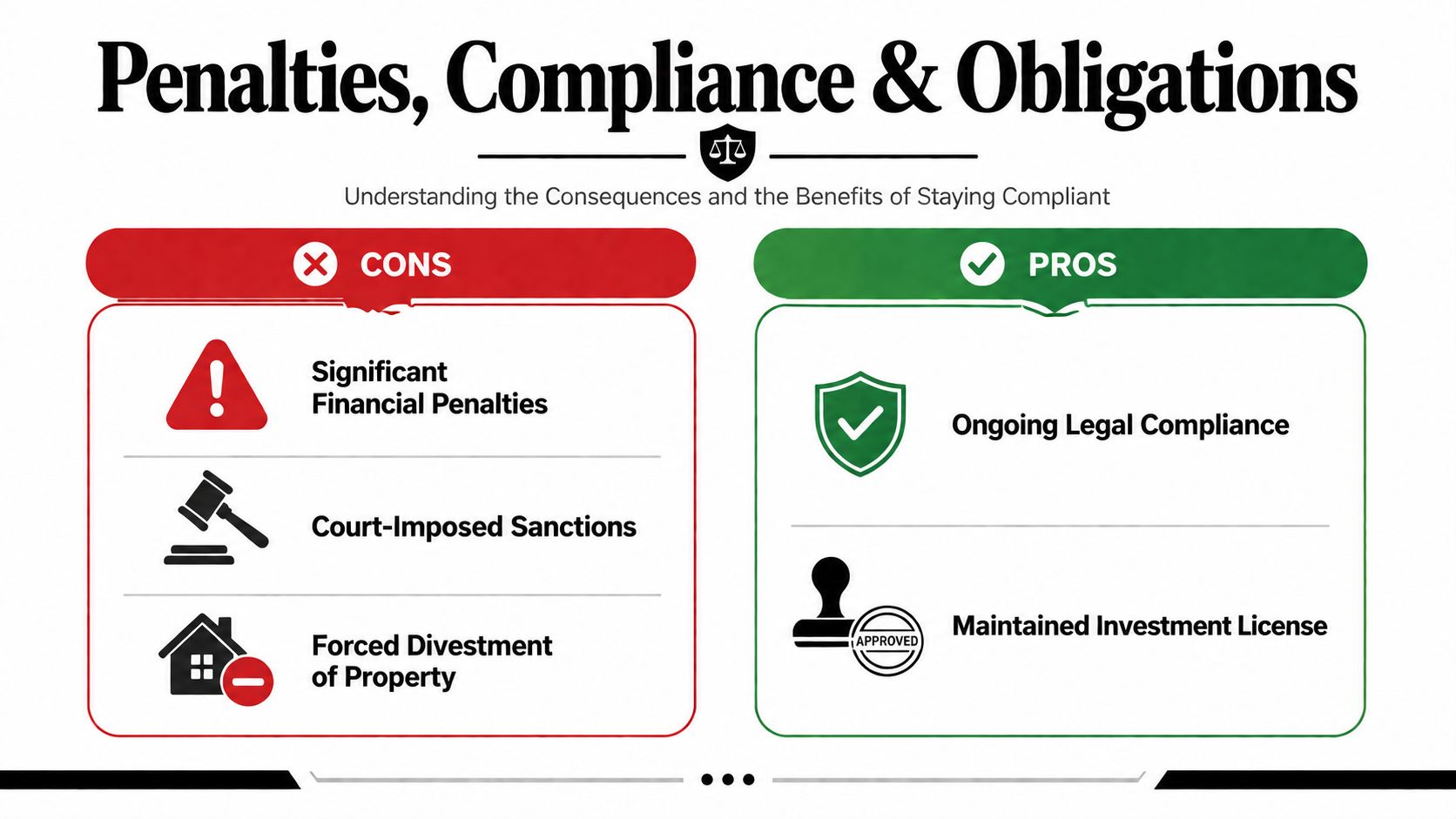
What ongoing compliance really means
The register is central to enforcement. At 30 June 2025, foreign persons from 132 countries held registered interests in Australian residential land ATO register report. That shows how broad the compliance footprint is. It also means the system is not only about getting permission at the start, it is about keeping the record accurate when assets are bought or sold.
Foreign owners must keep those records up to date when they acquire or dispose of relevant Australian assets ATO register report. In other words, the Australian property foreign ownership rules operate as a live reporting system, not a one-time filing exercise. That matters for group structures, refinancing, portfolio sales, and any later change in beneficial ownership.
Vacancy fee and rental readiness
The vacancy-fee rule is operationally important because it changes how you hold the asset. If a foreign owner's residential property is not occupied or available on the rental market for at least six months in a 12-month period, an annual vacancy fee can apply ATO property rules. That means an empty apartment is not a neutral holding position.
Best practice: underwrite the property as if it must be rentable from day one, because that is often what the compliance position demands.
The practical response is straightforward. Keep records clean, track tenancy availability, and make sure any change in ownership or structure is reported correctly. For high-net-worth owners, this is usually easiest when the legal, tax, and property management teams work from the same file rather than separate assumptions.
Strategic Takeaways for International Investors
Australia is still attractive, but the strategy has changed. Foreign capital is no longer free to chase the broad housing market, it is being directed towards new supply, land with development potential, and certain redevelopment pathways residential land guidance. That is not a side note. It is the main investment signal.
For the right buyer, that creates an advantage. If you want to compete intelligently, shortlist assets that are structurally eligible first, then assess yield, holding cost, and exit liquidity. The best outcomes usually come from new developments, off-the-plan acquisitions, and vacant land that can be built on, not from trying to force a resale home into a prohibited category.
A sensible checklist is short:
- Confirm your buyer status.
- Classify the property correctly.
- Secure approval before commitment.
- Register the holding properly after acquisition.
- Budget for all taxes, fees, and ongoing obligations.
That sequence is what separates a viable Australian deal from a costly false start. If you want to compare Australia with other destinations or build a more disciplined cross-border buying process, explore the market guides and investor resources at World Property Investor.