
You can be sitting in London with a spreadsheet open, a deposit sitting in an account, and three routes on the screen, Portugal, the UAE, and Turkey. The question looks simple at first, until you realise you're not just buying a passport story, you're committing to a real property asset, a holding period, and a resale constraint that will decide whether the numbers work or not. That's why Turkey citizenship by investment should be treated as a property decision first, and a citizenship decision second.
For UK buyers, the attraction is obvious. Turkey gives you a property-linked route into citizenship, not a donation-only route or a pure funds allocation, and that makes the asset quality matter far more than most glossy migration brochures admit. The programme was launched in January 2017, and the main real-estate route now sits at a minimum USD 400,000 with a 3-year hold, which already tells you this is a higher-capital, more serious route than it once was. The state's own investment guide sets out that threshold and the holding period clearly, and it's the right place to start if you're comparing Turkey with better-known residency options. Turkey's official investment guide
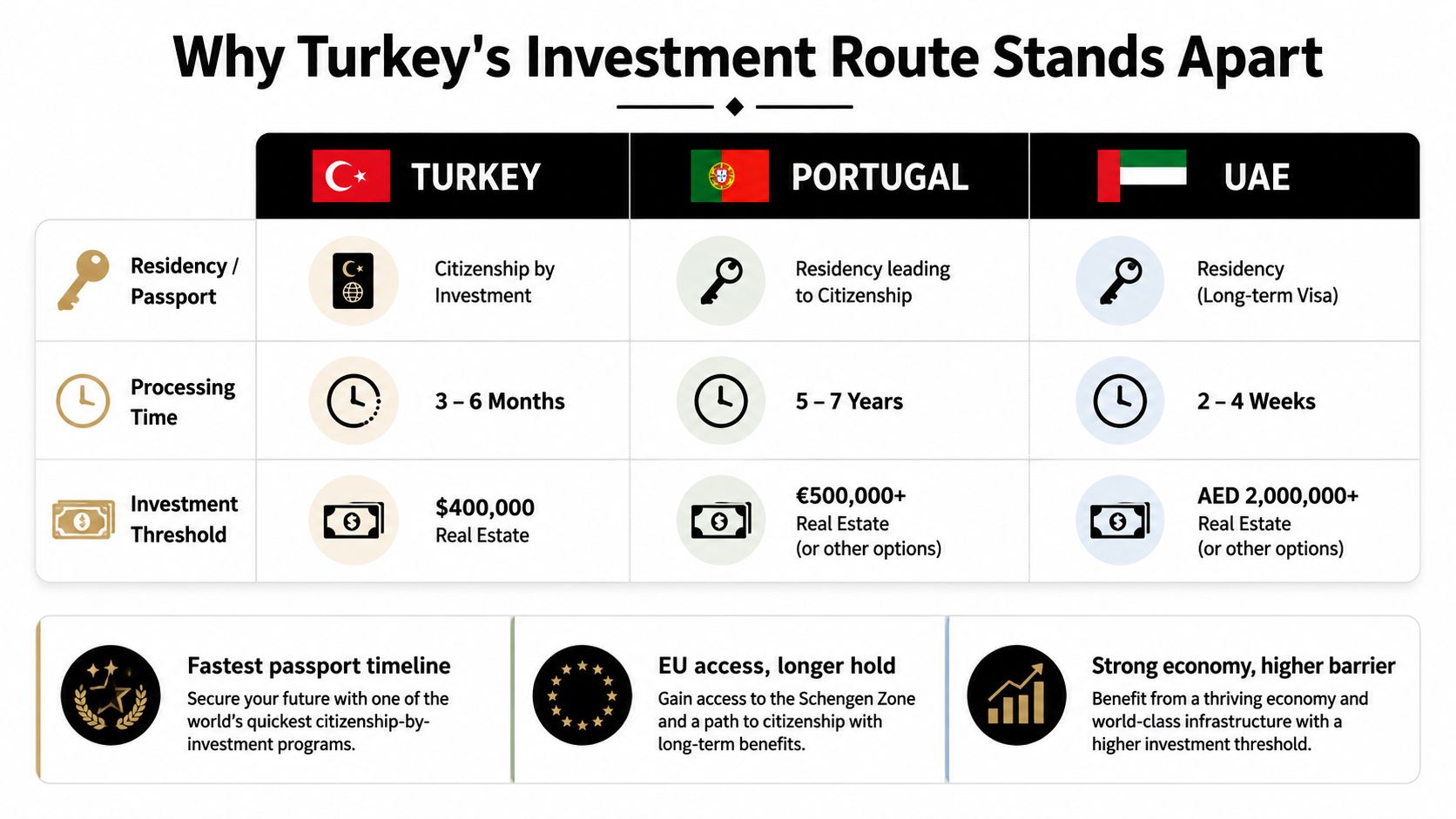
Practical rule: if the property wouldn't make sense without the passport angle, don't buy it. The citizenship benefit should improve a decent investment, not rescue a weak one.
Turkey matters in the wider investor-migration market because it became institutionally large very quickly. Henley & Partners said Turkey's programme accounted for 15 to 20% of the investment-migration industry in 2022, which is a sign of scale, not novelty. That matters for buyers because scale usually means more established process, but it also tends to attract more competition, more intermediaries, and more mediocre stock pitched as “citizenship approved”. The right answer isn't to chase the headline. It's to decide whether Turkish property offers enough yield, liquidity, and resale comfort for your risk appetite.
If your main aim is EU-style mobility, Turkey isn't the same play as Portugal. If your main aim is a strong market with a visible legal route and a property you can understand, it's a credible shortlist candidate. For a deeper market view, I'd also look at the wider property investment in Turkey before you let the citizenship label steer the purchase.
Table of Contents
- How the Programme Is Structured
- The Property Route in Practice
- From Purchase to Passport
- Where the Property Numbers Deliver
- Risks, Due Diligence and the Three-Year Trap
- How Turkey Compares to Portugal, Spain and the UAE
- Your Practical Next Steps and Common Questions
How the Programme Is Structured
Turkey's route is best understood as a set of capital options, not a single property trick. The state keeps the property pathway in the same legal family as other qualifying investments, which is why serious investors need to compare the routes before deciding that real estate is automatically the right answer. In practice, the property route is popular because it fits how most UK buyers think, tangible asset, title deed, visible location, eventual resale. But it is only one track in a broader capital-based framework.
The official menu includes USD 500,000 for a fixed capital contribution, USD 500,000 in a bank deposit, USD 500,000 in government bonds, USD 500,000 in real-estate or venture-capital fund shares, USD 500,000 as a private pension contribution, or creating at least 50 jobs. Henley Global's programme summary lays out those alternatives plainly. Henley Global's Turkey programme summary
Turkey Citizenship by Investment, Qualifying Routes
| Route | Minimum Amount | Hold Period | Notes |
|---|---|---|---|
| Property purchase | USD 400,000 | 3 years | Main route for property buyers |
| Fixed capital contribution | USD 500,000 | 3 years | Business and corporate route |
| Bank deposit | USD 500,000 | 3 years | Cash-based option |
| Government bonds | USD 500,000 | 3 years | Public debt route |
| Real-estate or venture-capital fund shares | USD 500,000 | 3 years | Fund-based investment |
| Private pension contribution | USD 500,000 | 3 years | Long-term savings route |
| Job creation | 50 jobs | Not framed as a holding route | Employment-led option |
The point of that menu is simple. Turkey is not forcing every applicant into property, but it is giving property investors the cheapest mainstream qualifying entry. That makes the programme appealing to buyers who would rather own something visible than park capital in bonds or deposits. It also means the property route will always attract a different profile from the fund route, more owner-occupiers, more holiday-home buyers, more family money, and more people who want an asset they can use.
The programme is not a residency toy. It's a citizenship decision wrapped around a capital allocation decision, and the property market still has to justify itself on its own merits.
The final approval is still discretionary at the top of the system. You can satisfy the threshold and still fail if the paperwork is sloppy or the asset doesn't meet the rules. That's why a clean file matters more than a clever story. For a broader buying framework, the citizenship by investment guide is worth reading alongside the legal route map.
The Property Route in Practice
The property route looks straightforward on paper, but the closing mechanics are where buyers either protect themselves or make expensive mistakes. The qualifying purchase price is USD 400,000, but the number alone is not enough. The price has to be backed by a state-approved valuation report, and the payment has to move through a Turkish bank with funds converted at the Central Bank of the Republic of Turkey exchange rate and documented by a Foreign Exchange Purchase Certificate. Those are not formalities. They are the proof chain that makes the purchase eligible.
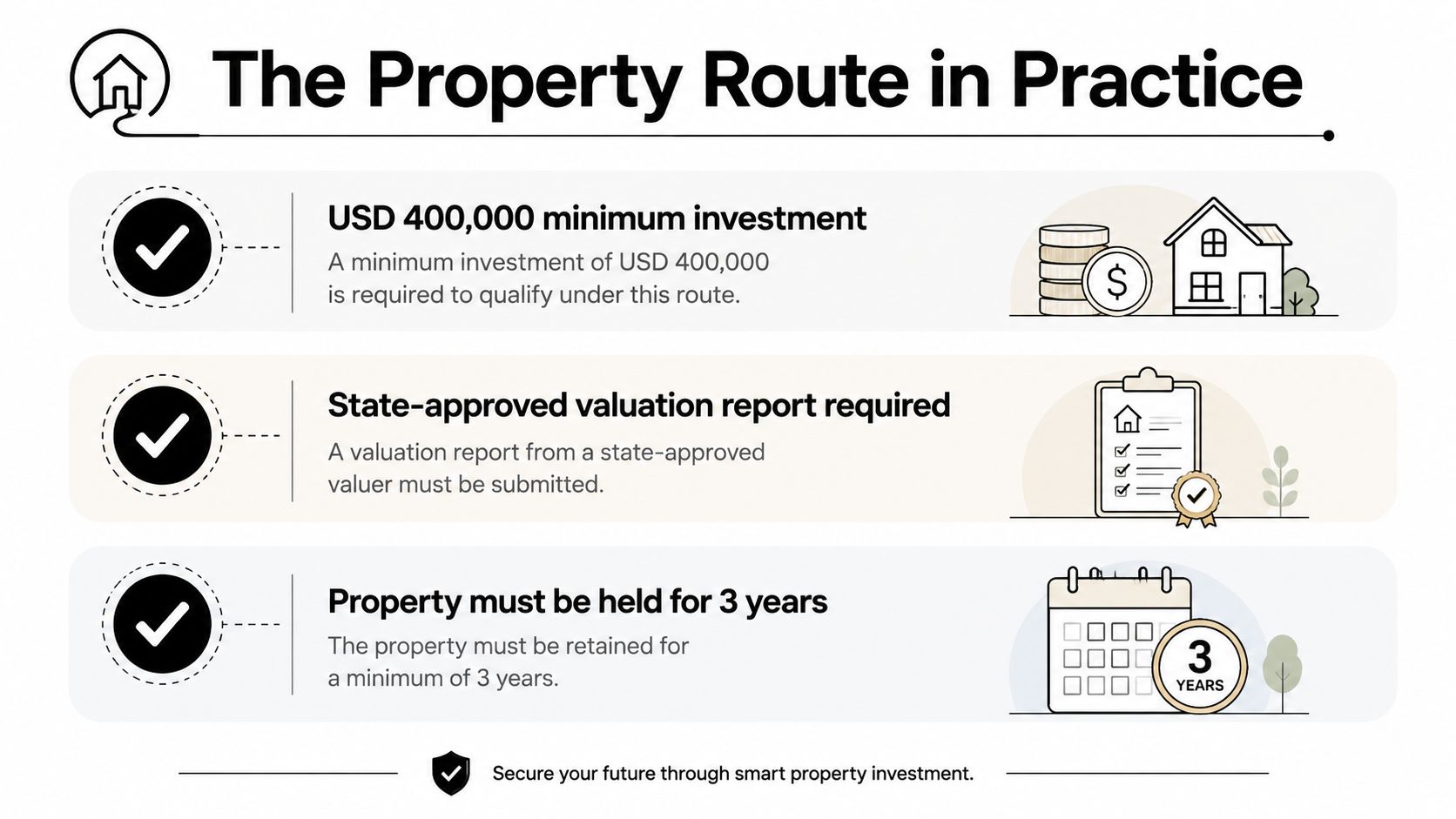
What to check before you transfer funds
Start with the title and the asset itself. Multiple properties can be combined to reach the threshold, but undeveloped land plots do not qualify. That matters because some sellers will try to package cheap land, half-finished units, or awkward titles as if they were equivalent to a clean apartment sale. They aren't.
Then look at the paperwork sequence. The valuation report must support the declared price, not sit awkwardly beside it. If the valuation comes in low, or if the paper trail on the payment route is unclear, the file will become harder to defend later. That's where buyers who are used to informal overseas transactions get caught out.
Practical rule: if the seller or agent wants to “fix the paperwork later”, walk away. For this route, later is usually too late.
I'd also insist on due diligence at the title office level, not just on the brochure level. Your lawyer should confirm who the seller is, whether the property is eligible, whether the payment route is clean, and whether the valuation and bank documents line up with the purchase contract. If you want a practical buying checklist, see how to buy property in Turkey.
The safest way to think about this route is as a closing checklist with citizenship attached. Buy the right asset, document the payment properly, preserve the valuation trail, and keep the title clean. If any one of those links is weak, the application becomes a gamble rather than a process.
From Purchase to Passport
The application sequence is more structured than many brokers admit. First comes the conformity certificate from the relevant authority. Then the applicant applies for a short-term residence permit under Article 31/1(j). Only after that does the citizenship application move forward for a Presidential decision. The investment itself must be held for 3 years, and that lock-up is not negotiable.
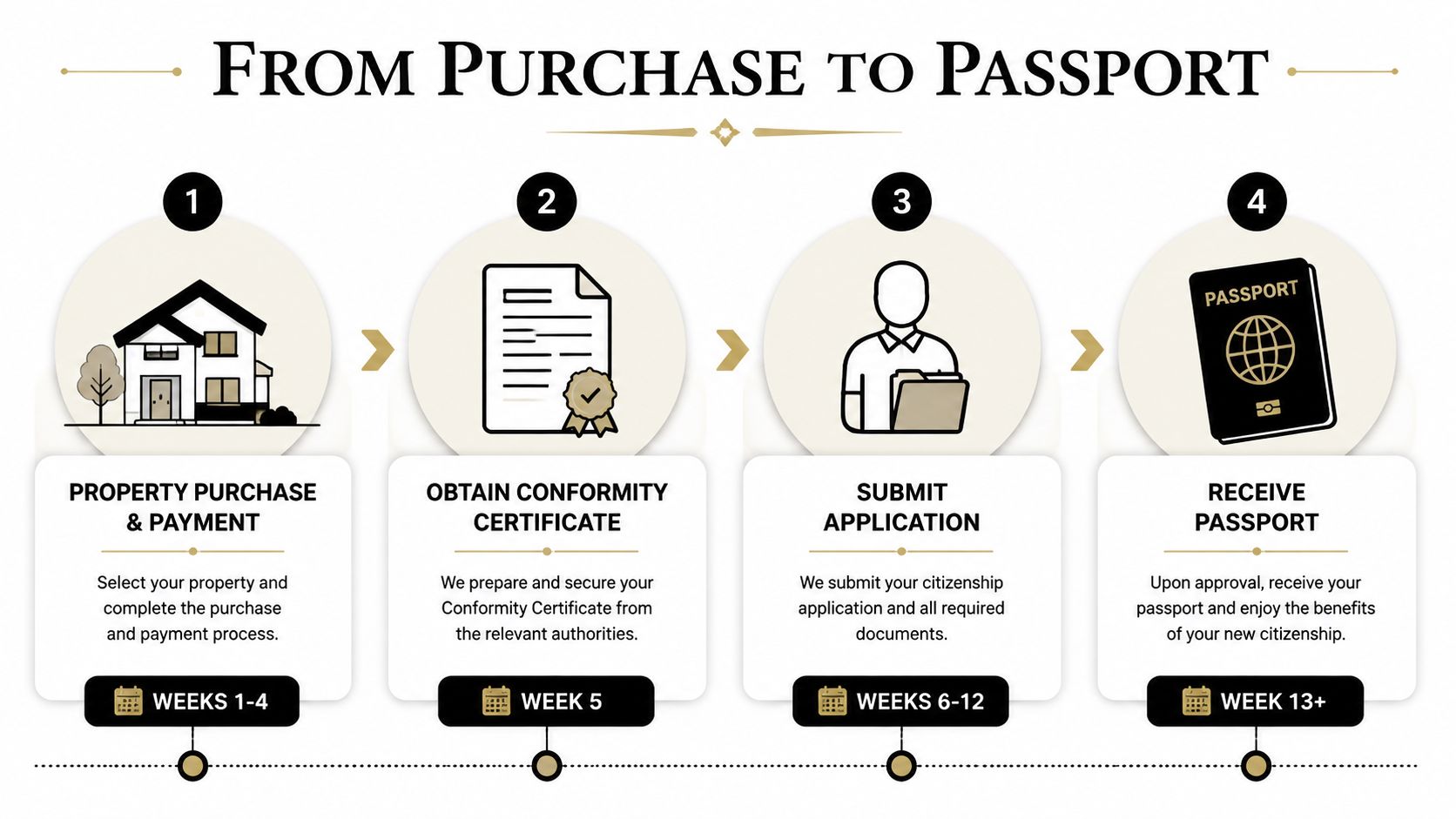
The sequence matters because it shows where files break down. Source-of-funds questions can slow the residence stage. A weak valuation can delay the conformity certificate. A messy title deed or an incomplete family pack can stall the citizenship decision. None of those issues is mysterious, but they're common enough to wreck a supposedly simple case.
Documents and admin that need respect
You'll need properly translated and apostilled civil documents, clean identity records, and a coherent source-of-funds file. If dependants are included, the family structure has to be set up properly from the start. I've seen too many buyers assume the main applicant can “sort the family side later”, then discover the paperwork doesn't neatly follow the money.
The best files are boring files. Straight ownership, clean bank trail, and no gaps between the purchase and the citizenship application.
There's also a strategic choice here. Some buyers use one main applicant and keep the structure simple. Others bring in more than one adult co-investor, especially where the family is already pooling capital for a holiday home or long-term base. That can work, but only if the ownership and application roles are clearly drafted before completion.
For a useful source-of-funds framework, the source of funds verification guide is the sort of practical reference that saves headaches later. If you're trying to move from contract to approval without drama, keep the process dull and documented.
Where the Property Numbers Deliver
The citizenship threshold is only half the calculation. The question is whether the property earns its place while you wait out the holding period. Treat Turkey as a property decision first and a passport decision second. The asset has to stand on its own, because a weak purchase does not become a good one just because the citizenship file is clean.
A glossy villa can look perfect in a sales video and still be a poor investment. A plain apartment in a better rental pocket can produce a stronger outcome, cleaner occupancy, and a better exit. That trade-off is exactly where many buyers get it wrong.
What I look for in a Turkish asset
I start with demand, not lifestyle. Istanbul suits buyers who want depth, a large domestic market, and a wider resale pool. Antalya and Alanya are more direct holiday and rental markets. Bodrum and Çeşme sit higher up the prestige ladder, which can suit personal use and capital preservation, but the income profile is usually thinner. Bursa appeals to some investors because of its connectivity and broader regional economy, but it still needs careful location selection.
The city matters, but the micro-location matters more. A property near transport links, established services, and an active tenant base is easier to rent and easier to sell later. A weak location with a strong brochure is still a weak location.
Your citizenship asset should fit your exit plan. If you want rent during the hold, buy where the letting market is broad and predictable. If you want a polished second home with citizenship attached, accept that the return may be lower and the holding costs may carry more weight.
Practical rule: do not buy a “citizenship villa” because it photographs well. Ask who rents it, who buys it later, and what the running costs do to your real return.
Holding costs are where the story gets serious. Property taxes, insurance, maintenance, management fees, and the day-to-day cost of keeping a foreign asset in good order all eat into returns. If you ignore those charges, the headline price tells you very little about the actual investment case.
The strongest deals are usually the simplest ones. Clean layouts, good transport access, and an obvious rental audience tend to perform better than trophy assets with awkward floor plans or narrow buyer appeal. That matters even more if you plan to use the property yourself for part of the year and let it the rest of the time. The citizenship outcome is valuable, but it should never blind you to weak rentability or a difficult resale. On this route, the property has to justify itself.
Risks, Due Diligence and the Three-Year Trap
The biggest mistake buyers make is treating the three-year hold as a minor administrative note. It isn't. If you buy badly, you're locked into that mistake for the full holding period, and the citizenship route makes the consequences more expensive because the asset can't be treated casually. The market data matters here too. By 2022, foreigners had acquired Turkish citizenship rights through investments totalling USD 7.53 billion across 25,969 individuals, and industry reporting has put the cumulative total at 40,000 applications and USD 15 billion since 2017. A Henley & Partners analysis also estimated that roughly USD 3 billion of Turkey's USD 7.6 billion in foreign direct investment in 2021 came from the programme, implying it may have represented about 39.5% of total FDI that year. Peer-reviewed economics paper and industry analysis
Where deals go wrong
Title risk is the first problem. If the Tapu file is dirty, the rest of the process becomes fragile. Currency risk is the second. You are buying and converting through a local banking process, so your sterling planning and Turkish lira reality can diverge quickly if you don't budget conservatively. Then there's the resale trap, a property bought for citizenship can look fine on entry and still be awkward to exit if the market softens or the asset was overpriced at the start.
Developer risk is the other thing I'd watch hard. Ask for the completion history, bank guarantees where relevant, and evidence that the project isn't just glossy marketing. If the seller is not a Turkish national or a qualifying corporate entity, your lawyer should stop the deal cold and verify the chain.
For ownership structuring, the beneficial ownership guide is useful because citizenship purchases often involve family capital, trusts, or informal understandings that never hold up when the file is tested. That's the exact point where people discover they've confused control, title, and application rights.
My view is blunt: if the asset relies on optimistic resale, aggressive rent forecasts, or a developer's verbal reassurance, it's not a citizenship purchase, it's a risk transfer.
How Turkey Compares to Portugal, Spain and the UAE
Turkey wins on entry cost and straight-line simplicity for property buyers. The main route sits at USD 400,000, which is below the USD 500,000 capital routes used in other structures and far below the typical AED 2 million UAE property-linked standard visa threshold. It also asks you to hold for 3 years, which is shorter than the long residency runway many buyers associate with Portugal's older real-estate logic. That alone puts Turkey in a different bracket for people who want a faster property-linked outcome.
Portugal still has the appeal of EU proximity and a different lifestyle proposition. Spain has long appealed to lifestyle buyers, holiday-home owners, and buyers who want a familiar Mediterranean market. The UAE remains the obvious comparison for tax-minded investors and globally mobile professionals, but it comes with a much higher barrier and a very different market structure. Turkey sits in the middle, pragmatic rather than luxury-first.
The bigger point is that these schemes solve different problems. Turkey suits buyers who want a tangible property asset and a citizenship path that doesn't require an enormous upfront cheque. Portugal suits those chasing European mobility and who are happy with a more demanding runway. Spain is about lifestyle, weather, and demand. The UAE is about global positioning and tax efficiency for the right profile. If you're also comparing nationality rules more broadly, Spanish citizenship requirements is a useful reference point for how differently European pathways can be structured.
My recommendation is simple. Don't ask which programme sounds best in abstract. Ask which one fits the asset you'd still own if the passport side disappeared tomorrow.
Your Practical Next Steps and Common Questions
Start with the documents, not the agent pitch. You need passports, birth certificates, marriage certificates where relevant, apostilles, certified translations, source-of-funds evidence, and biometric-style photos prepared properly. Then get a Turkish lawyer to confirm the title, the seller, the valuation trail, and the exact application sequence before you transfer a single pound. If the adviser can't explain the file in plain English, don't sign.
Questions to put to your team
Is the property eligible for the citizenship route, and is the title clean?
Ask for a full Tapu check and a written view on any encumbrances.Does the valuation support the declared price?
If it doesn't, you've got a compliance problem, not a negotiation opportunity.How will the funds be transferred and evidenced?
The bank trail has to be tight, and the conversion paperwork must be complete.What happens if the application is delayed or refused?
You need to know the exit position before completion, not after.Can the property be rented during the holding period?
That depends on the asset and the structure, so get it clarified before you assume income.
Short answer on the common questions: yes, the route can include family members where the application is structured correctly, dual nationality is often possible for UK nationals depending on home-country rules, and the property can only be treated as a true investment if the rental and resale logic works during the three-year hold. The key is to separate citizenship eligibility from investment quality. Both matter, but investment quality comes first.
A lot of investors focus on the passport and forget the asset. That's backward. The programme's scale, including the view that it may have accounted for a meaningful share of Turkey's foreign direct investment in 2021, shows why it's taken seriously, but it doesn't remove property risk. Treat the purchase like a disciplined real-estate allocation, then let the citizenship outcome be the bonus rather than the excuse.
If you want to compare routes properly, start with the property, the holding cost, the rental case, and the exit. If those work, Turkey can be a smart, usable option. If they don't, walk away and keep your capital flexible.
World Property Investor publishes practical, data-led guides that help you compare international property markets without the sales noise. If you're weighing turkey citizenship by investment against other overseas buying options, visit World Property Investor for more country guides, yield breakdowns, and step-by-step buying advice before you commit.