
Turkey sold 834,751 homes between January and July 2025, up 24.19% year on year, while gross rental yields averaged 7.76% according to Global Property Guide's Turkey market data. For a UK buyer, that combination matters because it points to something more useful than hype. Turkey is not just cheap. It is active, liquid, and still capable of producing income.
That said, affordability alone doesn't make a good overseas investment. Buying in Turkey is straightforward in some respects and deceptively tricky in others. The legal transfer process is formal. Banking and payment routing can catch UK buyers out. Short-term letting rules are not something to assume. And owning property is not the same as securing the right to live there.
Most guides stop at the Tapu. That's where the actual work usually starts.
If you're trying to understand how to buy property in Turkey from a UK base, the right approach is to think through the full chain: market selection, legal eligibility, title checks, banking, currency planning, completion mechanics, and post-purchase use. Buyers who get that sequence right usually move through the process calmly. Buyers who rush to “reserve” a property before sorting the boring details tend to create their own problems.
For a broader framework on overseas acquisitions, this guide on how to buy property abroad is a useful companion. Turkey rewards preparation more than speed.
An Introduction for International Property Investors
Turkey attracts British buyers for two reasons that rarely appear together in one market: lower entry pricing and meaningful rental potential. For UK investors used to far higher acquisition costs at home, that's a serious starting point, not a lifestyle fantasy.
Wise's UK guide puts the affordability gap in plain terms. A city-centre apartment in Turkey averages around £1,380 per square metre, compared with about £4,510 in the UK according to Wise's buying guide for UK purchasers. That price difference explains why many buyers first look at Turkey as a diversification market rather than a primary residence decision.
The second attraction is market depth. Liquidity matters when you're buying abroad because you need a market where people transact, rent, refinance, and resell. Turkey has that. It also has a wide spread of asset types, from Istanbul apartments to coastal properties aimed at tourism-driven demand.
Practical rule: Cheap property is not the same as investable property. The right question isn't “Can I afford this?” It's “Can I buy it cleanly, hold it efficiently, and use it the way I intend?”
A UK investor also needs to think differently from a local buyer. Sterling-to-lira timing matters. Transfer compliance matters. The legal use of the property matters if income is part of the plan. So does the distinction between buying for personal use, long-term letting, holiday letting, or a citizenship-linked strategy.
The Turkish market can work well for the right buyer. It tends to work best when expectations are commercial rather than romantic. Buy where the demand is understandable, where the paperwork is verifiable, and where your exit options remain open.
Understanding The Turkish Property Market in 2026
More than 834,000 homes changed hands in Turkey in the first seven months of 2025. For a UK buyer, that matters because volume usually means better price evidence, more active resale channels, and less reliance on agent storytelling.
Turkey is not a niche second-home market. It is a large domestic market with overseas demand layered on top. That distinction matters because local demand often supports liquidity far better than purely lifestyle-led destinations.
Turkey also remains a split market. Istanbul behaves differently from coastal resort areas, and both behave differently from smaller “up-and-coming” districts marketed to foreign buyers. If you buy on headline yield alone, you can miss the actual question. Who is the end user, what are they paying for, and how easy is it to rent or resell without a discount?
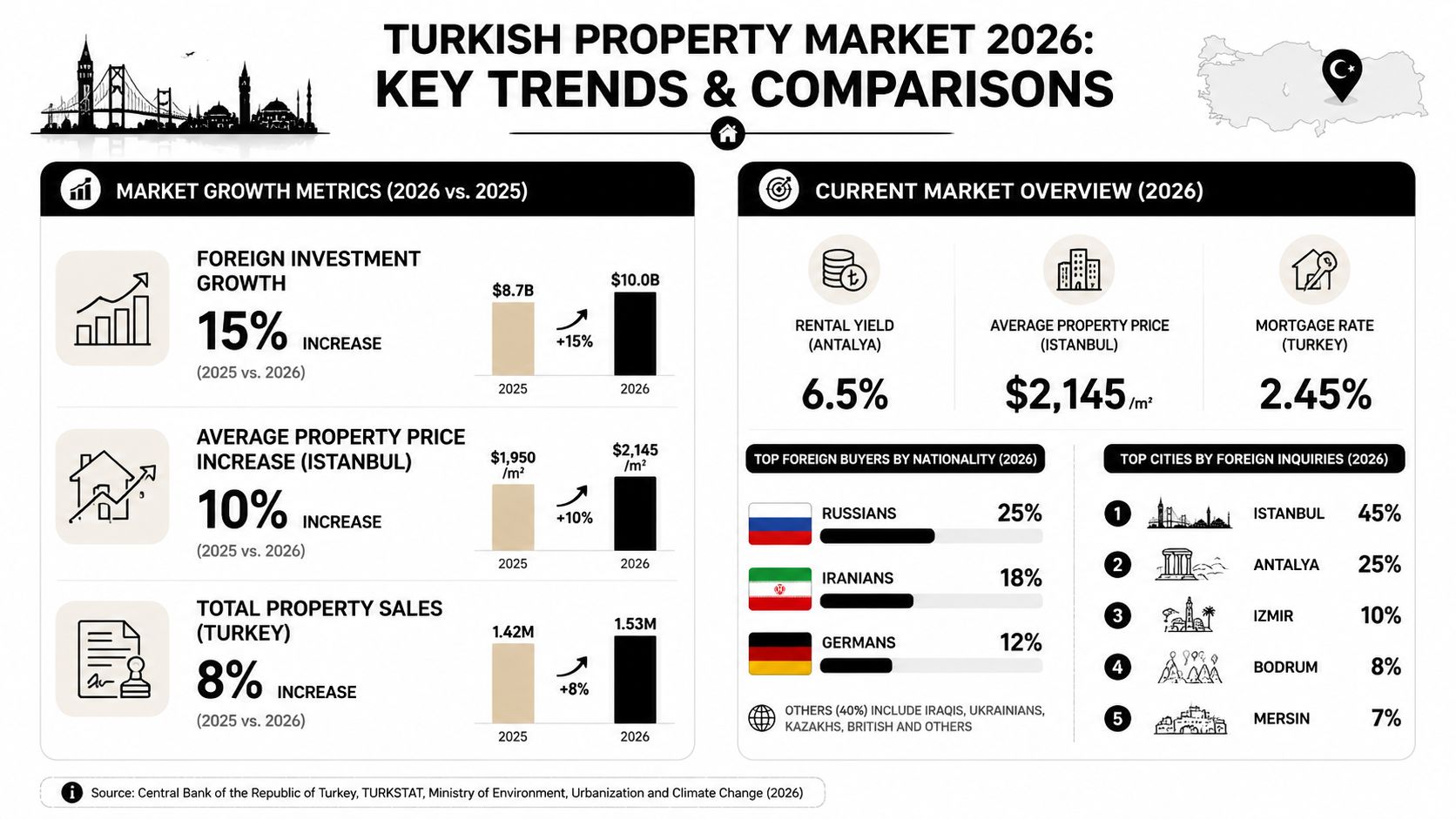
What the market numbers mean for a UK investor
The attraction is clear. Entry pricing is still lower than in much of the UK, and many Turkish assets can produce stronger gross yields on paper than buyers are used to seeing at home.
The trade-off is just as clear. Higher gross yield does not automatically mean better net return. Turkish purchases demand closer control of foreign exchange, banking flows, tax treatment, furnishing costs, and local management. For UK investors, a deeper analysis starts after the brochure yield.
I advise clients to test each deal on three levels:
- Acquisition risk: Can you verify title, valuation, permits, and the seller's position without gaps?
- Income risk: Is the rental plan legal for that building, district, and use case?
- Currency risk: If sterling weakens or the lira moves sharply, does the deal still work once transfer costs and ongoing expenses are included?
That last point gets ignored too often. A property can look attractively priced in lira, then become less attractive by the time deposits, staged payments, and completion funds are converted from pounds. Buyers using a phased payment plan need an FX strategy, not just a property budget.
Istanbul, Antalya and Bodrum serve different investment cases
Istanbul is the broadest and most liquid market. It usually suits buyers who want year-round tenant demand, a wider resale audience, and more neighbourhood-level choice. The downside is that stock quality varies sharply, and transport links, building age, and earthquake compliance matter far more than a glossy listing suggests.
Antalya sits closer to the tourism and second-home model. It can work well for personal use plus seasonal income, but buyers need to be stricter on occupancy assumptions, management fees, and the legal position on short-term lets. A holiday-rental plan that works in one building may not work in the next.
Bodrum is more selective and more lifestyle-driven. Buyers here are often paying for scarcity, marina access, view lines, or brand value. That can support pricing, but it can also narrow the buyer pool on exit and make yields less straightforward than they appear in agent projections.
A good purchase starts with matching the city to the holding strategy. Long-term urban rental, regulated short-stay use, and prestige second-home ownership produce very different cash flow patterns.
For buyers comparing day-to-day ownership economics, this guide to the cost of living in Turkey gives useful context on household expenses, staffing, utilities, and local spending power.
Established districts usually beat “emerging area” marketing
The word “emerging” often means cheaper entry. It can also mean thin demand, inconsistent build quality, weaker property management, and a slower resale process.
For first-time overseas buyers, I usually prefer areas where demand already exists and is easy to explain. Near a major employment centre. Near reliable transport. Near a proven tourism corridor. Near a university or hospital cluster. Those are easier stories to underwrite than promises about future infrastructure or speculative regeneration.
Here is the practical comparison:
| Market type | Usually suits | Main strength | Main caution |
|---|---|---|---|
| Established urban market | Long-term investors | Deeper tenant and resale demand | Higher entry price |
| Coastal tourism market | Holiday-let or mixed-use buyers | Lifestyle appeal and tourism demand | Rental rules and vacancy risk |
| Emerging district | Higher-risk investors | Lower entry cost | Less proven demand |
One more point matters in 2026. Investors should separate “can be rented” from “can be operated as a holiday rental legally and profitably.” Those are not the same thing. In Turkey, the income model has to be checked before purchase, not adjusted later.
Legal Framework and Ownership Rules for Foreigners
Foreign buyers can legally purchase in Turkey without becoming residents first, but that headline point hides the part that catches UK investors out. The legal right to own, the right to stay, and the right to rent out the property are three separate questions. They need three separate checks before any reservation fee is paid.
Turkey is relatively open to overseas buyers compared with many markets, especially if you review broader foreign ownership restrictions by country. Even so, the rules are specific enough that a property can look suitable on paper and still fail your plan in practice.
What foreign buyers can and cannot do
A UK national can buy property in Turkey without holding Turkish citizenship or a residence permit. Ownership is available to foreigners, but it is subject to limits on where and how much land can be acquired. Restricted military and security zones remain off limits, and large land acquisitions are capped by law.
Those restrictions matter most for villa plots, development land, and edge-of-town sites, not just city apartments. I often see buyers focus on price per square metre and ignore zoning or location status until late in the deal. That is backwards. Legal eligibility should be confirmed before valuation, negotiation, or deposit.
Ownership does not solve immigration status
Property ownership on its own does not give a buyer an automatic right to live in Turkey long term. If your plan is frequent use, semi-retirement, or long seasonal stays, treat immigration as a parallel workstream, not an afterthought.
This is one of the most common planning errors with lifestyle purchases. An agent may present ownership, residency, and rental income as if they naturally fit together. They often do not. A flat can be lawful to buy, unsuitable for your visa goals, and poorly positioned for legal short-term letting, all at the same time.
If the sales side is vague about residency rights or rental permissions, pause the deal and verify the position with your own lawyer.
The legal check is broader than title
For a UK investor, the main question is not only "Can I own this property?" It is "Can I own it, pay for it cleanly, use it as intended, and repatriate income without creating avoidable tax or compliance problems?"
That wider view matters in Turkey because buyers are exposed to currency risk, local title procedures, and different rental rules depending on how the property will be operated. A long-let apartment, a part-time holiday home, and a tourist rental unit do not carry the same regulatory profile.
Use this filter before committing:
| Legal question | Why it matters in practice |
|---|---|
| Is the property in an area open to foreign ownership? | Location restrictions can block the purchase entirely |
| Is the title status clean and consistent with the property being sold? | Marketing material and registered reality do not always match |
| Is my intended rental model lawful? | Short-term holiday letting may face stricter rules than standard tenancy use |
| Can I evidence the source and route of funds clearly? | Cross-border payments, FX transfers, and future resale proceeds need a clean paper trail |
| Have I checked UK and Turkish tax treatment before exchange? | Rental income, capital gains, and reporting obligations affect net return |
Finance and FX planning affect legal risk
Many UK buyers treat funding as a separate issue from legal due diligence. In Turkish transactions, they overlap. If funds arrive late, arrive from the wrong account, or are converted badly, completion can become more expensive or more difficult than expected.
FX management is part of purchase discipline. Agreeing a price in one currency while holding capital in sterling creates exposure between reservation and completion. For cash buyers, that can change acquisition cost. For financed buyers, it can also affect deposit size, lender ratios, and the buffer available for taxes and fees.
Local borrowing is possible in some cases, but terms for foreign nationals do not always resemble a standard UK mortgage. Buyers should assume a higher equity contribution, tighter underwriting, and more document scrutiny. Build the deal around confirmed funding, not optimistic assumptions.
Use case matters as much as ownership rights
A property that is legal to buy is not automatically legal or practical to run as a holiday rental. That distinction matters more in 2026 because enforcement and licensing expectations are more relevant to returns than brochure-level yield estimates.
For UK investors, it is common for the numbers to drift from reality. A coastal apartment may look attractive on purchase price alone, but the true investment case depends on whether short-term letting is permitted, how the building is managed, what occupancy pattern is realistic, how income will be taxed, and how sterling-to-lira movements affect net cash flow.
Legal due diligence should answer those questions before contract signature, not after completion.
Your Step-by-Step Guide to the Purchase Process
Cross-border purchases rarely fail at the viewing stage. They fail on paperwork, payment routing, and assumptions about what a signed contract gives you. In Turkey, UK buyers who treat reservation as a commitment before legal checks are complete usually weaken their position too early.
The process works well when you control it from day one. That means using your own advisers, fixing the payment route before money moves, and treating land registry transfer as the point that creates ownership.
A specialist international real estate lawyer is often worth the cost for UK buyers because Turkish paperwork, local practice, and UK expectations do not always align.
Set up the transaction before you commit to the asset
Do the admin first.
UK buyers usually need a Turkish tax number before completion, and banking should be arranged early enough to handle incoming compliance checks, proof of funds, and transfer timing. If funds are coming from the UK, ask your lawyer and bank what evidence will be needed for the purchase file and for the eventual title deed stage. Do not assume a same-day transfer will solve a late document problem.
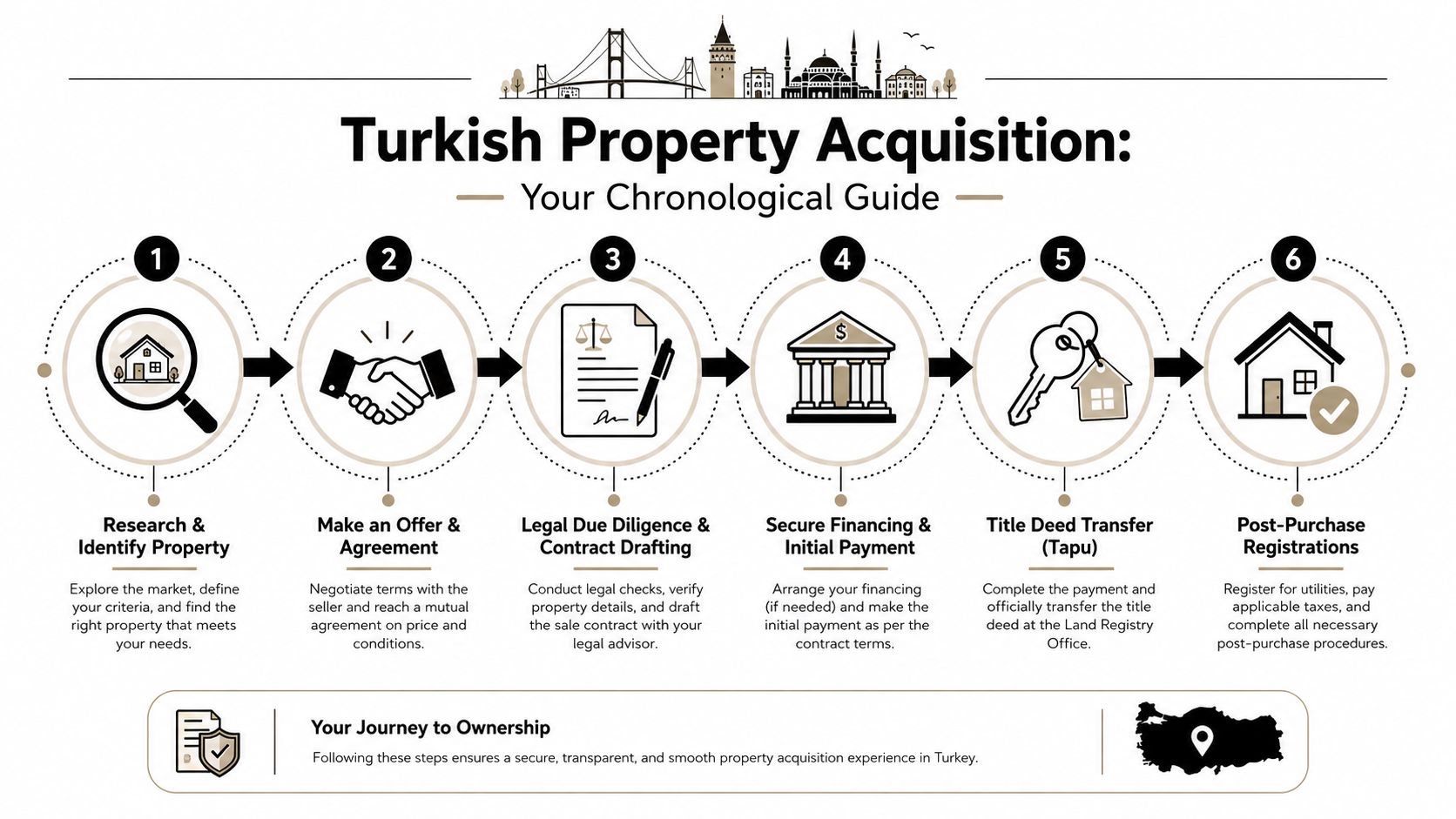
A practical sequence looks like this:
Choose the property and agree provisional terms.
Fix the price, payment schedule, included items, and target completion date. Keep the deal subject to legal review.Instruct an independent lawyer.
Use your own adviser, not someone acting primarily for the agent or developer.Assemble the buyer file.
Passport, tax number, address documents, translated documents if required, and any banking evidence needed for the transfer chain.Map the payment route.
Confirm which account receives the deposit, which account receives the balance, what currency will be used, and how each payment will be evidenced.Only then sign a reservation or sale contract.
The contract should reflect the actual commercial terms and any conditions agreed after due diligence starts.
That order matters. A buyer who pays first and checks later is exposed on refund terms, timing pressure, and weak bargaining position if defects appear.
Due diligence decides whether the deal should proceed
The legal work starts with the property, not the brochure.
Your lawyer should review the Tapu, confirm the registered owner, and check whether anything is recorded against the property that could affect transfer, use, financing, or resale. Registration at the land registry is the step that matters in practice. Until that is complete, ownership has not transferred cleanly.
A proper review should cover:
- Title ownership: The seller must have legal authority to transfer the property
- Encumbrances and annotations: Mortgages, liens, court notes, debts, or restrictions should be identified before money moves
- Planning and building status: The property should match its approved use and physical reality
- Occupancy and use risk: A unit sold as an investment may still face limits on holiday letting, building rules, or management restrictions
- Utilities and habitation status: Problems here can affect immediate use and future saleability
For UK investors buying for income, this is also the point to test the business model. Ask direct questions about whether the building rules permit short-term rental activity, whether a site management company imposes restrictions, and whether the property type suits your intended operation. A legally transferable property is not automatically a workable buy-to-let or holiday rental.
The expensive mistake is paying a deposit before the title file, building position, and use restrictions have been checked.
Valuation and registration timing also need attention. Foreign buyers can face process steps that are easy to underestimate if the selling side presents the purchase as routine. Build enough time into the transaction for document review, valuation, translations, and the registry appointment. Rushing usually creates more delay, not less.
A visual overview can help if you're new to the mechanics:
Contract, payment and final transfer
Once the legal review is clean, turn back to the contract and payment structure. UK buyers need discipline on both wording and cash movement concerning these aspects.
Keep reservation deposits proportionate. Make sure the contract states what happens if legal defects appear, if a registry issue delays transfer, or if a condition precedent is not met. If you are converting sterling, decide who carries the currency risk between contract date and completion date. On larger purchases, that can change the actual cost materially.
Every payment should be traceable. Record the sender account, recipient account, amount, currency, purpose of payment, and the document that authorises it. That helps with completion, future resale records, and any later tax review.
The final transfer is completed through the land registry process. That is the point at which the buyer should verify that the title record has been updated correctly, names are accurate, and the registered details match the deal agreed.
A sensible completion checklist looks like this:
| Stage | What to confirm before moving on |
|---|---|
| Offer accepted | Property details, agreed price, fixtures included, payment timetable |
| Before deposit | Independent lawyer instructed, title review started, refund terms documented |
| Before contract signature | Payment route confirmed, FX plan set, due diligence points raised |
| Before completion | Funds cleared, valuation and translations handled, registry appointment confirmed |
| After transfer | Title record checked, utilities transferred, insurance arranged, management handover completed |
Buyers who keep control of that sequence usually avoid the avoidable problems. Buyers who accept pressure from an agent, seller, or developer often spend the rest of the transaction reacting to issues instead of preventing them.
Navigating Taxes Fees and Running Costs
The property price is only the first number. What matters in practice is your total acquisition cost, your ongoing holding cost, and the amount of financial friction between agreeing the deal and owning the asset cleanly.
The one precise cost that should be in every buyer's budget from day one is the 4% title deed tax. That's the clearest fixed transaction cost in the sourced guidance and one that buyers shouldn't discover late.
What sits outside the purchase price
UK buyers often budget for the property, the deposit, and perhaps legal fees. That's not enough. You also need to plan for admin, compliance, insurance, and the cost of moving money internationally.
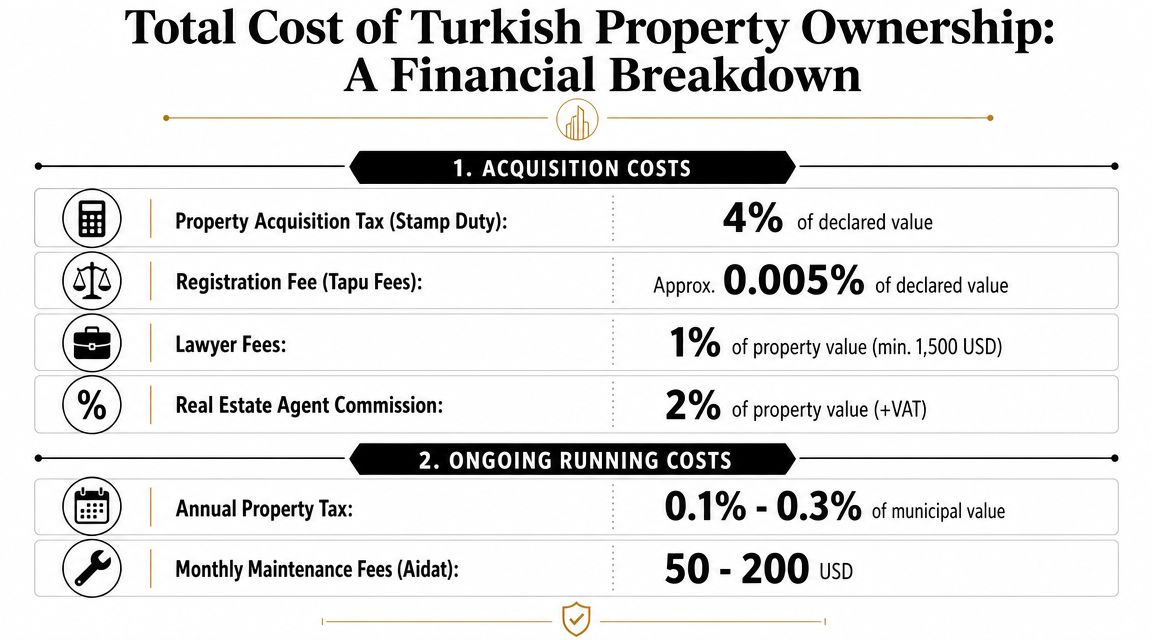
A practical budget should include:
- Title deed tax: 4% of the property value
- Legal fees: Vary by lawyer and transaction complexity
- Agent fees or commissions: Confirm who pays and on what basis
- Valuation-related costs: These can be mandatory in the process
- Insurance and setup costs: Utility and ownership administration often follow immediately after completion
If the property is new build, ask very direct questions about what is and isn't included in the quoted figure. Developers often present a clean headline number. Investors need the true all-in cost.
FX risk is a real acquisition cost
For UK buyers, currency movement can change the economics of a purchase even when the agreed price doesn't move. That issue is often underexplained in mainstream property guides.
GOV.UK notes that British nationals should seek legal advice and watch for fraud, and the official UK guidance also highlights that buyers may need a Turkish tax number, may face timing and compliance steps when transferring funds from UK banks, and should treat sterling-to-lira exchange rate risk as a serious planning issue according to GOV.UK's guidance for buying property in Turkey.
That has three practical consequences:
Don't wait until completion week to think about FX.
By then you're exposed and under time pressure.Match payment timing to legal milestones.
Sending funds too early creates avoidable counterparty risk.Document the source and route of funds.
UK and Turkish banking checks can slow transfers if paperwork is weak.
A deal can be legally sound and still become financially inefficient if you handle the money badly.
Running costs after completion
Buyers focused on yield often underwrite gross income and ignore the drag of ownership administration. That's where many Turkish deals look stronger on paper than they feel in real life.
Recurring costs usually include:
| Cost area | Practical note |
|---|---|
| Insurance | Make sure compulsory cover and any additional cover are in place |
| Building charges | Apartment schemes often have management or communal costs |
| Maintenance | Coastal properties and holiday-use units can be more maintenance-heavy |
| Tax reporting | Cross-border ownership creates ongoing admin, not just one-off purchase work |
If the plan is long-term letting, these costs are manageable if the tenant demand is stable. If the plan is short-term rental, you should assume more variable operating expenses and more active management.
What works and what doesn't
What works is a conservative budget with room for slippage. What doesn't is assuming the purchase price is the investment cost.
Good buyers do three things well:
- They budget in sterling and local currency terms
- They line up banking before funds are needed
- They ask for a complete cost schedule before they commit
That discipline matters more in Turkey than in slower, more standardised markets because payment routing and transaction timing can create avoidable stress quickly.
Pathways to Residency and Citizenship via Property
Property ownership in Turkey can support broader lifestyle or mobility plans, but the two most common routes are often mixed up. One is about being able to buy. The other is about status after the purchase. They are not the same decision.
The official starting point is straightforward. Foreigners do not need a residence permit to buy property in Turkey, according to Invest in Türkiye's property acquisition and citizenship guidance. That removes one common misconception immediately.
Buying property versus living in Turkey
A standard property purchase gives you ownership rights. It does not automatically hand you immigration rights. That's the key distinction.
If your goal is investment, holiday use within the rules, or diversification, that may be enough. If your goal is to spend extended time in Turkey, relocate, or build a residency strategy, you need to consider the immigration side separately and early.
For many buyers, that means asking a practical question before they buy: “Am I purchasing for return, for personal use, or as part of a move?” The answer affects location choice, ownership structure, and time horizon.
Citizenship by investment has a clear threshold
Turkey's citizenship-linked route is much more specific than ordinary ownership. Foreigners pursuing Turkish citizenship through property must purchase at least USD 400,000 of real estate and must not sell for 3 years, according to the same Invest in Türkiye guidance on citizenship through property.
That route suits a narrower buyer profile. It is not a casual add-on.
Here's the practical comparison:
| Route | What it gives you | Main consideration |
|---|---|---|
| Standard purchase | Ownership of the property | Does not itself create a right to live there |
| Residency-related planning | Potential basis for longer legal stay, subject to rules and application process | Needs separate immigration assessment |
| Citizenship by investment | Citizenship-linked route through qualifying purchase | Requires USD 400,000 minimum and 3-year hold |
If citizenship is even a possible objective, treat the purchase like a regulated immigration-linked investment, not a normal buy-to-let. That means tighter document control, cleaner valuation evidence, and very careful legal advice.
For investors comparing options globally, this overview of citizenship by investment helps place Turkey in a wider context.
Common Pitfalls and How to Avoid Them
A large share of cross-border property problems start before the sale contract is signed. In Turkey, the expensive mistakes are usually ordinary ones: relying on the selling side for advice, sending funds without a currency plan, or assuming a flat can be operated as a holiday rental just because it sits in a resort area.
I see the same pattern with UK buyers. They focus on price per square metre and expected rental income, then leave legal use, payment mechanics, and tax treatment until late in the process. That order creates avoidable risk.
Relying on the seller's team
Estate agents, developers, and recommended solicitors may all look organised. Their commercial objective is still to get the transaction closed.
Use your own independent lawyer and make the brief specific. Ask for title review, lien and encumbrance checks, building compliance review, contract review, and confirmation of whether your planned use of the property is legally realistic. If your projected return depends on short lets, that point needs to be checked before any deposit is paid, not after.
A buyer who wants a second opinion on process discipline can compare this with an Australian property buying guide. The market is different, but the principle is the same. Independent due diligence protects buyers from sales-led momentum.
Assuming short-term rental income is automatic
This is one of the most common underwriting errors. Buying a residential property in Bodrum, Antalya, or Istanbul does not automatically mean you can run it as a legal holiday let.
Turkey tightened the framework for short-term rentals through Law No. 7464. The Ministry of Culture and Tourism sets a permit regime for rentals of 100 days or fewer, and multi-unit buildings can require consent conditions that make the model harder than many overseas buyers expect, as outlined by the Republic of Türkiye Ministry of Culture and Tourism short-term rental guidance.
Ask these questions before you commit:
- Can this exact unit legally be rented for stays under 100 days?
- Is a permit required, and who can apply for it?
- Does the building management plan block that use?
- If the short-let model fails, does the long-let yield still justify the purchase?
Buy legal use first. Then assess the view, finishes, and marketing story.
Treating FX as an afterthought
Sterling based buyers often agree a purchase in one currency environment and complete in another. That can change the actual acquisition cost, reduce reserves for taxes and furnishing, and weaken your yield from day one.
Handle currency planning at the same time as legal due diligence. Set the budget in pounds, identify when each payment is due, and decide whether to stage transfers or fix a rate for part of the purchase funds. A property that looks affordable at reservation stage can become uncomfortable by completion if GBP/TRY or GBP/USD moves against you and your contract leaves little timing flexibility.
Skimming over title and registry checks
The Tapu is not an admin step to clear at the end. It is the core proof of ownership, and errors here are far more serious than a cosmetic defect or delayed handover.
Your lawyer should confirm who owns the property, whether there are mortgages, attachments, easements, or court restrictions recorded against it, and whether the physical unit being shown matches the registered legal position. Off-plan and newly completed stock need even more care because permits, habitation status, and delivery promises do not always line up neatly.
Ignoring the operating and tax reality
Some buyers calculate the purchase price accurately and still misprice the investment. The gap usually sits in the running model.
Check annual ownership costs, building fees, insurance, expected maintenance, and the tax treatment of rental income and future disposal. UK investors should also consider how Turkish taxes interact with UK reporting obligations and whether the ownership structure creates unnecessary friction. A property can still be a good buy with these costs included, but the numbers need to work after friction, not before it.
The pattern is straightforward:
| Risk | Better approach |
|---|---|
| Using the seller's recommended advisers without checks | Appoint an independent lawyer and define the scope of work |
| Assuming holiday-let income | Verify permit, building rules, and fallback long-term rental demand |
| Sending funds without FX planning | Match payment dates, exchange strategy, and reserve levels early |
| Treating Tapu review as routine paperwork | Check title, charges, permits, and legal status in detail |
| Underestimating post-purchase costs | Model tax, fees, management, and maintenance before exchange |
Turkey can work well for UK buyers who treat the purchase as an investment process, not a holiday purchase with paperwork attached. The buyers who avoid trouble usually do three things early: separate advice from sales, test the rental model against the actual rules, and control the money path as carefully as the legal path.
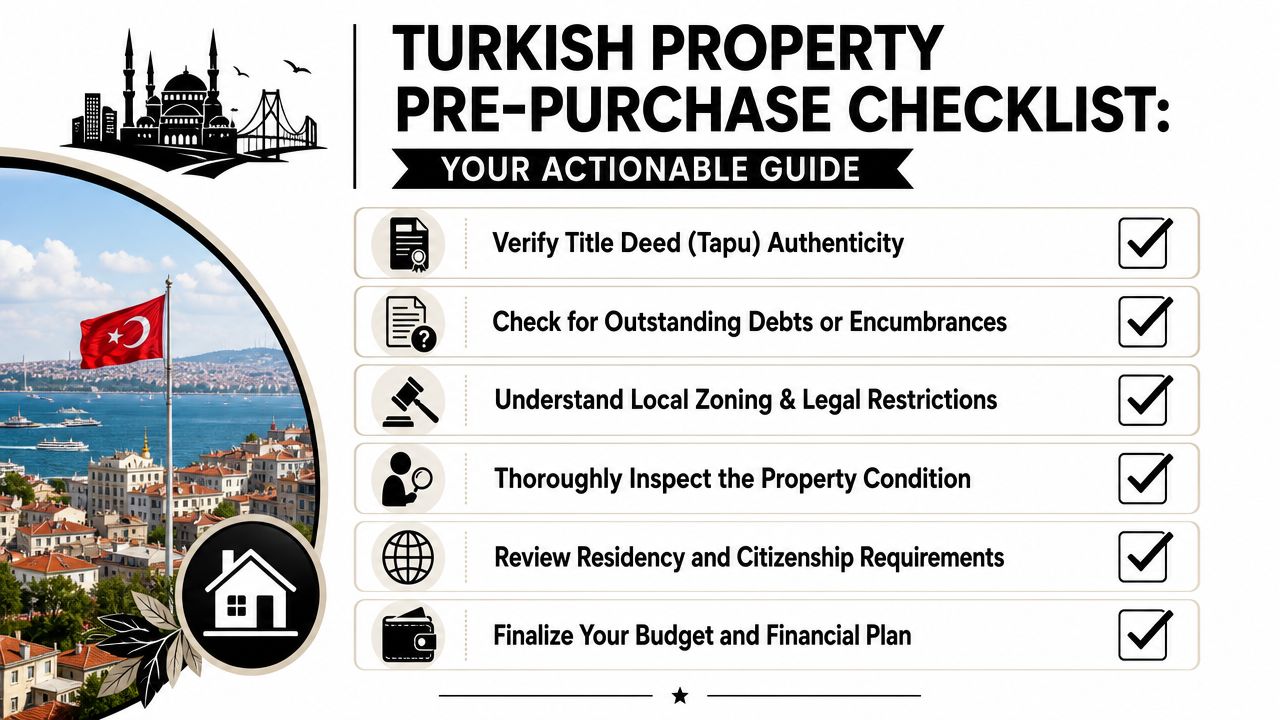
Your Turkish Property Pre-Purchase Checklist
The safest overseas buyers turn complexity into a checklist. That sounds basic, but it works. Turkey is not hard to manage when each decision is made in the right order and documented properly.
Use this list before you commit.
Before you agree the deal
- Define the purpose clearly: Decide whether the property is for long-term letting, holiday use, short-term rental, relocation, or a citizenship-linked strategy.
- Check foreign-buyer eligibility: Confirm the asset is in a location a foreigner can buy and that your intended use is realistic.
- Stress-test the budget: Include acquisition costs, currency movement risk, legal fees, and running costs, not just the asking price.
- Research the micro-market: A strong city doesn't automatically mean a strong street, block, or building.
Before you pay a deposit
- Appoint an independent lawyer: Keep legal advice separate from the selling side.
- Verify title and registration route: Make sure the ownership chain and land registry transfer are clean.
- Confirm the payment path: Sort your tax number, banking arrangements, and transfer documentation early.
- Check rental legality: This matters especially if the investment case depends on holiday lets or short stays.
After completion planning
- Arrange insurance and ownership admin: Don't leave post-completion setup until after you've flown home.
- Prepare for tax and compliance obligations: Cross-border ownership creates an ongoing paper trail.
- Review management options: If you won't be in Turkey regularly, decide who handles keys, maintenance, tenants, and inspections.
- Keep a written transaction file: Store contracts, proof of payment, registry documents, and translations together.
If you like working from structured buying frameworks, this Australian property buying guide is also a useful example of how experienced buyers reduce risk by turning the process into a disciplined sequence.
A Turkish purchase usually goes well when you stay boring. Verify, document, budget conservatively, and don't let enthusiasm outrun process.
If you're comparing Turkey with other global markets, World Property Investor publishes country guides, yield breakdowns, tax overviews, and step-by-step buying advice to help you research property opportunities with more confidence.