
Puglia is one of the few Italian regions where a British buyer can still find meaningful value, but only if they stop treating it as one market. The region is already pulling international attention, with Ostuni ranking first among Italian comuni for international searches and UK demand for Italian homes rising 28% in early 2025 (Italian Estate 2025 report). That's the signal. The opportunity now sits in choosing the right submarket, pricing the taxes properly, and refusing to overpay for glossy holiday-home narratives.
For UK buyers, the bigger question isn't whether foreigners can buy in Puglia. They can, and UK nationals can buy property or land in Italy whether they live there or not, with the usual administrative steps such as a codice fiscale, a notary, and transaction costs that often land around 10 to 15% on second homes (Wise on buying property in Italy). The issue is whether the numbers still work after registration tax, IMU, financing costs and renovation risk are stripped out. That's where most buyers get sloppy.
Puglia still makes sense for the right buyer because it sits in a different part of the Italian market from Tuscany or Lake Garda. The famous areas are crowded, but the region still contains deep value if you understand the difference between the Salento coast, Ostuni, the Valle d'Itria masserie belt, and the inland towns. It also helps that the legal framework is national, which means your due diligence discipline matters more than local charm.
What this guide covers
You'll get the price map, the rental reality, the tax rules, the financing routes, and the pitfalls that regularly catch out overseas buyers. The goal is simple, buy with your eyes open, not with a brochure.
Table of Contents
- What this guide covers
- Why Puglia Matters for Overseas Buyers in 2026
- Puglia's Submarkets and Where Prices Sit
- Rental Yields, Demand and Short-Let Economics
- Legal and Tax Rules Every UK Buyer Must Understand
- The Step-by-Step Buying Process from Offer to Keys
- Financing a Puglia Property as a Non-Resident
- Renovation and Holiday-Let Strategy
- Due Diligence, Local Professionals and Common Pitfalls
Why Puglia Matters for Overseas Buyers in 2026
Search demand is the first clue that Puglia has moved from niche to mainstream. International buyer interest has sharpened around a few headline towns, and that matters because liquidity in Italian property often follows attention before it follows price. When buyers all chase the same postcard villages, the spread between a well-bought house and an expensive mistake gets wider, not smaller.
The value case against more established Italian hotspots
Compared with Tuscany or Lake Garda, Puglia still gives UK buyers a stronger shot at entry without immediately sacrificing character. That doesn't mean the region is cheap across the board. It means the market is fragmented enough that you can still buy into a genuine submarket mismatch if you know where to look.
The practical advantage in 2026 is not just price. It's the mix of renovated stock coming through after Superbonus works, stronger tourism flow in Apulia, and a pound that buys more than it did when sterling was weaker. I'm not interested in romantic language here. I'm interested in the fact that renovated homes, sea-view apartments and inland project stock are not priced the same way, and buyers who ignore that usually overpay.
Practical rule: start with the submarket, not the province. A cheap listing in the wrong town is still expensive if nobody wants to stay there or rent it.
What you should expect before you book viewings
A serious buyer should arrive with three questions already answered. First, is this a lifestyle purchase, a rental asset, or a mixed-use asset. Second, what tax treatment will apply. Third, what happens to net return once the bank, the notary and the municipality all take their share.
That is why this guide is split into seven parts, price map, rental maths, tax rules, buying process, finance, renovation economics and due diligence. If you work through those in order, you'll make a far cleaner decision than the average overseas buyer who starts with a pretty villa and ends with a problem.
Puglia's Submarkets and Where Prices Sit
Puglia is four distinct property markets, not one. Salento, Ostuni and the northern coast, the Valle d'Itria masserie belt, and inland towns attract different buyers, command different prices, and carry different rental and resale risks. Choose the submarket before choosing the property.
The four markets that matter
The Salento coast, particularly Gallipoli, Otranto and Santa Maria di Leuca, is the clearest holiday-home market. Sea-view apartments generally sit around €2,800 to €4,500 per square metre. Buyers pay for coastal access, overseas demand and summer appeal, but those premiums leave less room for error if rental income disappoints.
Ostuni and the northern coastal strip usually offer a lower entry point, at approximately €2,200 to €3,200 per square metre. The town's brand, lifestyle demand and access to the coast support prices, although the strongest streets and renovated homes can command a significant premium.
The Valle d'Itria masserie belt, including Cisternino, Locorotondo and Martina Franca, is priced at roughly €2,500 to €3,800 per square metre for restored stone properties. This is a design-led, character-property market. Scarcity supports values, yet restoration quality and access matter more than the address alone.
Inland towns such as Ceglie Messapica, San Vito dei Normanni and Altamura sit around €900 to €1,400 per square metre. They offer lower purchase costs and more local pricing, but tourism is less intense and resale demand can be narrower.
| Puglia submarket price ranges (2026) | Price €/m² | Key driver |
|---|---|---|
| Salento coast | €2,800 to €4,500 | Sea views, holiday demand, foreign interest |
| Ostuni and northern coastal strip | €2,200 to €3,200 | Brand power, lifestyle demand, access to coast |
| Valle d'Itria masserie belt | €2,500 to €3,800 | Scarcity of restored stone stock, heritage appeal |
| Inland towns | €900 to €1,400 | Lower tourist intensity, more local pricing |
Why the spread is so wide
UNESCO trulli heritage, proximity to the sea, scarce restored masserie, and concentrated foreign demand push selected pockets above the regional norm. A visually attractive property can still be a weak investment if its micro-location limits occupancy or resale interest.
Do not confuse restoration charm with investment quality. A trullo that needs work may appear inexpensive, but structural repairs, new systems and finishing costs can remove the discount quickly.
Treat under-restauro listings as construction projects, not cheap homes. Price the works before making an offer, then test the expected rent after Italian registration tax, IMU, management, maintenance and any mortgage costs. Inland towns suit buyers prioritising a lower entry price and personal use. Buyers seeking stronger rental demand and exit appeal should expect to pay more in the established coastal and heritage submarkets.
Rental Yields, Demand and Short-Let Economics
Short-let economics vary sharply across Puglia's submarkets. Salento can attract strong summer demand, Ostuni benefits from year-round lifestyle appeal, Valle d'Itria masserie command higher rates but heavier operating costs, and inland towns usually depend more on local demand and personal use. Underwrite the exact location, not a regional average.
What a realistic Ostuni deal looks like
A representative €220,000 two-bed in Ostuni can gross roughly €28,000 to €32,000 a year if it achieves around €120 to €160 average nightly rates and 55% occupancy. That produces an attractive headline yield, but gross income says little about the money left for the owner. A Puglia market snapshot records a typical active entire-home listing at a median nightly rate of €149 and about €551 per month in revenue, with the middle half of listings between €106 and €233 per night (NightlyIndex Puglia data).
The deductions determine whether the purchase works. Airbnb and Booking commissions, property management, utilities, cleaning, maintenance reserves and IMU reduce the operating return before financing. Italian registration tax is also part of the acquisition cost, so calculate both the cash invested and the annual income. Use this guide to rental yield calculators to compare gross yield, net operating yield and cash-on-cash return consistently.
| Ostuni two-bed yield stress test | Annual € |
|---|---|
| Gross rental income | 28,000 to 32,000 |
| Platform commissions | negative |
| Management fees | negative |
| Utilities and cleaning | negative |
| Maintenance reserve | negative |
| IMU on second home | negative |
| Net operating income | materially lower than headline |
| Cash-on-cash after leverage | lower again |
Why the net number matters more than the headline
A short let can work, but occupancy discipline, calendar management and realistic pricing decide the result. Test a weaker season as well as a strong one, then add mortgage interest and repayment costs. Buyers can use an income calculator for holiday lets to check whether projected income covers the full operating burden.
My view is simple: if the deal only works at peak-season pricing, it's not an investment, it's a hope.
Masserias may earn more per booking, yet their pools, grounds, staffing and repairs raise running costs and increase seasonal exposure. Ostuni offers stronger exit appeal, Salento can suit a deliberately summer-led strategy, and inland towns need a lower purchase price to compensate for thinner tourist demand. Choose the operating model before choosing the property. Rustic beauty attracts bookings, but disciplined management determines the return.
Legal and Tax Rules Every UK Buyer Must Understand
Buyers from the UK do not need residency in Italy to buy in Puglia, but they do need to understand the tax stack. The legal order matters, because if you get the sequence wrong, you can end up paying for avoidable mistakes or buying a property that doesn't fit the tax treatment you assumed.
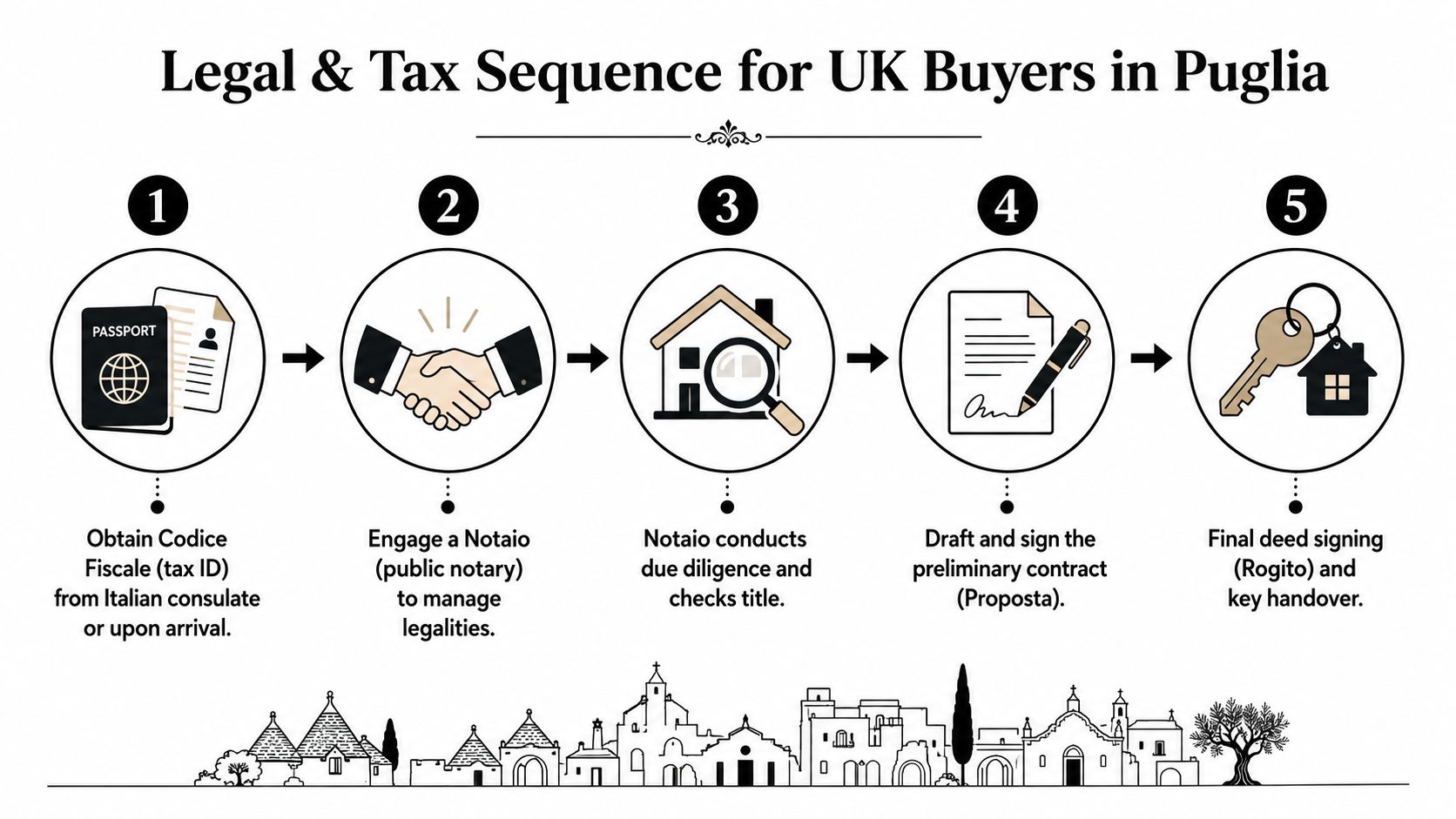
The legal sequence in the right order
Start with the codice fiscale, which you can obtain through the Italian authorities or a consulate route. Then appoint a notaio, because the notary is the public official who checks title and completes the deed, not your private solicitor. I'd still use an independent Italian avvocato where the deal has complications, because the extra cost is usually modest compared with the downside of a bad purchase.
For ownership structure, the split is whether the purchase counts as a primary residence or a second home. Italian buyer tax is typically 2% of cadastral value for a qualifying first home, but 9% for a second home, and new-builds are commonly subject to VAT instead of registration tax (Wise on property tax in Italy). The tax base is the cadastral value, not market price, so the burden can be lower than the headline rate suggests.
The taxes that keep hitting after completion
The other recurring costs are IMU and TARI, plus mortgage-related charges if you borrow. For UK readers, the key point is that the post-Brexit change affected travel and wider tax planning more than the basic right to buy, because reciprocity still allows UK nationals to purchase in Italy (italylawfirms on non-resident ownership). If you're buying to rent, you also need to think about the UK-Italy double tax treaty position on rental income, capital gains and inheritance (World Property Investor on double taxation treaties).
Rule of thumb: if the seller says tax treatment is “the same for everyone”, walk away and ask a professional to model it properly.
The Step-by-Step Buying Process from Offer to Keys
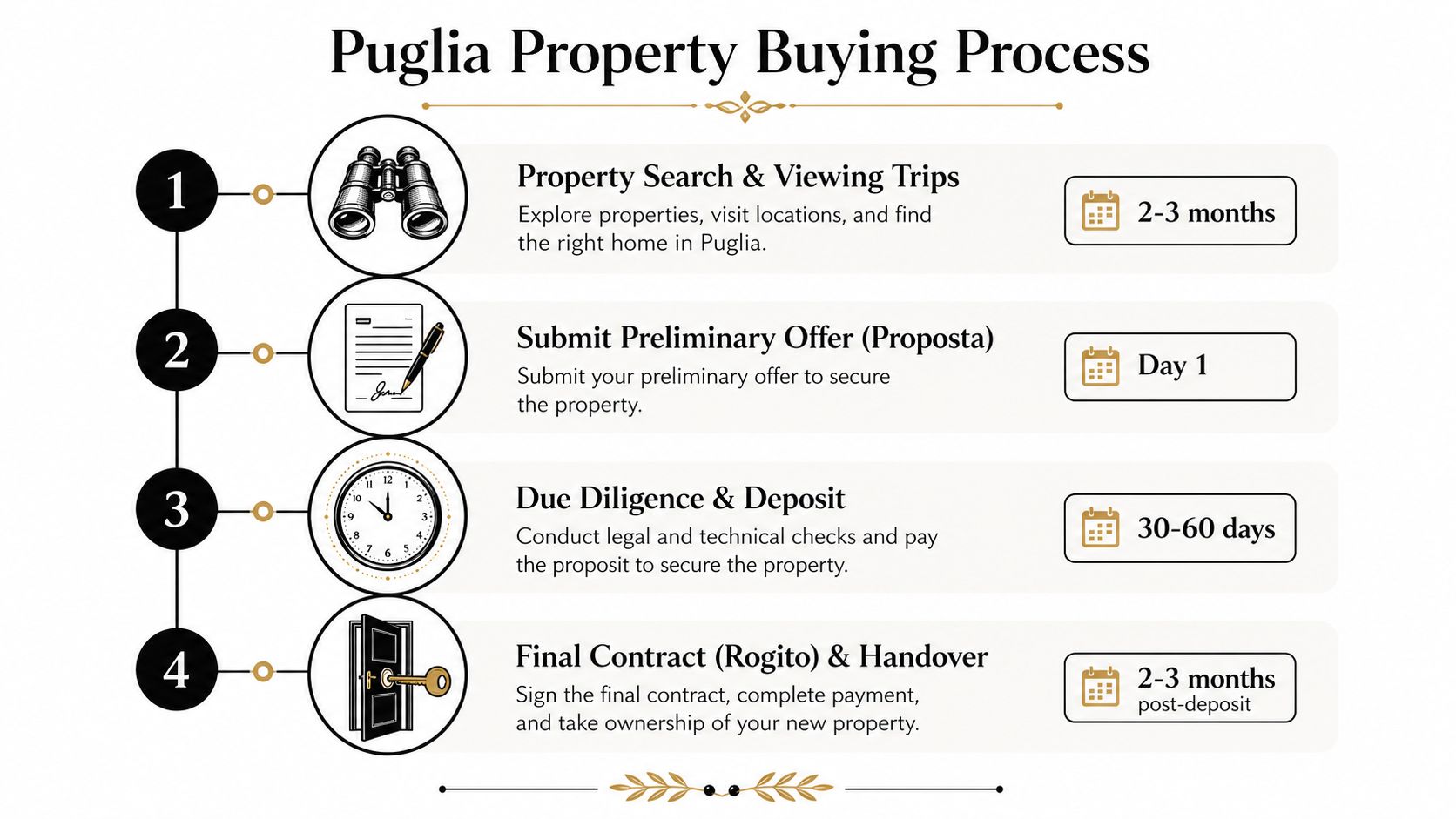
Puglia deals move best when buyers treat them as a process, not a romantic chase. Viewings come first, but the smart move is to arrive with a buyer's agent or adviser who knows which properties are clean and which ones only look clean from the driveway.
How the transaction usually unfolds
The first formal step is often a proposta irrevocabile d'acquisto, usually supported by a deposit of around €5,000 to €20,000 held by the selling agent. After that comes the due-diligence phase, where the notaio checks title, mortgages, urban compliance and cadastral consistency, including unresolved planning issues or condoni status. If the file is clean, the deal progresses to the compromesso, where the deposit normally rises to 10 to 30%.
The final deed, or rogito notarile, is signed in front of the notary. The balance is paid by bank draft or transfer, the keys are handed over and the property is registered at the Conservatoria dei Registri Immobiliari. For a typical purchase, the timeline from offer to rogito is usually 3 to 6 months, though awkward titles can drag that out.
What the process costs in practice
Notary fees commonly run around 1 to 2.5%, and if you don't read Italian, you should budget €200 to €500 for a translator. That's a sensible price to pay for understanding exactly what you're signing. The buying mechanics are also well covered in broader international property purchase guidance, which is useful context if Puglia is your first overseas deal.
Don't rush the deposit just because the house is popular. If the paperwork is weak, speed only helps the seller.
Financing a Puglia Property as a Non-Resident
Leverage is available, but it is not easy money. UK buyers often assume mortgage access will look familiar, then discover Italian lenders care much more about documentation, local banking setup and the shape of the income file. They're right to be cautious.
The main borrowing routes
Italian banks such as Intesa Sanpaolo, UniCredit and BPER typically lend non-residents at 50 to 60% LTV at rates around Euribor plus 1.8 to 2.8%, but they want a codice fiscale, an Italian bank account and translated, apostilled income proof. On second-home purchases, the mortgage can also trigger a 5.5% mortgage demand tax instead of the registration-tax treatment discussed earlier (World Property Investor on overseas mortgages).
| Financing Options for Non-Resident Puglia Buyers | Typical LTV | Indicative Rate | Key Costs | Complexity |
|---|---|---|---|---|
| Italian bank mortgage | 50 to 60% | Euribor plus 1.8 to 2.8% | Mortgage demand tax, bank fees, valuation | High |
| UK-based lender or broker route | 60 to 70% | Competitive but case-specific | Higher arrangement fees | Medium to high |
| Specialist brokered euro mortgage | 60 to 70% | Competitive but variable | Broker fee, legal and admin costs | Medium |
What I'd tell a UK buyer
UK-based lenders and specialist brokers can offer more flexibility, especially where the buyer wants a euro mortgage with a higher LTV, but they tend to charge more up front. If you're self-employed, or your income sits inside offshore structures, your file will be judged more aggressively than a straightforward PAYE case.
World Property Investor also publishes property-mortgage guidance for cross-border buyers, and that's a sensible reference point if you're comparing financing across countries rather than just in Italy. The point is not to hunt for the cheapest headline rate. It's to find the structure that survives underwriting and still leaves the purchase cash-flow positive.
Renovation and Holiday-Let Strategy
A renovation in Puglia is an investment case, not a fantasy project. The strongest opportunities are properties where the structure, permissions and rental demand support the budget. A cheap shell becomes expensive when roof repairs, damp, planning restrictions and weak local demand arrive together.
Budget the building before the rental
Short lets can generate meaningful turnover in the right location, provided the property is managed professionally. That does not make every submarket suitable. Ostuni and the Valle d'Itria can support premium restored homes, while Salento depends heavily on location and season. Inland towns need a lower purchase price and a clear demand strategy. A local manager can reduce the owner's workload, but commission and operating costs reduce the return.
Separate the renovation budget into structural works, mechanical and electrical systems, bathrooms, kitchens, furnishing and external areas. Trulli and stone masserie require a different technical approach from coastal apartments. Old masonry, roofs and moisture can alter both the programme and final cost.
For a 90 sqm trullo renovation, allow months rather than weeks. Permissions such as CILA, SCIA or, where applicable, vincolo paesaggistico, will determine the permitted works. Before signing, appoint an independent professional to review the scope, planning position and contractor quotations. A specialist in renovation project management can also coordinate trades, inspections and progress when you are based in the UK.
Managed rentals and net returns
Managed-rental operators are increasingly visible in Ostuni and Salento. That gives overseas owners a practical operating option, not a guarantee of profit. Ask for the full fee schedule, including guest communication, cleaning, maintenance, linen, emergency call-outs and platform commission.
| Puglia holiday-let economics by property type | Gross income potential | Main constraint | Net return pressure |
|---|---|---|---|
| Coastal apartment | Seasonal | Location and competition | Management, IMU and tax |
| Restored trullo | Premium if well positioned | Restoration quality | Repairs and running costs |
| Stone masseria | Strong at the top end | High capital requirement | Maintenance and staffing |
| Inland project property | Lower and slower | Limited demand | Vacancy and management |
Model net yield after Italian registration tax, IMU, mortgage interest, furnishing, cleaning, utilities, insurance, platform fees and local management. Gross yield headlines vanish once these costs are deducted. If the property only works before tax and finance costs, reject it. Buy for the specific submarket, keep a renovation reserve, and treat the first year as an execution period rather than a profit forecast.
Due Diligence, Local Professionals and Common Pitfalls
Puglia rewards disciplined buyers and punishes optimistic ones. The way to avoid trouble is to treat the file, not the façade, as the product. A beautiful masseria with weak paperwork is a liability, not an asset.
The documents you should insist on
Start with the legal papers, visura ipotecaria, atto di provenienza and the matching visura catastale and planimetria catastale. Then check the certificato di agibilità, the APE, and any condominium accounts if the property sits in a managed building. The cadastral plan must match the as-built state. If it doesn't, you need an explanation before you commit.
The professionals worth paying for
A notaio handles the title check and rogito. A geometra or independent surveyor inspects the structure, cadastral consistency and practical compliance. A commercialista or tax adviser should model IMU, TARI and purchase tax before you sign. Bring in an avvocato for off-plan disputes or inheritance complications, and use a translator if you don't read Italian well enough to catch risk.
Cheap advice is expensive when it saves you from one bad sentence in the contract.
The recurring traps in Puglia
The biggest problems are usually not dramatic at first glance. They're things like abusive or condoned extensions, missing APE, unpaid IMU attached to the property, or nuda proprietà deals that look discounted but strip away your right to use the home. In rural Puglia, vincoli paesaggistici can block pool or annexe works, and some municipalities tighten rules around short-let licensing, including parts of Bari and Lecce.
A sensible buyer doesn't try to “sort it later”. They price the risk before exchange, then walk away if the file doesn't line up. That is how you buy property in Puglia without turning a good-looking villa into a slow, expensive argument.
World Property Investor publishes practical overseas-property guides, tax breakdowns and market comparisons that help you judge whether a deal really works after costs. If you're weighing buying property in Puglia against other Italian regions, visit World Property Investor and use the site's research to compare taxes, yields and buying steps before you commit to viewings.