
For global investors evaluating the UK property market, understanding the distinction between leasehold vs freehold tenure is fundamental. The choice is not merely a technicality; it defines your rights, responsibilities, and the long-term financial trajectory of your asset. In simple terms, freehold grants outright ownership of a property and the land it occupies, in perpetuity. Leasehold, conversely, is a right to occupy a property for a fixed term, after which ownership reverts to the freeholder.
Grasping this core difference is the first step in formulating a robust UK property investment strategy. It directly influences capital appreciation, ongoing liabilities, and your ultimate return on investment (ROI).
Defining the Core Ownership Structures
For any international investor, a firm grasp of local property tenure is a critical component of due diligence. The UK's dual system can be unfamiliar to those accustomed to simpler ownership models and directly impacts capital growth, running costs, and legal control.
A clear understanding of these principles is a prerequisite for success, a concept detailed in our beginner's guide to real estate investing. Your selection between leasehold and freehold will fundamentally shape your investment's performance.
A Clear Comparison of Leasehold and Freehold
Freehold represents the most absolute form of property ownership available in the UK. As the freeholder, you own the building and the land it stands on indefinitely, registered as such at HM Land Registry. This provides total autonomy over alterations, sale, or inheritance, subject only to local planning regulations.
Leasehold, by contrast, is effectively a long-term tenancy agreement with the freeholder. While you own the right to occupy the property for the lease's duration—which may span from decades to centuries—the land itself remains the freeholder's asset. Upon the lease's expiry, ownership of the property technically reverts to the freeholder, making the length of the remaining term a critical determinant of its market value.
For an investor, the key takeaway is the balance between control and liability. Freehold offers ultimate control but full responsibility. Leasehold typically offers a lower entry price, particularly for flats in prime urban locations, but involves ongoing financial obligations and subservience to a freeholder.
This table provides a foundational comparison:
| Feature | Freehold Ownership | Leasehold Ownership |
|---|---|---|
| Asset Ownership | Outright and indefinite ownership of the building and the land. | Ownership of the right to occupy the property for a fixed term; the land is not owned. |
| Ownership Duration | Perpetual; there is no time limit. | Finite; defined by the lease length (e.g., 99, 125, or 999 years). |
| Ongoing Costs | No ground rent or service charges, unless part of a managed private estate. | Annual ground rent and service charges are typically mandatory. |
| Property Control | Full autonomy over alterations, subject to planning permissions. | Consent from the freeholder is often required for significant changes. |
Comparing Key Investment Factors
When analysing leasehold versus freehold, the discussion must quickly progress beyond definitions to practical investment metrics: control, long-term value, and annual expenditure. These factors directly shape your ROI and the asset's function within a diversified portfolio.
With a freehold title, you possess complete autonomy. You own both the structure and the land, empowering you to undertake value-add strategies such as extensions or conversions without seeking third-party consent, subject to local planning law.
Leasehold, however, operates within a contractual framework defined by the freeholder. The lease agreement dictates what is permissible. Simple modifications, such as changing flooring, may require formal permission from the freeholder, often incurring administrative and legal fees.
Control And Autonomy
The degree of control is a significant differentiator. A freeholder can adapt a property to meet evolving market demands or tenant preferences without external approval. In a dynamic property market, this agility provides a distinct competitive advantage.
Leaseholders are constrained by the terms of their lease. This legal document can contain restrictive covenants, limiting activities from keeping pets to subletting or operating a business from the premises. While intended to maintain building standards, these clauses can limit an investor's ability to maximise rental income or adapt the property's use.
This diagram provides a clear visual summary of the two ownership models.
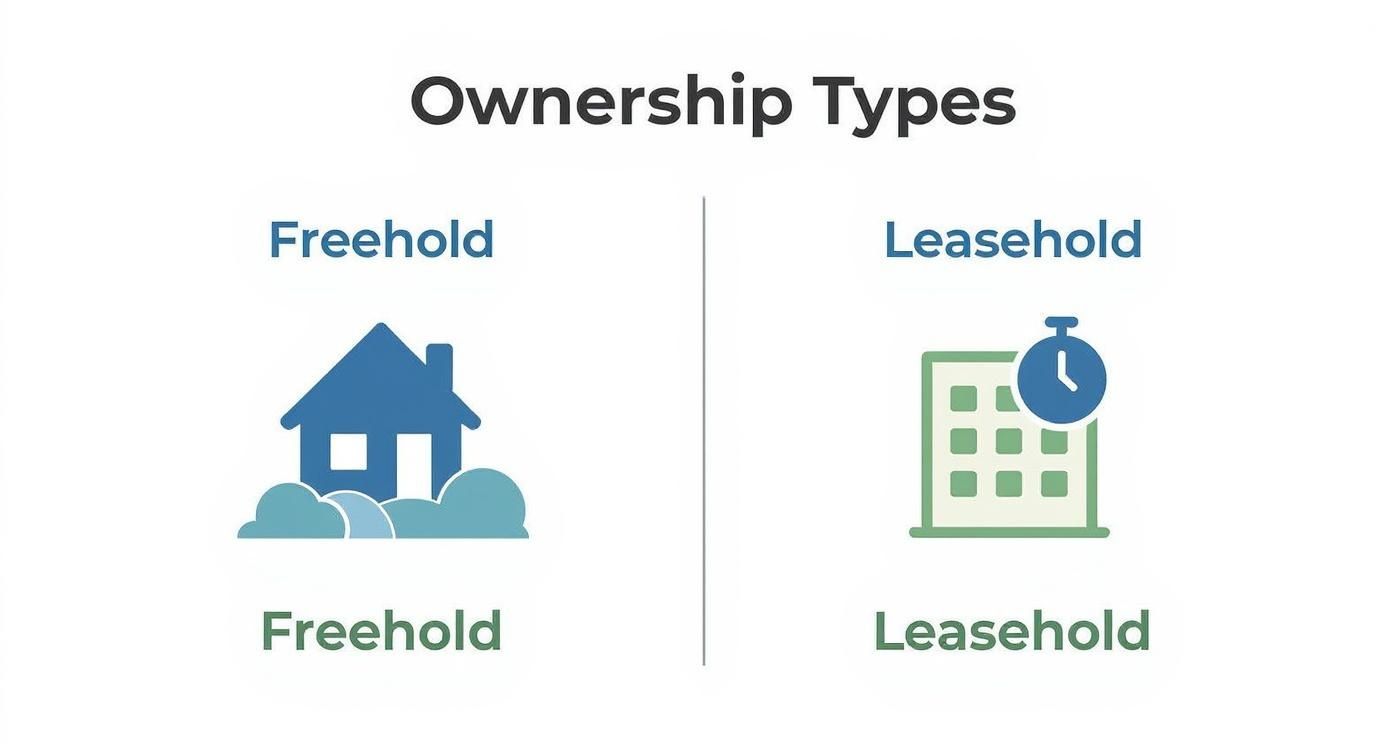
It clearly illustrates the perpetual ownership of freehold against the time-limited rights of a leasehold—a critical distinction for long-term capital preservation.
Financial Commitments And Ongoing Costs
The ongoing cost profiles of freehold and leasehold properties are markedly different. Freehold liabilities are predictable: council tax, insurance, and maintenance. There are no mandatory fees payable to a third party.
Leasehold properties, however, involve two key recurring charges: ground rent and service charges. Ground rent is a fee paid to the freeholder for the use of their land. Service charges cover the maintenance of communal areas, building insurance, and management fees. Data from UK housing authorities shows these charges can be unpredictable and are prone to increases, complicating the accurate forecasting of net rental yield.
The core financial trade-off is between a higher initial capital outlay for a freehold and the perpetual, often escalating, running costs of a leasehold. This makes a detailed analysis of the lease terms essential to determine a property's true investment potential.
Long-Term Value And Mortgageability
A primary concern for investors is how ownership type impacts long-term value. A freehold property’s value is directly correlated with market forces; it appreciates over time without inherent structural depreciation. This stability makes it a preferred asset for lenders and prospective buyers.
Conversely, a leasehold property is a depreciating asset by definition. As the lease term shortens, the property's value erodes. This issue becomes acute when the remaining term falls below 80 years, at which point the cost of extending the lease increases substantially due to the introduction of 'marriage value'. Lenders also become cautious, often declining mortgage applications on properties with short leases (typically under 70 years), which constricts the pool of potential buyers and negatively impacts the resale price.
According to the latest Gov.uk housing survey data, England's housing stock comprises approximately 20.5 million freehold dwellings (81%) and 4.8 million leasehold properties (19%). This market preference is stark in house sales, where 93% of transactions are freehold. Conversely, almost all flats are sold as leasehold, defining its niche in the urban apartment sector.
Leasehold vs Freehold Investment Matrix
This matrix breaks down the key factors for investors, focusing on the metrics that directly influence financial returns and portfolio strategy.
| Investment Factor | Freehold Ownership | Leasehold Ownership | Investor Takeaway |
|---|---|---|---|
| Control | Full autonomy over property and land, subject to planning laws. | Limited by the lease agreement; requires freeholder consent for changes. | Freehold offers maximum flexibility for adding value and adapting to market needs. |
| Ongoing Costs | Predictable: council tax, insurance, maintenance. | Unpredictable: ground rent, service charges, potential one-off levies. | Leasehold costs can erode net yield and are difficult to forecast with certainty. |
| Long-Term Value | Value appreciates with the market; no inherent depreciation. | A depreciating asset; value declines as the lease term shortens. | Freehold is a more stable long-term asset for capital growth. |
| Mortgageability | Highly desirable for lenders; straightforward to finance. | Difficult to mortgage if lease term is under 70-80 years. | A short lease severely limits exit strategy and resale value. |
| Complexity | Simple ownership structure; fewer legal complications. | Complex lease terms require thorough legal review before purchase. | Leasehold requires greater due diligence to mitigate risks from hidden clauses and costs. |
The decision depends on investment objectives. Freehold offers simplicity, control, and long-term security, making it ideal for strategies focused on capital growth. Leasehold can provide access to prime urban locations at a lower capital entry point but demands rigorous management of ongoing costs and a thorough understanding of the lease agreement.
How Property Ownership Works Around the World
While the leasehold vs freehold system is central to the UK market, it is just one model of property tenure. For a global investor, understanding how different jurisdictions define property rights is fundamental to risk management.
Legal frameworks and terminology vary significantly between countries, directly impacting security of tenure, mortgageability, inheritance rights, and long-term asset value.
In the United States, the dominant model is fee simple ownership, the direct equivalent of UK freehold, granting absolute title to the property and land. For apartments, the condominium ('condo') model is used, where an individual owns their unit outright plus a shared interest in common areas—a structure analogous to the UK's commonhold system. In emerging markets like Dubai, tenure can be more complex, with specific zones designated for foreign freehold ownership while others are restricted to long-term leaseholds.
A Quick Tour of Key Property Markets
Comparing the UK with other established investment markets highlights these critical differences.
- France & Spain: In these established European markets, apartment ownership is typically structured as 'copropriété' (France) or 'propiedad horizontal' (Spain). In both systems, an investor buys the freehold of their individual unit along with an undivided share of the communal parts, providing a secure and widely understood form of ownership.
- Germany: The market is dominated by a strong rental culture, but for ownership, the 'Wohnungseigentum' system for apartments is similar to the French and Spanish models, granting freehold title to the unit and a share in the common property.
- Dubai (UAE): This emerging market presents a mixed model. Foreign investors can purchase property on a freehold basis in designated investment zones. However, in many other areas, ownership is restricted to long-term leases, often for 99 years, which function similarly to a UK leasehold and must be analysed as a depreciating asset.
The crucial takeaway for investors is that the term 'ownership' is not universal. What constitutes absolute ownership in an established market may be a time-limited right in an emerging one—a distinction that fundamentally alters the investment case.
What This Means for International Investors
These structural differences have direct, practical consequences. A fee simple title in the USA offers maximum security and is easily assessed by lenders. A 99-year leasehold in Dubai, however, requires the same forensic analysis of lease term and ground rent as a UK equivalent.
Restrictions on foreign ownership must also be investigated. While markets like France and Spain are relatively open, others can impose specific conditions. For a deeper analysis of these complexities, our guide on investing in overseas property provides a valuable starting point.
The duration of ownership is a key metric for calculating long-term capital growth. A 99-year lease is a finite, depreciating asset, unlike a perpetual freehold title. This directly shapes the property's value curve and its resale potential. A prudent investor must look beyond the physical asset to the legal foundation upon which it is built.
Analysing UK Regional Market Variations
It is a critical error to view the "UK property market" as a monolithic entity. It is a mosaic of regional markets, each with distinct characteristics shaped by history and economic drivers. This geographical nuance is essential when evaluating the leasehold vs freehold proposition.
An investor’s strategy must be adapted to local conditions. A strategy for London, where leasehold flats are the dominant property type, will be fundamentally different from one in a suburban region where freehold houses are the norm. Understanding these regional concentrations is not an academic exercise; it is essential for effective risk management and portfolio construction.
Historical Roots And Modern Trends
The prevalence of leasehold tenure in certain areas is often rooted in historical land ownership patterns. In major cities like London and Liverpool, large aristocratic estates, the Church, or the Crown historically leased land for development rather than selling it. This created a legacy of leasehold titles that continues to define these markets.
More recently, the practice of developers selling new-build houses on a leasehold basis created new clusters of such properties, particularly in the North West of England. This trend has since been curtailed by government reform following significant public and political scrutiny.
Data from the Office for National Statistics (ONS) clearly illustrates this regional variation. The North West of England historically had the highest proportion of new-build leasehold house sales. While this practice has been largely halted, the existing housing stock reflects this trend. This data underscores the necessity of granular regional analysis. Official statistics on residential property transactions in England and Wales provide further insight.
Strategic Implications For Investors
For a global investor, this regional data is actionable intelligence. It allows for the targeted acquisition of freehold assets or, alternatively, informs a strategy for navigating a leasehold-dominant market with a clear understanding of the associated risks and management requirements. A deep analysis of local market dynamics is fundamental, a principle we explore in our guide on the role of location in real estate investment success.
An investor must align their acquisition strategy with regional market realities. Attempting to build a freehold-only portfolio in a prime central London location, for example, is inefficient and overlooks strong potential yields from well-managed leasehold assets.
Consider the practical application of this principle:
- London and Major City Centres: Dominated by leasehold flats due to high population density. Investors in these markets must be experts in lease analysis, service charge management, and enfranchisement legislation.
- The North West: Historically high concentration of leasehold houses. Investors must conduct forensic due diligence on existing stock, paying close attention to ground rent clauses and their review mechanisms.
- Home Counties and Rural Areas: Predominantly comprised of freehold houses. These regions offer greater control and stability but often at higher entry prices and with potentially lower rental yields compared to urban centres.
The leasehold vs freehold decision cannot be made in isolation. A successful UK property strategy must be finely tuned to the specific character of its target region, balancing the opportunities and challenges of the local tenure landscape.
The Shifting Landscape of UK Leasehold Reform
The balance of power in the leasehold vs freehold debate is undergoing a significant shift. The UK government has introduced landmark reforms designed to address long-standing criticisms of the leasehold system, which has been seen as complex and open to exploitation through escalating charges.
The cornerstone of this change is the Leasehold and Freehold Reform Act, legislation that fundamentally rebalances the rights of leaseholders in England and Wales. This is not a minor adjustment; it is a structural overhaul aimed at making property ownership fairer and more transparent. For investors, understanding these changes is critical for compliance, risk mitigation, and identifying strategic market opportunities.
Key Changes Investors Must Know
One of the most impactful reforms is the abolition of the two-year ownership requirement for lease extensions or freehold purchases. Previously, an investor had to own a property for at least two years before being eligible to begin the statutory process of extending their lease or participating in a collective purchase of the freehold.
The removal of this barrier grants investors far greater flexibility and control from the outset, enabling them to act immediately to secure an asset's long-term value. This has significant positive implications for mortgageability, a topic covered in our guide to financing investment property.
The UK government's reforms are a direct response to long-standing issues within the leasehold system. With the introduction of the Leasehold and Freehold Reform Act, a key change is the removal of the two-year ownership rule for leaseholders looking to extend their lease or purchase the freehold. This reform now allows any registered owner to make a claim immediately, a move set to benefit nearly five million leaseholders by offering greater security. Discover more details on how these changes will be implemented in the full Spring 2025 update.
Practical Implications for Your Portfolio
Beyond lease extensions, the reforms target the opacity of ongoing costs. The act enhances transparency and provides leaseholders with a more robust mechanism to challenge unreasonable service charges levied by freeholders or their managing agents.
For a portfolio investor, this change de-risks a major variable. The ability to scrutinise and challenge excessive fees provides greater cost certainty, making it easier to accurately forecast net yields and long-term holding costs.
Other critical updates include:
- Simpler Enfranchisement: The process for leaseholders to collectively purchase their building's freehold has been streamlined to be easier and more cost-effective.
- Capping Ground Rents: While new leases are already subject to a peppercorn (zero) ground rent, the reforms aim to address issues with existing leases, although the final mechanism for this is still under development.
These changes signal a clear policy direction from the UK government. The objective is to make leasehold ownership more secure, with stronger rights and fewer financial pitfalls. For the astute global investor, this evolving legal landscape presents an opportunity to re-evaluate leasehold assets that may now offer enhanced potential for control and value appreciation.
A Practical Due Diligence Checklist for Investors
Translating theory into sound investment decisions requires a systematic and rigorous due diligence process. Whether assessing a freehold house or a leasehold flat, this checklist provides a practical framework for identifying risks and securing a profitable asset in the leasehold vs freehold landscape.

This process is about constructing a complete legal and financial picture of the asset to uncover hidden liabilities that could erode future returns.
Essential Checks for Leasehold Properties
Leasehold properties require forensic scrutiny due to the complexities of the lease agreement. While a solicitor's role is crucial, an informed investor must know the right questions to ask.
Your investigation should focus on these key areas:
- Remaining Lease Length: This is the most critical metric. Confirm the exact number of years remaining. If the term is approaching or has fallen below 80 years, you must factor the significant cost of a statutory lease extension into your valuation.
- Ground Rent Analysis: Scrutinise the ground rent schedule. Is it fixed, or does it contain an escalating clause? Onerous review clauses, particularly those that double the rent at frequent intervals, can render a property unmortgageable and unsaleable.
- Service Charge History: Obtain and analyse at least three years of service charge accounts. Look for consistency, unexplained increases, and evidence of contributions to a sinking fund for major future works. Enquire about any planned major works not yet billed.
- Restrictive Covenants: Review the lease in full to identify any clauses that could impede your investment strategy. This includes restrictions on subletting, making alterations, or other limitations on the use of the property.
An investor’s primary objective with a leasehold property is to quantify all future liabilities. A short lease or an aggressive ground rent review clause is not merely an inconvenience; it is a direct and calculable deduction from the property's capital value.
Key Diligence for Freehold Properties
While structurally simpler, freehold ownership is not without potential complications. Due diligence here focuses on confirming the extent of your ownership and identifying any shared responsibilities.
Ensure you have clear answers on these points before completing a freehold purchase:
- Verify Property Boundaries: Obtain the official Land Registry title plan and compare it against the physical boundaries on-site. Boundary disputes are common and can be costly and time-consuming to resolve.
- Check for Shared Responsibilities: Determine if the property shares access, such as a driveway or private road, or communal areas. Understand the legal structure for maintenance costs—whether through a formal residents' association or an informal agreement.
- Identify Covenants and Easements: Even freehold titles can carry restrictive covenants limiting development or use. There may also be easements, such as a utility company's right of access to maintain their equipment on your land.
This checklist is an essential tool in your decision-making framework. By systematically addressing these points, you transition from a speculative buyer to an informed investor, capable of accurately assessing the true value and risk profile of a UK property.
Frequently Asked Questions
When investing in UK property, precise details are paramount. Here are clear, data-driven answers to the most common questions from global investors regarding leasehold and freehold tenure.
What Is the 80-Year Rule for Leaseholds?
The ‘80-year rule’ is a critical threshold in leasehold valuation. Once a lease term drops below 80 years, the cost of a statutory lease extension increases significantly. This is due to the inclusion of 'marriage value' in the calculation.
Marriage value is the latent value released by merging the leasehold and freehold interests. By law, this profit must be split 50/50 with the freeholder. This can transform a manageable expense into a substantial capital outlay. For an investor, acquiring a property with a lease term near or below this 80-year mark necessitates factoring in this future cost, which should be reflected as a significant discount on the purchase price.
Can I Get a Mortgage on a Short Lease Property?
Securing a mortgage on a property with a short lease is challenging. Most mainstream UK lenders will not offer finance on a property with fewer than 70 years remaining on the lease. Some have stricter criteria, requiring the lease to have at least 30-40 years remaining after the mortgage term concludes.
This severely restricts the pool of potential buyers upon resale, negatively impacting the property's market value. Lenders view a short lease as a high-risk, depreciating asset. Consequently, financing is difficult to secure and, if available, often comes with less favourable terms.
What Are My Options for Gaining More Control?
As a leaseholder, UK law provides two primary mechanisms for gaining greater control over your asset, both of which typically require collaboration with other leaseholders.
- Right to Manage (RTM): This statutory right allows qualifying leaseholders to take over the day-to-day management of their building without purchasing the freehold. This enables them to appoint their own managing agent, control service charges, and oversee maintenance, thereby managing running costs more effectively.
- Collective Enfranchisement: This is the legal process by which a qualifying group of leaseholders can compel the landlord to sell them the freehold. Success results in the leaseholders becoming their own landlord, allowing them to grant themselves 999-year leases and reduce ground rents to zero. It is the most comprehensive method for gaining control.
Are There Hidden Costs with Freehold Ownership?
While freehold ownership eliminates ground rent and service charges, it brings total responsibility for all maintenance and repair costs, from minor repairs to major structural issues like subsidence.
Furthermore, investors must be aware of 'estate rentcharges' common on modern housing developments. This is a fee paid to a management company for the upkeep of shared amenities like private roads, communal gardens, or drainage systems. These function similarly to service charges and must be identified and quantified by your solicitor during the conveyancing process.
At World Property Investor, we provide the in-depth analysis and global market guides you need to invest with confidence. Explore our data-driven resources to compare opportunities and build your international portfolio. https://www.worldpropertyinvestor.com