
Investing in Cyprus property offers global investors a compelling combination of financial strategy and lifestyle appeal. Driven by a stable, EU-member economy and attractive residency programmes, the market presents a strategic alternative to more saturated Western markets. It is an opportunity to access strong rental yields and potential capital appreciation in a jurisdiction with a favourable tax regime and over 300 days of sunshine annually.
Why Global Investors Are Choosing Cyprus Property
For sophisticated investors, the rationale for entering the Cypriot property market is built on robust fundamentals. Beyond the Mediterranean climate, Cyprus offers tangible financial incentives and a familiar legal framework based on English common law, which significantly reduces the complexity often associated with overseas property acquisition.
The Cypriot government has amplified this appeal with strategic initiatives, including its residency-by-investment programme. According to official data from the Department of Lands and Surveys, foreign buyers represent a significant and growing segment of the market. In the first half of this year alone, transactions involving foreign nationals totalled €387 million, underscoring sustained international confidence.
Contrasting Market Fundamentals: Established vs. Cypriot Markets
A side-by-side comparison with established markets like the UK reveals clear distinctions. Many mature markets are characterised by high entry costs and compressed rental yields, often eroded by rising interest rates and punitive taxation. In contrast, Cyprus offers more accessible price points and robust rental demand, fuelled by consistent tourism and a growing cohort of expatriates and digital nomads.
This dynamic positions Cyprus as a prime location for portfolio diversification, offering a blend of stability and growth potential that is increasingly scarce in developed European economies. For a broader analysis of high-growth locations, our guide to the top emerging property investment markets provides valuable context.
The core value proposition for global investors is clear: Cyprus provides an opportunity to secure a hard asset in a stable, low-tax EU jurisdiction. It is a strategic move for both wealth preservation and lifestyle enhancement.
To further clarify, let's dissect the primary advantages that make investing in Cyprus property a prudent choice for international buyers.
Key Advantages of Cyprus Property Investment
The following table summarises the core benefits attracting global investors to the Cypriot real estate market.
| Benefit Category | Description for Global Investors |
|---|---|
| Favourable Tax Regime | With no inheritance tax and low property taxes, Cyprus offers significant fiscal advantages over many Western countries with heavier tax burdens on property and wealth. |
| Residency & EU Access | A real estate investment from €300,000 can secure permanent residency, providing a valuable foothold within the European Union for non-EU nationals. |
| Strong Rental Yields | Underpinned by a thriving tourism sector and a growing professional expatriate community, rental yields frequently outperform those in major European and global cities. |
| Strategic Location & Familiarity | Situated at the crossroads of Europe, Asia, and Africa, Cyprus also offers a familiar business environment with widespread English use and a legal system based on common law. |
These pillars—tax efficiency, EU residency, solid returns, and operational ease—form the foundation of Cyprus's appeal, making it a standout choice for any investor seeking opportunities beyond their domestic market.
Decoding the Cyprus Property Market
A successful investment requires a data-driven analysis that looks beyond lifestyle appeal. The Cypriot property market is not a monolith; it is a collection of distinct regional markets, each with its own supply-and-demand dynamics, price trends, and rental yields. Understanding these nuances is fundamental to effective capital allocation.
The market has demonstrated remarkable resilience, supported by strong overseas demand and a robust tourism sector. Property values have shown steady growth, particularly in prime coastal locations. Investors can typically expect gross rental yields between 4% and 7% per annum. In key tourist areas, short-term holiday lets can often drive returns higher during peak season, presenting a compelling case against yields in many established global cities.
Established Hubs Versus Emerging Hotspots
Cyprus offers a spectrum of investment opportunities, from mature, stable markets to emerging areas with significant growth potential. This allows investors to tailor their strategy based on their risk appetite and financial objectives.
-
Established Markets (Limassol & Paphos): These cities are the blue-chip assets of the Cypriot property market. Limassol serves as the island's cosmopolitan business hub, attracting high-net-worth individuals and corporate tenants who command premium rental rates. Paphos has long been a favoured destination for retirees and holidaymakers, ensuring a deep and liquid market for sales and rentals. Investing here is synonymous with stability and proven performance.
-
Emerging Markets (Larnaca): Larnaca is currently the market's rising star. It is undergoing a significant regeneration, including a major marina expansion, while property prices remain more accessible than in Limassol or Paphos. For investors focused on capital growth, Larnaca offers tangible potential for asset appreciation as large-scale infrastructure projects materialise.
This regional diversity is a strategic advantage. A balanced portfolio might pair a stable, income-generating asset in Paphos with a speculative, growth-oriented investment in Larnaca. Our guide on investing in overseas property offers a broader framework for such portfolio construction.
Understanding Buyer Preferences and Property Types
Location is only one part of the equation; asset type is equally critical. Different buyer demographics seek different properties, and aligning an investment with current market trends is key to maximising returns. A clear trend across all regions is the high demand for modern, turnkey properties.
Data shows that apartments constitute 68% of purchases by foreign buyers, with the remaining 32% allocated to houses. New-build apartments and luxury villas are particularly sought after. According to recent market analysis, the average price for a new-build house acquired by a foreign buyer was €459,000 in the first quarter—a 12% increase year-on-year. This demand is accelerating, with 2,156 foreign buyers in the first five months of the year alone. You can find more detail on these Cyprus property market trends.
Key Takeaway: The market is not one-size-fits-all. A two-bedroom apartment in Paphos targeting the short-term tourist rental market is a fundamentally different investment from a commercial office space in Limassol aimed at long-term corporate lets. Success depends on matching the right property in the right location to a specific, identifiable demand.
This data-led approach helps identify where capital will be most effective. Whether the objective is steady rental income, long-term appreciation, or a personal holiday home that generates revenue, the Cyprus market offers a viable path for the informed investor.
Navigating the Legal Steps to Ownership
Executing the legal aspects of a Cyprus property purchase correctly is critical. While the legal system is based on English common law, providing a degree of familiarity, specific local procedures must be followed. Errors can lead to delays or significant legal and financial complications.
The process, from identifying a property to receiving the Title Deeds, is well-defined. For non-EU buyers, an additional approval step is required, but it is typically a formality. A common mistake is to rush the process or rely on a developer's solicitor instead of engaging independent counsel—a shortcut that can jeopardise an entire investment.
Assembling Your Professional Team
Before committing to a deposit, the first priority is to appoint a reputable, independent solicitor. Their sole responsibility is to protect your interests and conduct the essential due diligence that safeguards your capital.
Your solicitor will perform several non-negotiable checks:
- Title Deed Verification: A search at the Land Registry will confirm the seller's legal ownership and identify any outstanding mortgages or legal claims (encumbrances) against the property. This is the single most important verification.
- Permit Scrutiny: All planning and building permits will be reviewed to ensure the property was constructed legally and complies with all regulations.
- Seller Legitimacy: The identity and legal standing of the seller, whether a private individual or a corporate entity, will be confirmed.
The Step-by-Step Buying Process
Once your solicitor has completed their initial due diligence and confirmed the property is sound, the formal purchase process begins.
-
Reservation Agreement: Upon agreeing on a price, you will sign a Reservation Agreement and pay a reservation deposit, typically between €5,000 and €10,000. This removes the property from the market for an agreed period, allowing your solicitor to conduct final in-depth checks.
-
Contract of Sale: Your solicitor will then draft the Contract of Sale. This is the primary legal document detailing all terms of the transaction, including the final price, payment schedule, and completion date. Review this document thoroughly with your solicitor before signing.
-
Stamping and Lodging the Contract: After signing, the contract is stamped at the local Tax Office and lodged at the District Land Registry Office. This is a crucial step that registers your beneficial interest in the property, legally preventing the owner from reselling it or securing a mortgage against it.
The map below illustrates the varied investment landscape across the island. Paphos is known for its established resale villa market, Limassol for its high-end commercial and residential towers, and Larnaca for its new development pipeline.
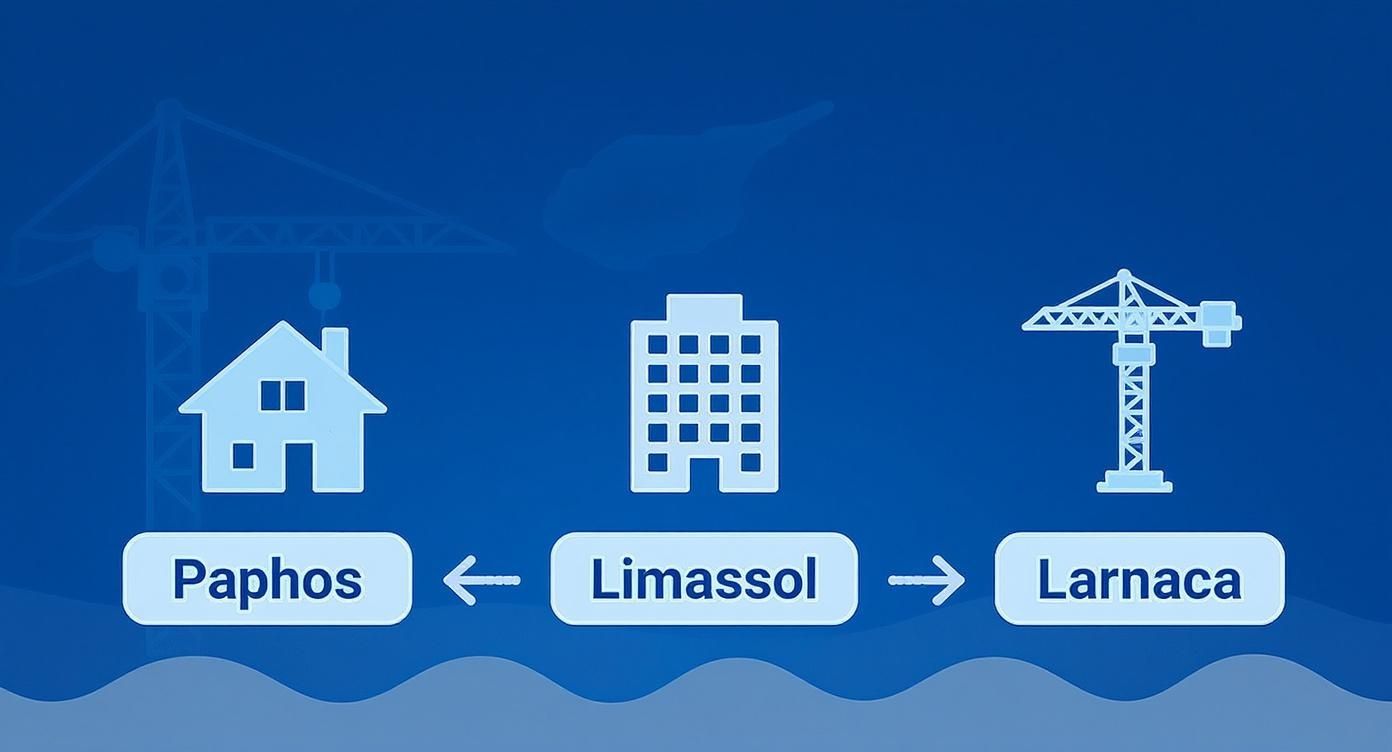
The legal focus will shift depending on the asset. Due diligence for an off-plan apartment in Larnaca will differ from that for a 20-year-old villa with established Title Deeds in Paphos.
Special Requirements for Non-EU Buyers
As a non-EU national, you must obtain permission from the Council of Ministers to purchase property. This is largely a procedural formality.
Your solicitor will submit the application on your behalf after the Contract of Sale is signed. It is a standard part of the process, not a barrier to ownership.
Key Insight: The Council of Ministers' permit is a regulatory measure for monitoring foreign property ownership. Provided you have a clean criminal record and are purchasing a legitimate property, approval is almost always granted. While it can add a few months to the timeline, it rarely prevents a sale from completing.
Finalising the Purchase and Securing Title Deeds
The final stage involves the transfer of legal ownership. Once all payments are complete and the Council of Ministers' permit is issued, your solicitor will arrange an appointment at the Land Registry to transfer the Title Deeds into your name.
At this point, you will pay the property transfer fees. It is essential to have budgeted for all associated taxes and costs; for a comprehensive overview, consult our guide to understand property taxes for investors.
Receiving the Title Deeds provides ultimate proof of ownership. Historically, delays were common, particularly with new developments, but the system has improved significantly. Nonetheless, confirming a property has clean, available Title Deeds from the outset remains the golden rule of secure property investment in Cyprus.
How to Finance Your Cyprus Property Purchase
Securing the appropriate financing is a critical step in turning an investment strategy into a tangible asset. Global investors have several established routes for funding a purchase in Cyprus, but a thorough understanding of mortgage options, deposit requirements, and ancillary costs is essential for building a solid financial foundation.
The three primary funding methods are cash purchases, mortgages from Cypriot banks, and equity release from existing property portfolios. While a cash purchase offers simplicity, the strategic use of leverage can significantly enhance returns if managed correctly. Many investors opt for a hybrid approach, combining a substantial cash deposit with local financing.
Getting a Mortgage in Cyprus
Cypriot banks are generally receptive to lending to non-resident buyers, reflecting confidence in the property market's stability. Recent central bank data shows a significant uptick in lending to foreign nationals, with new property loans reaching €284.1 million in the last reporting period, a 19.4% increase. This indicates a healthy and accessible lending environment. For historical market data, the Cyprus property price history on globalpropertyguide.com is a useful resource.
Lending criteria are aligned with international banking standards. Lenders will assess:
- Stable Income: Verifiable evidence of consistent earnings.
- Good Credit History: A clean credit report from your country of residence.
- Affordability: An analysis of your debt-to-income ratio to ensure repayment capacity.
Typically, non-residents can borrow 60-70% of the property’s value (Loan-to-Value), requiring a minimum deposit of 30-40%. Interest rates are competitive within the Eurozone, but it is advisable to compare offers from multiple lenders or use a specialist mortgage broker.
Budgeting Beyond the Sticker Price
A common oversight for first-time overseas investors is underestimating the total acquisition costs. These fees and taxes can add a significant amount to the final outlay, and failing to budget for them can create financial strain.
Investor Takeaway: A sound rule of thumb is to budget an additional 10-15% of the purchase price to cover all associated taxes, legal fees, and administrative costs. This creates a sufficient buffer and eliminates last-minute financial pressure.
Key costs to factor into your financial plan include:
- Stamp Duty: This is levied on the contract of sale and is calculated on a sliding scale, capped at a maximum of €20,000.
- Property Transfer Fees: Paid to the Land Registry upon transfer of the Title Deeds. This fee is based on the property's market value but is often waived if VAT is applicable to the purchase.
- VAT on New Builds: New properties are subject to a standard VAT rate of 19%. A reduced rate of 5% may be available if the property is to be used as your primary residence in Cyprus.
- Legal Fees: Independent legal representation is non-negotiable. Budget 1-2% of the purchase price, plus VAT, for solicitor fees.
A clear understanding of these figures from the outset is crucial. For a more detailed exploration of funding strategies, our comprehensive guide on financing an investment property provides further insights. Prudent financial planning is what transforms a good opportunity into a great investment.
Calculating Your Potential Return on Investment

Successful property investment is rooted in precise financial analysis. It requires a realistic projection of income streams against all operational and ownership costs. A property that appears attractive on paper can become unprofitable if ancillary expenses like management fees, maintenance, communal charges, and taxes are not fully accounted for.
To accurately assess an investment's potential in Cyprus, two key metrics must be calculated: net rental yield and capital appreciation. The yield represents the annual income after all costs, expressed as a percentage of the property's total purchase price. Appreciation is the growth in the property's value over time. Together, these metrics provide a clear picture of total return and should guide your investment strategy.
Worked Example One: A Long-Term Rental Apartment
Let's analyse a typical two-bedroom apartment in a prime area of Paphos, targeting the long-term rental market which benefits from a large expatriate community and year-round demand. This strategy focuses on generating a stable, predictable income.
- Total Purchase Price (including all fees): €250,000
- Gross Annual Rental Income: €1,200 per month = €14,400
Next, we deduct the annual operational costs.
- Property Management Fee (10%): €1,440
- Communal Fees & Maintenance Fund: €1,200
- Insurance & Local Taxes: €400
- Contingency for Voids/Repairs (5% of rent): €720
This leaves a Net Annual Income of €10,640.
To calculate the net rental yield, we divide the net income by the total purchase price: (€10,640 / €250,000) x 100 = 4.26% Net Yield. This represents the actual cash return on the investment each year—a solid performance for a stable asset class. For a more detailed walkthrough, you can learn how to calculate return on investment for real estate in our dedicated guide.
Worked Example Two: A Short-Term Holiday Let Villa
Now, let's consider an alternative strategy: a three-bedroom villa with a private pool in a tourist-focused area like Protaras. This approach targets the lucrative holiday rental market, which generates higher weekly rates but entails more intensive management and is subject to seasonality.
- Total Purchase Price (including all fees): €400,000
- Projected Gross Annual Income: Based on 24 weeks occupancy at an average rate of €1,500/week = €36,000
The operational costs for a short-term let are significantly higher.
- Management & Changeover Fees (20%): €7,200
- Utility Bills (owner-paid): €3,000
- Marketing & Platform Fees (e.g., Airbnb): €1,500
- Pool/Garden Maintenance & Insurance: €2,500
- Contingency Fund (10% of rent): €3,600
This results in a Net Annual Income of €18,200.
The net rental yield is calculated as follows: (€18,200 / €400,000) x 100 = 4.55% Net Yield. While the yield is marginally higher, it is accompanied by greater operational complexity and a direct dependence on the tourism sector's performance.
Investor Insight: The choice between a long-term and short-term rental strategy depends on an investor's risk appetite and desired level of involvement. Long-term lets offer passive, stable income, whereas holiday lets provide higher gross revenue potential but demand more active management and assume greater vacancy risk.
Rental Strategy Comparison: Long-Term Let vs Short-Term Holiday Let
To illustrate the differences more clearly, the table below provides a side-by-side comparison of the financial and management implications for the two strategies.
| Metric | Long-Term Rental (Annual) | Short-Term Holiday Let (Annual) |
|---|---|---|
| Gross Annual Income | €14,400 | €36,000 |
| Total Annual Costs | €3,760 | €17,800 |
| Net Annual Income | €10,640 | €18,200 |
| Projected Net Yield | 4.26% | 4.55% |
| Management Intensity | Low | High |
| Income Stability | High (Consistent) | Medium (Seasonal) |
The short-term let generates significantly higher gross income, but the elevated operational costs compress the margin, resulting in a net yield that is only slightly better. The decision hinges on whether this marginal yield uplift justifies the additional management burden and seasonal risk.
Managing Risks and Building Your Local Team
While the opportunities in Cyprus are substantial, a prudent investor understands that ignoring potential risks is the quickest path to a poor investment outcome. Risk awareness is not about pessimism; it is about preparedness. A balanced view allows for the development of a strategy that prioritises capital preservation from the outset.
Several key risks require consideration. Currency fluctuations between an investor's home currency and the Euro (EUR) can impact both the initial purchase budget and the value of repatriated rental income. While Cyprus has a stable, UK-based legal system, legislative changes can occur.
Historically, the most cited risk has been delays in securing Title Deeds, particularly for off-plan developments. This can complicate future sales or refinancing, making it a critical area for due diligence.
Mitigating Common Investment Risks
Fortunately, these risks are manageable with foresight and professional guidance. Proactive risk mitigation is an integral component of any successful investment plan.
- Currency Risk: Do not leave your acquisition cost exposed to foreign exchange market volatility. Engage a foreign exchange specialist to lock in an exchange rate at the point of agreement. This provides certainty on the final cost.
- Legal & Regulatory Risk: This underscores the importance of a qualified, independent solicitor. They act as your on-the-ground counsel, monitoring regulatory changes and ensuring your purchase remains fully compliant with local law.
- Off-Plan & Title Deed Risk: Due diligence is non-negotiable. Your solicitor must verify the developer’s track record, confirm all planning permissions are in place, and—most importantly—ensure there is a clear and contractually guaranteed path to securing separate Title Deeds upon completion.
Key Takeaway: The single most effective risk management tool is a strong, independent local team. Attempting to navigate the market alone exposes an investor to avoidable problems that can be easily mitigated with expert advice.
Assembling Your On-the-Ground Professionals
Your success in the Cyprus market will be directly correlated with the quality of the professional team you assemble. These are not just service providers; they are partners in protecting and growing your investment. Vet them carefully, check their credentials, and always prioritise their independence.
Your essential team should include:
- An Independent Lawyer: Their sole allegiance must be to you, not the developer or agent. They are responsible for due diligence, contract scrutiny, and ensuring all legal requirements are met.
- A Reputable Estate Agent: A skilled agent provides invaluable market intelligence, access to quality properties, and professional negotiation. Seek agencies with a proven track record and positive testimonials from other international buyers.
- A Property Management Company: For investors planning to rent out their property, a reliable manager is essential. They will source tenants, collect rent, manage maintenance, and transform your property into a hands-off, income-generating asset.
Frequently Asked Questions
When considering an overseas property investment, several key questions consistently arise. Below are concise, practical answers to the most common queries from global investors exploring the Cyprus market.
How is rental income taxed for non-residents?
The tax treatment of rental income is straightforward and highly favourable. As a non-resident landlord, you will first be liable for tax in Cyprus. The Cypriot tax system provides a generous personal income tax-free allowance of €19,500 per year. Rental income is only taxed if it exceeds this threshold.
Most countries, including the UK, USA, and many EU nations, have a Double Taxation Treaty with Cyprus. This prevents your rental income from being taxed twice. You must still declare the income in your country of residence, but you can claim a credit for any tax already paid in Cyprus, typically offsetting your domestic tax liability on that income.
What is the inheritance tax situation?
This is a significant advantage of investing in Cyprus. There is no inheritance tax on property located on the island. The tax was completely abolished.
This allows the property to be passed on to your beneficiaries without them facing a substantial tax liability from the Cypriot authorities. This is a powerful benefit for long-term estate planning and wealth preservation, contrasting sharply with the high inheritance tax rates in many Western nations.
Investor Takeaway: The absence of inheritance tax is a compelling strategic advantage. It allows for the efficient transfer of wealth and ensures the full value of your asset can be passed to the next generation.
Can non-residents obtain a mortgage in Cyprus?
Yes. Cypriot banks are experienced in lending to non-resident buyers and have well-established processes for it.
Typically, you can borrow between 60% and 70% of the property’s value. This requires a cash deposit of 30% to 40%. The application process is similar to that in most developed countries, requiring proof of income and a clean credit history to demonstrate your ability to service the debt.
What are the typical annual running costs?
Once the property is acquired, several ongoing costs should be factored into your financial projections. These are generally much lower than in countries like the UK, but they must be budgeted for.
- Communal Fees: For properties in a development with shared amenities (e.g., pools, gardens), these fees cover maintenance. Budget approximately €600 to €1,500 per year.
- Municipality/Refuse Tax: This local tax covers services like waste collection and street lighting. It is typically a modest €90 to €300 per year.
- Insurance: Building and contents insurance is essential. Costs generally range from €200 to €500 per year, depending on the property's value and location.
- Utilities: Costs for water, electricity, and internet are in line with European averages. Be aware that extensive use of air conditioning during summer months can increase electricity bills.
Ready to explore global property markets with confidence? At World Property Investor, we provide the in-depth guides and data-driven analysis you need to make informed decisions. Discover your next investment opportunity with us. Learn more at World Property Investor.