
Buying property in Andorra, once a niche consideration for UK investors, is now a strategic move. This principality, nestled in the Pyrenees, delivers a powerful combination of financial benefits—including its low tax regime and robust capital growth—alongside an exceptional quality of life. For investors focused on portfolio diversification, Andorra presents a market that is both stable and remarkably resilient.
Why Investors Are Turning to Andorra
For decades, British buyers focused on predictable markets such as Spain or France. Andorra is now capturing their attention for compelling, data-driven reasons. The principality offers a unique blend of financial prudence and lifestyle advantages rarely found elsewhere in Europe.
Favourable Tax Regime and Economic Stability
A primary driver of investor interest is Andorra's highly attractive tax system. Unlike the UK, there is no wealth tax, no inheritance tax for direct descendants, and no gift tax. Personal income tax is capped at a maximum of 10%, a figure significantly lower than prevailing UK rates.
This financial advantage is underpinned by a stable economy and political environment, providing a secure backdrop for long-term property investment. According to recent IMF reports, Andorra's economic outlook remains positive, supported by prudent fiscal policies.
The market fundamentals are equally robust. Supply is inherently limited by mountainous geography and stringent building regulations. This scarcity, combined with growing international demand, consistently supports capital appreciation.
Investor Takeaway: The Andorran property market is defined by scarcity and demand. With minimal land available for new construction, existing properties demonstrate strong value retention, making them a defensive asset within a diversified portfolio.
Impressive Market Performance
Recent data illustrates the market's strength. The average housing price has seen a significant increase, climbing by nearly 50% in just a few years, from approximately €3,112 to €4,582 per square metre. This period included a 14.4% surge in a single year, as reported by local housing authorities.
In prime locations like Escaldes-Engordany, prices have exceeded €5,689 per square metre. Such growth demonstrates the potent returns available to those buying property in Andorra. For a deeper analysis, investors can consult data on Andorra's real estate price dynamics on internationalinvestment.biz.
Strategic Portfolio Diversification
Compared to established but often saturated Mediterranean markets, Andorra offers a fresh opportunity. Its resilience during broader economic downturns and its non-EU status provide a useful hedge against European market volatility.
For investors looking beyond traditional assets, Andorran real estate is a solid, tangible investment with dual benefits. It stands out when considering the top emerging property investment markets globally, thanks to its unique combination of stability, growth potential, and lifestyle appeal.
Understanding Andorran Property Law for Foreign Investors
For British investors accustomed to conveyancing solicitors and the Land Registry, the Andorran legal process may feel different. However, it is a structured, secure, and transparent system.
Navigating the legal framework is less about bureaucratic hurdles and more about understanding a state-centric approach designed for security, with key government officials overseeing the entire transaction.
At the core of any purchase by a non-resident is a mandatory government permit: the Autorització d'inversió estrangera (Authorisation for Foreign Investment). This is the cornerstone of the legal process and is non-negotiable for non-citizens.
Securing the Foreign Investment Authorisation
Obtaining this permit is a formal but straightforward step. Your legal representative will typically handle the submission, which requires several key documents. The government's objective is to verify the buyer's identity and the legitimate origin of the purchase funds.
Typically, you must provide:
- A certified copy of your valid passport for identity verification.
- A police criminal record certificate from your country of residence. For UK citizens, this is an ACRO Police Certificate, which must be officially translated and apostilled.
The application is submitted to the Andorran government, with approval usually taking two to four weeks. This timeline must be factored into the purchase schedule, as the final sale cannot proceed without it. This structured process provides a clear framework for those exploring the practicalities of investing in overseas property for the first time.
The Central Role of the Public Notary
Unlike the UK system, where solicitors represent each party, in Andorra, a public notary (Notari) plays a central, impartial role. A Notari is a government-appointed legal professional who oversees the final stages of the sale, guaranteeing its legality and ensuring correct registration.
The Notari is responsible for:
- Verifying all legal documents, including the foreign investment permit and property deeds.
- Witnessing the signing of the final deed of sale (Escriptura Pública de Compra-venda).
- Ensuring all taxes and fees are paid before finalising the transaction.
- Registering the property in your name with the relevant Andorran authorities.
This system provides a high level of security. The Notari acts as a neutral third party, protecting the interests of both buyer and seller and ensuring the transaction adheres strictly to Andorran law.
Investor Takeaway: The Notari system offers robust consumer protection. Their function is not to negotiate but to authenticate the transaction, ensuring the title is clear and the transfer of ownership is legally sound. This removes much of the ambiguity present in other legal systems.
Key Legal Differences from the UK System
For a British buyer, the process holds several fundamental differences. The initial reservation deposit—typically 10% of the purchase price, paid upon signing a preliminary contract (Contracte de Reserva)—is often non-refundable unless the seller defaults. This represents a firmer commitment than making an offer in the UK, which can be withdrawn with less financial risk.
Furthermore, Andorra lacks a central, public property sales database comparable to the UK's Land Registry or portals like Zoopla. Verifying a property's market value relies on professional valuations and the agent's market knowledge. This makes engaging a reputable, experienced local agent essential for conducting thorough due diligence. While different, the legal framework is designed to be methodical and secure for anyone buying property in Andorra.
Tying Property to Residency in Andorra

For many investors, a property in Andorra is not just a portfolio addition; it is a strategic pathway to gaining residency. The principality has established, investment-led routes to legal residence, allowing a property purchase to be aligned with long-term lifestyle and financial objectives.
This direct link between property ownership and residency is a powerful incentive. It offers a tangible route to enjoying the country's low-tax environment and high quality of life on a permanent basis. Unlike some purely transactional 'golden visa' schemes, Andorra's programmes are well-integrated into its economic framework.
The Passive Residency Route
The most common path for property investors is the 'passive residency' programme, known as residencia sense activitat lucrativa (residency without lucrative activity). It is designed for individuals with sufficient income from outside Andorra who do not intend to work there, making it ideal for retirees, high-net-worth individuals, and international entrepreneurs.
Qualification requires a significant investment into the Andorran economy. The headline figure is €600,000, and a property purchase can satisfy the majority of this requirement.
The investment is structured as follows:
- A non-interest-bearing deposit of €47,500 must be lodged with the Andorran National Institute of Finance (INAF). An additional €9,500 is required for each dependant.
- The remaining €552,500 must be invested in qualifying Andorran assets. Buying property is the most popular and straightforward method.
Therefore, purchasing a property valued at €552,500 or more fulfils the main investment criterion for a passive residency application. If the property costs less, the difference must be topped up with other qualifying investments, such as Andorran government bonds.
Investor Takeaway: Passive residency creates a clear, asset-backed path that links your property purchase directly to your legal status. It provides security for both your investment and your right to live in Andorra.
Active Residency: An Alternative Approach
For entrepreneurs planning to establish a business in Andorra, 'active residency' is the appropriate route. This path does not have a minimum property investment threshold, but property ownership plays a vital supporting role.
To obtain active residency, an applicant must typically:
- Establish an Andorran company, owning more than 34% of its shares.
- Serve as a director of that company.
- Lodge a €50,000 deposit with the INAF.
- Contribute to the Andorran social security system (CASS).
While buying a property is not a mandatory financial requirement, proving a fixed address in Andorra is. Owning a home provides a stable foundation for the application and demonstrates a tangible commitment to living in the principality.
Maintaining Residency Status
Securing residency is the first step; maintaining it requires adherence to specific conditions. For passive residents, the primary obligation is a minimum physical presence of at least 90 days per year in Andorra. This is considerably more flexible than the 183 days required for active residents, who become tax resident.
The original investment must be maintained for the duration of the residency. The deposits held by INAF are refundable if you relinquish residency, provided there are no outstanding liabilities to the government. This ensures that while the commitment is significant, capital is not permanently locked.
A Buyer's Guide to Finances, Taxes and Mortgages
Successfully buying property in Andorra requires meticulous financial planning. UK buyers must account for taxes, fees, and ongoing costs that differ from their domestic market. Understanding this financial landscape is key to accurately calculating the total investment and ensuring a smooth transaction.
The costs are transparent but distinct from the UK system. Budgeting for these additional expenses at the outset prevents unforeseen liabilities and provides a realistic picture of the potential return on investment.
Core Purchase Costs and Taxes
The primary acquisition tax is the Property Transfer Tax, or ITP (Impost sobre Transmissions Patrimonials). This is the Andorran equivalent of the UK's Stamp Duty Land Tax.
The ITP is a combined tax levied at a flat rate of 4% of the final purchase price. This is split between the central government (1.5%) and the local parish, or comú, where the property is located (2.5%). This flat rate applies to all resale properties.
Alongside the ITP are notary fees. The public notary's fees are regulated and typically amount to between 0.5% and 1% of the property’s value, plus a small fixed administrative charge. While estate agent commissions are customarily paid by the seller, it is prudent to confirm this in the initial agreement.
Investor Takeaway: As a rule of thumb, budget an additional 5% to 6% of the purchase price to cover the ITP and notary fees. For a €500,000 property, this means allocating an extra €25,000 to €30,000 for transaction costs.
This table provides a clear breakdown of the typical costs an investor will encounter beyond the property price.
Estimated Costs When Buying Property in Andorra
| Fee/Tax | Typical Percentage/Cost | Notes |
|---|---|---|
| Property Transfer Tax (ITP) | 4% of the purchase price | A flat-rate tax, split between the government and the local parish. |
| Notary Fees | 0.5% – 1% of the purchase price | Regulated fees for the public notary who officiates the sale. |
| Agency Fees | Paid by the seller | Customarily covered by the vendor; always confirm in the contract. |
| Bank Fees | Varies by lender | Can include mortgage arrangement fees and valuation costs. |
| Legal/Admin Fees | Varies | For additional legal advice or administrative support. |
Factoring these costs into the initial budget is non-negotiable for a clear view of the total capital outlay.
Securing a Mortgage in Andorra
Obtaining a mortgage from an Andorran bank is a common route for UK buyers. Local banks are experienced in dealing with non-resident clients and view property as a secure asset class. However, their lending criteria differ from those of UK lenders.
Andorran banks typically offer non-residents a loan-to-value (LTV) ratio of up to 60%, occasionally extending to 70% for prime properties or applicants with strong financial profiles. This requires a substantial deposit of at least 30% to 40% from the buyer's own funds.
To apply, you must provide a comprehensive file of documents, including:
- Proof of income (e.g., payslips, P60s, recent tax returns)
- Bank statements for the last six to twelve months
- A recent credit report from a UK agency such as Experian
- Proof of deposit and the source of funds
Demand from foreign buyers is reflected in the local mortgage market. In the first half of one recent year, Andorra saw 308 new residential mortgages approved, totalling €95.5 million—an 11.6% year-on-year increase. The market is dominated by apartments, which constitute 90% of the housing stock. As Andorra lacks a public sales registry like the UK Land Registry, a professional valuation is critical. For further context, you can learn more about Andorra's property price history on GlobalPropertyGuide.com.
Ongoing Ownership Costs
Once the purchase is complete, financial focus shifts to ongoing ownership costs. These are significantly lower than in the UK, which enhances long-term investment appeal.
The main annual property tax is the Impost sobre la propietat immobiliària. This modest tax is levied by the local parish and often amounts to just a few hundred euros per year. This is a fraction of the UK's Council Tax, which can run into thousands of pounds annually.
Additionally, each parish charges a small local tax called Foc i lloc. This is a fixed fee per household for municipal services, typically under €100 per year. For investors planning to rent out their property, our broader guide on financing an investment property offers wider strategic insights.
These low holding costs dramatically improve the net rental yield and overall profitability of owning property in Andorra compared to most other European jurisdictions.
The Buying Process: Offer to Ownership
https://www.youtube.com/embed/tobgARS0JlI
The property acquisition process in Andorra is highly structured, secure, and driven by legal professionals. Understanding this timeline is the first step for any serious investor.
The initial action should be to assemble a professional team: a reputable local estate agent (Immobiliària) and an experienced, independent lawyer (Advocat). While the agent works for the seller, a good lawyer serves as your advocate, protecting your interests at every stage.
From Offer to Reservation Contract
Once a property is selected, the process begins with a formal offer. If accepted, the parties move swiftly to sign a preliminary agreement, the Contracte de Reserva (Reservation Contract). This legally binding document secures the property and removes it from the market.
At this stage, a deposit of 10% of the agreed purchase price is required. This deposit is typically non-refundable unless the seller defaults or specific contractual conditions are not met, representing a significant commitment.
The 10% deposit is a serious financial commitment. It underscores the importance of conducting preliminary checks before signing, as withdrawal thereafter almost certainly means forfeiting the deposit.
The Due Diligence Phase
With the reservation contract signed, your Advocat commences the critical due diligence phase. This is an exhaustive legal and administrative review of the property to ensure there are no underlying issues.
Your lawyer will meticulously verify:
- Property Titles: Ensuring the seller has a clean, undisputed legal right to sell.
- Encumbrances: Checking for outstanding mortgages, taxes, or community fees tied to the property.
- Planning Permissions: Confirming the property was built legally and possesses its certificate of habitability (certificat d'habitabilitat).
This process typically takes several weeks. Concurrently, a non-resident's application for the Foreign Investment Authorisation will be processed. This government approval must be finalised before the sale can complete. For foundational concepts, our beginner's guide to real estate investing is a useful resource.
Final Steps to Ownership
The process culminates at the notary's office. Here, the Notari—a neutral, government-appointed official—oversees the final signing of the deed of sale, the Escriptura Pública de Compra-venda.
This is a formal meeting attended by the buyer (or their legal representative), the seller, and potentially bank representatives. Before signing, the remaining balance of the purchase price, plus all funds for taxes and fees, must be available in an Andorran bank account. The notary will verify this before proceeding.
The infographic below illustrates the main costs handled at this final stage.
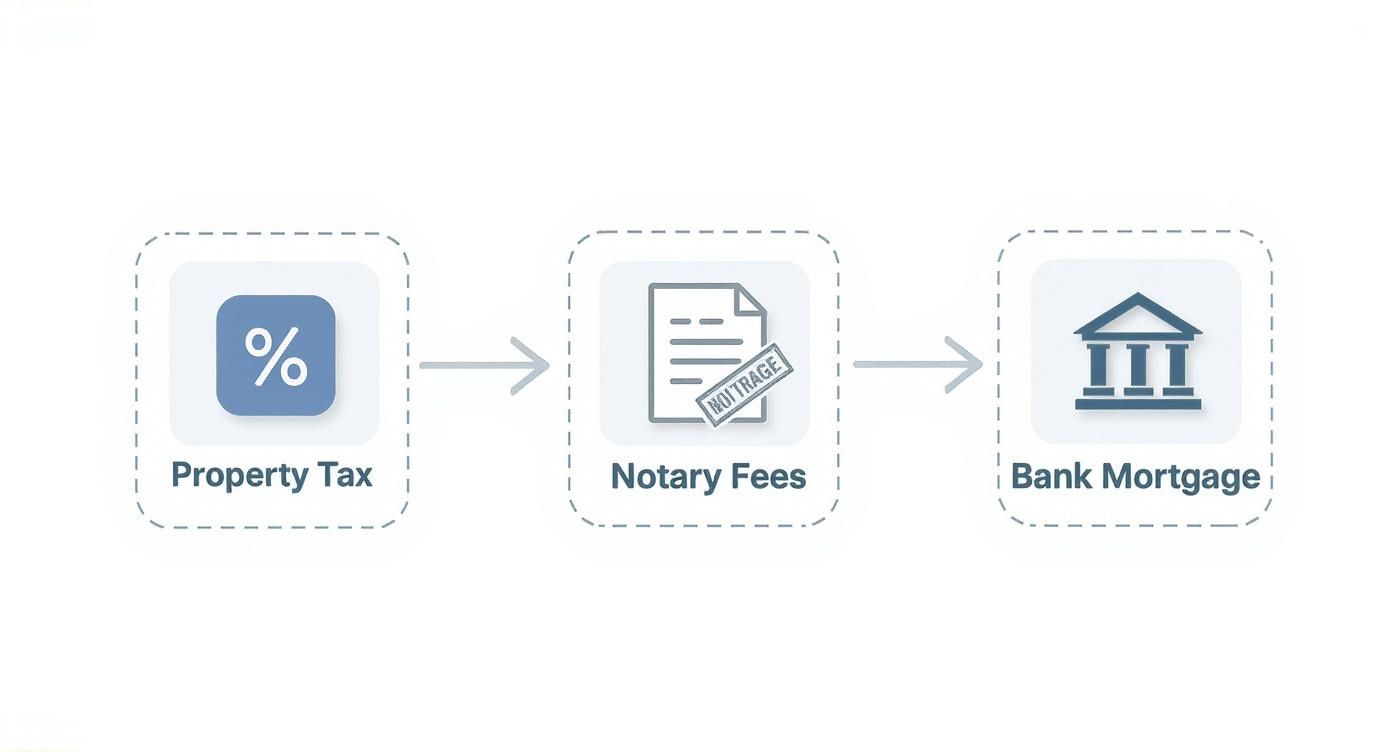
The Property Transfer Tax, notary fees, and any mortgage-related bank costs are the final financial hurdles.
Once the Escriptura is signed, the keys are transferred, and ownership is official. The entire journey, from signing the reservation contract to completion, typically takes four to eight weeks.
Where to Invest: Analysing Andorra's Parishes
When buying property in Andorra, the choice of parish is as crucial as the property itself. Each location offers a distinct investor profile, risk level, and return potential. Aligning this choice with financial goals—whether high rental yields or steady capital growth—is paramount.
The central parishes, Andorra la Vella and Escaldes-Engordany, are the nation's commercial heart. They command the highest property prices but offer consistent long-term rental demand from professionals, making them a lower-risk choice for capital preservation.
In contrast, ski-focused parishes like Canillo and La Massana present a different investment thesis. These areas are tourism hubs, offering higher potential yields from short-term holiday lets, particularly during the winter season.
Prime versus Growth Locations
Andorra la Vella & Escaldes-Engordany: As the established prime market, these central parishes are ideal for investors prioritising stability and long-term capital appreciation. Demand for quality long-term rentals is consistently high, driven by the concentration of businesses and amenities. While yields may be lower, the investment is underpinned by strong market fundamentals.
La Massana & Ordino: These parishes offer a blend of lifestyle appeal and growth potential. They are more affordable than the centre yet provide excellent access to ski resorts like Vallnord Pal-Arinsal. This makes them attractive for both long-term residents and seasonal holiday rentals, offering a balanced risk-reward profile.
Yield Prospects and ROI
Calculating potential return on investment (ROI) requires a clear understanding of rental yields, which vary significantly by location and rental strategy. Our guide on how to determine a property's investment potential is a valuable resource for these calculations.
Realistic yield expectations:
- Long-Term Rentals: In central parishes, gross rental yields typically range from 2.5% to 4%. This reflects higher property values but offers the security of consistent, year-round tenancy.
- Short-Term Holiday Lets: In ski-adjacent areas like Soldeu or Arinsal, yields can climb to 5% to 7% or higher during peak season. This strategy requires active management and carries the risk of off-season vacancy.
Investor Takeaway: Investment strategy should dictate location. For a hands-off investor seeking stable appreciation, the central parishes are a logical choice. For those prepared for active management to maximise income, the ski resorts offer higher yield potential.
From a macroeconomic perspective, Andorra presents a compelling case for investors seeking diversification. The principality has a stable, prosperous economy driven by tourism and financial services, supported by low unemployment. Further insight is available via reports on Andorra's economic stability on imf.org.
Ultimately, buying property in Andorra remains a fundamentally sound decision for investors with a long-term view. By carefully selecting a parish that aligns with financial objectives, one can effectively balance risk and reward in this unique European market.
Your Questions Answered
When considering buying property in Andorra, several key questions consistently arise. Clear answers are crucial before proceeding. Here is a practical breakdown of the most common queries from investors.
Can a UK Citizen Buy Property in Andorra Without Becoming a Resident?
Yes, it is possible. Non-residents are permitted to buy property in Andorra, but they must first obtain a government authorisation for foreign investment (Autorització d'inversió estrangera).
This permit allows ownership of a property purely as an investment or holiday home. It does not confer the right to live in Andorra full-time. For that, a separate residency permit application is required.
What Are the Inheritance Laws for Foreign Property Owners?
Andorra's inheritance tax regime is highly favourable. There is no tax on assets passed to direct descendants or a surviving spouse. For a UK national's assets, the process is generally guided by the laws of the deceased's nationality.
To simplify matters for heirs, it is highly recommended to draft an Andorran will with a local lawyer. This document will deal specifically with assets within the principality, mitigating potential cross-border legal complications and delays.
Are There Restrictions on the Type of Property Foreigners Can Buy?
Generally, no. Once the foreign investment authorisation is granted, the market is open. Foreign buyers can purchase residential apartments, chalets, and land for development, on the same terms as a local buyer.
However, specific local planning rules or restrictions can vary between parishes. A vital part of the lawyer's due diligence is to verify that the property complies with all local regulations and has no hidden legal impediments, ensuring the investment is secure.
At World Property Investor, we provide the in-depth analysis you need to make confident decisions in global real estate. Explore our comprehensive guides and market insights at https://www.worldpropertyinvestor.com.