
For global property investors, the term "Cyprus Golden Visa" once signified a direct route to an EU passport. That is no longer the case. The landscape has shifted, and the current programme offers permanent residency, secured through a €300,000 investment in either real estate or a local business.
This guide provides an authoritative, data-driven analysis of the programme, designed for investors who prioritise long-term fundamentals over market hype.
Understanding the Cyprus Golden Visa in 2025
Today's Cyprus Golden Visa is a residency-by-investment scheme. It is engineered for non-EU nationals seeking a transparent and efficient mechanism to establish a presence in Europe. The programme confers the right to live, conduct business, and benefit from the high quality of life Cyprus affords.
It is crucial to distinguish this from the former citizenship-by-investment scheme, which was terminated in November 2020. That programme was abolished following revelations that a significant percentage of passports had been granted improperly. In its place, Cyprus has focused entirely on its permanent residency programme, offering a more transparent and sustainable proposition for serious investors.
What Does Permanent Residency Entail?
Securing permanent residency in Cyprus provides an investor and their family with significant lifestyle and financial advantages. Unlike temporary visas, this status is granted for life. A key benefit is the minimal physical presence requirement: a single visit to the country once every two years is sufficient to maintain the permit.
This combination of flexibility and security is a powerful tool for global investors. It allows for the establishment of a European base without the restrictive residency obligations seen in many other jurisdictions. This makes it an ideal 'plan B' or a gateway to wider European commercial opportunities without necessitating a full relocation.
Core Benefits for a Global Investor
The appeal of the Cyprus Golden Visa extends far beyond its Mediterranean climate. For the discerning property investor, the benefits are practical, tangible, and financially sound.
- An EU Base of Operations: Establish a personal and business presence within a stable EU member state, noted for its pro-business environment and competitive corporate tax rate of 12.5%.
- Family Inclusion: The permit extends to the applicant, their spouse, and dependent children up to the age of 25, offering a comprehensive solution for the entire family.
- A Favourable Tax Regime: Cyprus offers attractive tax incentives for non-domiciled residents, including potential exemptions on worldwide dividend and interest income.
- A Pathway to Citizenship: While not a direct route, permanent residency is the foundational step. After eight years of legal residence, an individual can apply for Cypriot citizenship through the standard naturalisation process.
To fully appreciate its value proposition, it is prudent to compare this programme with other international property investment destinations to assess its competitive standing.
Qualifying for the Golden Visa
Qualification for the Cyprus Golden Visa rests on two pillars: a verifiable financial commitment and a clean personal background. The programme is structured for investors with legitimate funds who can demonstrate financial self-sufficiency. While the process is direct, it demands meticulous attention to detail.
The core requirement is a minimum investment of €300,000 (plus VAT). This capital must be deployed into specific, government-approved assets. Understanding these options is the first step in the due diligence process.
The Financial Commitment
While real estate is the most common investment route, the regulations are precise. The capital must be invested in brand-new properties purchased directly from a developer. This can be one or two residential properties, or commercial real estate such as offices, retail units, or hotels.
Beyond property, two alternative pathways exist to meet the investment threshold:
- Company Shares: An investment of €300,000 into the share capital of a Cypriot company. This entity must have a physical presence and employ at least five people in Cyprus.
- Investment Funds: A commitment of €300,000 to units in a Cyprus-based Collective Investment Organisation (e.g., AIF, AIFLNP, or RAIF).
Crucially, all investment funds must be proven to originate from outside Cyprus and be transferred through official banking channels. For further detail on structuring such transactions, consult our guide on financing an investment property.
Personal Eligibility Criteria
Beyond the financial requirements, applicants must satisfy several personal criteria. These are non-negotiable checks designed to ensure all participants are of good standing and can support themselves.
Applicants must demonstrate a secure annual income of at least €50,000 derived from outside Cyprus. This can include salaries, pensions, dividends, or rental income. The minimum threshold increases by €15,000 for a spouse and €10,000 for each dependent child.
A critical component is the criminal record check. The main applicant and all dependants must provide official certificates from their country of origin and current country of residence, confirming a clean criminal record.
Applicants must also sign a declaration stating they will not seek employment in Cyprus. While one can serve as a director in a company they have invested in, the residency permit is not a work permit. Finally, comprehensive health insurance is required for all individuals included in the application.
Cyprus Golden Visa Key Requirements at a Glance
| Requirement | Details |
|---|---|
| Minimum Investment | €300,000 (plus VAT) in new-build property, company shares, or investment funds. |
| Source of Funds | Must originate from outside Cyprus and be legally transferred and declared. |
| Annual Income | At least €50,000 from abroad, plus €15,000 for a spouse and €10,000 per child. |
| Criminal Record | A clean criminal history from country of origin and residence is mandatory. |
| Employment Status | Must declare no intention to seek employment in Cyprus. |
| Health Insurance | Comprehensive medical cover required for all applicants. |
Meeting these criteria is the foundation of a successful application, ensuring you are well-positioned to gain permanent residency in a stable, EU member state.
Your Step-by-Step Application Roadmap

Securing the Cyprus Golden Visa is a structured process, not an exercise in bureaucracy. When broken down into distinct stages, the procedure becomes clear and manageable. From initial consultation to permit issuance, the process typically takes approximately six months, making it one of the more efficient residency programmes in Europe.
This timeline, however, is contingent on thorough preparation and accurate documentation from the outset.
Stage 1: Initial Consultation and Due Diligence
The first step, before any transfer of funds, should be to engage a reputable legal advisor specialising in Cypriot immigration law. This is a critical move. They will assess your eligibility, provide a detailed overview of the programme’s requirements, and conduct preliminary due diligence to confirm you meet all personal and financial criteria.
During this stage, begin compiling core documents—passports, proof of income, and evidence of investment funds. Underestimating the time required to source, translate, and notarise documents is a common pitfall. Proactive preparation at this stage is key to a smooth process.
Stage 2: Property Selection and Purchase
Once eligibility is confirmed, the focus shifts to the investment itself. For the majority of applicants, this involves identifying a qualifying property. The rule is absolute: the investment must be in new-build real estate purchased directly from a developer.
Upon selecting a suitable property, a purchase agreement is signed and a deposit is paid. Your legal counsel will then conduct all necessary checks with the Land Registry to ensure the title is clean and unencumbered. This step formalises your investment intent, which is a cornerstone of the application.
A crucial practical step is opening a Cypriot bank account. This is required to transfer the investment funds from abroad, creating a clear and auditable financial trail for the authorities.
Stage 3: Compiling and Submitting Your Application
This stage involves the collation of all required documentation. Working with your advisor, you will assemble a comprehensive application file, including the property purchase agreement, proof of funds transfer, clean criminal record certificates, and health insurance policies.
The process can be mapped across seven key milestones:
- Initial Legal Consultation: Confirm eligibility and establish a personalised document checklist.
- Property Selection: Identify and reserve a qualifying new-build property with a developer.
- Bank Account Opening: Establish a local bank account to facilitate the investment transfer.
- Funds Transfer and Purchase: Transfer the €300,000 (plus VAT) and finalise the property acquisition.
- Document Compilation: Gather, translate, and notarise all required personal and financial paperwork.
- Application Submission: Your lawyer submits the complete file to the Civil Registry and Migration Department.
- Approval and Biometrics: Following approval (typically within six months), you and your family visit Cyprus to provide biometric data for your residency permits.
Attention to detail is paramount. Minor errors or omissions can lead to significant delays. A government processing fee of €500 per adult applicant is paid upon submission. After approval, a trip to Cyprus is required within one year to provide biometrics, after which the permanent residency cards are issued.
Understanding the Total Investment Cost
The headline figure of €300,000 for the Cyprus Golden Visa represents the core investment, not the total capital outlay. Prudent investors understand that the true cost of an acquisition includes all associated fees, taxes, and professional service costs.
These additional expenses are not incidental; they can add a significant sum to the total investment. A clear understanding of these costs from the outset is essential for accurate financial planning and a seamless transaction.
Breakdown of Additional Fees and Taxes
Your initial investment is the starting point. Several mandatory costs are layered on top of the property purchase, each essential for completing the transaction and securing residency.
These include:
- Government Application Fee: A non-refundable fee of €500 for the main applicant and each adult dependant. An additional €70 per person is required for the issuance of the Alien Registration Certificate (ARC).
- Legal Fees: Engaging a reputable Cypriot lawyer is non-negotiable. Fees typically range from 1% to 1.5% of the property purchase price, covering due diligence, contract review, and application submission.
- Stamp Duty: A one-off tax levied on the property purchase contract. It is calculated on a tiered scale: 0.15% on the first €170,860 of the property's value and 0.20% on the remaining amount, capped at €20,000.
These costs are predictable and should be included in your initial budget to ensure sufficient liquidity throughout the process.
The Critical Role of Value Added Tax (VAT)
The most significant additional cost is typically Value Added Tax (VAT). The standard VAT rate on new properties in Cyprus is 19%. For a €300,000 property, this equates to an additional €57,000.
However, a crucial tax incentive exists. Investors can qualify for a reduced VAT rate of 5% if the property is to be used as their primary and permanent residence in Cyprus. This distinction is vital—a property acquired solely as a rental investment will not be eligible for the reduced rate.
This tax concession can result in savings of tens of thousands of euros. To qualify, the property's buildable area must not exceed 130 square metres, and a formal declaration of intent to use it as a main residence is required.
For investors building a portfolio, a deeper analysis of regional tax liabilities is essential. You can explore how these costs compare globally in our guide to understanding property taxes for investors.
A Worked Example of Total Cost
Let's apply these figures to a practical example. Assume the purchase of a new apartment in Paphos for €350,000, intended as a primary residence, thus qualifying for the reduced VAT rate.
The approximate breakdown of costs would be:
- Property Price: €350,000
- Reduced VAT (5%): €17,500
- Stamp Duty: €614.56 (€256.29 on the first €170,860 + €358.28 on the remaining €179,140)
- Legal Fees (est. 1.2%): €4,200
- Application & ARC Fees (for one person): €570
In this scenario, the total estimated investment is approximately €372,885. This is over €22,000 more than the property price alone, illustrating the necessity of comprehensive budgeting for any serious Cyprus Golden Visa applicant.
Analysing the Cyprus Property Market
Acquiring a Cyprus Golden Visa is fundamentally an investment decision. As with any significant capital allocation, thorough market analysis is essential. The real value lies in the underlying asset—the property. Understanding the dynamics of the Cypriot real estate market is key to ensuring your investment not only meets residency requirements but also delivers long-term capital growth.
The market is not monolithic. The commercial hub of Limassol and the tourism-driven economy of Paphos offer different risk and return profiles. Aligning your property selection with your investment objectives—whether stable rental income, capital appreciation, or a hybrid strategy—is critical.
Rental Yields and Capital Appreciation
For many investors, rental yield is a primary performance metric. In Cyprus, gross rental yields for residential properties typically range between 3% and 6%. Location and asset class are the key determinants. A modern apartment in central Limassol targeting corporate tenants, for example, will generally command a higher yield than a seasonal holiday villa.
The second component of return is capital appreciation. While past performance is not indicative of future results, Cyprus has a track record of steady, long-term growth underpinned by tourism, foreign direct investment, and a growing number of international businesses establishing operations. Data from the Central Bank of Cyprus indicates a consistent upward trend in property price indices, positioning well-chosen real estate as a reliable store of value.
The key takeaway is to seek a balance. Chasing high rental yields in a location with limited growth potential is a flawed strategy. A property with a slightly lower yield in an area poised for strong capital appreciation will likely deliver superior total returns over a five-to-ten-year horizon.
Evaluating Property Types for ROI
The Cyprus Golden Visa offers flexibility in property type, but not all assets are created equal from an investment standpoint. Each serves a different market segment with a distinct risk-reward profile.
- Holiday Lets: Properties in prime tourist zones like Paphos or Ayia Napa can generate strong seasonal income. However, they are sensitive to fluctuations in tourism and require more intensive management.
- Long-Term Rentals: Apartments in business centres like Limassol and Nicosia provide stable, year-round income from a diverse tenant base of locals and expatriates. Yields are more predictable with lower vacancy rates.
- Commercial Units: Acquiring office or retail space can secure long-term leases with corporate tenants, providing a secure income stream. This is a specialised market, but returns can be robust for knowledgeable investors.
Contextualising these options is important. It is useful to compare the Cyprus market against top emerging property investment markets to understand its global positioning.
Economic Fundamentals and Market Drivers
The Cypriot property market is supported by solid economic fundamentals, not speculation. Its strategic location, full EU membership, and a pro-business regulatory environment create a stable foundation. For British investors, the strong economic ties between Cyprus and the UK provide an additional layer of security.
According to UK government data, total trade in goods and services between the two nations reached £3.8 billion in the four quarters to the end of Q2 2024, an increase of 4.1% on the previous year. With UK exports to Cyprus at £2 billion, these robust commercial links position the island as a natural EU gateway for British capital. You can explore the full trade and investment factsheet on the Gov.uk website for detailed figures.
This economic activity, coupled with a growing technology sector and reliable tourism, sustains healthy demand for both residential and commercial property. Focusing on these long-term drivers, rather than short-term market noise, enables a more resilient and informed investment decision.
How Cyprus Compares to Other EU Golden Visas
https://www.youtube.com/embed/vQ3IVXXBlZ0
A prudent investment decision requires a comparative market analysis. While the Cyprus Golden Visa is a strong contender, it operates in a competitive landscape. For most investors, the choice involves a direct comparison with its primary EU rivals: Greece and Portugal.
Each programme possesses unique characteristics regarding investment options, physical presence requirements, and the long-term pathway to citizenship. An investor focused on the lowest capital entry point may favour one programme, while another may prioritise a scheme with minimal residency obligations.
Investment Thresholds And Asset Options
The most direct point of comparison is the minimum investment threshold. Cyprus maintains a clear €300,000 requirement. This capital must be directed into new-build property, company shares, or specific Cypriot investment funds, channelling investment towards new economic development.
In contrast, Greece, previously known for a €250,000 entry point, has significantly increased its thresholds. In high-demand locations such as Athens, Mykonos, and Santorini, the minimum investment has risen to as high as €800,000. Portugal, meanwhile, has restructured its programme entirely, removing the popular direct real estate investment option. Its focus is now on collective investment funds, starting at €500,000.
For investors committed to direct property ownership, the Cypriot programme’s unambiguous €300,000 threshold for new-builds provides a predictable and transparent route. It avoids the complex regional pricing tiers of Greece and the outright prohibition on direct property investment now in place in Portugal.
This decision-tree infographic visualises the two primary hubs for property investment in Cyprus.
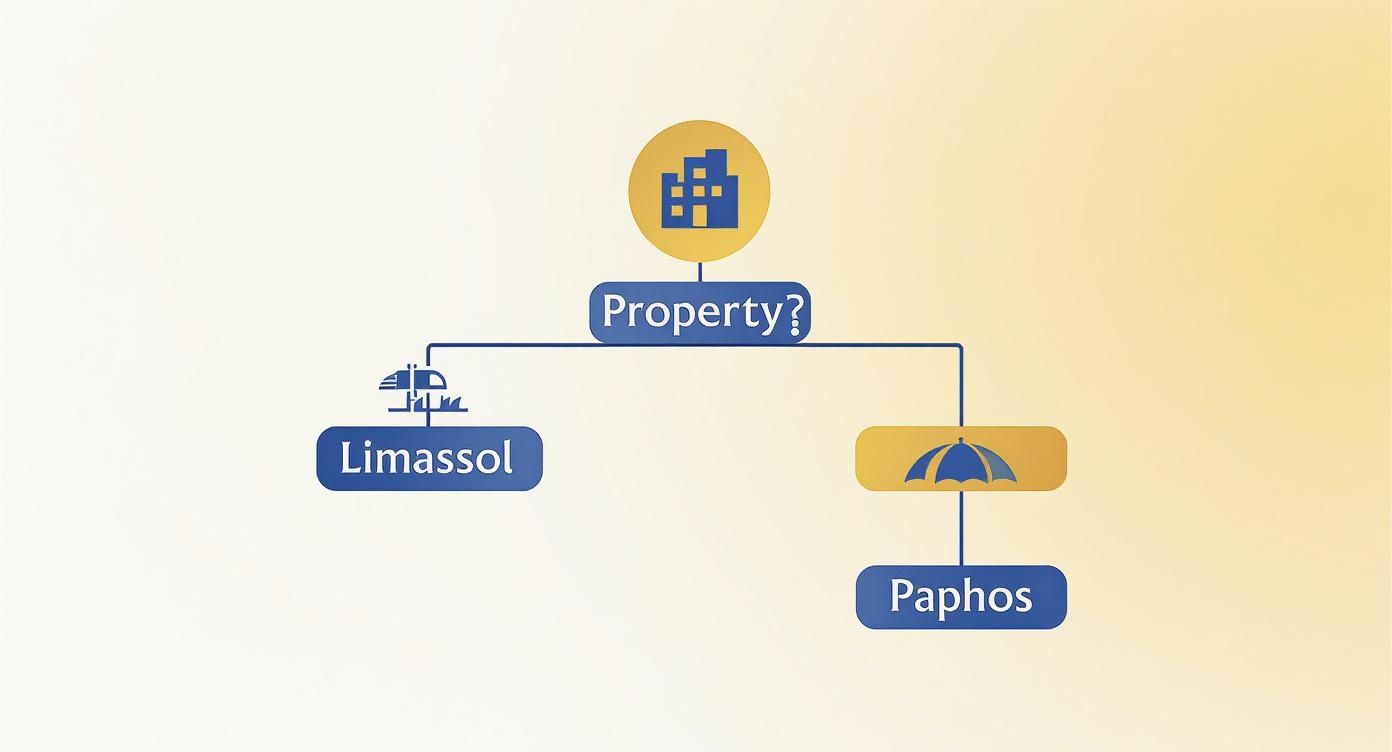
As the flowchart indicates, investors typically choose between Limassol for its modern, business-centric appeal, and Paphos for its high-quality lifestyle and established tourism market.
Processing Speed And Residency Rules
Processing time and residency obligations are critical factors for many investors. Cyprus excels in this regard. Applications are typically processed within approximately six months, which is remarkably efficient.
The physical presence requirement is also exceptionally lenient, requiring only a single visit once every two years. This offers maximum flexibility.
Greece offers a similarly swift timeline, but Portugal’s process has historically been subject to administrative backlogs. Portugal’s rules mandate an average of seven days per year in the country which, while manageable, is more demanding than the Cypriot requirement.
Golden Visa Comparison Cyprus vs Greece vs Portugal
This table provides a side-by-side comparison of the key features of Europe's leading residency-by-investment programmes.
| Feature | Cyprus | Greece | Portugal |
|---|---|---|---|
| Minimum Investment | €300,000 | €250,000 – €800,000 | €500,000 |
| Primary Asset Type | New Property, Funds | Real Estate | Investment Funds |
| Processing Time | ~6 Months | ~6-9 Months | 12-18+ Months |
| Physical Stay | Once every 2 years | None | 7 days per year |
| Path to Citizenship | 8 Years | 7 Years | 5 Years |
The data illustrates that each programme is tailored to a different investor profile. The optimal choice depends on whether the primary consideration is cost, speed, or the long-term potential for citizenship.
The Long-Term Path To Citizenship
While the immediate goal is permanent residency, many investors view this as the first step towards acquiring a second passport. The naturalisation timeline varies significantly between these countries.
- Cyprus: An individual can apply for citizenship after eight years of legal residence.
- Greece: The requirement is similar, with a pathway to citizenship after seven years of continuous residency.
- Portugal: Portugal offers an advantage here, with a shorter pathway allowing for a citizenship application after just five years of residency.
For a broader perspective on how different countries structure their investment environments, our guide on the best countries to invest in property provides valuable context.
Ultimately, the choice depends on an investor's strategic priorities. For those who value processing speed, simplicity, and a minimal physical presence requirement, the Cyprus Golden Visa presents a highly compelling and competitive case.
Frequently Asked Questions
While the strategic benefits of the programme are clear, practical questions often determine the final decision. Here are direct answers to the most common queries from investors considering the Cyprus Golden Visa.
Can My Family Be Included in the Application?
Yes. The Cyprus programme is structured to accommodate families. A single application covers the main investor, their spouse, and dependent children up to the age of 25. This provides a comprehensive solution for families seeking to establish a secure base in the European Union.
Is There a Physical Residency Requirement?
This is one of the programme's most significant advantages. To maintain permanent residency status, you are only required to visit Cyprus once every two years. This minimal obligation offers investors exceptional flexibility, allowing them to enjoy the benefits of EU residency without the commitment of full-time relocation.
Can I Work in Cyprus With a Golden Visa?
No, the permanent residency permit does not grant the right to work. As part of the application, you must sign a formal declaration confirming you do not intend to undertake salaried employment in Cyprus. You are, however, permitted to act as a director in a company in which you have invested and receive dividend income from it.
The purpose of the Cyprus Golden Visa is to attract capital investment, not to fill local employment positions. The programme is designed for individuals who can support themselves through income generated outside of Cyprus.
Does the Cyprus Golden Visa Lead to Citizenship?
While the Golden Visa itself grants permanent residency, it establishes a clear pathway toward citizenship. After residing legally in Cyprus for eight years, you become eligible to apply for a Cypriot passport through the standard naturalisation process. This requires meeting certain residency criteria and demonstrating genuine ties to the country.
What Happens if I Sell My Investment Property?
Your permanent residency status is directly tied to your qualifying investment. If you liquidate the asset that formed the basis of your Cyprus Golden Visa application, your residency rights will be revoked. To maintain your status indefinitely, the €300,000 investment must be preserved.
Ready to explore global property opportunities with confidence? World Property Investor provides in-depth guides, market analysis, and actionable advice to help you make informed decisions. Discover your next investment at https://www.worldpropertyinvestor.com.