
For the discerning property investor, the cost of living in a target country is not a lifestyle metric; it is a core driver of rental yields, tenant stability, and capital appreciation. Turkey presents a compelling case: its cost base is significantly lower than that of Western Europe, with day-to-day expenses running 45% to 65% cheaper than in the United Kingdom, according to cross-market analysis.
This affordability underpins strong, consistent demand for rental properties from a diverse pool of local professionals, expatriates, and retirees. For investors, this translates into a resilient and fundamentally robust rental market.
Analysing Turkey's Cost of Living for Property Investors
A low cost of living is more than a benefit for residents; it is a critical market fundamental for anyone acquiring property assets in Turkey. When daily life is affordable—from housing and utilities to transport—it creates a highly desirable environment for a broad tenant base.
This dynamic directly fuels rental demand and allows for competitive yet profitable rental pricing. For any serious investor considering investing in overseas property, grasping this relationship is a crucial first step in due diligence.
Unlike established but high-cost markets like France or Spain, Turkey occupies a rare space where significant growth potential and affordability converge. The financial upside is clear and quantifiable.
The UK vs Turkey: A Stark Financial Contrast
The opportunity becomes particularly striking when comparing key metrics with an established market like the UK. Recent data from economic bodies confirms that consumer prices, including rent, are substantially lower across the board in Turkey.
For example, a one-bedroom flat in a Turkish city centre costs, on average, around £463 per month. This is over 54% less than the equivalent property in the UK, which averages £1,016. The savings are even more pronounced for acquisition, with prices per square foot in Turkey being nearly 69% lower than in the UK.
Cost of Living Comparison: Turkey vs UK
To provide a clear perspective, the following table summarises key monthly costs. This snapshot illustrates the financial advantages that make Turkey’s rental market so resilient and appealing to prospective tenants.
| Expense Category | Average Monthly Cost in Turkey (£) | Average Monthly Cost in UK (£) | Approximate Saving (%) |
|---|---|---|---|
| Rent (1-bed city centre) | £463 | £1,016 | 54% |
| Utilities (Basic) | £55 | £253 | 78% |
| Groceries (Monthly) | £150 | £320 | 53% |
| Public Transport Pass | £22 | £70 | 69% |
| Restaurant Meal (Mid-range) | £25 (for two) | £60 (for two) | 58% |
Note: Figures are averages based on aggregated data and can vary by city and lifestyle.
The data makes it clear: the financial pressure on tenants is significantly lower in Turkey. This supports stable occupancy rates and predictable income streams for landlords.
This significant cost disparity has several direct implications for investors:
- Higher Potential Rental Yields: Lower acquisition costs combined with strong rental demand mean that gross yields frequently outperform those achievable in saturated Western European markets.
- A Wider Tenant Pool: Affordability acts as a magnet for a diverse range of tenants, including digital nomads, corporate expatriates, and local families, thereby reducing vacancy risk.
- Lower Operational Costs: Expenses such as maintenance, repairs, and property management fees are typically lower, which directly improves net operating income and overall Return on Investment (ROI).
For the strategic investor, Turkey's cost of living is not merely a statistic—it is the engine that drives tenant demand and profitability. It creates a market where capital can work more efficiently, delivering both healthy cash flow and the potential for long-term appreciation.
Breaking Down Monthly Expenses Across Key Cities
While national averages provide a useful baseline, an investor's analysis must be localised. The cost of living in Turkey is not a single figure but a mosaic of regional economic realities. The budget required to live in the sprawling metropolis of Istanbul is entirely different from that needed in a coastal town like Fethiye.
Understanding these local variances is what separates a robust financial forecast from speculation. A high-cost city like Istanbul may command premium rents, but it also targets tenants with higher incomes and expectations. Conversely, a villa in an affordable resort town appeals to retirees or expatriates with different financial structures. Aligning your property asset with the correct market demographic is fundamental.
The comparison below highlights the significant affordability gap in housing between Turkey and the UK, a primary driver of market activity.
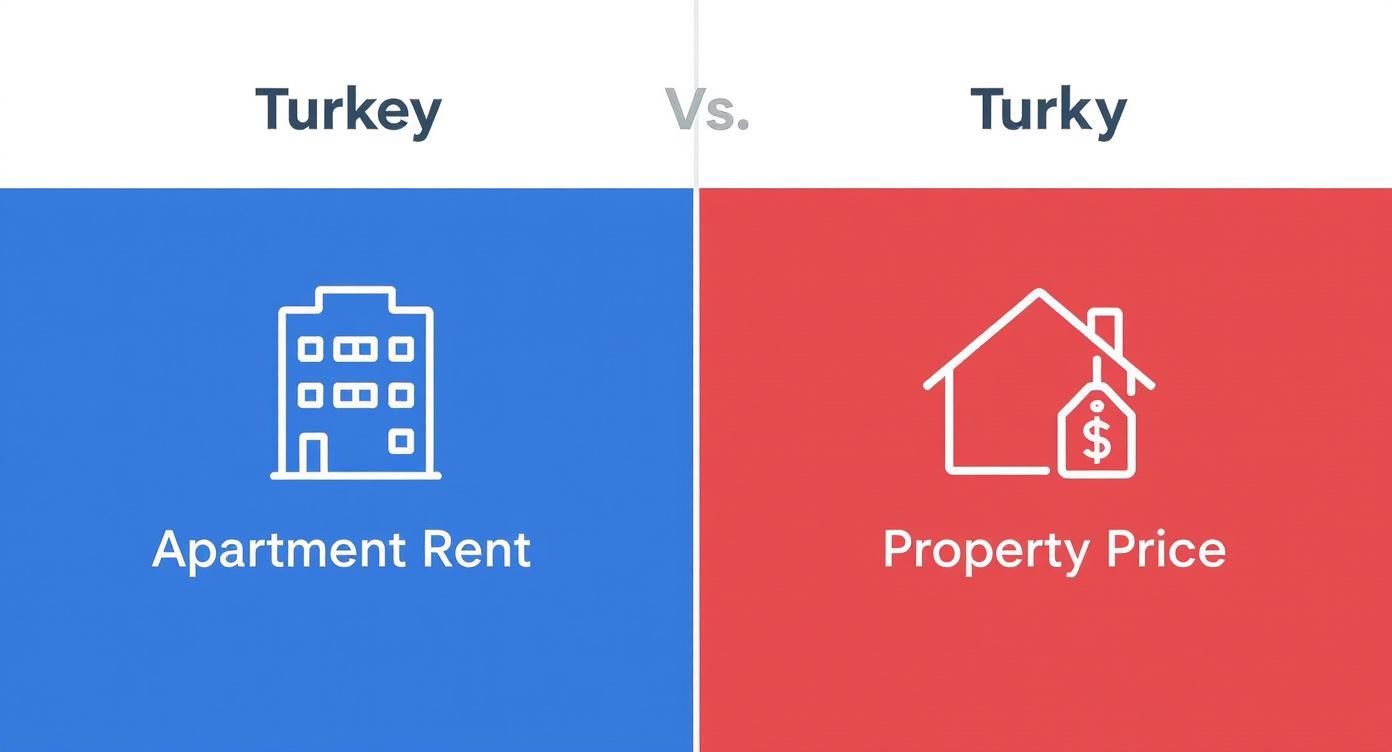
As illustrated, both renting and purchasing property in Turkey are considerably more accessible. This creates a powerful value proposition that fuels the rental market, attracting tenants and investors seeking superior returns.
Istanbul: The Economic Powerhouse
As Turkey's economic engine, Istanbul naturally has the highest cost of living. A flat in a sought-after central district like Beyoğlu or Beşiktaş will command 30-50% more in rent than in other major cities. Daily life, from dining to transport, also carries a 15-25% premium.
The trade-off is opportunity. The city's higher earning potential and concentration of corporate headquarters attract a constant flow of skilled professionals and corporate tenants. For an investor, this means robust and consistent rental demand, justifying the steeper property prices with the promise of higher rental income and stronger capital growth potential.
Ankara: The Governmental and Diplomatic Hub
Ankara, the nation's capital, offers a more balanced economic equation. Here, a high quality of life is achievable without the price tag of Istanbul. A family of four can live comfortably on a budget that is roughly 20-30% lower, a saving driven primarily by more reasonable housing and international schooling costs.
This affordability makes Ankara a magnet for families, civil servants, and the diplomatic community. For investors, the city represents a stable, long-term rental market less exposed to the seasonal fluctuations of tourist-heavy coastal regions. Understanding these fundamentals is crucial, and you can learn more about the role of location in real estate investment success in our detailed guide.
Izmir and the Aegean Coast
Izmir, Turkey’s third-largest city, blends a relaxed coastal lifestyle with the amenities of a major urban centre. The cost of living is notably lower than in Istanbul, attracting a growing demographic of young professionals, creatives, and retirees, which in turn creates a vibrant and diverse rental market.
The Aegean coast exemplifies how lifestyle trends shape rental demand.
- For Tenants: The appeal lies in a superior "work-life balance," with easy access to beaches and a more laid-back culture.
- For Investors: This opens up opportunities for both long-term residential lets and lucrative seasonal holiday rentals, offering strategic flexibility.
Antalya and the Mediterranean Resorts
On the Mediterranean coast, towns like Antalya, Fethiye, and Kaş are dominated by tourism and a large expatriate retiree community. Here, the cost of living is dynamic and seasonal. While daily expenses are generally low, rental prices in prime locations can surge during the high season from May to October.
An investor targeting a coastal property must understand this dual market. A long-term rental to a retired couple offers steady, year-round income. In contrast, a short-term holiday let strategy can generate significantly higher returns during peak months, albeit with greater management intensity and the risk of off-season vacancies.
Forecasting Housing and Utility Holding Costs
For any serious property investor, analysing the general cost of living in Turkey is merely the first step. The true viability of an investment is determined by accurately forecasting its holding costs—the recurring expenses that directly impact net return.
These foundational costs, primarily housing and utilities, are the bedrock of any financial model. Accurate projections allow for precise profitability calculations; inaccuracies lead to disappointing yields and cash flow challenges.

Deconstructing Rental Prices Across Key Markets
Rental prices in Turkey are highly variable, fluctuating significantly based on city, district, and building quality. For an investor, this variance dictates potential gross income.
- Istanbul: In prime central districts like Beşiktaş or Kadıköy, a modern two-bedroom flat can command rents from £1,000 to £1,800 per month. In an emerging suburb, a similar property might achieve £600 to £900, offering a more accessible entry point.
- Ankara: As the capital, it has stable, family-oriented rental demand from diplomats and civil servants. A three-bedroom apartment in a sought-after area like Çankaya will typically rent for £700 to £1,100 per month.
- Izmir & Coastal Resorts: Rents in Izmir are approximately 15-25% lower than in Istanbul. On the coast, in towns like Fethiye or Bodrum, a two-bedroom villa can generate £1,500+ per month in the high season (May-October), but this figure can fall by 40-50% in winter—a critical risk to factor into annual projections.
Understanding Utility Bills and Aidat
Utilities in Turkey are inexpensive by UK standards but require accurate budgeting. For a standard 85m² apartment, a realistic monthly forecast would be:
- Electricity, Water, Gas & Refuse: A combined bill of £60 to £100 is a reasonable baseline. This can increase by 30% or more during peak summer (air conditioning) or winter (heating) months.
- Internet: A high-speed connection will cost between £10 and £15 per month.
A critical, and often overlooked, holding cost for investors is 'Aidat'. This is a mandatory monthly fee for the maintenance of the building or residential complex, covering communal services such as security, swimming pool upkeep, gardening, and lighting. Aidat can be as low as £20 per month in a simple building or exceed £200 in a luxury resort-style complex.
Failing to account for Aidat will significantly distort net yield calculations. When conducting due diligence on a property, always request the precise Aidat figure.
Building a Comprehensive Financial Model
To ascertain the true net return, all holding costs must be subtracted from gross rental income. This includes more than just utilities and Aidat.
A prudent investor will also budget for property management fees (typically 10-15% of rental income), annual property taxes, and a contingency fund for unexpected repairs (setting aside 5-8% of annual rent is standard practice).
Understanding the tax implications is non-negotiable for maximising returns. Our guide helps you understand property taxes for international investors, providing a clear framework for compliance.
By integrating these elements, you can construct a robust financial model that accurately reflects the true performance of your Turkish property investment.
Analysing Healthcare and Education Expenses
For investors targeting the lucrative long-term rental market—particularly professional expatriates with families—a firm grasp of local healthcare and education costs is essential.
These two categories represent major household expenditures that directly influence a potential tenant's rental budget. A clear understanding of these figures is crucial for positioning a property correctly and attracting high-calibre, stable tenants.
Unlike the UK's National Health Service, Turkey operates a dual healthcare system. While residents can use the state-run Sosyal Güvenlik Kurumu (SGK), a residence permit for most foreign nationals requires mandatory private health insurance. This is a key factor shaping the overall cost of living in Turkey for your target tenants.
Private healthcare is the preferred option for most expatriates due to its modern facilities, English-speaking staff, and minimal waiting times. Importantly for investors, these high-quality services are significantly more affordable than their Western European equivalents.
Breaking Down Private Healthcare Costs
The cost of private health insurance depends on age and coverage level, but annual premiums for a comprehensive policy typically fall between £400 and £900 per person. This is a critical data point when modelling a prospective tenant's budget.
Beyond the premium, out-of-pocket expenses are modest:
- Specialist Consultation: A consultation at a top private hospital in Istanbul or Ankara costs between £50 and £100.
- Minor Procedures: Costs for routine scans or minor treatments are a fraction of what UK private hospitals charge.
This affordability means that even with premium healthcare, an expatriate family’s disposable income remains strong, supporting higher rental budgets for well-located properties.
The key takeaway for property investors is that high-quality, affordable private healthcare is a major attraction for expatriates. It reduces their financial burden, making Turkey a more appealing long-term destination and expanding the pool of reliable, professional tenants for your portfolio.
The Cost of International and Private Education
For families, schooling is often the single largest expense after rent. Turkey has a clear distinction between local private schools and international schools, and the cost difference directly impacts a family’s rental budget.
International schools, which follow curricula like the British (GCSE/A-Level) or International Baccalaureate (IB), are the most expensive option. The annual tuition fees represent a significant financial commitment.
- Primary School: Fees typically range from £8,000 to £15,000 per academic year.
- Secondary School: For top-tier schools in Istanbul, this can climb to between £15,000 and £25,000 annually.
Alternatively, private Turkish schools offering bilingual programmes are a more cost-effective option. While they primarily follow the national curriculum, their focus on English and modern teaching methods makes them popular. Fees are substantially lower, usually between £4,000 and £8,000 per year.
An investor with a three-bedroom property near a reputable international school can confidently target tenants with higher incomes, as their budget must absorb these significant educational costs. Conversely, a property near an affordable private Turkish school may appeal to a broader range of professional families. This local knowledge allows for a more precise tenant targeting and rental pricing strategy.
Modelling Budgets For Your Target Tenants
Raw cost-of-living data is foundational, but translating it into a viable investment strategy requires deeper analysis. To accurately assess the market, an investor must model realistic monthly budgets for their target tenant profiles.
This exercise is critical for setting appropriate rental rates, forecasting occupancy, and ensuring the investment performs as expected. Below are three common tenant profiles: a single professional in Istanbul, a retired couple on the coast, and an expatriate family in Ankara. These serve as a practical starting point for your own due diligence.

Profile 1: The Single Professional in Istanbul
This profile represents a young or middle-aged professional in sectors like technology, finance, or a multinational corporation. They prioritise convenience and lifestyle, seeking a modern flat near business hubs like Levent or social centres like Kadıköy.
Their largest outgoing is rent for a one-bedroom flat in a desirable, well-connected area. A significant portion of their income is allocated to dining, socialising, and transport, making properties with excellent public transport links highly sought after.
- Rent (1-Bed, Central): £700 – £1,100
- Utilities & Aidat: £100 – £150
- Transport (Public & Taxi): £80 – £120
- Groceries & Dining Out: £350 – £500
- Leisure & Fitness: £100 – £200
- Total Monthly Estimate: £1,330 – £2,070
This indicates that a modern, well-located one-bedroom property is well within the budget for this demographic, underpinning the strong rental demand in Istanbul’s core districts.
Profile 2: The Retired Couple in Fethiye
This demographic is drawn to Turkey’s Aegean and Mediterranean coasts for the climate, relaxed lifestyle, and significantly lower living costs. Their income is typically fixed (pensions or investment returns), making budget predictability paramount. They seek comfortable, low-maintenance properties, such as a two-bedroom apartment or a small villa with outdoor space.
Their expenditure is focused on healthcare, home cooking with produce from local markets, and occasional dining out. While their overall budget is lower than an Istanbul professional’s, their stability makes them excellent long-term tenants.
- Rent (2-Bed Apartment/Villa): £550 – £850
- Utilities & Aidat: £120 – £180
- Private Health Insurance: £100 – £150 (for two)
- Groceries & Local Markets: £300 – £400
- Leisure & Transport (Car): £150 – £250
- Total Monthly Estimate: £1,220 – £1,830
Properties in established coastal towns that offer comfort and accessibility are perfectly positioned to capture this reliable market segment.
By modelling tenant budgets, you move from abstract market data to a concrete understanding of affordability. This directly informs your acquisition strategy, helping you select properties that align with the financial capacity of the most stable tenant pools, thereby minimising vacancy risk and maximising your returns.
Profile 3: The Expatriate Family in Ankara
Ankara is a hub for families associated with embassies, multinational corporations, and international schools. Their priorities are safety, space, and access to quality education and healthcare. A three or four-bedroom apartment in a secure complex or a villa in a family-friendly neighbourhood like Çankaya is the standard requirement.
This profile has the largest budget, heavily weighted towards significant school fees and housing costs. Factoring in these major expenses is vital when calculating potential returns. For a deeper analysis, it is worth reviewing our guide to calculate your return on investment for real estate.
- Rent (3/4-Bed Apartment/Villa): £800 – £1,300
- International School Fees (1 Child): £800 – £1,500
- Utilities & Aidat: £150 – £250
- Groceries & Household: £500 – £700
- Transport (Family Car): £200 – £300
- Total Monthly Estimate (Excluding School): £1,650 – £2,550
These profiles clearly demonstrate how Turkey’s cost of living creates distinct rental sub-markets. Investment success depends on matching the property asset to the correct demographic and budget.
Your Top Questions Answered
Entering any new property market raises critical questions. For investors evaluating Turkey, queries frequently centre on real-world income requirements, inflation, and the day-to-day costs that ultimately shape net returns.
Here are direct answers to the most common questions, designed to support a more robust and realistic investment strategy.
What is the Required Income to Live Comfortably in Turkey?
While "comfortable" is subjective, it can be quantified. A single professional renting a quality flat in a desirable Istanbul district should have a net monthly income between £1,200 and £1,800. This covers rent, bills, transport, and a healthy budget for socialising.
For a family of four, particularly with international school fees, a monthly income closer to £2,500 to £3,500 would be required. However, in a coastal city like Fethiye or Antalya, the same family's outgoings could be 20-30% lower.
Investor Takeaway: This data is essential for pricing your rental property. Understanding what your target tenants can realistically afford allows you to set a competitive rent that maximises occupancy and minimises costly void periods.
Is Istanbul Significantly More Expensive Than Other Turkish Cities?
Yes. Istanbul is Turkey's most expensive city, although it remains far more affordable than London or Paris. Rent for a comparable apartment in a prime Istanbul neighbourhood can be up to 50% higher than in Ankara or Izmir. Daily costs like transport and groceries also carry a 15-25% premium.
The trade-off is a much stronger economic engine. Istanbul offers greater rental demand from corporate tenants and tourists, which often translates into superior yields and more reliable long-term capital growth. The strategic investor weighs the higher entry cost against the city's powerful market fundamentals. This analysis is key to identifying the best buy-to-let locations globally.
How Does Turkish Inflation Affect My Costs as a Foreign Investor?
Turkey has experienced high inflation in its local currency, the Turkish Lira (TRY). However, for an investor holding a hard currency like GBP, EUR, or USD, the dynamic is different. As the Lira depreciates against your home currency, your capital buys more, which can cushion your operational costs.
The primary risk is the erosion of rental income value when converted from Lira. To mitigate this, seasoned investors employ two key strategies:
- Inflation-Linked Rent Increases: Tenancy agreements should include a clause tying annual rent increases to the official inflation rate (TÜFE). This protects the real-terms value of your income.
- Foreign Currency Contracts: In the luxury and corporate rental markets, it is often permissible to structure rental agreements in a stable currency like the Euro or US Dollar. This effectively neutralises the risk of Lira volatility.
What Are the "Hidden" Costs I Should Budget For?
A comprehensive financial model must account for more than just rent and utilities. Overlooking ancillary costs can significantly skew net yield projections.
Ensure you budget for:
- Aidat (Maintenance Fees): This non-negotiable monthly fee covers the upkeep of communal areas in apartment buildings. It can range from £20 for a basic block to over £200 for a luxury complex with extensive facilities.
- Residence Permit (Ikamet) Renewal: For investors residing in Turkey, the annual residence permit renewal involves administrative fees and requires valid private health insurance.
- Utility Deposits: One-off security deposits are required to establish electricity, water, and gas accounts.
- Professional Fees: While property taxes (Emlak Vergisi) are low, budgeting for an accountant to handle your annual rental income tax declaration is prudent for ensuring full compliance.
By incorporating these expenses into your financial model from the outset, you will have a much clearer and more accurate forecast of your net returns.
At World Property Investor, we provide the data-driven analysis and on-the-ground insights you need to make informed decisions in global real estate. Explore our in-depth guides to uncover your next high-yield opportunity at https://www.worldpropertyinvestor.com.