
For the global property investor, Thailand’s market represents a compelling balance of value and opportunity. Unlike the volatile cycles seen in many Western economies, the market's quiet resilience is underpinned by two powerful engines: a world-class tourism sector and strategic government investment in infrastructure. This creates a stable yet dynamic landscape ideal for considered, long-term growth.
This guide provides a practical analysis of Thailand housing prices, offering the data-driven insights necessary for making an informed investment decision.
The Current State of the Thai Property Market
The Thai property sector is not a single, uniform entity. It is a collection of distinct regional markets, each with its own economic drivers, price points, and investment logic. The market has a track record of steady, sustainable appreciation rather than the sharp, speculative swings observed elsewhere, particularly in its primary city and coastal hubs.
This stability is built on robust fundamentals. A consistent influx of international tourists and a growing expatriate community create reliable, year-round demand for rental properties, which in turn supports attractive rental yields. Concurrently, significant government expenditure on major transport projects, such as the expansion of Bangkok's BTS and MRT lines and new high-speed rail links, continues to unlock value in previously peripheral areas.
Key Market Indicators
An analysis of market data reveals a landscape of contrasts. Established hotspots like Bangkok and Phuket command premium prices—a classic case of high demand meeting limited supply in prime postcodes. In contrast, locations to the north, such as Chiang Mai, or coastal cities to the east, offer much lower entry points with what many analysts believe is significant scope for capital growth. This diversity allows investors to align strategy with specific objectives, whether that is immediate rental income or long-term asset appreciation.
For a broader context, our comprehensive international property investment guides offer comparisons with other global markets.
For the discerning investor, the key is to look beyond headline figures. While a luxury condominium in central Bangkok may offer prestige, a portfolio of smaller units in an up-and-coming neighbourhood might deliver a superior return on investment over the long term.
To provide a clear baseline for initial analysis, the table below summarises key property indicators across Thailand's main investment destinations.
Thailand Key Property Market Indicators at a Glance
This data offers a crucial baseline for comparing opportunities and understanding the financial landscape.
| City | Average Condo Price (per sq m) | Average House Price (3-bed) | Estimated Gross Rental Yield |
|---|---|---|---|
| Bangkok | ฿150,000 | ฿10,000,000 | 4.5% – 5.5% |
| Phuket | ฿120,000 | ฿12,000,000 | 5.0% – 7.0% |
| Chiang Mai | ฿75,000 | ฿6,000,000 | 5.5% – 6.5% |
| Pattaya | ฿85,000 | ฿7,500,000 | 6.0% – 8.0% |
The data shows significant variance between the bustling capital and the relaxed northern hub of Chiang Mai, highlighting the importance of aligning location choice with financial objectives.
A Detailed Analysis of Current Housing Prices and Trends
To properly evaluate the Thai property market, one must look beyond national averages. It is best viewed as a mosaic of local markets, each with distinct characteristics, price points, and growth drivers. Understanding these nuances is the first step towards identifying a sound investment.
The market is primarily segmented into condominiums, townhouses, and detached villas, each behaving differently. For most foreign investors, condominiums are the principal asset class, particularly in major cities and coastal hotspots, due to more straightforward ownership laws. Consequently, the condominium market is highly attuned to international demand and tourism trends.
A Tale of Two Markets: Established vs Emerging
When researching Thailand housing prices, a clear divergence emerges between prime, established locations and up-and-coming areas. In Bangkok, for instance, a high-end condominium in a blue-chip district like Sukhumvit or Silom can easily exceed ฿250,000 per square metre. These are mature, stable markets where prices are sustained by strong rental demand from expatriates and a long history of steady capital growth.
Conversely, an emerging neighbourhood such as Thonburi, or areas further along new BTS Skytrain extensions, offers much lower entry points, often between ฿80,000 to ฿120,000 per square metre. While initial rental yields may be slightly lower, the potential for long-term capital appreciation is often considerably higher as new infrastructure and commercial projects revitalise the area. A similar pattern exists in coastal regions; a sea-view villa in a popular Phuket location like Surin could command double the price of a comparable property in a quieter, developing part of the island.
Key Takeaway: The choice between established and emerging markets is a strategic one. Prime locations offer lower risk and stable returns, whereas emerging areas present higher growth potential but require more thorough due diligence.
This infographic provides a visual summary of the key property indicators currently shaping the investment landscape.
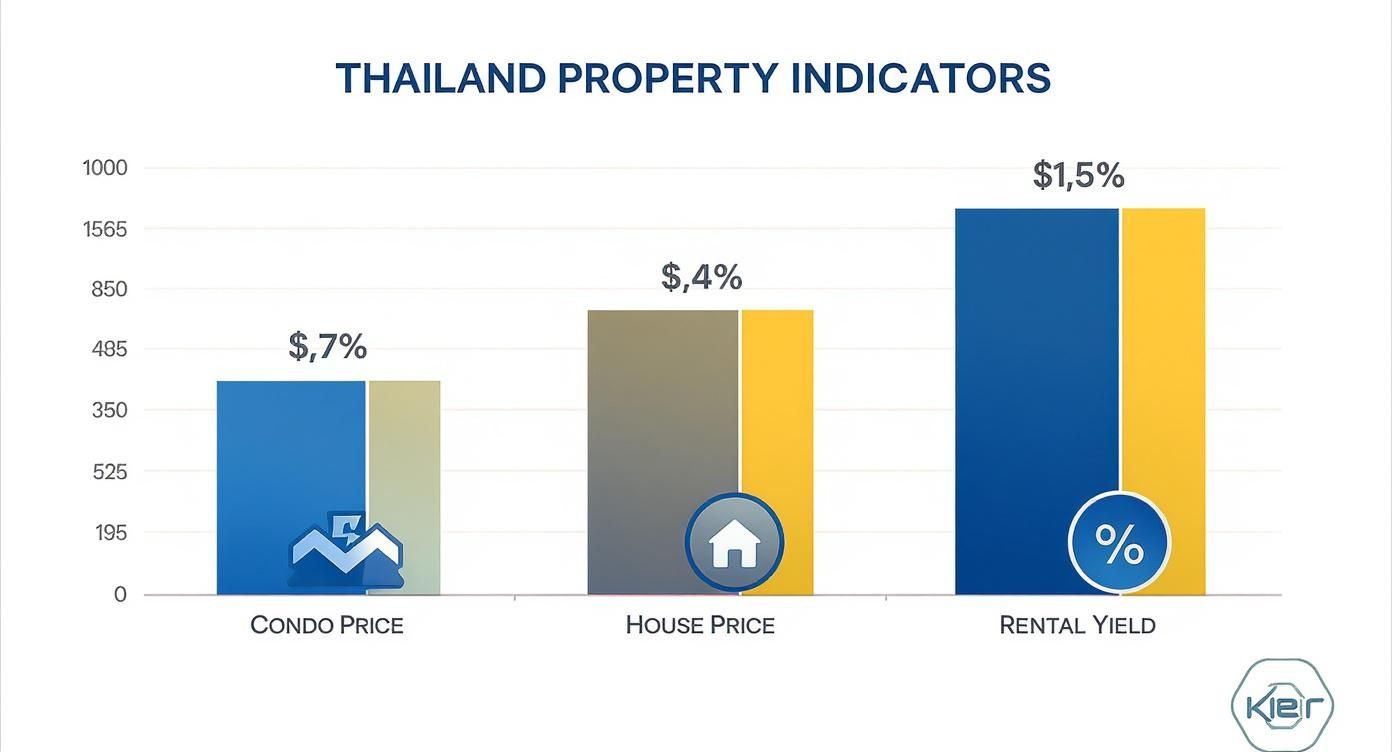
The chart illustrates the subtle but significant differences in price momentum and yield potential across property types, offering a clear indication of where investor focus is currently concentrated.
Recent Price Movements and Underlying Drivers
Recent data from the Bank of Thailand (BOT) indicates a market experiencing steady growth, avoiding the volatility seen in some other global markets. The Nationwide Residential Property Price Index climbed by 2.71% in Q2 2025. This is not a speculative bubble but a gradual upward trend driven by fundamental factors like rising construction and land costs.
By segment, single-detached houses saw an annual price increase of 2.55%, while townhouses rose by 3.53% year-on-year. This performance reflects a healthy, functioning market.
This growth is not uniform. A "flight to quality" is evident, where new-build, high-specification condominium projects in prime locations are outperforming older stock. The primary drivers of this trend are:
- Infrastructure Investment: Government expenditure on transport links, including high-speed rail and urban transit extensions, consistently boosts property values in connected areas.
- Foreign Buyer Demand: A strong rebound in tourism and a growing cohort of digital nomads and long-stay expatriates have reignited demand, particularly for condominiums and luxury villas.
- Local Economic Growth: A stable domestic economy provides local buyers with confidence, creating a solid foundation for the housing sector.
This confluence of factors positions Thailand firmly on the map for astute investors. To see how it compares with other dynamic locations, refer to our guide on the top emerging property investment markets worldwide. Understanding these trends allows you to position your portfolio to capitalise on the most promising opportunities.
How Thai Property Prices Compare Internationally
For any seasoned investor, context is paramount. Evaluating Thailand’s housing prices in isolation provides an incomplete picture. The true investment case emerges when they are benchmarked against established Western markets, particularly for UK-based investors accustomed to one of the world’s most expensive property landscapes.
The difference in the cost of entry is stark. Whereas a prime postcode in London or Manchester requires substantial capital, an equivalent lifestyle location in Thailand can be secured for a fraction of the price. This is not about compromising on quality; it is about deploying capital into a market where it can work more effectively, securing premium assets with far stronger potential for both rental income and long-term appreciation.
A Direct Comparison of Purchase Prices
Let us examine the figures. In central Bangkok, a high-quality condominium might cost around ฿150,000 per square metre (approximately £3,400). In Phuket, a property of a similar standard could be acquired for about ฿120,000 per square metre (£2,720).
Contrast this with prime locations in the UK. According to data from the Office for National Statistics, average prices in central London can easily exceed £14,000 per square metre. The disparity is enormous.
This price differential offers investors significant strategic flexibility. The capital required for a single, modest flat in a UK city could potentially fund a portfolio of several high-yield condominiums in a sought-after Thai location like Pattaya or Chiang Mai. This allows for diversification of risk and multiplication of potential income streams.
The core takeaway for investors is the sheer purchasing power of their capital in Thailand. It unlocks access to prime real estate—whether a city-centre condo or a coastal villa—that would be financially prohibitive for many in their home market.
Rental Yields and Affordability
The value proposition extends beyond the initial purchase price. The relationship between a property's cost and the rent it can generate—the gross rental yield—is typically far more attractive in Thailand. While yields in major UK cities often hover between a modest 3% and 4.5%, it is common to achieve yields of 5% to 8% in popular Thai tourist hubs.
This is driven by a fundamental difference in the rental market. According to live data from Numbeo, rent prices in the United Kingdom are a staggering 145.5% higher than in Thailand. A one-bedroom city-centre flat in the UK averages £1,032 per month, compared to just £363 in Thailand.
This affordability ensures a deep and consistent pool of tenants, from local professionals to the ever-present expatriate and tourist communities. You can explore these cost-of-living comparisons further in this in-depth Numbeo analysis.
Ultimately, the lower acquisition cost combined with robust rental demand creates a powerful formula for return on investment. This makes the Thai market particularly compelling for investors building a portfolio of income-generating assets. For a wider view on high-performing rental markets, our guide to the best buy-to-let locations globally provides useful context.
Understanding the Key Drivers of Property Values
To make a prudent investment, one must look beyond price tags and understand the factors that influence the Thailand housing prices landscape. Like any market, it is a complex interplay of economics, social trends, and regulations. In Thailand, however, this mix is unique, creating distinct opportunities and specific risks for international investors.
At its core is Thailand's powerful tourism engine. A steady flow of international visitors creates constant demand for short-term rental accommodation, from city-centre condominiums in Bangkok to holiday villas in Phuket. This directly supports rental yields and provides a reliable income stream for buy-to-let investors, forming a solid foundation for property values in primary tourist hubs.
This reliance on tourism is not without risk. As demonstrated during global travel shutdowns, a sharp decline in visitor numbers can severely impact rental demand and temporarily soften property values. A prudent investor must weigh the high-yield potential against the market's sensitivity to global travel trends.
The Impact of Government and Economic Policy
Government policy is another major force shaping property values. Thailand's ongoing investment in large-scale infrastructure projects, such as expanding Bangkok's mass transit systems and constructing high-speed rail networks, is a significant long-term driver of capital growth. These projects not only improve connectivity but also unlock value in previously overlooked areas, transforming them into desirable residential locations. For investors with a long-term perspective, acquiring property along these future transport corridors can be an effective growth strategy.
The macroeconomic picture is equally important. Factors such as GDP growth, interest rates set by the Bank of Thailand, and the stability of the Thai Baht all have a direct impact on the market. A strong economy fuels local demand and bolsters foreign investor confidence, while stable interest rates maintain manageable borrowing costs. Conversely, economic instability or a volatile currency can create uncertainty, affecting both purchasing power and the ability to repatriate profits.
Navigating the Regulatory Landscape
Finally, the legal framework governing property ownership is critical for any non-resident investor. In Thailand, foreign nationals are permitted to own condominiums freehold, but they are restricted from owning land directly. This has effectively created a two-tier market.
-
Condominium Market: Foreign ownership in any single condominium building is capped at 49% of the total saleable area. This quota system provides a clear, legally defined path for international buyers, making the condominium market the most accessible and popular choice.
-
Landed Property Market: For houses and villas, foreign investors typically use long-term leasehold agreements (usually for 30 years and often renewable) or establish a Thai limited company to own the asset. While these routes are viable, they introduce additional layers of legal complexity and cost.
This legal distinction funnels the majority of foreign investment into the condominium sector, which directly supports prices and liquidity within that segment. Understanding these regulations is fundamental to judging the true value and long-term potential of an investment. For a deeper look at how legal frameworks shape real estate, our guide on the importance of location in real estate investment success provides valuable context.
The interplay between robust tourism, strategic infrastructure spending, and specific foreign ownership laws creates a unique environment. Successful investors are those who can analyse how these three forces converge in a particular location to drive sustainable growth.
Navigating the Property Purchase Process
Acquiring property in Thailand is a well-established process for foreign investors, but it demands a clear understanding of the local legal and financial landscape. A thorough grasp of the available ownership structures and associated costs is key to a secure investment and to avoiding common pitfalls that can inflate your final Thailand housing prices.
The first and most critical step is to engage a reputable, independent solicitor. While a property agent is invaluable for sourcing opportunities, a solicitor works exclusively for you. Their role is to protect your interests, conduct thorough due diligence, verify ownership titles, and scrutinise contracts. They are an essential layer of security.
Legal Ownership Structures for Foreign Buyers
For non-Thai nationals, the law provides two primary routes to property ownership, each with distinct rules and strategic implications.
The most direct and popular method is the acquisition of a condominium unit on a freehold basis.
-
Freehold Condominium Ownership: Under Thailand’s Condominium Act, foreigners are legally permitted to own a condominium unit outright, in their own name. The key regulation is that foreign ownership within the entire building cannot exceed 49% of the total saleable area. This is the most secure and sought-after form of ownership for international buyers as it grants full title rights.
-
Leasehold Agreements: As foreigners cannot own land directly, a leasehold agreement is the standard method for acquiring houses, villas, or land. A typical lease is registered for a term of 30 years. These contracts are often structured with renewal options, but it is vital to recognise this is a contractual promise, not a guaranteed legal right. This is where robust legal advice becomes non-negotiable.
The choice between freehold and leasehold is a strategic one. Freehold offers ultimate security and ownership rights, while leasehold opens the door to landed properties like villas—often with more space and privacy—but with a finite ownership term.
A Breakdown of Purchase Costs and Taxes
The list price is only the starting point. To form an accurate picture of the total investment, one must budget for several transactional taxes and fees. These are typically shared between the buyer and seller, though the exact split is often a point of negotiation.
Understanding these ancillary costs is vital for accurately calculating your total outlay and potential return on investment. For those new to purchasing abroad, our guide on investing in overseas property offers broader insights into managing these additional expenses.
It is crucial to obtain a clear breakdown of closing costs before finalising any transaction. The following table outlines the typical taxes and fees involved.
Estimated Property Purchase Costs for Foreign Buyers in Thailand
| Cost Item | Typical Rate (% of Property Value) | Who Typically Pays (Buyer/Seller) |
|---|---|---|
| Transfer Fee | 2.0% | Shared 1.0% each |
| Stamp Duty | 0.5% | Seller (or shared) |
| Specific Business Tax (SBT) | 3.3% | Seller (if property owned < 5 years) |
| Withholding Tax | 1.0% (for companies) | Seller |
| Legal Fees | 0.5% – 1.0% | Buyer |
The Specific Business Tax (SBT) warrants particular attention. It applies if a property is sold within five years of acquisition, effectively acting as a tax on short-term speculative activity.
If the SBT is not applicable (i.e., the seller has owned the property for over five years), then the 0.5% Stamp Duty is payable instead. These costs can add a significant amount to the purchase price, so factoring them into financial models from the outset is essential for a successful investment.
Exploring Thailand's Prime Investment Hotspots

Location is the cornerstone of a successful property investment in Thailand. While national trends provide a broad overview, it is the hyper-local dynamics of a city or neighbourhood that will ultimately determine your returns.
A thorough analysis of each area's unique investment case is required. Is it an established, mature market offering stability, or an emerging hotspot with greater potential for capital appreciation? This strategic alignment is how you match your portfolio to your goals, whether you are pursuing immediate rental income or long-term growth.
Bangkok: The High-Yield Urban Powerhouse
As Thailand’s economic and cultural heart, Bangkok offers the most diverse range of investment opportunities. It is a mature, liquid market with constant demand from a large pool of local professionals, expatriates, and tourists.
The city’s blue-chip postcodes are the prime central districts such as Sukhumvit, Silom, and Sathorn. These areas command the highest Thailand housing prices, driven by their proximity to multinational offices, luxury retail, and the essential BTS Skytrain network. The investment case here is built on robust stability and strong rental demand, with gross yields for condominiums typically ranging between 4% and 5.5%.
However, astute investors are also focusing on the city's emerging districts. Areas like Thonburi, across the Chao Phraya River, are undergoing significant regeneration. New transport links are revitalising these once-overlooked neighbourhoods, offering lower entry prices and a genuine opportunity for significant capital growth as Bangkok's urban footprint expands.
Phuket: The Premier Lifestyle and Luxury Destination
Phuket’s property market is intrinsically linked to its status as a world-class tourism and lifestyle destination. The appeal here is not urban convenience but luxury, leisure, and the allure of a tropical paradise.
The island’s west coast, home to renowned beaches like Patong, Kamala, and Bang Tao, is the established heartland for luxury villas and high-end condominiums. These properties attract a mix of holidaymakers seeking short-term lets and affluent retirees or expatriates desiring a second home. This dual-demand profile supports excellent rental yields, often exceeding 6% in prime locations, particularly for properties with sea views or private pools.
For investors in Phuket, strategy often bifurcates. One can target high-yield holiday lets on the bustling west coast or focus on capital growth in the quieter, developing areas on the east coast or in the north, where new infrastructure is unlocking fresh value.
On the island’s calmer east coast, a different proposition exists. With its marinas and more relaxed atmosphere, it is a magnet for long-stay residents and the yachting community. While rental demand may be more seasonal, the potential for capital appreciation is considerable as the area continues to develop its high-end residential offerings.
Contrasting the Investment Cases
The price differential between regions is significant and underscores the diversity of available strategies. In Bangkok, a luxury condominium will cost around ฿200,000 per square metre, making it one of the country's most expensive cities. By contrast, Chiang Mai offers far more accessible options, with average apartment prices at ฿70,000 per square metre, while Phuket sits in between at around ฿100,000. For houses, smaller properties generally fall within the ฿3 million to ฿5 million range. You can learn more about how living costs in Thailand compare to the UK on condosforsalepattaya.com.
This disparity is precisely why strategic location selection is paramount. An investor prioritising reliable, steady income might favour a portfolio of high-demand condominiums in central Bangkok. Conversely, an investor with a greater risk appetite and a longer time horizon might see more potential in an off-plan villa in an up-and-coming part of Phuket, banking on future tourism and infrastructure to deliver significant capital appreciation over the next decade.
Common Questions on Investing in Thai Property
Entering a new property market invariably raises practical questions. To provide clarity and confidence, here are direct answers to the most common queries from global investors considering Thailand.
Can Foreigners Get a Mortgage in Thailand?
For most non-residents, the answer is generally no. Securing a local mortgage is notoriously difficult without a Thai work permit or long-term residency. Consequently, the vast majority of overseas buyers purchase property with cash, transferring funds directly from their home country.
There are rare exceptions. International banks like UOB, which have a presence in Thailand, may consider financing for high-net-worth clients, but this is assessed on a case-by-case basis and is far from standard practice. As a general rule, an investor should plan to fund their purchase without reliance on local bank financing.
The key takeaway for investors is to have your capital ready. The Thai property market is predominantly a cash market for foreign buyers, which simplifies the transaction but requires upfront financial planning.
What are the Rules for Repatriating Funds?
This is a critical question for any investor: "How do I get my money out?" Fortunately, Thailand’s foreign exchange regulations are clear, provided the correct procedures are followed from the outset.
When you initially transfer money into Thailand for a property purchase, your Thai bank must issue a Foreign Exchange Transaction Form (FETF) for any amount exceeding $50,000 USD. This document serves as official proof that the funds originated from overseas.
When you later sell the property, this FETF certificate is essential for repatriating your initial capital and any profit without complication. Attempting to move large sums out of the country without this proof can result in significant bureaucratic delays. Ensure your solicitor arranges this with the bank at the time of purchase.
Is a Local Solicitor Essential?
Yes, absolutely. While it may appear as an additional expense, engaging an independent solicitor is non-negotiable for a secure investment. Their sole function is to protect your interests.
A competent solicitor will perform crucial due diligence, including title deed searches, seller verification, and checking for any outstanding debts or legal encumbrances on the property. They are your primary safeguard against the potential pitfalls of an unfamiliar legal system and are essential for navigating the nuances of Thai property law.
At World Property Investor, we provide the data and analysis you need to make informed decisions in global real estate. Explore our in-depth guides and market insights at https://www.worldpropertyinvestor.com.