
For the serious global property investor, securing permanent residence in New Zealand is a strategic objective. This status elevates an individual from a temporary visitor to a long-term stakeholder, granting property rights equivalent to those of a New Zealand citizen. Acquiring permanent residence is not merely an administrative step; it is the key that unlocks the market, removing critical barriers faced by most overseas buyers.
Understanding Your Status: Resident vs. Permanent Resident
It is essential for international investors to distinguish between a Resident Visa and a Permanent Resident (PR) Visa, as the difference is fundamental to a successful investment strategy in New Zealand.
A Resident Visa can be viewed as a conditional, long-term permit. It grants the holder the right to live, work, and study in the country indefinitely but includes a critical limitation: travel conditions. This means that if you depart New Zealand after a specified date (typically two years), your right to re-enter as a resident expires.
In contrast, a Permanent Resident Visa is unconditional and indefinite. Crucially, it provides the freedom to travel to and from New Zealand at any time, without the risk of travel rights expiring. For a global investor requiring mobility, this long-term stability is invaluable.
Why This Distinction is Critical for Investors
The practical impact on property investment is significant. While a Resident Visa is a prerequisite, a permanent resident is treated on equal footing with a New Zealand citizen under the Overseas Investment Act.
This change in status delivers several key advantages:
- Unrestricted Purchasing Power: You can acquire residential land and property without requiring consent from the Overseas Investment Office (OIO)—a major regulatory hurdle for most foreign buyers.
- Simplified Legal and Tax Obligations: Your tax residency status becomes unambiguous, simplifying compliance with regulations such as the bright-line property rule.
- Greater Financial Stability: Banks and lenders view permanent residents as lower-risk borrowers, which often results in more favourable mortgage terms and improved access to finance.
Achieving permanent residence in New Zealand is not just an immigration milestone. It is a strategic financial move that unlocks the full potential of the property market, shifting an investor from an outsider to an insider with complete market access.
To build a solid foundation for an international portfolio, understanding these local nuances is the first critical step. For a broader perspective on buying property abroad, our comprehensive guide for property investors offers valuable insights that complement your journey in New Zealand. Aligning immigration and investment strategies is essential for maximising long-term returns.
Key Pathways to Achieving Permanent Residence
https://www.youtube.com/embed/3j4FyRO0fnY
Navigating New Zealand's immigration system requires identifying the pathway that best aligns with your circumstances and long-term objectives. For property investors, the journey to permanent residence in New Zealand almost always begins with securing a Resident Visa. There is no direct application for permanent status; applicants must first demonstrate a commitment to the country.
The primary routes are designed to attract individuals who can contribute to New Zealand's economy, either through in-demand skills or significant capital investment. Understanding these pathways is the first step in aligning your investment strategy with your residency plans.
The Skilled Migrant Category for Professionals
The Skilled Migrant Category (SMC) is a points-based system designed for professionals with skills in demand in New Zealand. Points are awarded for qualifications, work experience, age, and, critically, a skilled job offer.
To qualify, an applicant must secure a role with an accredited employer and meet a specified points threshold. This pathway is well-suited for investors who also possess a professional career that can facilitate residency. For example, an experienced project manager in the construction sector or a software developer may find this their most direct route to establishing a life—and a property portfolio—in New Zealand.
The diagram below illustrates the distinction between holding a Resident Visa and achieving the final goal of Permanent Residence.
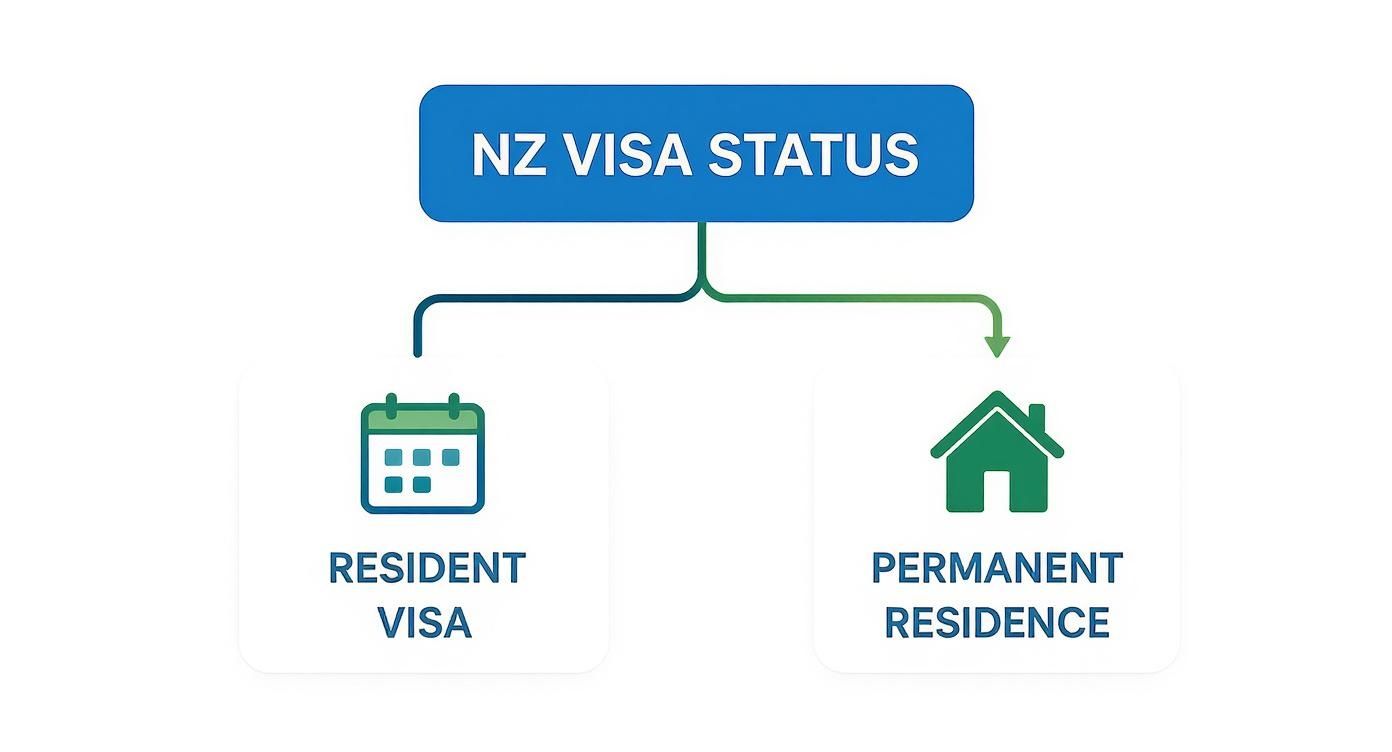
As shown, the Resident Visa is the initial conditional stage. Permanent Residence is the final, unconditional status that provides complete stability and rights.
The Active Investor Plus Visa for High-Net-Worth Individuals
For high-net-worth individuals, the Active Investor Plus Visa is the most direct investment-led route. This visa is specifically designed for those who can make a significant financial contribution to the New Zealand economy. It replaced older investor categories and now places a stronger emphasis on growth-focused investments rather than passive assets like government bonds.
The requirements are substantial. Applicants must invest between NZ$5 million and NZ$15 million over a four-year period. The specific amount depends on the investment type; a lower threshold is offered for direct investments into private New Zealand companies, providing a powerful incentive to support local businesses.
This pathway offers greater flexibility than the skilled migrant route, as it is not tied to a job offer. It is tailored for the serious investor whose primary contribution is capital. For property investors, this signals that New Zealand welcomes those who can stimulate economic growth and provides a secure foundation from which to build a real estate portfolio.
Key Takeaway: The Active Investor Plus Visa demands significant capital but provides a more direct path to residency for individuals whose strengths are financial rather than professional.
Other Relevant Routes to Residence
While the skilled migrant and investor visas are the main channels, other pathways may be relevant. The Residence from Work category, for example, allows individuals who have worked in New Zealand on an accredited employer work visa for at least two years to apply for residence. This can be a viable option for investors who first move to New Zealand to manage a business or take up a senior role.
New Zealand's immigration policy continually adapts to the country's economic needs. According to data from Stats NZ, long-term migrant arrivals for the year ending April 2024 were 167,400. While this figure reflects arrivals across all visa types, it underscores the ongoing demand for skilled individuals and investors to support economic growth.
Comparing New Zealand's Main Residence Pathways
This table summarises the core requirements and ideal applicant for each primary visa category leading to permanent residence.
| Pathway | Primary Requirement | Ideal Applicant Profile | Typical Time to PR |
|---|---|---|---|
| Skilled Migrant Category | A job offer from an accredited employer and meeting a points threshold based on skills, age, and experience. | Professionals and skilled workers with qualifications and experience in fields in demand in New Zealand. | 2-3 years after receiving the initial Resident Visa. |
| Active Investor Plus Visa | A direct investment of NZ$5-15 million into acceptable New Zealand investments over a four-year period. | High-net-worth individuals and serious investors seeking a direct, capital-led path to residency. | 4 years, after the investment period is complete. |
| Residence from Work | Holding an accredited employer work visa and working in a specific role for at least 24 months in New Zealand. | Individuals who initially move to New Zealand for work and subsequently decide to settle permanently. | 2 years on a qualifying work visa, plus processing time. |
Each pathway offers a solid route to making New Zealand a permanent base, but they cater to different circumstances.
Choosing the right option is a critical decision in the process of investing in overseas property. It requires a clear assessment of your professional skills, financial capacity, and long-term commitment. By comparing these routes, you can strategically identify the most efficient and viable option for achieving your goals.
Navigating the Application Process and Timelines

Securing permanent residence in New Zealand is a structured journey that demands meticulous preparation and attention to detail. The process is methodical, designed to ensure every applicant meets the country’s standards before being granted long-term status.
For many, particularly those on the Skilled Migrant pathway, the process begins not with a formal application but with an Expression of Interest (EOI). The EOI serves as an initial summary of your skills, qualifications, and intent, submitted to Immigration New Zealand. It is a points-based system where you present your credentials, including work experience, age, and any job offer.
If your EOI meets the current points threshold, you will receive an Invitation to Apply (ITA). This is a significant step, moving you from a pool of candidates to a formal applicant. However, an ITA is not a guarantee of a visa; it is the prerequisite for submitting a full, evidence-backed application.
The Essential Documentation Checklist
Once an ITA is received, a four-month deadline is typically given to compile a comprehensive application with all supporting documents. Inaccuracies or missing paperwork are a common cause of delays and rejections, making first-time accuracy crucial.
Core documents required include:
- Identity and Nationality: Certified copies of your passport and full birth certificate.
- Health Requirements: A full medical examination and chest X-ray from an approved physician for you and any accompanying family members.
- Character Verification: Police certificates from your home country and any other country where you have lived for 12 months or more in the last 10 years.
- Skills and Qualifications: Certified copies of academic transcripts and degrees. Qualifications from non-recognised institutions may require an assessment from the New Zealand Qualifications Authority (NZQA).
- Work Experience: Evidence of your employment history through reference letters, contracts, and potentially tax records.
For investor pathways, the financial documentation is extensive. A clear, traceable history of investment funds is mandatory. Any gaps in this paper trail can halt the application. Understanding how to structure your assets is key, and our guide on financing an investment property offers foundational knowledge that can assist.
Understanding Timelines and Costs
It is vital to have realistic expectations for both the timeframe and the costs involved. The time and financial commitment can vary significantly depending on the visa category.
Investor Insight: The Skilled Migrant Category has lower government fees, but the timeline can be less predictable due to EOI selection draws. In contrast, the Active Investor Plus Visa has higher application costs but offers a clearer, though still lengthy, four-year pathway tied directly to your investment.
Here is an approximate breakdown of what to expect:
| Visa Pathway | Estimated Processing Time | Estimated Government Fees (per applicant) |
|---|---|---|
| Skilled Migrant Category | 9-15 months after ITA | Approx. NZ$4,890 |
| Active Investor Plus Visa | 8-12 months after application | Approx. NZ$7,900 |
| Work to Residence | 3-6 months after meeting work criteria | Approx. NZ$4,290 |
Note that these are Immigration New Zealand estimates and are subject to change. These figures exclude additional costs for medicals, police certificates, document translations, and professional immigration advice, which can add several thousand dollars to the total.
How Permanent Residence Unlocks the NZ Property Market

For an international property investor, achieving permanent residence in New Zealand fundamentally changes the investment landscape. This is the single most important step that shifts an individual from a restricted overseas buyer to a full market participant, on the same legal and financial footing as a New Zealand citizen.
This status dismantles the regulatory barriers surrounding foreign property ownership, opening up fundamental advantages that redefine the potential of an investment portfolio.
Removing the Overseas Investment Office Barrier
The most significant and immediate change is freedom from the constraints of the Overseas Investment Act. As a permanent resident, you are treated as a New Zealander under the law. This means you can purchase residential property and land without needing consent from the Overseas Investment Office (OIO)—a major regulatory hurdle for foreign buyers.
The OIO process can be slow, costly, and uncertain. Bypassing it entirely provides a critical edge in a dynamic market. You can act quickly on opportunities, bid confidently at auctions, and negotiate on the same terms as local buyers. This freedom unlocks the entire residential market, from established family homes to new-build developments.
Navigating New Zealand's Favourable Tax Landscape
Securing permanent residence also clarifies your tax obligations, placing you within a system that is remarkably favourable to property owners. It simplifies compliance and presents several advantages that can directly increase your net return.
A key regulation is the bright-line property rule, which taxes the profit from selling a residential property if sold within a certain timeframe (currently ten years for most properties). As a permanent resident, your main home is typically exempt from this rule—a significant tax advantage not available for pure investment properties.
Furthermore, New Zealand’s tax system is notable for what it lacks. Unlike many other developed countries, it features:
- No general Capital Gains Tax (CGT) outside the bright-line rule.
- No Stamp Duty on property transfers, which significantly reduces transaction costs.
- No Inheritance Tax on the transfer of assets.
This unique tax environment means that a greater portion of rental income and capital growth is retained by the investor. The absence of these common property taxes makes New Zealand a highly attractive location for building long-term wealth through real estate.
Understanding Rental Income and Tax Obligations
As a permanent resident and tax resident, you are required to pay income tax on your rental profits. This income is added to your other earnings and taxed at your marginal rate. The positive aspect is that you can claim deductions for almost all expenses related to managing your rental property.
These allowable expenses typically include:
- Interest on the mortgage for the rental property.
- Rates and property insurance costs.
- Fees paid to property managers.
- The costs of repairs and maintenance.
Understanding these deductions is vital for optimising your financial position. For a more detailed examination, our guide to understanding property taxes for investors offers a comprehensive breakdown. This knowledge ensures both compliance and maximisation of net returns.
This favourable tax structure, combined with strong population growth, underpins the market's long-term fundamentals. Sustained net migration, as reported by Statistics New Zealand, fuels consistent housing demand, particularly in major urban centres.
Ultimately, obtaining permanent residence in New Zealand is more than securing your place in the country. It is a strategic move that grants unfettered access to the property market and aligns you with a tax system designed to reward long-term investment.
Strategic Property Investment for New Permanent Residents

Securing permanent residence in New Zealand is a significant achievement. The next phase involves deploying capital wisely. With residency status confirmed, your focus can shift from administrative processes to building a strategic property portfolio.
This requires a nuanced understanding of the local market, looking beyond media headlines to identify genuine, long-term value. A prudent strategy involves analysing opportunities not only in major cities but also in regional centres with strong growth potential.
While markets like Auckland offer scale, certain emerging markets can present a more compelling case for stronger rental yields and capital growth, often driven by different economic fundamentals.
Established vs. Emerging Markets: A Comparative Analysis
Traditionally, property investment in New Zealand has centred on Auckland and Wellington. These are established, liquid markets offering historically reliable, albeit often modest, capital growth. Auckland is the nation’s economic engine, fuelled by population growth, while Wellington’s stability is underpinned by its role as the seat of government.
However, for investors prioritising positive cash flow, the lower entry prices and tighter rental demand in certain regional cities can be advantageous. Locations such as Hamilton, Tauranga, and Christchurch are no longer peripheral; they are becoming major economic hubs.
- Hamilton: A key hub for logistics, education, and agritech, its proximity to Auckland makes it vital for commerce.
- Tauranga: Home to New Zealand's busiest port and a thriving horticulture sector, it attracts businesses and a growing population.
- Christchurch: The post-earthquake rebuild, combined with a flourishing technology sector, has forged a resilient economy backed by significant infrastructure investment.
These regions frequently deliver rental yields that surpass those in Auckland, where high property values can compress returns. It is not uncommon for gross rental yields in these regional centres to be 1-2% higher than in central Auckland.
Identifying Strong Investment Fundamentals
A location’s long-term potential is determined by more than current property prices. Due diligence must focus on the underlying drivers of sustainable growth.
Investor Takeaway: Look for a convergence of factors. A region with strong population growth, a diversifying local economy, and significant government investment in infrastructure presents a powerful combination for sustained property value appreciation.
When assessing a potential market, analyse these core fundamentals:
- Local Economic Drivers: Is the economy diversified or reliant on a single industry? Look for growth in future-proof sectors like technology, healthcare, and advanced manufacturing that create high-value employment.
- Population Trends: Use official data from Stats NZ to identify demographic shifts. Population inflow driven by employment and lifestyle is a clear indicator of upward pressure on housing demand.
- Infrastructure Development: Major projects such as new motorways, public transport links, hospitals, and schools are strong positive signals. They indicate future growth and government confidence in a region's trajectory.
Navigating the Purchase Process
For a new permanent resident, obtaining a mortgage is generally straightforward. Lenders will view you similarly to a citizen, though you will still need to provide proof of a stable income in New Zealand and a sound credit history.
The property sales process in New Zealand may also be unfamiliar. While private sales are common, auctions and tenders are prevalent, particularly in competitive markets.
- Auctions: Bidding is unconditional. Financing must be pre-approved, and due diligence—such as building inspections and legal checks—must be completed before bidding.
- Tenders: A confidential written offer is submitted by a deadline. The seller can then choose to negotiate with any of the bidders, allowing more time for due diligence.
Before making an offer, it is essential to analyse the financial viability of a potential acquisition. To gain proficiency in this area, our guide on how to calculate return on investment (ROI) for real estate provides a practical framework for assessing any deal.
Wrapping It Up: Common Pitfalls and Final Checks for Investors
Understanding the nuances of permanent residence in New Zealand is essential for serious property investment. Several common pitfalls can undermine an investor's strategy, making a clear-eyed approach vital.
The most critical error is confusing a Resident Visa with a Permanent Resident Visa. A Resident Visa has travel conditions that expire, potentially preventing re-entry to New Zealand. A Permanent Resident Visa, conversely, grants the indefinite right to travel, providing the stability a global investor requires.
Ongoing Responsibilities and Final Considerations
Securing permanent residence is the beginning of a new chapter with its own set of obligations. Your new status comes with responsibilities that will shape your financial strategy. As a New Zealand tax resident, you will generally be liable for tax on your worldwide income—a critical detail for managing an international portfolio.
You will also need to be aware of the requirements to maintain your status and, if it is a long-term goal, eventually apply for citizenship. This typically depends on the amount of time you are physically present in the country over a set period. Some temporary schemes, like the Youth Mobility Scheme, can act as a stepping stone. As noted by sources such as the Migration Observatory at the University of Oxford, these systems are often interlinked, with eligibility for some schemes recently expanding.
Final Takeaway: The journey from visa application to property purchase is interconnected. Each step, from meeting residency conditions to understanding tax obligations, influences the next.
While this guide provides a solid framework, it is not a substitute for tailored professional advice. Engaging accredited immigration and financial advisors is essential. They can help align your investment plans with your visa strategy, ensuring your path to building a New Zealand property portfolio is both successful and compliant.
Frequently Asked Questions
What is the difference between a Resident and a Permanent Resident Visa?
A Resident Visa grants you the right to live, work, and study in New Zealand indefinitely. However, it includes travel conditions, meaning your right to re-enter the country as a resident expires after a set period, typically two years.
A Permanent Resident Visa is the subsequent, unconditional stage. It removes all travel conditions, giving you the permanent right to leave and return to New Zealand at any time. This provides ultimate security and mobility for global investors.
Are there minimum financial requirements for investor visas?
Yes, the requirements are substantial. The primary route, the Active Investor Plus Visa, requires a significant investment of between NZ$5 million and NZ$15 million into approved New Zealand assets over a four-year period.
The exact investment amount depends on the asset class. The New Zealand government offers a lower threshold for direct investments into private companies, incentivising contributions to local enterprise.
How does PR affect my property tax obligations?
Once you have permanent residence, you are treated as a New Zealand citizen for tax purposes. This is a significant advantage. You will be subject to the bright-line property rule (though your main home is typically exempt), but New Zealand has no general capital gains tax, no stamp duty on property transfers, and no inheritance tax. This creates a highly favourable environment for property investment.
Do I need permanent residence to buy any property?
It is not strictly required for all property types, but it makes an enormous difference for residential investment. Without permanent residence in New Zealand, you are classified as an 'overseas person' and must obtain consent from the Overseas Investment Office (OIO) to buy most types of residential land or homes.
Gaining PR removes this restriction entirely. The entire residential property market becomes accessible, placing you on a level playing field with New Zealand citizens.