
For UK investors facing a saturated domestic market, Prague offers more than a change of scenery. It represents a strategic investment, combining strong capital growth potential with attractive rental yields, all within a stable and transparent EU legal framework.
This guide provides a data-led analysis of why Prague's property market is attracting significant international attention.
Why UK Investors Are Targeting Prague Property
For British investors accustomed to high entry costs and compressed yields, Prague presents a compelling alternative. The city's appeal is anchored in robust economic fundamentals that stand in contrast to the moderating growth seen across many established UK property markets.
Prague's economy is a dynamic mix of technology, tourism, and professional services, drawing a steady flow of international talent and corporate tenants. This creates consistent rental demand, particularly for modern one and two-bedroom flats sought by young professionals and expatriates.
Unlike the UK market, where gross rental yields in prime locations often struggle to exceed 3-4% (according to major property indices), Prague can deliver yields in the region of 4-6%. This offers a more compelling return on investment from the outset.
Prague vs. UK Property Investment: A Comparison
A side-by-side comparison highlights the fundamental differences. While every investment is unique, this table provides a general overview of Prague against a typical UK city investment.
| Metric | Prague | United Kingdom (Typical) |
|---|---|---|
| Gross Rental Yield | 4% – 6% | 3% – 5% |
| Price per Sq. Metre (City Centre) | €4,000 – €7,000 | €8,000 – €15,000+ |
| Foreign Ownership Rules | No restrictions for UK nationals | No restrictions |
| Capital Growth Potential | Strong (emerging market dynamics) | Moderate (mature market) |
| Mortgage Rates (approx.) | Circa 3.5% | 4.5% – 5.5% |
The key takeaway is that Prague offers a more accessible entry point with the potential for stronger initial cash flow, a powerful combination for investors seeking diversification.
Market Momentum and Value
The Czech property market is demonstrating sustained activity. In the first three quarters of 2025, Prague saw approximately 2,500 new apartments delivered and property transactions totalling nearly €123 million. This is not speculative; it is fuelled by fundamentals, including declining mortgage rates, which have fallen to a more manageable 3.5%, stimulating buyer activity.
These figures, detailed in CBRE's Prague Living Figures report for Q3 2025, highlight market vitality and present a timely opportunity.
For investors, the value proposition is clear. The average price per square metre in Prague, while rising, remains significantly lower than in major UK cities. A modern 60 sqm apartment may cost between €250,000 and €400,000—a fraction of the price for a comparable property in London or Manchester.
A Strategic European Foothold
The legal landscape is refreshingly straightforward. UK nationals face no restrictions on property ownership, a significant advantage compared to the complex regulations in other European destinations.
This ease of entry, combined with a stable political climate and a growing economy, makes Prague more than a location for a holiday home. It is a strategic European base for long-term capital appreciation and reliable rental income, placing it firmly among the top emerging property investment markets for serious portfolio consideration.
Navigating the Czech Legal System
A significant advantage of buying an apartment in Prague is the clarity of its legal system. The Czech Republic imposes no restrictions on foreign property ownership, placing British investors on an equal footing with Czech citizens. This open-door policy removes a major barrier often encountered in other markets.
In practice, this means you can acquire property directly in your own name without the need to establish a local company or utilise complex legal structures. The process is transparent and designed to protect both buyer and seller, providing a secure foundation for investment.
However, simplicity should not be mistaken for a reason to neglect professional advice. Understanding the specific roles of each professional is crucial for a secure purchase.
Your Key Legal Team
To execute a property purchase in Prague successfully, a reliable local team is essential. Each professional has a distinct function, and understanding their roles will prevent confusion and protect your capital.
-
Real Estate Agent (Realitní Makléř): The agent identifies properties, arranges viewings, and conducts initial negotiations. Their local knowledge is invaluable, but their primary objective is to complete the sale.
-
Lawyer (Advokát): Your most critical advisor. An independent lawyer works exclusively for you. They perform in-depth due diligence, review all contracts (Reservation and Purchase Agreements), and ensure the property's title is clear of encumbrances. Never rely on the seller's or agent's lawyer.
-
Notary (Notář): A neutral, state-appointed official. The notary oversees the final contract signing, verifies identities, and manages the secure escrow account where funds are held before being released to the seller upon official ownership registration.
Investor Takeaway: All three roles are vital, but engaging your own independent lawyer is non-negotiable. They are your personal advocate, tasked with identifying potential issues before you commit funds. This is the single most important decision for protecting your investment.
Personal vs. Cooperative Ownership
When reviewing listings, you will encounter two primary types of property ownership. Understanding the difference is fundamental, as it impacts control, financing options, and future liquidity.
Personal Ownership (Osobní Vlastnictví)
This is the most direct form of ownership, analogous to freehold in the UK. You own the apartment outright, plus a share of the building's common areas. This provides complete control to rent, sell, or renovate (subject to building regulations) and is strongly preferred by mortgage lenders.
Cooperative Ownership (Družstevní Vlastnictví)
With this structure, you do not own the property. Instead, you purchase a share in the housing cooperative that owns the building, granting you the right to use a specific apartment. Selling involves transferring your share, which may require approval from the cooperative's board. Securing a mortgage for this type of ownership is significantly more difficult.
For almost all foreign investors, personal ownership is the recommended route. It is simpler, more secure, and easier to finance. For broader context, our guide to investing in overseas property offers wider insights.
As a practical example, a UK investor acquiring a buy-to-let flat in the Vinohrady district would choose personal ownership. This allows them to secure a mortgage without complication, register the title directly in their name, and have complete freedom to manage the investment. No cooperative board approval is required, ensuring the direct control necessary to maximise returns.
Finding the Best Prague Districts for Rental Yields
For the serious investor, buying an apartment in Prague requires looking beyond the tourist landmarks of the Old Town Square to identify districts where sustainable rental yields are generated. While Prague 1 holds prestige, superior returns are typically found in dynamic, evolving districts that combine lifestyle appeal with consistent tenant demand.
Success is not merely about finding an attractive property; it is about matching the right asset with the right demographic in the optimal location. Understanding tenant profiles—from tech professionals to expatriate families—is the first step toward a viable buy-to-let strategy.
Established vs. Emerging Hotspots
Prague’s property market can be categorised into two main segments: established, premium districts and emerging, high-growth areas. Each offers a different risk-reward profile, and the optimal choice depends on your investment objectives.
-
Established Districts (e.g., Prague 2 – Vinohrady): Renowned for its Art Nouveau architecture, parks, and vibrant social scene, Vinohrady is a consistent favourite among affluent expatriates and locals. Rental demand is exceptionally stable, making it a low-risk investment for capital preservation. However, high entry prices compress gross yields to around 3.5-4.5%.
-
Emerging Districts (e.g., Prague 8 – Karlín & Prague 7 – Holešovice): These former industrial areas have undergone significant regeneration. Karlín is now a major business hub with modern offices and restaurants, attracting a steady stream of young professionals. Holešovice has a more creative, artistic character. Both offer lower entry prices than Prague 2, unlocking higher potential yields, often in the 4.5-6% range.
Investor Takeaway: While the stability of an area like Vinohrady is ideal for capital preservation, superior cash flow and capital growth potential often reside in well-chosen emerging districts like Karlín. Your strategy—whether income-focused or growth-oriented—should dictate your choice.
As you explore these markets, you will work with a core team of professionals. The infographic below illustrates the three key roles in your purchase.
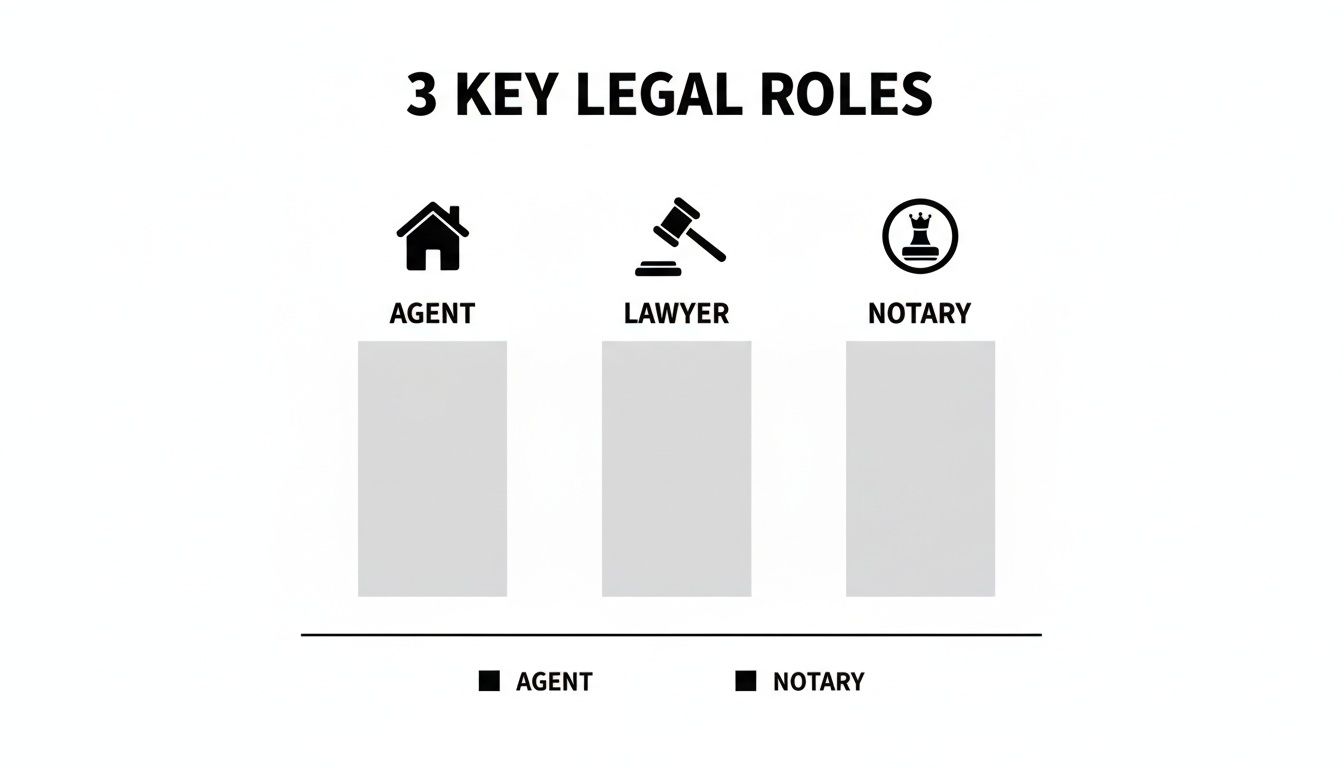
This visual highlights the distinct yet complementary functions of your agent, lawyer, and notary—a team essential for securing a sound investment in any Prague district.
A Data-Driven Look at District Performance
Subjective impressions of a neighbourhood are useful, but hard data provides the clarity required for confident investment. Recent market analysis reveals significant performance variations across Prague's districts, highlighting clear strategic opportunities.
According to Deloitte's Real Index from February 2025, while Prague's average property price reached CZK 139,900 per m², the district-level data is more instructive. For instance, the premium district of Prague 1 saw prices decrease by 4.2% to CZK 194,400 per m², potentially signalling a rare entry opportunity in the high-end market.
In contrast, Prague 2 surged by 11.6% to CZK 177,000 per m², benefiting existing investors but raising the entry barrier. For those seeking growth, Prague 3’s 6.2% rise to CZK 155,500 per m² indicates strong momentum in an area that balances central convenience with better value. You can explore this complete overview of Prague's apartment prices and trends.
Matching Property to Tenant Demand
Understanding price dynamics is only part of the analysis. The final step is aligning the asset with local tenant demand to maintain high occupancy and rental income. This strategic approach is fundamental to achieving real estate investment success through location.
Real-World Scenario: Karlín (Prague 8)
A modern, one-bedroom flat near a major office complex like The Forum Karlín is highly attractive to single professionals at multinational firms. They prioritise convenience and modern amenities, and are willing to pay a premium for them.
Real-World Scenario: Dejvice (Prague 6)
In Prague 6, a larger two or three-bedroom apartment near an international school will appeal directly to expatriate families. Their priorities are space, safety, and proximity to schools and parks. The rental strategy should target longer-term family tenancies.
By analysing both district-level price data and on-the-ground tenant demographics, investors can move beyond speculation and build a robust, high-performing Prague property portfolio.
Securing Finance and Budgeting for All Costs
When buying an apartment in Prague, the sale price is merely the starting point. A successful investment is built on a comprehensive financial plan that accounts for all associated costs, preventing unforeseen expenses from eroding returns.
Understanding all fees, taxes, and commissions is essential for establishing a realistic budget and calculating an accurate return on investment.
Mortgages for UK Buyers
UK investors can secure mortgages from Czech banks. While the application process for non-residents is more rigorous, requiring detailed scrutiny of financial standing, lenders are generally open to foreign buyers.
Applicants must provide extensive documentation, typically including translated proof of income (payslips, tax returns), employment contracts, and several months of UK bank statements. The objective is to provide the lender with complete confidence in your ability to service the loan.
Czech banks are more cautious with non-resident lending, which is reflected in their terms.
-
Loan-to-Value (LTV) Ratios: For foreign buyers, banks typically offer an LTV of 60-70%. This requires a cash deposit of at least 30-40% of the property’s value.
-
Interest Rates: Mortgage rates in the Czech Republic have often been competitive, sometimes lower than prevailing UK rates. They fluctuate with the Czech National Bank's base rate but generally create a favourable environment for financing an investment property.
For a broader strategic overview, our guide on financing an investment property covers universal principles.
A Worked Example: The True Cost of a €300,000 Apartment
To budget accurately, all transaction costs must be included. The following breakdown illustrates the total acquisition cost for a hypothetical €300,000 apartment.
Important Note: The Czech Republic abolished its 4% Real Estate Transfer Tax in 2020. This significantly reduced acquisition costs for buyers and makes the Prague market more attractive compared to jurisdictions with high stamp duty or similar taxes.
Typical additional costs to budget for include:
| Cost Item | Estimated Percentage | Approximate Cost on a €300,000 Property |
|---|---|---|
| Legal Fees | 0.5% – 1.0% | €1,500 – €3,000 |
| Notary & Escrow Fees | 1.0% – 2.0% | €3,000 – €6,000 |
| Real Estate Agent Commission | 3.0% – 5.0% (+ VAT) | €9,000 – €15,000 |
| Property Registration Fee | Fixed Fee (approx. 2,000 CZK) | ~€80 |
| Total Estimated Costs | 4.5% – 8.0% | €13,580 – €24,080 |
Based on these figures, the true acquisition cost for a €300,000 apartment is between €313,580 and €324,080. Factoring these expenses into your financial modelling from the outset is non-negotiable for a successful purchase.
Budgeting for Ongoing Ownership Costs
Financial planning extends beyond the acquisition. To calculate a true net rental yield and overall profitability, regular ownership costs must be accounted for.
The main recurring expenses for a landlord in Prague are:
-
Service Charges (Poplatky): Monthly fees paid to the building's management committee (SVJ) covering maintenance of common areas, waste disposal, and a contribution to the building's long-term repair fund.
-
Annual Property Tax: A modest municipal tax based on the property's size and location. Compared to UK council tax, it is exceptionally low and has a negligible impact on net yield.
-
Utilities: Tenants almost always pay for their own electricity, gas, and internet. This should be clearly stipulated in the lease agreement.
By constructing a comprehensive budget that includes both one-off acquisition costs and recurring ownership expenses, you can make a fully informed and financially sound investment in the Prague property market.
From Offer To Ownership: The Prague Property Purchase Process
The property purchase process in Prague is a well-defined sequence designed to protect both buyer and seller. For a UK investor, understanding these steps is key to a smooth and secure transaction.
The process begins after an offer is accepted. The first legal step is signing a Reservation Agreement and paying a reservation deposit, typically 3-5% of the purchase price.
This agreement removes the property from the market for an agreed period, usually 30 days, providing your lawyer with an exclusive window to conduct thorough due diligence. This is a critical step that secures your interest while vital legal checks are performed.
The Crucial Due Diligence Phase
Once the reservation deposit is paid, your independent lawyer begins their work. This is the most important stage of the process, where potential issues are identified before you are legally committed.
A comprehensive due diligence checklist must include:
- Land Registry (Katastr nemovitostí) Check: Your lawyer will obtain an official extract to verify the legal owner, confirm the property's specifications, and ensure there are no undeclared mortgages, liens, or third-party rights registered against it.
- Building Permit and Usage Confirmation: They will ensure the property was built legally and is registered for residential use, which is critical for new developments or converted attic apartments.
- Review of Homeowners’ Association (SVJ) Documents: For any apartment, your lawyer will examine the SVJ’s accounts for outstanding debts and review meeting minutes to identify planned major repairs that could result in future levies.
Investor Takeaway: Due diligence is your primary risk mitigation tool. A clean report from your lawyer is the green light to proceed. If significant issues are found, the reservation agreement should permit you to withdraw your offer and recover your deposit.
The Purchase Contract And Escrow Security
Following successful due diligence, the main legal document is the Purchase Contract (Kupní smlouva). Your lawyer will either draft this or meticulously review the seller's version to ensure your interests are protected. It details every aspect of the transaction, from the final price to handover conditions.
A central feature of the Czech purchase process is the use of a secure escrow account, managed by a notary or a lawyer. You transfer the remaining purchase funds into this account, not directly to the seller.
The funds are held securely and are released to the seller only after the Land Registry has officially completed the transfer of ownership into your name. This system provides complete security for both parties.
Finalising The Purchase And Taking Ownership
The final steps conclude the transaction. This involves signing the notarised purchase contract, for which your signature must be officially verified.
Your lawyer then submits the application to the Land Registry to register the change of ownership, a process that typically takes 20-30 days. Upon successful registration, the escrow agent releases the funds to the seller, and you receive the keys.
The market continues its upward trend; recent data shows the average asking price for new apartments reached CZK 168,000 per sqm (€6,824) in Q2 2025, an increase of nearly 9% year-on-year. This strong performance underscores the importance of a secure purchase process. You can review the latest Prague residential price analysis on Property Forum.
This process, particularly for new-builds, has its own considerations. Our guide on the pros and cons of buying off-plan properties provides further detail.
Common Questions from UK Property Investors
When considering buying an apartment in Prague from the UK, several practical questions consistently arise. Clear answers provide the confidence needed to proceed.
Here are the most common queries from UK buyers, with practical answers.
Can I Buy a Property Remotely from the UK?
Yes, the entire purchase can be completed remotely. The Czech legal system accommodates this through a formal Power of Attorney (PoA).
This legal document appoints a representative—almost always your independent lawyer—to act on your behalf. It grants them the authority to sign the purchase contract, manage funds, and handle the Land Registry application. The PoA must be notarised in the UK, then officially translated and legalised for use in the Czech Republic. It is a standard and secure procedure.
How Does Tax on Rental Income Work?
As a UK resident with a rental property in Prague, you have tax obligations in both countries. The UK-Czech Republic Double Taxation Agreement prevents you from being taxed twice on the same income.
The process is as follows:
- In the Czech Republic: You file a Czech tax return and pay income tax on your net rental profit at a flat rate of 15%.
- In the United Kingdom: You must declare this foreign rental income on your UK self-assessment tax return.
- Claiming Tax Credit: You can then claim Foreign Tax Credit Relief (FTCR) for the tax already paid in Prague. This credit is offset against your UK tax liability on that income, preventing double taxation.
Investor Takeaway: It is advisable to work with an accountant experienced in cross-border property tax. They will ensure compliance and help you claim all entitled reliefs, optimising your net return.
Are There Any Language Barriers to Consider?
While most professionals in Prague’s property sector speak excellent English, all official legal documents are in Czech. The purchase contract and Land Registry forms are legally binding only in their Czech version.
This is why engaging an independent lawyer is non-negotiable. A key part of their role is to provide you with certified English translations of all critical documents and explain each clause, ensuring you understand exactly what you are signing. Relying on automated translation for legal contracts is an unnecessary and significant risk.
Is My Money Protected if a Developer Fails on a New-Build?
This is a valid concern, particularly when buying off-plan. The Czech system has robust safeguards for buyers’ funds. Payments are not made directly to the developer’s general account.
Instead, your funds are held securely in an escrow account managed by a neutral third party, such as a notary or a bank. These funds are released to the developer in tranches as specific construction milestones are met and independently verified. This structure ensures that if the developer fails to complete the project, your money is ring-fenced and protected from the company’s other creditors.
At World Property Investor, we provide the data-driven guides and on-the-ground insights you need to make confident global property decisions. Explore our resources to compare markets, analyse deals, and build your international portfolio. Visit us at https://www.worldpropertyinvestor.com.