
Property investment is a strategic discipline for building long-term wealth. At its core, it involves acquiring real estate to generate a consistent income stream through rent, to achieve capital appreciation for a future sale, or both. As a tangible asset class, property serves as a reliable hedge against inflation and a stabilising component in a diversified portfolio, making it a cornerstone for serious investors worldwide.
Understanding the Foundations of Property Investment

Property investment generates returns through two fundamental engines: capital growth and rental income. This dual-return structure makes property a uniquely powerful asset. Unlike equities, which can be volatile, a physical property provides tangible value and utility. This stability is why investors, from individuals planning for retirement to large institutions, rely on real estate to anchor their financial strategies.
An investor’s returns are realised either through the long-term increase in the asset’s value (capital growth) or the immediate cash flow from rental payments (rental yield). A successful strategy typically balances both.
Why Property Remains a Core Asset
In a fluctuating global economy, property’s appeal is anchored in several key principles. It offers a natural hedge against inflation, as both rental incomes and property values tend to rise with the cost of living. This intrinsic link to the real economy provides a level of security that purely financial assets often cannot match.
Furthermore, direct ownership affords significant control. An investor can make improvements to increase an asset’s value, select tenants, and set the rental strategy. This hands-on approach is a distinct advantage for those who prefer active management. The primary benefits are clear:
- Inflation Hedge: Property values and rents typically rise with inflation, protecting purchasing power.
- Tangible Value: Real estate is a physical asset, not an abstract financial instrument.
- Control and Leverage: Investors can directly influence an asset’s performance and use financing to amplify returns.
Market Confidence and Investor Mindset
Confidence in property as an investment class remains robust, even in variable market conditions. In the UK, for example, data from major economic bodies shows that investment into the residential sector remains strong, driven by consistent demand for student accommodation and Build-to-Rent developments. This signals sustained investor faith in assets underpinned by fundamental needs.
A successful property investment strategy is built not on market timing, but on market fundamentals. Understanding demand, supply, economic drivers, and local demographics is the true foundation of long-term wealth creation in real estate.
Ultimately, the correct mindset focuses on these fundamentals rather than short-term speculation. Whether acquiring a first buy-to-let or expanding an international portfolio, a clear understanding of these core principles is your most critical tool. To begin, our beginner’s guide to real estate investing provides essential foundational knowledge.
Decoding Your Returns: Capital Growth and Rental Yield
Every property investment is driven by two distinct return mechanisms. Understanding how each contributes to wealth creation is a critical first step for any investor. Capital growth is the long-term value appreciation of the asset, while rental yield provides immediate, regular cash flow.
The Power Of Capital Growth
Often termed capital appreciation, this is the increase in a property's market value over time. It is a long-term play, driven by macroeconomic trends and specific local factors. National economic health and interest rate policies set the broader context, but local catalysts—such as new transport infrastructure or significant corporate relocation—are often what ignite substantial value growth.
This gain is realised upon selling or refinancing the asset. For example, a flat purchased for £250,000 that increases in value to £350,000 over seven years has generated £100,000 in capital growth. This is the primary objective for investors focused on building long-term net worth.
Established markets, such as London or Paris, typically offer slower, more predictable growth. In contrast, select emerging markets in regions like Eastern Europe or South East Asia may deliver faster appreciation, though this is usually accompanied by higher risk.
Capital growth is a testament to the old saying that in property investment, time is your greatest ally. It rewards patience, smart market selection, and a real understanding of the long-term forces shaping a location.
Understanding Rental Yield
While capital growth builds wealth over the long term, rental yield is the tangible, regular income generated by the asset. It is the lifeblood of a buy-to-let investment, representing the annual return from rent relative to the property's cost. Accurate calculation is essential for assessing an investment's viability.
There are two key calculations every investor must master:
- Gross Yield: A quick, indicative measure calculated as the total annual rent divided by the purchase price, expressed as a percentage. It is useful for rapid, high-level comparisons.
- Net Yield: The true measure of profitability. It is calculated by taking the annual rent, subtracting all operational costs—such as maintenance, management fees, insurance, and potential void periods—and then dividing by the purchase price.
For instance, a property bought for £200,000 generating £12,000 in annual rent has a gross yield of 6%. If annual costs total £3,000, the net rental income is £9,000, resulting in a more realistic net yield of 4.5%. This distinction is critical for accurate financial planning. You can gain a deeper understanding by learning how to calculate return on investment (ROI) for real estate in our detailed guide.
Comparing Capital Growth and Rental Yield
This table breaks down the fundamental differences between the two primary return streams in property investment, helping you align opportunities with your financial goals.
| Attribute | Capital Growth | Rental Yield |
|---|---|---|
| Nature of Return | Long-term increase in asset value, realised upon sale. | Immediate, regular cash flow from rental income. |
| Primary Driver | Market demand, economic growth, infrastructure improvements. | Local rental demand, tenant quality, property condition. |
| Risk Profile | Exposed to market cycles and economic downturns. | Vulnerable to void periods, tenant issues, rising costs. |
| Tax Implications | Taxed as Capital Gains upon disposal (subject to allowances). | Taxed as Income annually (subject to deductions). |
| Investor Focus | Wealth accumulation and building long-term equity. | Generating steady, passive income and covering costs. |
The most robust investments deliver a healthy blend of both. A property that covers its costs through rental income while its value steadily appreciates is the target for most strategic, long-term investors.
Navigating Global Property Asset Classes
The term “property investment” extends far beyond residential homes, encompassing a varied landscape of asset classes. For global investors building a serious portfolio, understanding the distinctions between different property types is a crucial first step. The market is broadly divided into two sectors: residential and commercial, each with its own risk-reward profile.
Residential property is the most common entry point, tapping into the fundamental human need for shelter. This creates a deep and consistent pool of tenant demand, making it a reliable cornerstone for many investors. Within this category, the options are diverse.
The Residential Spectrum
Investment characteristics vary significantly across different types of residential property. The key is to match the asset to your investment objectives.
-
Single-Family Homes: The traditional buy-to-let asset. They appeal to families seeking stability, often resulting in longer tenancies and lower turnover. However, the entire rental income is dependent on a single tenancy, concentrating risk.
-
Build-to-Rent (BTR) Developments: Large, purpose-built apartment blocks owned by a single entity and operated professionally. Investing directly or via a fund provides exposure to hundreds of units, diversifying risk and benefiting from professional management.
-
Purpose-Built Student Accommodation (PBSA): Blocks designed specifically for students, located near universities. Yields can be attractive, often exceeding standard residential returns, but management is intensive due to high annual turnover and greater wear and tear. Our guide to the best buy-to-let locations helps identify university cities with the strongest demand.
Commercial Real Estate Opportunities
Commercial real estate involves assets leased to businesses rather than individuals. This market is more sensitive to broad economic cycles but can offer longer lease terms and higher yields. Furthermore, tenants often bear the costs of maintenance and insurance under a 'triple net lease' structure.
The commercial sector is undergoing a significant structural shift. The growth of e-commerce has impacted traditional retail assets but has simultaneously created enormous demand for logistics and warehouse facilities.
A core principle for any modern property investor is to follow the big demographic and technological shifts. Where people are choosing to live, work, and shop is the clearest signal of which asset classes will thrive and which will face a tougher road ahead.
The main commercial asset types include:
- Office Buildings: Demand has polarised. Prime, modern, and energy-efficient buildings in central business districts remain sought after. Older, secondary-grade offices face significant challenges.
- Retail Spaces: A sector in transition. While some high streets struggle, retail parks with strong anchor tenants and local convenience stores demonstrate resilience.
- Industrial and Logistics: This has been the top-performing commercial asset class for several years. Warehouses, distribution centres, and "last-mile" delivery hubs are critical infrastructure for the digital economy, driving strong rental growth and investor interest.
Data from credible sources like the Office for National Statistics (ONS) or major economic bodies consistently shows these divergent trends. For example, recent reports often highlight the outperformance of industrial and residential sectors compared to office and retail, underscoring that a one-size-fits-all approach is no longer viable.
How to Analyse a Property Investment Market
A successful property investment is founded on rigorous, data-driven analysis, not speculation. Before considering individual properties, it is essential to understand the health and trajectory of the broader market. This involves a top-down approach, starting with the macroeconomic forces shaping a region before drilling down to property-specific fundamentals.
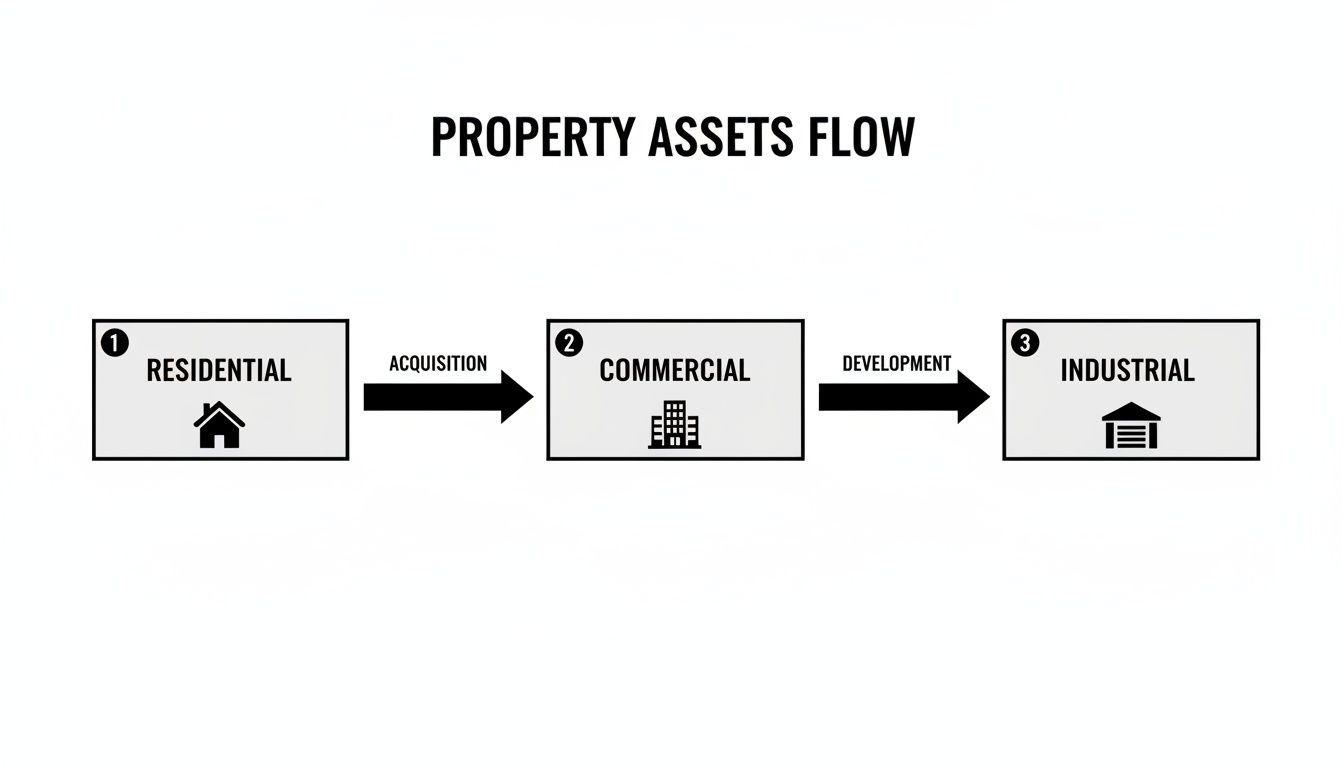
This flowchart helps to visualise the landscape, showing how an investor might progress from residential deals to commercial and industrial assets as they build their portfolio.
A robust analysis begins at the macro level. Key indicators published by national statistics offices and central banks are non-negotiable reading for any serious investor.
Evaluating Macroeconomic Health
The long-term success of a property investment is directly linked to the economic vitality of its location. A thriving economy creates jobs, attracts new residents, and boosts household incomes—all fundamental drivers of property demand and value.
Focus on these core metrics:
- Gross Domestic Product (GDP) Growth: Look for consistent, stable GDP growth. A region with a steadily expanding economy offers a more secure investment environment.
- Employment Figures: Low unemployment is positive, but new job creation is a more powerful indicator of future demand.
- Demographic Shifts: A growing population, particularly of young professionals and families, is a primary driver of housing demand.
Drilling Down to Property-Specific Metrics
With a clear macroeconomic picture, the next step is to analyse market-specific data. This involves assessing the supply-and-demand dynamics that directly impact rental yields and capital growth potential. Credible data from local housing authorities or major property consultancies is essential. Be wary of overly optimistic developer reports and always cross-reference with independent sources.
Market analysis isn’t about finding a "perfect" market, but about understanding the balance of risks and opportunities. A high-growth emerging market might offer greater capital appreciation but less stability than an established city like London.
For example, data from the ONS provides a clear benchmark of real-world performance, showing how UK house prices have performed against a backdrop of changing economic conditions. Accessing such official statistics is fundamental to evidence-based decision-making.
Key Local Market Indicators
Your due diligence for any specific location should prioritise these property-centric data points. Our guide can help you further determine a property's investment potential by applying these principles.
- Housing Supply vs Demand: An undersupply of housing relative to household formation fuels competition and drives values up. Conversely, an oversupply can lead to stagnant prices and falling rents.
- Rental Vacancy Rates: A crucial indicator of tenant demand. A low vacancy rate (typically below 5%) suggests a strong rental market. High rates signal weak demand or oversupply.
- Affordability Measures: Compare local house prices and rents to average local wages. Markets where property becomes severely unaffordable are at higher risk of price correction.
By combining macro and micro analysis, you build a comprehensive picture of a market’s fundamentals. This disciplined, data-first approach enables you to move beyond hype and identify genuine, long-term property investment opportunities.
Navigating Cross-Border Property Transactions
Expanding a property portfolio internationally presents significant opportunities for diversification and growth. However, cross-border transactions introduce unique legal, financial, and logistical complexities. Success depends on meticulous planning and a clear understanding of the local regulatory environment.
The first step is to investigate the country's foreign ownership laws. Some nations, like the UK, are open to international buyers. Others may impose restrictions, such as requiring a local partner or limiting ownership to specific property types. Clarifying this at the outset is essential.
Understanding Legal Frameworks and Ownership
Once eligibility is confirmed, it is vital to understand the forms of property ownership. The two most common are freehold and leasehold. Freehold grants ownership of the building and the land it stands on in perpetuity. Leasehold grants the right to use the property for a fixed, though often very long, period.
While many investors prefer freehold, a long-leasehold property in a prime, stable market can be an excellent investment. Key considerations are the length of the remaining lease term and the associated annual ground rent or service charges, as these directly impact net returns.
Engaging an independent solicitor who specialises in property law for foreign nationals in that specific country is non-negotiable. They will conduct due diligence, verify the property's title, and ensure the sales contract protects your interests.
Securing Finance and Managing Costs
Financing an overseas property can be a major hurdle. While some investors use cash, most require a mortgage. Local banks may be hesitant to lend to non-residents or may demand a larger deposit, often 30-40%.
A specialist international mortgage broker can be invaluable, providing access to lenders who cater to foreign buyers. Be prepared for a comprehensive application process that scrutinises your entire global financial profile.
Beyond the purchase price, a range of taxes and fees must be budgeted for:
- Stamp Duty or Property Transfer Tax: A tax on the purchase, usually a percentage of the property's value.
- Capital Gains Tax (CGT): Tax payable on the profit upon future sale, with rates and allowances varying significantly by country.
- Legal and Notary Fees: Professional costs, typically adding another 1-2% to the total outlay.
Many countries have double-taxation treaties to prevent individuals from being taxed twice on the same income or gain. An international tax advisor can provide guidance on structuring the purchase efficiently. Our guide on investing in overseas property offers further detail.
One of the most overlooked but significant risks in cross-border property investment is currency fluctuation. A 10% swing in exchange rates between paying your deposit and completing the purchase can add tens of thousands to your cost.
To mitigate this, work with a foreign exchange specialist. They can help you lock in an exchange rate for a future date, providing certainty on your final cost and shielding your capital from market volatility.
Mastering Risk Management in Your Portfolio

Successful investors dedicate as much effort to protecting their capital as they do to growing it. While property is a powerful wealth-building tool, it is not without risk. A resilient portfolio requires a proactive and disciplined approach to risk management.
Risks in property investment typically fall into three categories, each requiring a distinct management strategy. By understanding these threats, you can implement practical safeguards to protect your assets and maintain your long-term strategy.
Identifying Key Risk Categories
A robust property investment strategy anticipates potential problems. The most common risks are market-wide shifts, property-specific issues, and challenges with liquidity.
- Market Risk: Macroeconomic forces beyond your control, such as interest rate hikes, recessions that weaken tenant demand, or regulatory changes—like new landlord legislation published on official government sites like Gov.uk—that can impact profitability.
- Property-Specific Risk: Granular, on-the-ground problems, including unexpected maintenance (e.g., boiler failure), difficult tenants, or extended void periods between tenancies.
- Liquidity Risk: Property is an illiquid asset. It cannot be sold instantly at full market value. A forced sale in a downturn may require accepting a lower price, turning a paper profit into a real-world loss.
Practical Mitigation Strategies
For every risk, a mitigation strategy exists. Integrating these defences into your investment model from the outset is non-negotiable for long-term success.
Diversification is one of the most effective tools. Spreading investments across different geographical markets—for example, combining a stable city with a high-growth emerging hub—can protect against localised downturns. Similarly, diversifying across asset classes, such as residential and industrial, insulates a portfolio from sector-specific shocks.
The foundation of all risk management in property investment is rigorous due diligence. Overpaying for an asset or underestimating its running costs is the most common and entirely avoidable path to poor returns.
Financial preparedness is also crucial. Maintaining a contingency fund is essential. This cash reserve, typically covering 3-6 months of all property-related expenses (including mortgage payments), acts as a vital buffer against unforeseen costs or void periods.
Finally, comprehensive insurance is your ultimate safety net. Landlord insurance should cover buildings, contents, public liability, and rent loss. This is a fundamental component of protecting your capital and ensuring the long-term viability of your investment.
Your Property Investment Questions Answered
Whether you are acquiring your first rental property or expanding a global portfolio, important questions always arise. Here are concise answers to some of the most common queries from investors.
How Much Capital Do I Need to Start Investing in Property?
The required capital varies significantly by market and strategy. For a standard buy-to-let purchase in an established market like the UK, a deposit of at least 25% of the property's value is typically required. Additional funds must be allocated for Stamp Duty Land Tax, legal fees, and other transaction costs.
However, direct ownership is not the only route. Real Estate Investment Trusts (REITs) or property crowdfunding platforms offer exposure to the property market with a much smaller initial investment, without the responsibilities of direct landlording.
Is Residential or Commercial Property a Better Investment?
Neither asset class is inherently 'better'; they serve different functions within a portfolio. Residential property is generally considered more stable, offering predictable rental income and lower entry costs, making it more accessible to individual investors.
Commercial property can deliver higher yields and longer leases but is more exposed to economic cycles and requires greater capital and management expertise. Many experienced investors hold both to achieve a balanced risk-reward profile.
What Are the Biggest Risks for a First-Time Property Investor?
For new investors, the most common errors stem from inadequate preparation. These risks are manageable with a disciplined approach.
- Overpaying for the Asset: This often results from emotional decision-making or insufficient research. Base your offer on data, not excitement.
- Underestimating Ongoing Costs: A classic error is failing to budget for maintenance, potential void periods, insurance, and management fees. These must be factored into your financial forecasts.
- Poor Tenant Screening: Inadequate vetting can lead to rent arrears, property damage, and legal costs. A problematic tenant can quickly erode your returns.
A disciplined approach is your best defence. Build it on thorough due diligence, conservative financial projections, and keeping a healthy cash reserve aside for surprises. By focusing on these fundamentals, you lay the groundwork for long-term success.
At World Property Investor, we provide the data-driven guides and market analyses you need to compare opportunities, understand risks, and invest with confidence. Explore our expert insights at https://www.worldpropertyinvestor.com.