
For investors accustomed to the saturated and often volatile UK domestic market, Slovenia presents a compelling alternative. It is a stable, high-growth European market offering robust capital growth potential and a refreshingly straightforward ownership framework—a serious contender for any investor seeking to diversify their portfolio.
Why Investors Are Turning to Slovenia
While UK buy-to-let has been a focus for years, rising market saturation and affordability pressures are leading sophisticated investors to look further afield for genuine growth. Slovenia has emerged as a prime candidate, offering a unique combination of stability, value, and straightforward access for EU and, by reciprocity, UK citizens.
The appeal lies in the market's strong fundamentals. Slovenia boasts a resilient economy, consistent GDP growth, and a strategic location in the heart of Europe. Unlike some overheated Western European capital markets, Slovenia’s property sector is built on sustainable, organic demand rather than short-term speculation.
A Market Driven by Solid Fundamentals
A key driver underpinning property values is a structural housing shortage, particularly in urban hubs like the capital, Ljubljana. Official data from Slovenia's Statistical Office (SURS) consistently indicates that new housing completions lag significantly behind the rate of household formation. This supply-demand imbalance creates a solid foundation for both long-term capital appreciation and rental income growth.
This contrasts sharply with the UK, where market movements are often dictated by fluctuating interest rates and sudden government policy shifts. Slovenia’s market demonstrates a resilience that is highly attractive to investors seeking to hedge against the volatility seen in more mature markets.
For UK investors, Slovenia represents an opportunity to enter a market that is still on an upward trajectory. The blend of a robust economy, full EU membership, and a clear legal framework for property acquisition removes many of the barriers commonly associated with overseas investment.
Impressive Growth Projections
The potential for strong returns is a significant draw. While the UK market has seen average house prices stagnate around the £288,000 mark (according to ONS data) amid affordability challenges, Slovenia's market offers a more accessible entry point with far higher growth forecasts.
For example, property analysts have positioned Slovenia among the top global locations for property profit, with forecasts suggesting growth that could substantially outpace the UK’s modest annual rises. This makes buying property in Slovenia not merely a lifestyle choice, but a calculated financial decision. Understanding the dynamics of such growth markets is essential for portfolio expansion. You can learn more by reading our guide on the top emerging property investment markets.
Slovenia vs UK Property: At a Glance
A direct comparison highlights why many investors are now seriously considering the opportunities in Slovenia.
| Metric | Slovenia | United Kingdom |
|---|---|---|
| Market Trajectory | High-growth, emerging market with strong appreciation potential. | Mature, stable market with slower, more modest growth. |
| Affordability | Lower entry points, especially outside the capital. | High entry costs, particularly in major cities. |
| Rental Yields | Generally higher, often 4-6% in cities, driven by housing shortages. | Lower, averaging 3-5% in many areas due to high property values. |
| Economic Stability | Stable, EU member with consistent GDP growth. | Stable but subject to greater economic and political volatility. |
| Ownership Rules | Straightforward for EU citizens, based on the principle of reciprocity for UK citizens. | Well-established but with complex tax rules for landlords. |
| Growth Drivers | Tourism, foreign direct investment, and a structural lack of housing supply. | Population growth and long-term housing undersupply. |
This side-by-side view clarifies the investment case. While the UK remains a solid foundation for any portfolio, Slovenia offers the kind of growth and value that is increasingly difficult to find in established markets.
Understanding the Slovenian Property Market
To make an informed investment in Slovenia, one must look beyond the scenery and understand the market's core drivers. Unlike some of its more volatile European neighbours, Slovenia’s property sector is not built on speculative bubbles but on solid, long-term fundamentals that have proven remarkably resilient.
The market's performance over the last decade has been one of consistent, steady growth. Even during periods of wider European economic pressure, Slovenian property has largely avoided the dramatic fluctuations seen elsewhere. This stability stems from a powerful imbalance: a chronic housing shortage in high-demand locations.
The Real Drivers: Supply, Demand, and Price Growth
At its core, the Slovenian market is shaped by a persistent lack of new housing stock. Data from the Statistical Office of the Republic of Slovenia (SURS) consistently shows that the number of new dwellings built fails to keep pace with the rate of new household formation. This issue is particularly acute in Ljubljana, where a growing population of students, young professionals, and international workers compete for a limited pool of properties.
This structural deficit places a firm floor under both property values and rental rates. For a buy-to-let investor, this translates into lower vacancy risk and a higher probability of securing steady rental income and long-term capital growth.
Tourism provides an additional layer of demand. As Slovenia’s reputation as a premier holiday destination grows, so does the demand for short-term lets, particularly in the Alpine regions and along the Adriatic coast. This creates a secondary demand stream, increasing values for well-located holiday homes and apartments. For more context, explore our guide on the fundamentals of investing in overseas property.
The Stabilising Effect of International Investment
A key component of the market's stability is the growing presence of international buyers. Foreign investment adds a crucial layer of stability, ensuring the market is not solely reliant on domestic demand. This international interest broadens the buyer pool, injects fresh capital, and helps insulate the market from localised economic issues.
Recent figures from SURS illustrate this in practice. Foreign buyers, including a notable number from the UK, have accounted for a substantial portion of property transactions. Even when total domestic transactions dipped, overall prices held firm with a nationwide increase of +8.46% in one recent quarter, driven in part by this external demand. New apartments saw prices climb by 10.2%, demonstrating the strength in the most desirable market segments. You can explore more detailed Slovenian property price history and trends.
Key Takeaway: The Slovenian property market’s strength is built on three pillars: a structural housing shortage, robust tourism-driven demand, and a healthy inflow of international investment. This combination creates a resilient and predictable environment for long-term investors.
How Slovenia Compares to Other European Markets
- Established Markets (e.g., Germany, France): These markets are stable, but entry prices are high and rental yields are often low, typically in the 2-3% range. Capital growth tends to be slow and steady.
- Slovenia: This market offers a blend of stability and growth. Investors gain the security of an EU market with the higher growth potential of an emerging economy. Entry prices are far more accessible, and rental yields in prime locations like Ljubljana are stronger, often between 3.5% and 4.5%.
- Other Emerging Markets (e.g., some Balkan nations): These may promise higher returns but often come with greater political risk, less transparent legal systems, and significant market volatility. Slovenia’s EU membership and established legal framework mitigate these concerns.
Investing in Slovenian property is an investment in a market defined by sustainable demand and limited supply—a formula that has historically delivered consistent returns.
Navigating the Property Purchase Process
Acquiring property abroad can seem complex, but Slovenia’s system is clear and well-regulated. The process is built around a solid legal framework with mandatory professional oversight, providing significant confidence for international investors. For those familiar with the UK system, understanding a few key stages makes the journey from offer to ownership entirely manageable.
Slovenia’s approach is anchored by a centralised Land Registry (Zemljiška knjiga) and the compulsory involvement of a public notary. This structure guarantees a clean title and legal certainty. Crucially, EU citizens face zero restrictions, and through reciprocity, UK citizens have the same property rights as Slovenians. This straightforward setup has been a significant driver for foreign investment. The wider investment climate is detailed in the official guide on Slovenia's FDI advantages on investslovenia.org.
This diagram provides a simplified overview of the core stages.
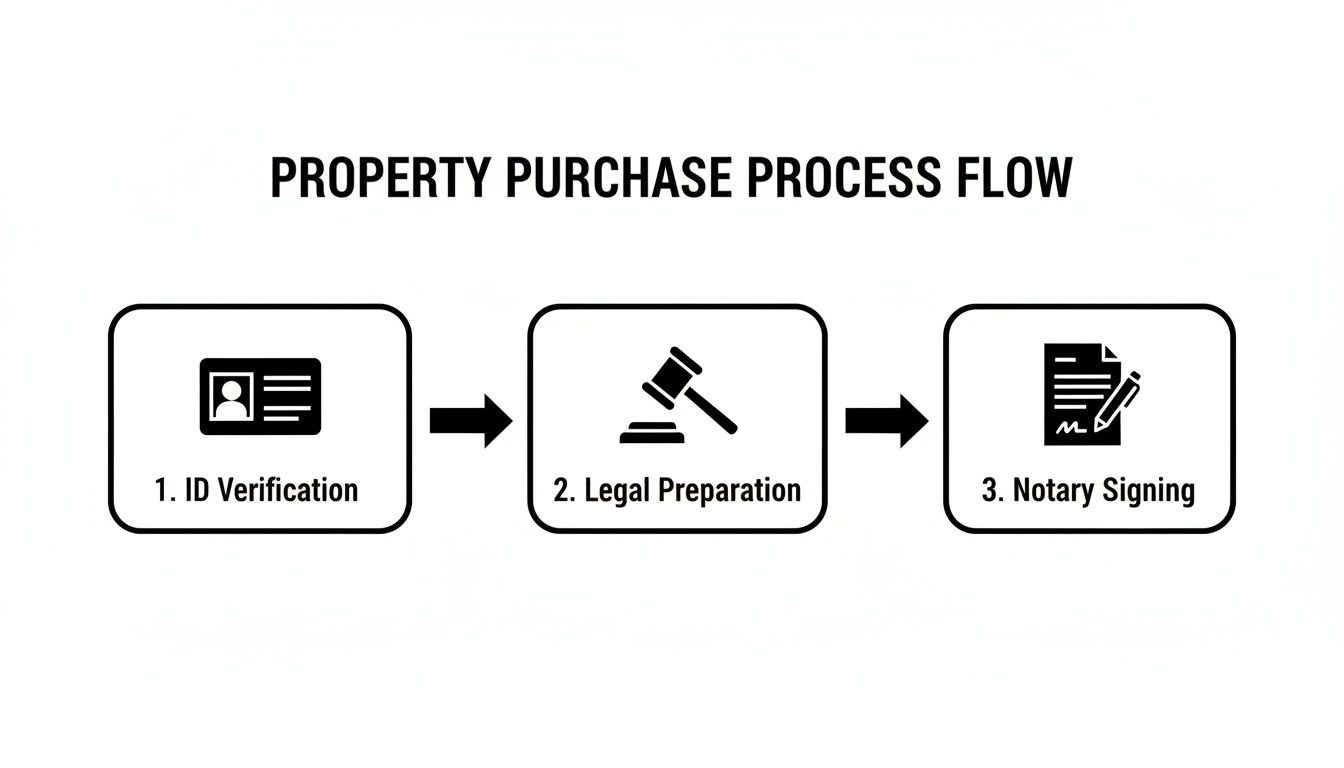
The key takeaway is the emphasis on official documentation and legal verification at every step, designed to create a secure and transparent transaction.
Essential First Steps and Legal Preliminaries
Before making an offer, two pieces of Slovenian identification must be secured: an EMSO number (Unique Master Citizen Number) and a Slovenian tax number (davčna številka). These are non-negotiable for property ownership. The EMSO serves as a personal identification number, while the tax number is required for all financial aspects of the purchase.
Obtaining these is a straightforward administrative task at a local administrative unit (upravna enota). Alternatively, a lawyer can be granted power of attorney to handle this efficiently.
Your next move is to assemble a professional team, which should always include:
- A reputable estate agent: A good local agent provides invaluable on-the-ground knowledge, handles negotiations, and guides you through local market nuances.
- An independent lawyer: While not technically mandatory for all steps, engaging your own lawyer is strongly advised for any foreign buyer. They will conduct all necessary checks, scrutinise contracts, and protect your interests throughout the process.
Diligent Property Checks
With your team in place, the due diligence phase begins. The definitive proof of ownership in Slovenia is the Land Registry (Zemljiška knjiga). A common and costly mistake is to rely solely on the seller's or agent's assurances.
Your lawyer's first task is to obtain an up-to-date Land Registry extract. This crucial document confirms:
- Legal Ownership: Verifies the seller is the legal owner with the right to sell.
- Encumbrances: Identifies any outstanding mortgages, debts, or third-party claims.
- Easements and Rights of Way: Discloses any rights others may have over the property.
They must also investigate building and zoning permits to ensure the property was built legally and that your intended use (e.g., short-term holiday lets) is permitted.
From Offer to Preliminary Contract
Once due diligence is complete, a formal offer can be made. Upon acceptance, the next step is typically the signing of a preliminary contract (predpogodba). This is a legally binding agreement that secures the key terms: price, payment schedule, and completion date.
At this stage, a deposit of 10% of the purchase price is required. This is held securely in an escrow account. If the buyer withdraws without valid legal cause, the deposit is forfeited. If the seller withdraws, they are typically required to pay double the deposit amount as a penalty.
The preliminary contract is a critical milestone. It transforms a verbal agreement into a binding commitment and protects both parties by clearly defining the terms and penalties for withdrawal.
The Notary’s Role and Finalising the Sale
The final stage is the signing of the main sale and purchase agreement, which must be executed in the presence of a public notary. The notary is a neutral, state-appointed official who ensures the legality of the entire transaction.
The notary verifies all identities, confirms the seller has a clean title, and ensures the contract complies with Slovenian law. They also oversee the payment of the property transfer tax, which must be settled before ownership can be registered.
Once the contract is signed and funds are transferred, the notary submits the application to the Land Registry to officially record you as the new owner. Your ownership is legally complete and fully secured only when your name is formally entered into the Land Registry.
Financing Your Purchase and Budgeting for Costs
Accurate financial planning is essential for a successful property investment. Beyond the asking price, a firm grasp of financing options and all associated costs is necessary to avoid unforeseen financial pressures.
While obtaining a mortgage as a non-resident is possible, expect stricter lending criteria than a local buyer would face. Slovenian banks are generally cautious and will require a clear picture of your financial standing, often necessitating a more significant upfront investment.
Securing a Mortgage as a Non-Resident
Slovenian banks do lend to foreign nationals, but loan-to-value (LTV) ratios are typically capped at around 60-70%. This means a substantial deposit of at least 30-40% of the property's purchase price will be required. From the bank's perspective, this higher down payment mitigates the perceived risk of lending to an international buyer.
A robust financial profile is essential. To begin an application, you will usually need:
- Proof of Identity: A valid passport and your Slovenian tax number.
- Income Verification: Recent payslips, employment contract, or tax returns from your home country.
- Bank Statements: Typically the last six to twelve months.
- Preliminary Sale Agreement: The signed predpogodba.
The application process may take longer than in the UK, as certified translations of documents will be required. For further funding strategies, our guide offers more detail on financing an international investment property.
Budgeting for One-Off Transaction Costs
Transaction costs can add a significant amount to your total budget. In Slovenia, buyers should plan for these to be between 3% and 13% of the property’s value.
The largest single expense is usually the Property Transfer Tax (DPN), set at a standard rate of 2%. This tax does not apply if the seller is a company and VAT is charged on the sale instead, which is common for new-build properties. Other key costs include regulated notary fees, legal fees of around 1%, and the estate agent’s commission, which is capped at 4% and often split between buyer and seller. You can find more insights into Slovenia's transfer tax system on worldwide-tax.com.
A typical breakdown includes:
- Property Transfer Tax (DPN): 2% of the contract price (unless VAT is applicable).
- Notary Fees: Set by an official tariff, scaling with the property's value.
- Legal Fees: Budget around 1% for independent legal counsel and due diligence.
- Land Registry Fee: A small administrative fee for registration.
- Agent Commission: Legally capped at 4%, often split 2% for the buyer and 2% for the seller.
Understanding Ongoing Ownership Costs
Ongoing ownership costs are crucial for calculating your net rental yield and overall return on investment (ROI). The main annual tax is the Compensation for the Use of Building Land (NUSZ), a local municipal tax that varies by location, size, and property use.
Other regular costs to factor into your budget include:
- Property Insurance: Essential to protect your asset.
- Utilities: Standard electricity, water, heating, and internet costs.
- Maintenance Fund: For apartments, a mandatory monthly contribution to the building’s reserve fund (rezervni sklad) covers communal repairs.
- Management Fees: If renting out the property, a property manager will typically charge 8-15% of the monthly rent.
By planning for both initial transaction fees and these recurring expenses, you can build a realistic financial model for your investment.
Finding the Right Investment Location
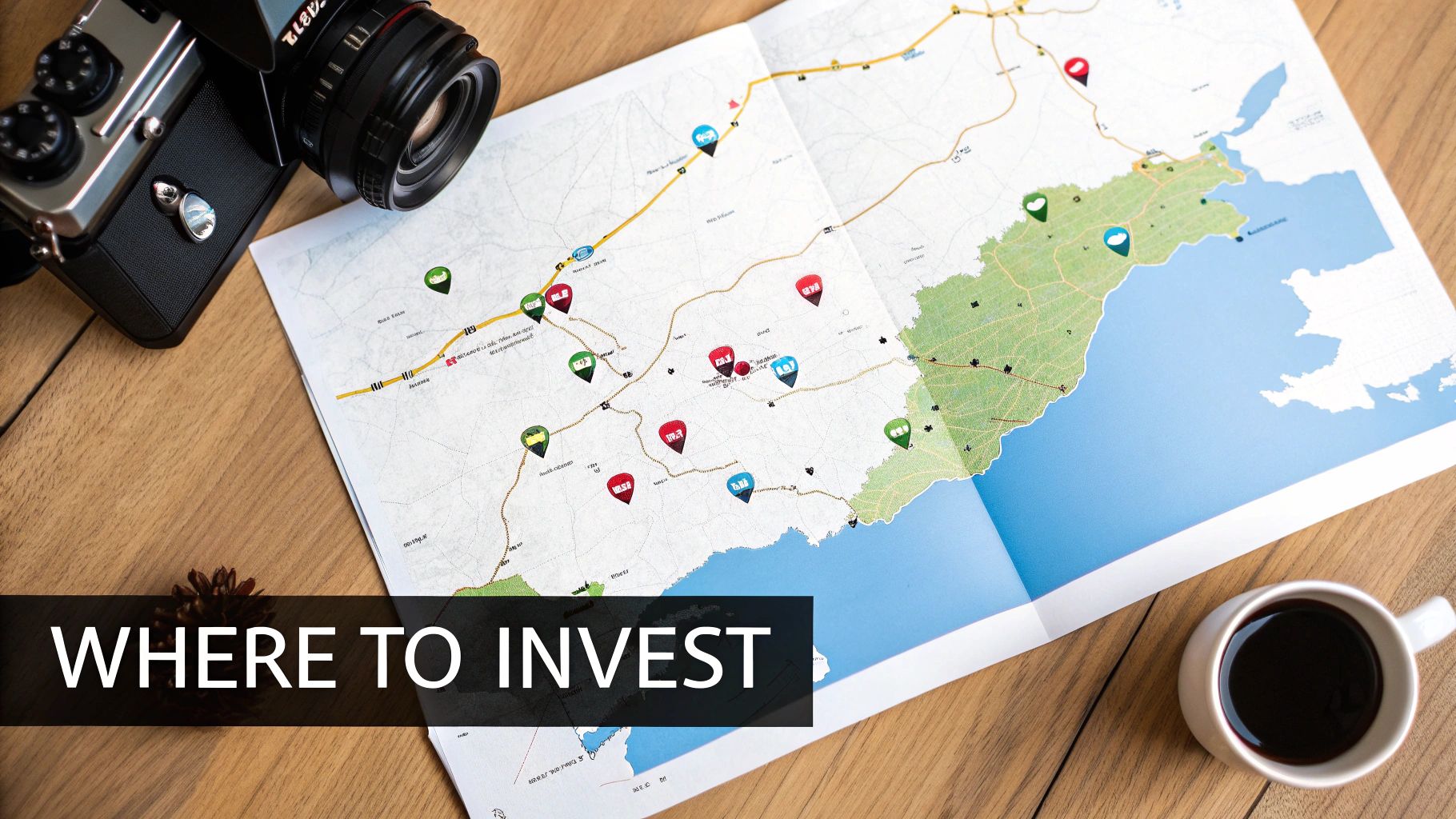
When buying property in Slovenia, location is the single most important decision. Your strategy must align with your investment objectives, whether you are targeting steady rental income, seasonal holiday lets, or long-term capital growth. Each region offers a different risk-and-reward profile.
The Slovenian property market is not monolithic. The dynamics of the capital, Ljubljana, are entirely different from the Alpine regions or the Adriatic coast. A one-size-fits-all approach is ineffective. It is critical to understand why location is the key to real estate investment success.
Ljubljana: The Buy-to-Let Stronghold
For investors prioritising stable, year-round rental income, Ljubljana is the undisputed prime location. As the nation’s economic and academic centre, it benefits from a constant influx of students, professionals, and international workers, fuelling a deep and resilient rental market with low vacancy rates.
Districts such as Bežigrad and Vič are popular due to their proximity to university faculties and business centres. A modern one-bedroom flat in these areas can command a strong monthly rent. Gross rental yields in Ljubljana are moderate but reliable, typically ranging from 3.5% to 4.5%. The market's real strength lies in its steady capital appreciation, supported by a consistent tenant pool. For more data, globalpropertyguide.com offers some solid insights into Slovenian rental yields.
Holiday Homes: Tourism-Driven Potential
For a holiday home that can generate lucrative short-term rental income, Slovenia’s tourism hotspots are the obvious choice. The market is split into two primary zones: the Alpine region and the Adriatic coast.
- The Alpine Region (Bled, Bohinj, Kranjska Gora): These areas attract tourists year-round for hiking in summer and skiing in winter. A traditional chalet or a modern apartment can generate substantial income, especially during peak seasons.
- The Adriatic Coast (Piran, Portorož, Izola): This small but scenic coastline is a major draw in summer. A historic townhouse in Piran or a seaside apartment in Portorož can command premium rates from May to September.
Takeaway: A successful holiday let in Slovenia requires an understanding of seasonality. While coastal properties excel in summer, Alpine properties can offer a more balanced, year-round income stream, reducing reliance on a single peak season.
Emerging Markets: High-Growth Opportunities
For investors with a higher risk tolerance and an eye for future growth, looking beyond established prime locations can be a strategic move. Emerging markets in Slovenia offer lower entry costs and the potential for greater capital appreciation as infrastructure and tourism expand.
Two regions stand out for their growth potential:
- The Soča Valley: Famous for its outdoor adventure sports, this area is rapidly gaining international recognition. Properties here are more affordable than in core Alpine resorts but benefit from the same tourism trends.
- Maribor: As Slovenia's second-largest city, Maribor presents a compelling value proposition. Property prices are significantly lower than in Ljubljana, yet it has a strong student population and a growing business sector, creating an opportunity for higher rental yields.
The choice between an established hub like Ljubljana and an emerging market like the Soča Valley depends on your investment horizon and risk tolerance. Ljubljana offers stability and predictable returns, while emerging regions provide the potential for more dynamic growth.
Frequently Asked Questions for UK Buyers
For a UK investor considering Slovenia, several specific questions naturally arise. This section addresses the most common queries, from the post-Brexit landscape to remote property management, providing the clarity needed to proceed with confidence.
Can I Still Buy Property in Slovenia After Brexit?
Yes. British citizens can still buy property in Slovenia based on the principle of reciprocity. This means UK citizens can acquire property as long as Slovenian citizens have similar rights in the UK—which they do.
While EU/EEA citizens can buy without additional formalities, buyers from the UK now need to obtain a decision on reciprocity from the Slovenian Ministry of Justice. This is a standard administrative procedure that your lawyer will handle, but the time required should be factored into your purchase timeline.
How are Rental Income and Capital Gains Taxed for UK Residents?
Understanding the tax implications is non-negotiable for calculating your net return. As a non-resident landlord, rental income generated in Slovenia is taxed there first.
- Rental Income Tax: An annual tax return must be filed in Slovenia. After deducting allowable costs, the effective tax rate on rental profit is typically around 25%.
- Capital Gains Tax (CGT): If you sell the property, CGT is levied on the profit. The rate starts at 25% and reduces every five years of ownership, falling to 0% after 15 years.
Crucially, the UK and Slovenia have a Double Taxation Agreement. This treaty prevents you from being taxed twice on the same income. You declare the Slovenian income on your UK tax return and can claim credit for the tax already paid in Slovenia. Our guide on understanding international property taxes provides more detail on this process.
Is It Realistic to Manage a Rental from the UK?
Yes, managing a property from another country is entirely feasible in a well-organised market like Slovenia's, but it requires a sound strategy. Attempting to self-manage remotely can become a false economy, where minor issues escalate into costly problems.
The most effective solution is to hire a professional local property management company. For a fee, typically 8-15% of the monthly rent, they handle all aspects of the tenancy:
- Sourcing and vetting tenants
- Collecting rent and managing deposits
- Coordinating maintenance and repairs
- Ensuring compliance with local regulations
For an international investor, this service is invaluable, transforming the property from a second job into a passive asset.
What Are the Biggest Risks for a Foreign Investor?
Slovenia is a stable and transparent market, but it is not without risk. For foreign buyers, the most significant pitfalls usually stem from a lack of on-the-ground knowledge rather than market volatility.
Actionable Insight: The most common error is inadequate due diligence. Never assume a property's legal status is clean. Always insist on an up-to-date Land Registry extract and an official zoning certificate (lokacijska informacija) before signing any binding agreement.
Other risks to monitor include:
- Currency Fluctuations: Movements in the GBP/EUR exchange rate will affect your purchase costs and the value of rental income when repatriated to sterling.
- Regulatory Changes: Policy shifts, such as new rules for short-term lets or changes to property taxes, could impact your investment model.
- Overpaying: Without local market insight, it is easy to overpay. Work with a trusted agent and benchmark your target property against recent, comparable sales to ensure a fair price.
By being aware of these risks and building a reliable local team—starting with a good lawyer and agent—you can navigate the process with confidence.
At World Property Investor, we provide the in-depth analysis and practical guides you need to make informed decisions in global real estate markets. Explore our resources to build your international property portfolio with confidence at https://www.worldpropertyinvestor.com.