
For discerning global investors prioritising stability, quality of life, and steady capital growth, buying a property in Austria presents a compelling proposition. Unlike more volatile markets, Austrian real estate is anchored by a robust economy and consistent demand, particularly in prime urban centres such as Vienna and high-yield tourist regions throughout the Alps. This creates a secure environment for investors with a long-term perspective.
Why Invest in Austrian Real Estate?
Austria's appeal extends far beyond its alpine landscapes. For property investors, the nation represents a bastion of economic and political stability in the heart of Europe. Its strong legal framework and transparent property registration system provide a secure foundation for any acquisition.
A core component of this security is the Grundbuch, or Land Registry. This public register provides indisputable proof of ownership and details all encumbrances, from mortgages to rights of way. It offers a degree of legal certainty rarely found in other jurisdictions.
Economic Fundamentals and Market Stability
The Austrian economy is characterised by its resilience, low unemployment, and a strong industrial sector. This economic health translates directly into a stable and predictable property market. According to the Austrian National Bank (OeNB), the market has undergone a healthy correction since its 2022 peak, with overvaluation cooling significantly.
This normalisation has created a more balanced environment. As of early 2024, the market is leaning in favour of buyers, with transaction volumes recovering from the 2023 slowdown. It is not uncommon for buyers to negotiate 3% to 8% from asking prices—a clear sign of a mature, not an overheated, market.
Diverse Investment Opportunities
Austria offers two distinct but equally attractive investment paths: the steady, year-round demand of its cities or the lucrative seasonal income of its tourist hotspots.
-
Established Urban Centres (Vienna, Salzburg, Graz): These cities are driven by consistent rental demand from a growing population of students, professionals, and international expatriates. Vienna, frequently ranked as the world's most liveable city, possesses a strong rental market with historically low vacancy rates in its prime districts.
-
Emerging Alpine & Tourist Regions: Areas such as Tyrol and the Salzkammergut offer excellent seasonal rental yields, fuelled by a world-class tourism industry. A ski chalet or a lakeside apartment can generate significant income from holiday lets, tapping into both the winter ski season and the summer hiking season.
The following table provides a comparison of these two primary investment avenues.
Key Investment Characteristics Across Austrian Markets
| Investment Factor | Vienna & Major Cities | Alpine & Tourist Regions |
|---|---|---|
| Primary Driver | Long-term rental demand from residents, students, and professionals. | Seasonal tourism (skiing in winter, hiking/lakes in summer). |
| Rental Yields | Stable and predictable, typically lower but more consistent. | Potentially high but seasonal and variable. |
| Vacancy Risk | Generally low due to consistent housing demand. | Higher during off-seasons; dependent on tourism trends. |
| Capital Growth | Steady, long-term appreciation tied to economic fundamentals. | Can be strong, but more linked to tourism appeal and local regulations. |
| Management | Simpler; often managed by local letting agents for long-term tenants. | More intensive; requires active management for short-term holiday lets. |
| Best For | Investors seeking stable, lower-risk, long-term returns. | Investors seeking higher yields and a lifestyle component. |
The choice between an urban apartment and an alpine retreat depends on an investor's risk appetite and management preference.
Key Takeaway: The Austrian market is not suited for short-term speculation but rewards a long-term perspective. A typical holding period of at least 5 to 7 years is advisable to offset transaction costs and benefit from gradual capital appreciation.
Engaging professional legal counsel from the outset is essential, particularly for non-EU citizens. An experienced local solicitor will ensure compliance with all regional regulations and safeguard your interests throughout the transaction.
If you are new to property investment, our beginner's guide to real estate investing offers foundational knowledge to help you start with confidence.
Understanding Foreign Ownership Rules and Eligibility

Before commencing a property search in Austria, the primary question is one of legal eligibility. The answer is determined entirely by citizenship.
For citizens of EU and EEA countries, the process is straightforward. They possess the same property acquisition rights as Austrian nationals and can purchase freely without special permits.
For all other foreign nationals—including British, American, and Australian investors—the process is more complex. The ability to purchase is governed by provincial laws, collectively known as the Ausländergrunderwerbsgesetz (Foreigner Land Acquisition Act).
Crucially, this is not a single, nationwide law. Each of Austria’s nine federal states (Bundesländer) establishes its own regulations. This means that the required documentation, criteria, and probability of approval can differ significantly between Vienna and a village in Tyrol.
Navigating the Approval Process
For a non-EU/EEA buyer, every purchase must be approved by the local land transfer commission, the Grundverkehrskommission. This body acts as a gatekeeper, ensuring any foreign acquisition serves Austrian economic or social interests.
The commission's primary purpose is to prevent speculative purchasing that could inflate local prices and to protect sensitive agricultural or forest land. A buyer must demonstrate a legitimate purpose for the acquisition, such as establishing a primary residence or contributing to the local economy via a tourism business.
To secure approval, a detailed application is required. While the specific documents vary by state, standard requirements include:
- Proof of Identity: A notarised copy of your passport.
- The Purchase Agreement: A draft of the sale contract (Kaufvertrag).
- A Declaration of Use: A formal statement explaining the intended use of the property (e.g., primary residence, holiday home, commercial rental).
- Proof of Funds: Evidence demonstrating sufficient capital to complete the purchase.
This is a rigorous review process. Depending on the state and the application's complexity, a decision can take from several months to over a year. Engaging an Austrian solicitor who specialises in this area is non-negotiable.
How Rules Differ Across Federal States
The variations between states are the single most important factor for any non-EU/EEA investor. Some regions are notoriously restrictive for foreign buyers, while others are more open to investment.
Consider these two examples:
Example 1: A British investor wishes to buy a ski chalet in Tyrol.
Tyrol, along with Vorarlberg and Salzburg, enforces some of the country's strictest regulations. This policy is designed to protect the local housing market from being saturated with holiday homes. To gain approval here, the investor would need to demonstrate a very strong economic or social connection to the region. The desire for a holiday home is almost never a sufficient reason.
Example 2: An American investor plans to buy an apartment in Vienna.
Vienna is a different case. As a city-state, it is generally more liberal with a more straightforward approval process. Here, the focus is typically on confirming the property will be used as a primary residence or that it complies with zoning regulations for rental use. The process is faster and more predictable than in the Alpine states.
Key Takeaway: Your choice of location directly dictates the complexity of the acquisition process. A property in a less restrictive state like Vienna or Styria offers a smoother path to ownership than one in a highly regulated tourist region.
This regional complexity defines the Austrian property market for foreign investors. For a broader analysis of buying abroad, our guide to investing in overseas property offers valuable perspectives. Mastering these local rules is the first and most critical step.
Securing a Mortgage as an International Buyer
Financing is often the most challenging aspect of buying property in Austria for an international buyer. Austrian lenders are characteristically conservative and apply stricter criteria to non-residents, who are perceived as higher risk. However, with thorough preparation and a clear understanding of banking expectations, securing a mortgage is achievable.
Austrian banks almost never offer 100% financing to foreign nationals. A substantial deposit is non-negotiable. While a local buyer might secure a mortgage with a 20% deposit, international investors must budget for a significantly larger down payment.
Deposit Requirements and Loan-to-Value Ratios
For most non-EU/EEA buyers, lenders will require a deposit of between 30% and 40% of the property's value. This means the loan-to-value (LTV) ratio—the amount you can borrow against the purchase price—will be capped at approximately 60-70%.
This cautious approach is a hallmark of the Austrian market. Banks prioritise financial stability, and a larger deposit demonstrates commitment and mitigates their lending risk. High LTV products common in other countries are not available here.
In practical terms, for a €400,000 apartment in Vienna, an investor would need a cash deposit of at least €120,000 to €160,000, plus additional funds for transaction costs.
Essential Documentation for Your Application
During a mortgage application, your finances will be subjected to rigorous scrutiny. Meticulous organisation is essential. Lenders require incontrovertible proof of your ability to service the debt.
The typical documentation required includes:
- Proof of Identity: A certified copy of your passport.
- Proof of Income: At least three to six months of recent payslips and your latest annual tax return. Self-employed applicants must provide at least two years of audited accounts.
- Bank Statements: Six months of personal bank statements to demonstrate cash flow and savings.
- Credit History: A credit report from your country of residence (e.g., an Experian or Equifax report for UK residents).
- Purchase Agreement: A draft of the property purchase contract (Kaufanbot or Kaufvertrag).
Choosing Between Fixed and Variable Rates
Austrian lenders offer both fixed-rate and variable-rate mortgages, a choice that will significantly impact your investment's cash flow.
- Fixed-Rate Mortgages: These lock in your interest rate for a set period, typically 5, 10, or 15 years. This provides certainty and simplifies the forecasting of monthly outgoings and rental yield. For most buy-to-let investors, this predictability is a considerable advantage.
- Variable-Rate Mortgages: These are linked to a benchmark rate such as Euribor, plus the bank’s margin. Monthly payments fluctuate with interest rate changes. While they may appear cheaper initially in a low-rate environment, they introduce risk if rates rise.
Following a period of rate increases, market conditions have stabilised in early 2024. Many investors are opting for fixed-rate products for the security they offer over the medium term. You can explore more strategies for financing an investment property in our detailed guide.
Opening an Austrian bank account early in the process is a practical step that simplifies the mortgage application and is essential for paying the deposit, legal fees, and ongoing property expenses.
The Austrian Property Buying Process Explained
Acquiring property in Austria is a structured and secure process that demands a methodical approach. The system is built on legally binding steps from the outset, designed to protect both buyer and seller through complete transparency.
Your first action should be to engage local professionals. An experienced real estate agent (Immobilienmakler) provides on-the-ground guidance, but the most critical advisors are your independent solicitor (Rechtsanwalt) or public notary (Notar). They are legally responsible for safeguarding your interests throughout the transaction.
Making a Formal Offer
The process begins not with an informal agreement but with a formal, written document called a Kaufanbot. This is a serious commitment. Once signed by the seller, it becomes a legally binding preliminary contract, obligating both parties to complete the sale under the agreed terms.
It is absolutely crucial to have financing arranged and preliminary due diligence completed before submitting a Kaufanbot. Withdrawing after the seller has accepted can result in significant financial penalties, often a percentage of the purchase price.
This infographic outlines the core elements international buyers must have prepared before this stage.
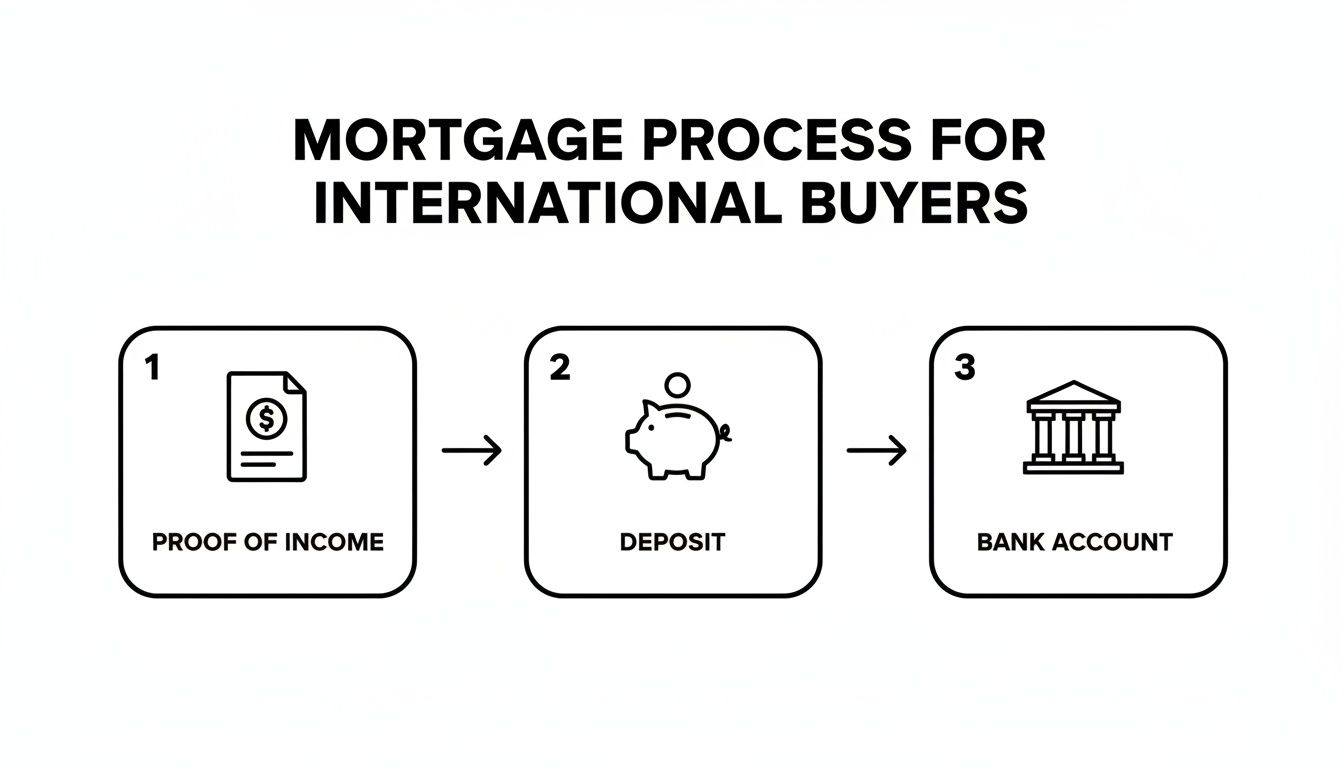
Having your proof of income, a substantial deposit, and an Austrian bank account arranged is a prerequisite for a successful purchase.
The Role of the Notary and Due Diligence
With the Kaufanbot signed, your solicitor or notary conducts comprehensive due diligence. This involves a detailed examination of the Grundbuch (Land Registry) to confirm:
- Clear Title: Ensuring the seller is the undisputed legal owner.
- No Encumbrances: Checking for outstanding mortgages, liens, or third-party rights.
- Building Permits and Zoning: Verifying compliance with local building regulations.
Simultaneously, the notary drafts the main purchase agreement, the Kaufvertrag. This master document details every term of the sale, from the final price to the handover date. For legal validity, it must be signed by both parties in the notary's presence.
The notary’s role extends beyond witnessing signatures. They often act as the Treuhänder (escrow agent), providing a crucial layer of financial security that is fundamental to the Austrian system.
Securing the Transaction with an Escrow Account
Once the Kaufvertrag is signed, you will transfer the full purchase price, plus all taxes and fees, into a secure escrow account managed by the notary. These funds are not released to the seller immediately.
The notary holds the funds until they receive official confirmation that the property title has been successfully transferred to your name in the Land Registry. Only when your ownership is legally registered does the seller receive payment. This system eliminates the risk of payment without a successful title transfer and is one of the most robust investor protection mechanisms in any European property market.
To learn more about assessing a deal's financial viability, you can discover how to determine a property’s investment potential in our dedicated guide.
Final Registration and Handover
The final step is the registration of your ownership in the Grundbuch. The notary submits all necessary documents, including the signed Kaufvertrag and proof of tax payment, to the local district court. This registration can take several weeks.
Once the Land Registry is updated with your name, the process is complete. The notary releases the funds to the seller, and you can arrange the handover of the keys. A typical transaction, from offer to final registration, takes between one and three months.
Budgeting for Taxes, Fees and Ongoing Costs
A prudent property investment in Austria requires budgeting beyond the headline purchase price. The advertised price is merely the starting point; a comprehensive budget must account for both one-off transaction fees and the recurring costs of ownership.
These additional costs typically amount to between 9% and 13% of the property’s purchase price. Accurate budgeting from the outset is crucial for determining your total capital outlay and forecasting your net yield.
One-Off Transaction Costs
A number of mandatory fees and taxes are due at the point of sale. These are non-negotiable and constitute a significant portion of your initial budget. Your notary will typically manage the collection of these funds via the escrow account.
The primary costs include:
- Property Transfer Tax (Grunderwerbsteuer): A standard rate of 3.5% of the purchase price.
- Land Registry Fee (Eintragungsgebühr): A fee of 1.1% of the purchase price to register your name as the new owner in the Grundbuch.
- Notary and Legal Fees: These generally range from 1.5% to 3.0% of the price, plus 20% VAT, depending on the transaction's complexity.
- Real Estate Agent Commission (Maklerprovision): If an agent was used, their commission is typically 3.0% of the purchase price, plus 20% VAT.
The following table provides a summary of typical closing costs.
Estimated Closing Costs for Austrian Property
This table summarises the one-time fees as a percentage of the property's purchase price.
| Cost or Fee | Typical Percentage of Purchase Price |
|---|---|
| Property Transfer Tax | 3.5% |
| Land Registry Fee | 1.1% |
| Notary & Legal Fees (+ VAT) | 1.5% – 3.0% |
| Estate Agent Commission (+ VAT) | 3.0% |
| Total Estimated Range | 9.1% – 10.6% (+) |
These fees are substantial, and having the additional capital available is non-negotiable.
Key Takeaway: Budget for approximately 10% of the purchase price to cover all closing costs. For a €500,000 property, this requires an additional €50,000 in liquid funds.
Ongoing Costs of Ownership
Once the property is acquired, financial focus shifts to the ongoing costs of ownership. These recurring expenses directly impact your net rental income and overall return on investment.
The two main ongoing costs are the annual property tax (Grundsteuer) and, for apartments, monthly building management fees (Betriebskosten).
The Grundsteuer is a local municipal tax which is relatively low compared to other European nations. It is calculated using an assessed property value (Einheitswert) that is often significantly below market value. For most properties, this annual tax amounts to a few hundred euros.
The Betriebskosten for apartments are a more significant monthly expense. These fees cover the maintenance of the building's common areas, including:
- Cleaning and lighting for common areas
- Lift maintenance
- Building insurance
- Waste disposal
- Contributions to the building's repair fund (Rücklage)
These costs are apportioned among all apartment owners and vary depending on the building's age, size, and amenities. It is vital to review the building's accounts before purchase to understand these financial commitments. For a deeper analysis of fiscal responsibilities, you can understand property taxes with our comprehensive guide.
Common Questions from Foreign Buyers
Despite a clearly defined process, buying property in Austria can present challenges for those unfamiliar with the system. The following are the most common questions from international buyers, addressing practical, real-world concerns.
Can I Rent Out My Property in Austria?
Yes, but the method of rental depends on the property’s official designated use (Widmung).
For buy-to-let apartments in urban centres like Vienna or Graz, long-term rentals are standard and form the bedrock of a well-regulated investment market.
The situation is more complex in tourist areas. Properties in Alpine regions such as Tyrol or Salzburg often carry a "touristic use" obligation. This mandates that the property must be made available for short-term holiday lets through an approved management company. It cannot be used solely as a private holiday home or rented on a long-term basis. It is imperative to verify the Widmung before making an offer.
How Long Does the Buying Process Take?
From a formal offer (Kaufanbot) to receiving the keys, a typical purchase in Austria takes between one and three months. Several factors can influence this timeline.
- Your Financing: Mortgage approval and associated paperwork can add several weeks. Cash buyers have a distinct time advantage.
- Foreign Buyer Approval: For non-EU/EEA citizens, awaiting approval from the Grundverkehrskommission can extend the timeline to six months or longer in more restrictive states.
- Professional Efficiency: The efficiency of your notary and any backlog at the local Land Registry also play a role.
With funds and an experienced legal team in place, a transaction can often be completed closer to the one-month mark, provided no special permits are required.
What Is the Minimum Holding Period for a Profitable Sale?
While there is no official rule, experienced market participants advise a minimum holding period of five to seven years. The Austrian market is characterised by steady, gradual appreciation, not rapid gains suitable for "flipping".
The primary reason is the high transaction costs. The combined costs of buying and selling can amount to 10% to 13% of the property’s value. The property's value must appreciate sufficiently to cover these costs before any net profit is realised.
A patient, disciplined strategy is most effective in Austria. Analysis from the Austrian National Bank (OeNB) consistently shows that the market rewards long-term stability. The optimal approach is to focus on fundamentally strong locations and negotiate a keen entry price to position for a profitable exit.
Do I Need to Be Physically Present in Austria to Buy?
No, physical presence is not required for the entire process. Most critical steps can be handled by a legally appointed representative via a Power of Attorney (Vollmacht).
You can grant your Austrian solicitor or notary the authority to act on your behalf, enabling them to sign the binding offer and final purchase contract (Kaufvertrag). This document must be correctly drafted, signed in your home country, and certified with an apostille to be legally valid in Austria. This is a common and secure method for international investors to acquire property remotely.
What Happens if a Seller Backs Out of the Deal?
The Austrian system is very robust in this regard. Once the formal offer (Kaufanbot) is signed by both parties, it becomes a legally binding preliminary contract.
If the seller attempts to withdraw without a valid legal reason (e.g., a contractual condition not being met), you have the right to sue for specific performance. This means you can take legal action to compel them to complete the sale at the agreed price. Alternatively, you could sue for damages to recover incurred costs, such as legal and mortgage arrangement fees. The binding nature of the Kaufanbot is a cornerstone of Austrian property law, providing significant security for genuine buyers.
At World Property Investor, we provide the in-depth analysis and practical guidance you need to navigate global real estate markets with confidence. Explore our comprehensive country guides and investment strategies to build your international portfolio.