
For the discerning UK investor accustomed to a saturated London market or the volatility of traditional emerging economies, Slovenia offers a compelling alternative. It presents a rare combination of Eurozone stability and genuine growth potential.
This compact EU nation is more than just another European prospect; it fuses a resilient, high-growth economy with steady, sustainable property price appreciation. For investors prioritising calculated, long-term capital growth underpinned by robust fundamentals, the Slovenian market warrants serious consideration.
Why Slovenia is a Prudent Choice for Global Property Investors
The core appeal of Slovenia lies in its market dynamics, which stand in stark contrast to the speculative fervour often seen in other European hotspots. Unlike markets propped up by transient foreign capital, Slovenia’s property sector is founded on an exceptionally high owner-occupier rate. This creates a stable foundation, one far less susceptible to the sharp corrections witnessed elsewhere.
The market is driven almost entirely by strong domestic demand—a clear indicator of a healthy, sustainable ecosystem. For a British investor, this translates to a lower-risk environment where long-term value is built on genuine local need, not fleeting international trends. It is a significant departure from markets such as Dubai or parts of Spain, where over-reliance on foreign buyers can create considerable volatility.
Economic Resilience and Consistent Growth
Slovenia’s economy is the bedrock of its investment appeal. As a stable Eurozone member with a powerful industrial and export-focused base, it has proven remarkably resilient. Official data from bodies like the European Commission consistently point to steady GDP growth, with Slovenia frequently outperforming many of its regional peers.
This economic stability fuels a robust job market, particularly in the country's burgeoning technology and pharmaceutical sectors. With record-low unemployment rates, which according to the Statistical Office of the Republic of Slovenia hover around 3.2%, more households possess the financial security to purchase property. It is this sustained local purchasing power that supports property values from the ground up.
The Undersupply Advantage
For any serious property investor, the supply-and-demand equation is paramount. In Slovenia's prime locations, there is a clear, persistent housing undersupply that works in an investor's favour.
- Ljubljana: The capital has a significant shortage of modern, well-located apartments. Demand is being fuelled by young professionals, a growing student population, and an expanding tech scene, yet new construction completions are failing to keep pace.
- Adriatic Coast & Alpine Regions: In hotspots like Piran or Bled, stringent planning regulations are in place to preserve the area's natural and architectural heritage. This deliberately limits new development, which drives up the value of existing properties and creates a natural floor for prices.
For the strategic investor, this structural undersupply is a powerful long-term growth driver. It means an asset is not merely a building; it is a scarce resource in a high-demand area, insulating its value against market fluctuations.
This dynamic creates a compelling case for buying property in Slovenia. While prices have seen consistent growth—climbing over 60% in some areas in the last five years according to market analysis—the market is not overheated. Instead, that growth reflects genuine demand, suggesting a sustainable path for future appreciation. To see how this compares globally, consider our analysis of other top emerging property investment markets.
The current climate, where transaction volumes are cooling slightly while prices hold firm, presents a strategic entry point for buyers with a long-term vision.
Understanding the Slovenian Property Market
To make an informed investment in Slovenia, one must look beyond the headlines and analyse the hard data. Currently, the market presents a dual narrative: prices are still climbing steadily, but the number of transactions has cooled. This dichotomy creates an interesting window for discerning investors prepared to act.
On the ground, while rising prices normally signal a seller's market, the drop in sales volume suggests buyers are becoming more cautious and affordability is a growing concern. This provides buyers with more negotiating leverage than was available a year or two ago. The market is transitioning from frantic to considered.
Price Trends vs. Transaction Volumes
The Slovenian property market has been incredibly resilient. For years, it has demonstrated consistent year-on-year growth in residential prices, a trend built not on speculation, but on solid economic fundamentals and a genuine housing shortage, especially in desirable areas.
However, national averages do not provide the full picture. Prime locations like Ljubljana have seen prices escalate much faster than the rest of the country. This underscores the importance of local knowledge; a nationwide trend cannot be uniformly applied to a specific city or region.
Recent figures from Slovenia's Statistical Office (SURS) highlight this divergence. In the last quarter, residential property prices rose by 8.46% year-on-year, continuing a decade-long upward trend. However, sales activity declined for the third consecutive year, with only 8,124 homes sold—a significant 21.13% decrease from the previous year. For a deeper dive into historical data, this analysis of Slovenia's property price history and trends is an excellent resource.
This leads to a key summary of the current market landscape for UK investors.
Slovenian Property Market Key Indicators
The table below breaks down the core metrics shaping the Slovenian real estate market today, offering a clear snapshot for investors.
| Metric | Recent Data | Implication for UK Investors |
|---|---|---|
| Year-on-Year Price Growth | +8.46% (Residential) | Strong capital appreciation potential, but entry prices are rising. |
| Annual Sales Volume Change | -21.13% (Residential) | A cooling market gives buyers more negotiation power and reduces competition. |
| Average Ljubljana Price | Approx. €4,000-€5,500/m² (Central) | The capital remains a premium, stable market, ideal for long-term holds. |
| Average National Price | Approx. €2,500-€3,500/m² | Opportunities exist outside Ljubljana at more accessible price points. |
As is evident, the market is nuanced. While growth is strong, the slowdown in transactions suggests that carefully chosen properties, priced correctly, are the ones that will succeed.
What is Fuelling Demand?
Behind these figures are the real-world economic drivers that maintain market buoyancy. Slovenia's stability is not accidental; it is built on a solid economic base that directly fuels housing demand. Understanding this is key to formulating a long-term investment plan.
The main factors at play include:
- A Booming Tech Scene: Ljubljana, in particular, hosts a fast-growing technology hub. This attracts highly skilled, well-paid professionals who create consistent demand for quality rental properties.
- Record-Low Unemployment: With unemployment at historically low levels, more Slovenians have the financial stability to purchase property, which supports prices from the ground up.
- Major University Towns: Cities like Ljubljana and Maribor have large student populations, ensuring constant, reliable demand for rental accommodation. This forms the bedrock of the buy-to-let market.
- Tourism Power: The enduring appeal of the Adriatic coast and the Julian Alps ensures a strong market for short-term holiday lets, providing investors with another viable rental strategy.
This blend of economic strength and diverse demand streams creates a highly resilient market. Unlike destinations reliant on a single industry, Slovenia’s property values are supported by multiple pillars, which mitigates risk for investors.
Established Hotspots vs. Emerging Opportunities
While Ljubljana remains the primary engine of the Slovenian property market, astute investors are beginning to compare its performance with up-and-coming areas. The capital offers stability and proven rental demand, making it a lower-risk option for those prioritising steady income and capital preservation.
Conversely, secondary cities like Maribor or coastal towns such as Koper offer lower entry prices and potentially a much higher ceiling for growth. These areas are beginning to benefit from new infrastructure projects and a shift in lifestyle preferences, particularly with the rise of remote work. An investment here may carry slightly more risk, but the potential for capital appreciation is often significantly greater.
For instance, a modern two-bedroom apartment in Ljubljana's city centre commands a premium price. A similar property in a well-connected part of Maribor could be acquired for 30-40% less, yet still generate an attractive rental yield due to the lower initial capital outlay. This balanced approach allows you to tailor your strategy to your risk appetite and financial objectives. For further insights into building a varied portfolio, explore our guides on global property investment strategies.
The Legal Pathway to Ownership for UK Buyers
For British citizens, the process of buying property in Slovenia is refreshingly straightforward due to the 'reciprocity principle'. In simple terms, because Slovenians can acquire property in the UK, British nationals are afforded the same right in Slovenia. The UK’s membership in the OECD further cements this, removing many of the hurdles that buyers from outside the EU or OECD might face.
This means you can purchase property directly, in your own name. There is no need to establish a local company—a common and often costly workaround in more restrictive markets. The process is well-regulated and transparent, but engaging a team of key professionals is essential for a successful transaction.
The flowchart below illustrates the current market dynamics, showing how rising prices have cooled sales activity, potentially creating a window of opportunity for well-prepared buyers.
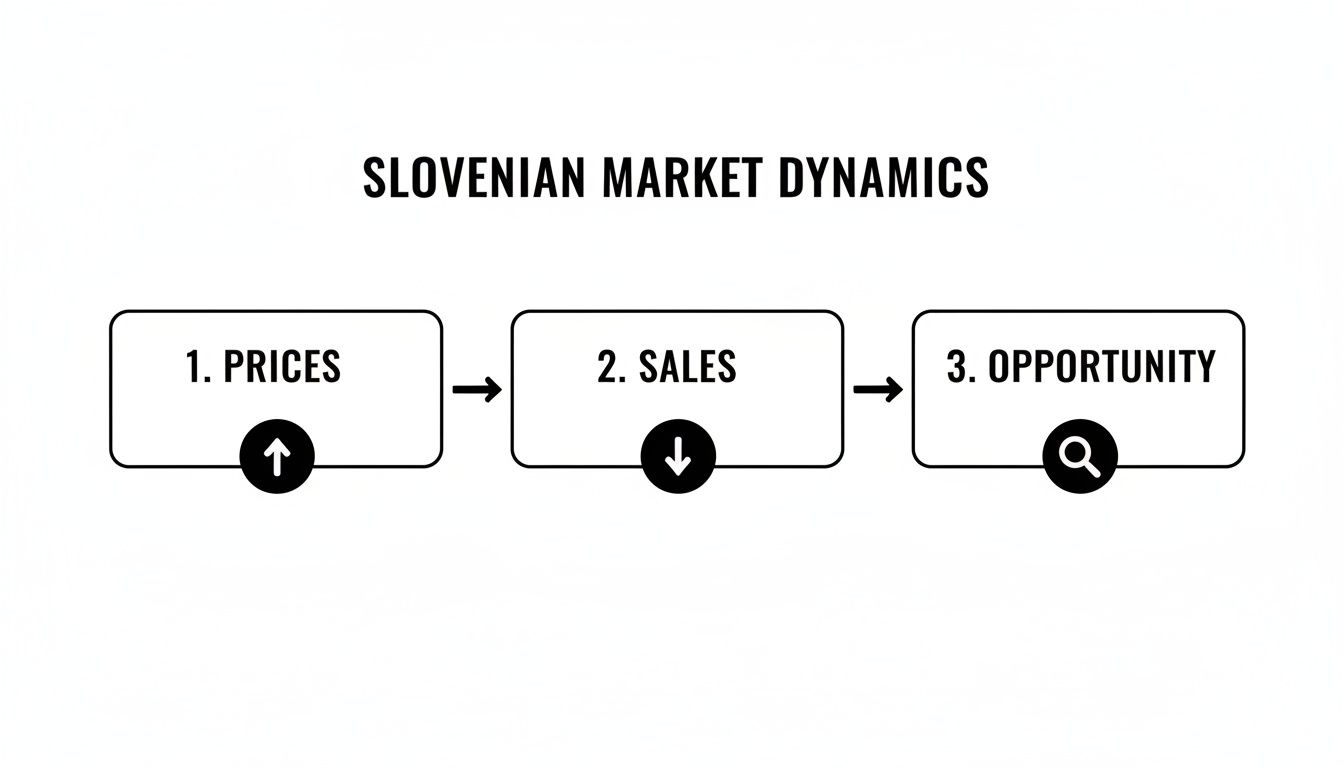
While a shortage of quality properties keeps prices firm, the dip in sales volume suggests buyers now have more negotiating power than in recent years.
Your Professional Team on the Ground
Completing a Slovenian property transaction requires a professional team. Understanding their respective roles is the first step to protecting your interests and ensuring a smooth process.
- Estate Agent (Nepremičninski Posrednik): The agent serves as your link to the market, arranging viewings and handling negotiations. While an excellent source of local knowledge, it is crucial to remember their legal duty is to the seller.
- Notary (Notar): The notary is a neutral, state-appointed legal professional responsible for drafting the final sales contract and ensuring the transaction complies with Slovenian law. They verify the process but do not conduct in-depth due diligence on your behalf.
- Independent Lawyer (Odvetnik): This is, without question, your most critical appointment. For any serious investor, retaining an independent lawyer is non-negotiable. They act as your advocate, conducting thorough due diligence, checking for encumbrances or claims against the title, and ensuring the contract fully protects your interests.
Never rely solely on the notary or the seller’s agent for legal checks. An independent lawyer works exclusively for you. Their objective is to identify potential red flags before you are financially committed. This single decision can prevent significant complications and expense later on.
Essential Preliminary Steps
Before signing any contracts, every foreign buyer must complete two minor but crucial administrative tasks. It is advisable to address these early to prevent delays.
- Obtain a Slovenian Tax Number (Davčna Številka): This unique ID is mandatory for any property transaction. You can apply for one at any local tax office (Finančni Urad) with your passport. It is usually issued on the same day.
- Obtain an EMSO Number (Enotna Matična Številka Občana): This is a personal identification number. Once you have your tax number, you can obtain your EMSO from an administrative unit (Upravna Enota).
From Offer to Ownership: The Key Stages
Once you have identified a suitable property and your paperwork is in order, the purchase process follows a clear, structured path. Each step is designed to provide greater legal security as you move towards official ownership.
The first formal commitment is the signing of a preliminary contract (predpogodba). This document locks in the price and key terms. At this stage, you will typically pay a deposit, usually 10% of the purchase price. This contract is legally binding, so it is vital that your lawyer has reviewed every clause.
Next, the notary drafts the main sales contract (prodajna pogodba). This is the final, definitive legal document detailing every aspect of the sale. Once you and the seller sign this in the notary's presence, the remaining balance is usually transferred into a secure escrow account.
The final and most critical step is registering your ownership in the land registry (zemljiška knjiga). The notary handles this submission. Once your name is officially entered into the registry, the property is legally yours. To understand how this fits into a broader strategy, our complete guide on investing in overseas property provides invaluable context.
A Practical Breakdown of Costs and Taxes
A successful property investment ultimately depends on accurate financial forecasting. Beyond the headline purchase price, a transparent understanding of all associated costs is essential for calculating your true return on investment.
Fortunately, Slovenia’s transaction costs are modest compared to many other European markets. As a general rule, you should budget an additional 3% to 5% of the property’s value to cover all acquisition expenses.
Key Upfront Transaction Costs
When acquiring a resale property (one not sold by a VAT-registered business), the principal tax is the Property Transfer Tax (DPN). This is levied at a flat rate of 2% of the sale price and is typically the single largest transaction cost for investors.
Beyond the transfer tax, several professional and administrative fees must be accounted for. These are essential for ensuring your purchase is secure and legally sound.
- Notary Fees: The notary is central to the process. Their fees for drafting the final sales contract and handling the land registry submission are set by a regulated tariff, usually ranging from 0.1% to 0.4% of the property value, plus VAT.
- Land Registry Entry: A small, fixed fee is required to formally register your ownership in the land registry (zemljiška knjiga). This is typically under €100.
- Agent Commission: If you use a buyer's agent, their commission is negotiable but often shared with the seller's agent. The total commission is legally capped at 4% (+VAT), so your share would normally be around 2%.
- Legal Fees: It is highly recommended to hire your own independent lawyer for due diligence. For their services, expect to pay between 0.5% and 1.0% (+VAT) of the purchase price.
Ongoing Ownership Costs and Taxes
Once you take possession of the property, your financial obligations shift to ongoing ownership costs. The main recurring cost is the annual property tax, which is currently calculated based on a property’s assessed value from 2007. For most residential properties, this tax is relatively low.
However, investors should monitor potential fiscal reforms. The Slovenian government has indicated its intention to introduce a new residential property tax, which could particularly affect second homes and investment properties.
While the details remain under discussion, this is a crucial factor for long-term financial planning. Our guide on how to understand property taxes for global investors provides a broader context for these types of changes.
A key takeaway for investors is that while current holding costs are low, future tax policies may shift. Factoring a potential increase in annual property tax into your financial models is a prudent measure for any long-term investment strategy.
Financing Your Slovenian Property Purchase
For non-residents, obtaining a mortgage in Slovenia is possible, though the conditions are stricter than for locals. Banks are generally willing to lend to foreign buyers, especially from other EU or OECD countries, but they adopt a more cautious approach to risk.
You should expect to provide a higher deposit, typically between 30% and 40% of the property’s value. This is significantly more than the 20% often required from Slovenian residents. From the bank's perspective, a larger deposit demonstrates commitment and provides a buffer against market fluctuations.
Interest rates for non-residents may also be slightly higher, often by 0.25% to 0.50%. Slovenian banks follow ECB rate guidance, with current mortgage rates for residents hovering around 3.0% to 4.0%. You can expect your offer to be at the upper end of this range or slightly above it. Banks such as UniCredit and NLB are known to be more open to working with foreign clients but will require extensive documentation, including proof of a stable, regular income, preferably in euros.
Optimising Returns on Your Slovenian Property
Acquiring the right property is merely the first step. The true skill lies in optimising that asset to generate the best possible returns. In Slovenia, this involves understanding the two distinct rental strategies available and appreciating the country's solid potential for long-term capital growth.
Your entire approach must be attuned to the local market. Slovenia presents a fascinating dynamic where high rental demand consistently meets a structural undersupply of quality housing, particularly in the most desirable areas. This creates a fertile ground for investors who can match the right property and location to the right rental model.
Rental Yields and Strategic Considerations
The Slovenian rental market is essentially bifurcated. There are stable, long-term lets in the cities, and high-potential, short-term holiday rentals in tourist hotspots. Each strategy comes with a distinct risk and reward profile.
Long-term rentals in Ljubljana and Maribor offer a reliable, consistent income stream, underpinned by strong demand from students, young professionals, and a growing tech workforce. Gross rental yields for well-located city apartments typically sit in the 3% to 4.5% range. While not spectacular, this return is built on consistency and significantly lower management intensity.
In contrast, short-term holiday lets offer the potential for higher returns. A property in the Alpine regions of Gorenjska or a coastal town like Piran can deliver significantly higher gross yields, often reaching 6% to 8% or more during the high season. This higher income potential is accompanied by greater volatility, higher operational costs, and a total reliance on the seasonal tourism cycle.
Long-Term Capital Appreciation
Beyond monthly rental income, Slovenia's property market has a proven track record of delivering impressive long-term capital growth. This is what makes it a compelling choice for UK investors seeking stable European exposure.
Eurostat data shows Slovenia's residential property price index climbed from a base of 100 in 2010 to approximately 170 in recent years—a 70% cumulative increase that has outpaced larger markets like Spain. This is not speculative growth; it is driven by fundamental economic strength, low unemployment, and the persistent housing shortage in prime coastal and Alpine regions. For more on this, Slovenia Estates offers valuable local insights.
For a deeper understanding of financial modelling, our guide on how to calculate your return on investment for real estate provides the essential tools.
Pre-Purchase Due Diligence Checklist
Thorough due diligence is non-negotiable. Before committing capital, your independent lawyer must verify every detail of the property to protect your investment.
- Land Registry Check: First and foremost, confirm the seller holds a clean, undisputed title. Check for any mortgages, debts, or third-party claims registered against the property.
- Building and Occupancy Permits: Ensure the property has all necessary permits: a gradbeno dovoljenje (construction permit) and, crucially, a uporabno dovoljenje (occupancy permit). Unauthorised constructions are a surprisingly common issue.
- Zoning and Planning Laws: Your lawyer should investigate local zoning regulations to confirm your intended use—especially for short-term rentals—is permitted. Also, check for any planned developments nearby that could affect the property's future value.
- Access Rights: This is a critical check for rural or older properties. Confirm there are no disputes over access roads or shared land to avoid future complications.
A common pitfall for foreign buyers is assuming a modern-looking property is fully compliant. Do not make this mistake. Meticulous verification of permits and planning status by your lawyer before signing is your best defence against future legal and financial issues.
Common Pitfalls to Avoid
Navigating the Slovenian market requires an awareness of local nuances. One of the biggest challenges can be obtaining planning permission (gradbeno dovoljenje) for renovations, especially in historic centres or protected natural areas where regulations are incredibly strict.
Another frequent misstep is underestimating the seasonality of the tourist rental market. While summer and winter can be highly lucrative, you must budget for the shoulder seasons. In spring and autumn, occupancy rates can fall sharply. A successful holiday-let strategy requires a healthy financial buffer to manage these periods without creating cash flow strain.
Frequently Asked Questions About Investing in Slovenia
Even with a robust strategy, investing in a foreign country always raises specific questions. Here we address some of the most common queries from UK investors considering Slovenia.
What Are Realistic Rental Yields in Slovenia Today?
Returns are entirely dependent on strategy and location. In prime city locations like Ljubljana, long-term rentals generate gross yields of 3% to 4.5%, driven by steady demand from professionals and students. Conversely, short-term holiday lets in tourist hotspots like Bled or Piran can achieve yields of 6% to 8% or higher, but this comes with the risk of seasonal vacancies and more intensive management.
How Liquid Is the Slovenian Property Market?
For standard properties in high-demand areas, liquidity is generally good. A well-maintained apartment in Ljubljana’s city centre or a desirable coastal town can typically be sold within two to four months, provided it is priced correctly. There is a solid pool of local buyers for such properties. Niche or rural properties, such as a remote farmhouse or a property requiring major renovation, could remain on the market for six months or longer. For investors, this serves as a reminder to focus on locations with consistent, year-round demand.
Are There Any Restrictions on Short-Term Lets?
Yes, and this is a critical area to monitor. The Slovenian government is tightening regulations around short-term rentals, particularly those on platforms like Airbnb. A new Hospitality Act is expected, which will likely grant local councils greater power to limit or even prohibit such activities. Before purchasing with a holiday-let strategy in mind, instruct your lawyer to check both current and proposed local regulations for that specific area. Rules can vary significantly between municipalities and are subject to change.
What Is the Minimum Holding Period for a Profitable Exit?
While there is no fixed rule, a holding period of at least seven years is advisable. This timeframe allows you to ride out any market fluctuations and benefit from Slovenia's strong long-term capital growth trend. It is also important to factor in round-trip transaction costs (buying and selling), which can total 8% to 14% of the property's value. Attempting to 'flip' a property in a shorter period makes it extremely difficult to cover these costs and realise a meaningful profit.
For UK investors, Slovenia's buy-to-let potential is underpinned by solid economics and a classic supply-demand squeeze. With only 5,165 new homes completed nationwide in a recent year and new housing loans jumping 18.6% to €1.41 billion, the pressure on rental stock is clear. This imbalance is what supports both rental income and asset values. Discover more insights on Slovenia's economic and property market drivers at Investropa.
Can I Get a Mortgage as a UK Non-Resident?
It is challenging but not impossible. Certain Slovenian banks, such as UniCredit and NLB, are more open to lending to foreigners, but you will face stricter conditions than a local applicant.
- Higher Deposit: Be prepared to provide a deposit of 30% to 40% of the purchase price.
- Income Verification: You will need to provide clear proof of a stable, regular income, preferably in euros.
- Slightly Higher Rates: Expect interest rates to be 0.25% to 0.50% higher than those offered to residents.
A strong financial profile and meticulously organised documentation are non-negotiable. Working with a local mortgage broker experienced with foreign clients can significantly improve your chances of success.
At World Property Investor, we provide the data-driven analysis and practical guides you need to make informed decisions in global real estate markets. From emerging European hotspots to established investment destinations, our resources are designed to help you invest with confidence. Explore our comprehensive guides at https://www.worldpropertyinvestor.com.