
Portugal isn't one property market, and the most attractive place to live isn't automatically the strongest investment. Lisbon may offer the deepest services and resale liquidity, while Cascais suits families and commuters, the Algarve remains a mature holiday-home market, and inland Portugal can offer lower entry prices at the cost of thinner liquidity and more operational work.
That distinction matters for British buyers. Portugal had 48,238 UK citizens resident at 31 December 2024, evidence of an established community, while the country's property demand is increasingly divided between international cities, coastal lifestyle hubs and lower-cost regional markets. The migration data and British settlement patterns help explain why the best places to live in Portugal are judged by more than scenery. Services, transport, English-speaking networks, tenant demand and exit options matter just as much.
The rankings below match locations to distinct resident and investment profiles. They consider lifestyle, indicative housing levels, rental economics, transport, services, regulation, liquidity, risks and buyer suitability. Figures are market indicators, not guaranteed returns. Current tax treatment, visa rules, licensing requirements and municipal regulations should be checked before committing funds. For wider international comparisons, browse Idealista listings via API alongside independent legal and tax advice.
Table of Contents
- 1. Lisbon for urban liquidity and international services
- 2. Porto for value-focused urban buyers
- 3. The Algarve for established holiday-home demand
- 4. Cascais for families and commuters
- 5. Sintra for heritage-led living
- 6. Covilhã and Serra da Estrela for higher-risk value
- 7. Braga and Minho for regional value and professional tenants
- 8. Portugal-wide tax and market considerations
- Top 8 Places to Live in Portugal, Liveability & Investment Comparison
- Match the location to the life you will actually lead
1. Lisbon for urban liquidity and international services
Lisbon is not Portugal's strongest choice for maximum gross yield. It is usually better suited to buyers who prioritise urban infrastructure, international employment and a broad resale market. That profile can matter more than a higher indicative yield when the strategy depends on finding tenants, accessing services and selling to an international pool of buyers.
Neighbourhood selection remains decisive. Príncipe Real and Belém attract established lifestyle renters, while Alcântara and Marvila may offer repositioning opportunities linked to regeneration. Those opportunities carry building-level risks, so buyers should verify construction condition, planning status, condominium records and permitted use before assigning a premium to the location.
The city's international ecosystem supports demand from professionals, students and relocating households. It also creates a pricing trade-off. The 2026 yield index places Lisbon's median gross rental yield at 4.07%, below the mainland median of 5.3% in the twelve months to March 2026. The municipal yield comparison supports viewing Lisbon primarily as a liquidity and services market, rather than a pure income strategy.

Who Lisbon suits
Lisbon tends to fit buyers seeking:
- Professional tenants: Public transport, employment centres and everyday amenities can produce broader tenant demand than an isolated holiday location.
- International resale appeal: Overseas buyers are familiar with the city, which may simplify marketing and exit planning.
- Service access: Hospitals, schools, airports, advisers and financial services are generally easier to reach than in smaller inland markets.
The Golden Visa is not a general property-purchase benefit. Residential property eligibility is restricted, and the relevant route should be confirmed with an immigration lawyer before purchase. Financial modelling should include IMT, legal fees, financing, condominium charges, insurance, maintenance and vacancy. Headline rent alone does not establish a reliable return.
For a detailed location and purchase discussion, see this guide to buying a house in Lisbon, Portugal.
Practical rule: Choose Lisbon when dependable access to tenants, services and future buyers matters more than maximising gross yield.
2. Porto for value-focused urban buyers
Porto suits buyers who want an established city without accepting Lisbon's pricing profile as their starting point. The trade-off is greater property-level uncertainty. Ribeira and Miragaia offer heritage appeal and visitor demand, while Cedofeita is more closely associated with central residential life. Outside these areas, transport links, local services and the depth of the tenant pool need checking street by street.
The supplied rental observations place Porto's gross yield above Lisbon's, although some lower-cost municipalities perform better. That makes the city relevant to an income-conscious urban strategy, not proof of a guaranteed return. Rent, vacancy, management, repairs, tax and financing should be tested against the specific property rather than a city average.
Choose the building before the district
Porto's older housing stock can bring roof, damp, wiring, plumbing, façade and communal-area liabilities. A refurbished flat may still sit in a poorly maintained building, or contain alterations that lack authorisation. An independent survey, condominium minutes and documentation for past works should therefore precede any commitment.
The resident profile should shape the purchase:
- Long-term professionals: Look for reliable transport, usable workspace and daily amenities. A picturesque address alone may not sustain tenant demand.
- Short-term guests: Confirm licensing requirements, condominium rules and the municipality's current position before signing.
- Renovation investors: Secure defined quotations and a contingency allowance. A low purchase price can disappear into structural or compliance work.
Porto's value case is strongest where purchase cost, achievable rent and resale demand remain balanced. Portugal house prices and market context provides broader context for comparing Porto with Lisbon, but underwriting still requires recent local comparables and property-specific evidence.
Porto is a reasonable match for buyers prioritising urban character and potential income economics over maximum liquidity. Its advantage depends less on the headline postcode than on building condition, tenant fit and the cost of making the asset legally and technically sound.
3. The Algarve for established holiday-home demand
The Algarve suits buyers who want a coastal home with personal use and holiday-rental potential, provided they accept a seasonal market and higher carrying costs. Albufeira has a broad tourism base, Lagos combines historic character with coastal demand, Tavira offers a quieter eastern setting, and Quinta do Lago sits in a higher-priced luxury segment. The right choice depends on whether the priority is frequent personal use, peak-season income, or resale liquidity.
Foreign-buyer recognition supports that case. The UK ranked first in foreign visits to homes for sale in Faro in idealista's Q1 2026 data, according to idealista's foreign-demand reporting. British interest also led in Funchal and several other Portuguese markets, while US and UK buyers together led international searches in twelve of the twenty major cities analysed. That visibility can support resale demand, although it also brings competition from buyers targeting the same locations.

A holiday property's lifestyle appeal and rental performance can diverge. Walking access to restaurants, shops and beaches makes personal use easier and may broaden guest demand, but such locations normally command a higher purchase price. A villa may perform well in peak season while producing weaker annual results after low-season vacancies, management, repairs, utilities and owner stays.
The main checks are practical:
- Housing competition: The Algarve's 2024 average housing price was €3,334 per square metre, compared with €2,622 nationally, according to the comparison reported by The Telegraph.
- Affordability pressure: International expat research found 53% considered housing unaffordable and 40% found it difficult to secure, which challenges assumptions that the region remains uniformly inexpensive.
- Environmental exposure: Water availability, insurance terms and local development controls should influence long-term valuation.
- Operating model: Compare a specialist manager with self-management, using booking records and verified occupancy rather than verbal projections. Guidance on holiday rental property management can help frame that comparison.
For established holiday-home demand, the Algarve is strongest when the buyer values personal access and recognisable tourism demand, and underwrites seasonal income conservatively.
4. Cascais for families and commuters
Cascais is best suited to residents who place a high value on coastal living without giving up access to Lisbon. Beaches, restaurants, international communities, schools and rail connections support everyday use, not just weekend enjoyment. That combination gives the area a stronger fit for families, remote-working professionals and buyers who intend to occupy the property themselves.
The trade-off is pricing and income. Cascais is a premium lifestyle market, so indicative rental returns are generally more restrained than in lower-cost locations. The available municipal data, as noted earlier, places its gross yield below the mainland median. Buyers should therefore treat rental income as one part of the decision, alongside services, tenant recognition and potential resale liquidity, rather than assume a guaranteed return.
A useful comparison is between three property types. Homes close to the railway may suit commuters seeking a practical Lisbon connection. Larger properties near schools can support longer family tenancies, while marina-adjacent apartments appeal more directly to lifestyle purchasers. In each case, the premium needs to be tested against achievable rent, maintenance costs and likely resale demand.
Before making an offer, verify:
- Transport: Walk the route to the station at different times and assess the commute.
- Parking: Confirm that any allocated space is usable, especially if family tenants are part of the target market.
- Building charges: Review condominium budgets, planned works and reserve funds.
- Rental format: Compare a professional tenancy with holiday letting after management, vacancy and compliance costs.
Cascais suits buyers seeking quality of life, family usability and an internationally recognisable address. It is less appropriate for someone whose priority is maximum yield from a limited budget. British purchasers can use this guide to move to Portugal from the UK while checking residency and relocation requirements alongside the property assessment.
5. Sintra for heritage-led living
Sintra suits buyers who place architecture, nature and cultural identity ahead of simple rental efficiency. Its palaces, wooded setting and distinctive villages can support residential demand and niche tourism, yet the same characteristics may bring planning limits, difficult access, damp, maintenance complexity and seasonal income.
Location changes the investment case. Sintra-Vila has the strongest tourism orientation. São Pedro generally offers a more residential setting, while secluded mountain estates appeal to purchasers seeking privacy, land and period character. These options serve different strategies: a primary home, a boutique hospitality project or a long-term asset that does not depend heavily on rent.
Character creates both value and cost
Heritage features can distinguish a property from standard apartments, but they may also slow repairs and raise costs. Older, shaded buildings require close inspection for damp and mould, while protected features or planning restrictions can limit alterations. Commission a building survey and confirm the applicable planning position before estimating renovation costs or designing a conversion.
A beautiful Sintra property can be a compelling home, but its income case needs a clearer operating plan than a standard city flat.
Short-term letting needs current municipal verification. An existing listing does not prove that a new owner can continue the same use. Check the licence, its transferability, the condominium's position, insurance requirements and any local restrictions before relying on tourism projections.
The buyer profile matters more than a headline yield. Sintra works for someone prepared to manage seasonal volatility and protect the property's character. It is less suitable for an owner seeking simple, highly liquid buy-to-let ownership. A carefully managed retreat or cultural stay may create differentiation, but demand still requires deliberate marketing, appropriate operations and realistic allowance for quiet periods. The setting can support the proposition, but it cannot replace evidence that guests or tenants will pay for it.
6. Covilhã and Serra da Estrela for higher-risk value
Covilhã and Serra da Estrela suit buyers who accept lower-cost regional property with more demanding operations. Mountain scenery, hiking, winter sports, rural tourism and remote-working potential support a clear lifestyle proposition. The trade-off is a thinner market than Lisbon, Porto or the Algarve, with fewer tenants, slower resale and potentially limited access to contractors or specialist managers.
The region's appeal is the space and character that may be difficult to buy in coastal hotspots. That advantage matters only when matched to a defined customer group, such as hikers, skiers, families, rural tourists or remote professionals. A larger property can support agritourism, outdoor accommodation or a work retreat, but its operating model must be tested before purchase.
Validate infrastructure and operating costs
Broadband should be treated as an investment variable. Test the connection at the property, check mobile coverage and ask nearby residents about reliability. A listing description cannot establish whether the site will support remote workers or dependable guest communications.
Review four points before committing:
- Define the customer: Choose the primary audience and identify its seasonal pattern, transport needs and spending behaviour.
- Price the conversion: Older rural buildings may require structural work, improved access, heating upgrades and wastewater solutions. Obtain local quotations rather than relying on coastal renovation assumptions.
- Check local support: Locate builders, cleaners, maintenance contractors and emergency contacts before completion. Distance can make minor faults expensive to manage.
- Model the ramp-up: Allow time to build occupancy, reviews and local partnerships. Early bookings should not be treated as a stable run rate.
This market can reward hands-on owners, but it is not passive by default. Patience, local relationships and a credible exit plan matter as much as the purchase price. The guide to the best places to buy a holiday home abroad provides an international comparison, while local inspection remains decisive.

7. Braga and Minho for regional value and professional tenants
Braga and the wider Minho region suit buyers seeking a northern Portuguese base with lower-cost urban living and a professional tenant profile. Braga has its own employment, education and cultural economy, while its connection with Porto widens the potential tenant pool for workers who do not need to live in the larger city.
The region sits between a tourist-led market and a purely local rental market. Guimarães contributes heritage appeal, while suburban districts can suit families and locally employed tenants. That balance may support steadier demand, but investors need street-level evidence. Transport links, services and tenant depth can change sharply between municipalities and neighbourhoods.
Braga's median gross rental yield was 4.90% in the twelve months to March 2026. Vila Nova de Gaia recorded 5.00%, and Setúbal 5.05%, in the same municipal comparison. The municipal comparison suggests that value-oriented locations can improve the income equation, although these are indicative gross figures and exclude wider ownership costs, vacancy and management.
Build flexibility into the letting strategy
A well-presented flat near reliable transport may appeal to professionals and visitors. That flexibility can reduce dependence on one demand source, but only where the property's layout, furnishing, licensing and management arrangements support both uses. Buyers should confirm the permitted letting model before treating short stays as an alternative revenue stream.
Prioritise:
- Transport access: Assess routes to employment centres and Porto, including actual journey times rather than map distance alone.
- Everyday amenities: Shops, schools, healthcare and walkability influence the appeal to longer-term tenants.
- Local management: Confirm who will handle repairs, inspections and tenant communication.
- Holding period: Allow for a longer ownership horizon than in a highly liquid central market.
Braga and Minho fit buy-and-hold investors better than owners seeking rapid resale gains. The regional entry point may be more measured, but liquidity is thinner and demand must be underwritten locally. The strategy suits residents who value professional employment access and regional services, provided they accept less depth than Lisbon or Porto and verify current conditions before purchase.
8. Portugal-wide tax and market considerations
Location cannot compensate for a weak acquisition model. Portugal's residential market entered 2026 under strong price pressure. Statistics Portugal data reported by Portugal house-price analysis showed a 17.8% year-on-year rise in house prices in Q1 2026, with a national median of €2,337 per square metre. idealista also reported a 19% year-on-year fall in listings, with just over 100,000 apartments advertised in Q1 2026, in its 2026 market assessment.
The practical effect is reduced choice and greater competition. National and regional averages are only starting points. A buyer's decision should account for building condition, transport, services, licensing, likely tenant demand and resale liquidity, rather than treating Portugal as one uniform market.
Tax status changes the purchase calculation
For many tax-resident buyers, the 2026 IMT structure uses progressive bands, beginning with a 0% band up to €106,346, followed by 2% to €145,470, 5% to €198,347, 7% to €330,539, 8% to €660,982, 6% flat to €1,150,853, and 7.5% above that. PwC's 2026 IMT guide should be checked for the relevant category and current interpretation.
Non-resident buyers of urban residential property face a separate treatment. The 2026 non-resident IMT guidance states that a flat 7.5% IMT rate replaces the usual progressive bands and exemptions for that group. Confirm tax status, property classification and transaction treatment before relying on an estimate.
Tax, licensing and municipal enforcement can change. Independent Portuguese legal and tax advice should be obtained before signing a reservation agreement or assuming a holiday-let licence transfers with the property.
Top 8 Places to Live in Portugal, Liveability & Investment Comparison
| Region | 🔄 Implementation complexity | ⚡ Resource requirements | ⭐📊 Expected outcomes | 💡 Ideal use cases | ⭐ Key advantages |
|---|---|---|---|---|---|
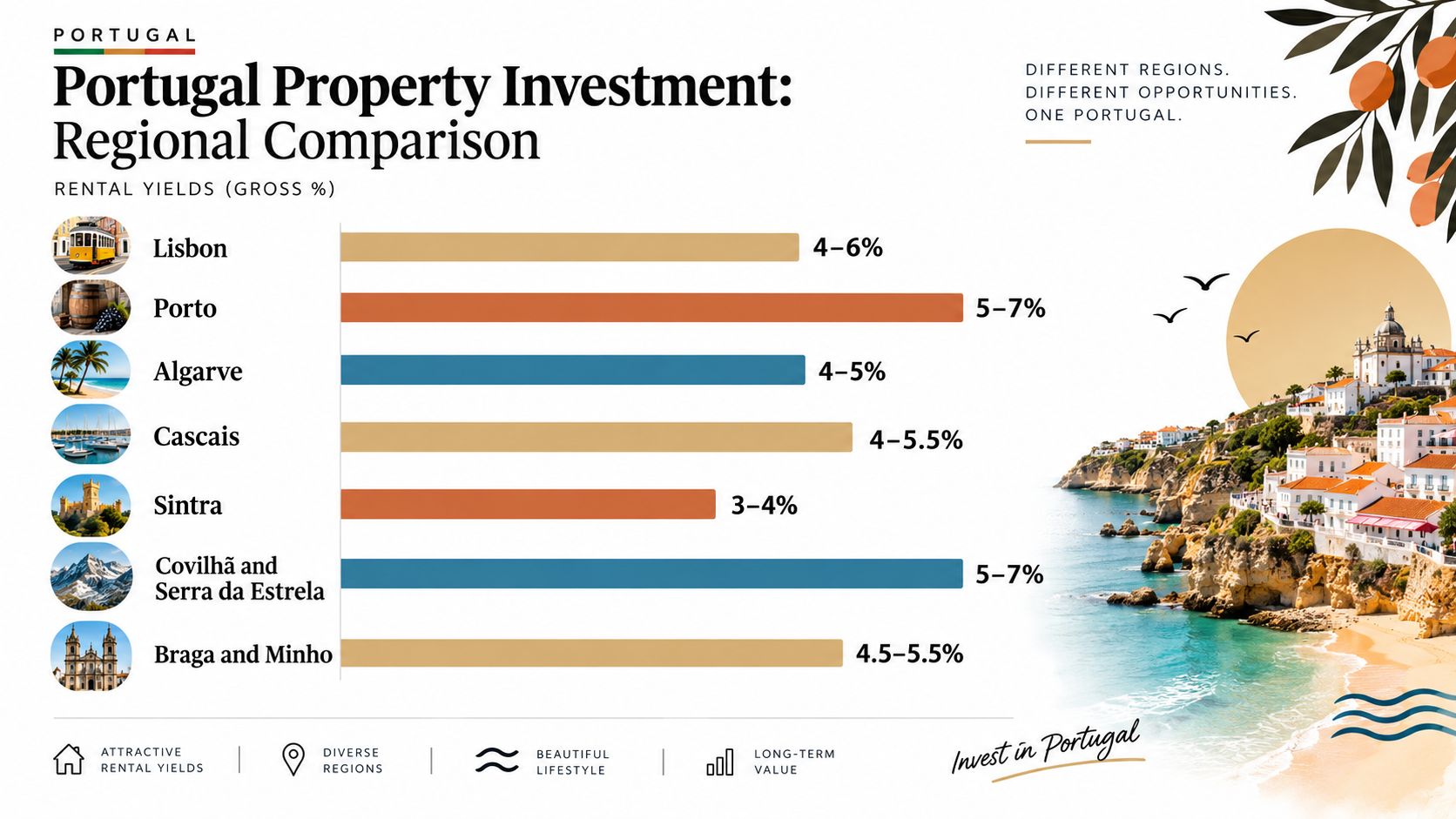
| Lisbon: Urban Investment Hub with Golden Visa Appeal | High 🔄: complex permitting, Golden Visa/legal conveyancing | High ⚡: €280k–€500k+ entry; higher management & taxes | ⭐⭐⭐📊: Reliable demand; 4–6% yields central; historic appreciation 8–12% (2015–22), now 2–4% pa | 💡: Golden Visa buyers, tourism buy‑to‑let, corporate EU presence | ⭐: Strong tourism, infrastructure, liquidity, international talent |
| Porto: Atlantic Port City with Emerging Opportunity | Medium 🔄: renovation issues in older stock but simpler regs than Lisbon | Medium ⚡: lower purchase prices; moderate renovation budgets | ⭐⭐⭐📊: Higher gross yields 5–7%; price growth 5–8% pa | 💡: Yield-focused investors, holiday‑let operators, budget-conscious expats | ⭐: Lower entry cost, strong tourism (cruise/wine), improving demand |
| The Algarve: Coastal Holiday Investment (Mature) | Medium 🔄: established processes but seasonal/regulatory limits | Variable ⚡: prime high capital (€8k–€12k/m²) or modest interior prices | ⭐⭐📊: Compressed gross yields 4–5% (net ~2–3%); long‑term steady capital growth ~2–3% | 💡: Retirees, holiday‑home owners, conservative investors | ⭐: Mature market, proven management, very high tourist volumes |
| Cascais: Lisbon Suburb with Coastal Commuter Appeal | Medium 🔄: standard conveyancing; local parking/ownership issues | High ⚡: premium prices (€5.8k–€9k/m²); moderate management | ⭐⭐⭐📊: Stable yields ~4–5.5%; steady appreciation 4–6% | 💡: Affluent expat families, remote workers, Lisbon commuters | ⭐: Coastal lifestyle, train link to Lisbon, dual tourist/professional demand |
| Sintra: Mountain Retreat with Heritage Tourism | Medium‑High 🔄: heritage rules, seasonal operations | Medium ⚡: moderate purchase costs; potential remediation/maintenance | ⭐⭐📊: Niche yields 3–4% typical; capital growth 4–6% (lifestyle premium) | 💡: Lifestyle investors, wellness/heritage tourism operators | ⭐: UNESCO heritage, differentiated premium positioning |
| Covilhã & Serra da Estrela: Interior Mountain Discovery | High 🔄: limited local infrastructure; self‑management often required | Low ⚡: very low entry prices (€800–€1,800/m²) but higher capex & marketing | ⭐⭐⭐📊: Attainable yields 5–7%; high appreciation potential (early‑stage) | 💡: Value investors, adventure/agritourism, digital‑nomad retreats | ⭐: Exceptional value, niche outdoor tourism, minimal institutional competition |
| Braga & Minho Region: Northern Heritage with Professional Demand | Low‑Medium 🔄: straightforward but smaller local market | Low‑Medium ⚡: affordable pricing; modest refurbishment budgets | ⭐⭐📊: Balanced yields 4.5–5.5%; steady 4–5% appreciation forecast | 💡: Value-focused investors, professionals tied to Porto, pilgrimage tourism | ⭐: Affordability, dual tourist/professional tenant base, regional growth |
| Portugal: National Tax, Visa & Market Summary | High 🔄: varying municipal regs and evolving STR rules | Variable ⚡: depends on region and visa path; requires professional advice | ⭐📊: Outcomes vary by region (yields 3–7%); EU market access overall | 💡: Strategic allocators, visa/tax planners, national diversification | ⭐: Diverse sub‑markets, D7/other residency routes, established conveyancing services |
Match the location to the life you will actually lead
The best place to live in Portugal depends on the life you're buying, not the destination that appears most often in lifestyle rankings. Lisbon is the strongest shortlist candidate for buyers who value liquidity, services, international tenant demand and a recognisable resale market. Its lower indicative yield than several mainland alternatives is the price of that depth, not evidence that it's a poor market.
Porto offers a more cost-conscious urban case. It suits buyers who want city amenities and a strong cultural proposition while accepting greater building-specific risk, particularly in older stock. The Algarve remains the clearest choice for an established holiday-home market, especially when personal use matters, but owners need to distinguish peak-season appeal from reliable annual net income.
Cascais is better matched to families, commuters and remote professionals who want coastal living close to Lisbon. Its premium pricing means the purchase needs to be justified by usability, tenant quality and long-term resale appeal. Sintra belongs on a different shortlist. It suits buyers who value heritage, nature and a distinctive lifestyle and can tolerate seasonality, maintenance complexity and potentially narrower liquidity.
Braga and Minho offer a regional value strategy with professional and tourist demand, but they require local research and a longer holding perspective. Covilhã and Serra da Estrela should be reserved for buyers who can manage higher operational and resale risk. A rural property can offer space and differentiation, but broadband, renovation, contractors, marketing and occupancy must be tested before purchase.
Use this decision sequence:
- Start with your resident profile: Decide whether you'll live there, commute, retire, use the home seasonally or run a rental business.
- Separate gross from net: Deduct tax, management, insurance, repairs, utilities, financing, vacancy and owner use.
- Test the exact property: Confirm transport, broadband, licensing, condominium rules, planning status and building condition.
- Compare alternatives: Put the proposed deal beside at least one city, coastal and regional option using conservative assumptions.
- Get independent advice: A Portuguese lawyer and tax adviser should verify ownership, IMT, contracts, licensing and your buyer status.
Portugal's market is attractive precisely because it offers several different answers. The right answer is the location whose costs, services, tenant demand and operational demands fit the life you'll lead.
World Property Investor publishes Portugal guides, market analyses, rental-yield comparisons and international property research for buyers assessing destinations such as Lisbon, Porto and the Algarve. Visit World Property Investor to compare markets and develop a more disciplined shortlist before you commit.