
For UK investors looking to diversify beyond the domestic market, Lisbon represents a strategic move for portfolio growth. The decision to buy a house in Lisbon, Portugal, is no longer about pursuing a niche trend; it is about accessing a resilient market underpinned by strong price growth, a robust economy, and persistent rental demand.

Understanding Lisbon's Property Market
Lisbon’s property market is no longer one of Europe's best-kept secrets. It is a mature and dynamic investment destination attracting significant global capital. Unlike the boom-and-bust cycles observed in other European capitals, Lisbon has demonstrated remarkable resilience and sustained growth.
This is not a market built on short-term speculation. The city’s appeal is anchored in solid fundamentals: a powerful tourism sector, a burgeoning tech scene attracting high-earning professionals, and an exceptional quality of life that continues to draw expatriates and digital nomads.
Capital Appreciation and Market Performance
The data provides a clear picture. Lisbon’s property prices have climbed to record highs, making it a focal point for UK buy-to-let investors seeking high-growth international assets. According to data from Portugal's National Statistics Institute (INE), by early 2026, average asking prices had reached €5,400 per square metre. This valuation turns a standard 75m² apartment into a €400,000 asset—a figure more than double that of 2015 and up approximately 48% in five years alone.
Even as the market matures, Lisbon’s 9.9% annual price growth keeps it ahead of many counterparts, offering growth that complements a UK-based portfolio. For more granular detail on Lisbon's performance, investors can consult specialist platforms like Investropa.
Key Takeaway: The sustained price growth in Lisbon is not a speculative bubble. It is a direct result of powerful, consistent demand from both international buyers and a growing local professional class, all competing for a limited supply of quality housing in the city's prime central districts.
To assess the landscape, the following table provides a snapshot of key metrics for investors.
Lisbon Property Market at a Glance (2026)
| Metric | Figure |
|---|---|
| Average Price (Central Lisbon) | €5,400 per sq. metre |
| 5-Year Price Growth | +48% |
| Average Annual Price Growth | 9.9% |
| Typical 2-Bed Apartment Cost | €400,000+ |
| Prime Rental Yield (Long-Term) | 4% – 6% |
| Prime Rental Yield (Short-Term) | 7% – 12%+ |
These figures highlight a market that delivers on both capital growth and rental returns—a combination increasingly difficult to find in other established European hubs.
Comparing Lisbon to Other European Hubs
While prime property in London or Paris can command prices upwards of €15,000 per square metre, Lisbon still offers a more accessible entry point without sacrificing growth potential. This value proposition is a core part of its appeal.
Despite its impressive price run, Lisbon remains competitive. An investor can acquire a premium asset in a highly desirable neighbourhood for a fraction of the cost of a comparable property in other major Western European cities. When this relative affordability is combined with strong rental yields, it creates a powerful formula for return on investment (ROI).
For those looking to diversify further, our guide on the top 7 emerging property investment markets offers insights into other high-growth opportunities.
Key Investment Drivers
Several key factors continue to fuel demand and support property values in Lisbon, making it an attractive prospect for long-term investors:
- The Tourism Engine: Lisbon welcomes millions of tourists annually, creating robust demand for short-term lets (known locally as Alojamento Local), especially in historic areas like Alfama and Baixa.
- A Magnet for Tech and Talent: The city has successfully cultivated a vibrant tech scene, attracting international firms and a well-paid workforce seeking high-quality rental accommodation.
- Unbeatable Quality of Life: Lisbon consistently ranks among the world's best cities for quality of life. Its favourable climate, safety, and cultural scene make it a place people desire to live, not just visit.
These elements combine to create a stable and predictable environment for property investment. Understanding these fundamentals is a crucial first step before you decide to buy a house in Lisbon, Portugal.
Selecting the Right Location: An Investor's View
When you seek to buy a house in Lisbon, Portugal, location is paramount. Tourist guides highlight charming cobbled streets, but as an investor, your perspective must be different, focusing on the fundamental drivers of growth and return.
Success is not merely about buying a great property; it is about matching a specific neighbourhood to a clear investment objective. This principle is universal, as detailed in our guide on the importance of location in real estate investment.
Lisbon's property market is a mosaic of distinct districts, each with its own character, risk profile, and potential. It includes stable, blue-chip areas and dynamic, high-growth neighbourhoods. Understanding this spectrum is key to aligning your capital with your goals, whether that is steady capital preservation or more aggressive growth and yield.
Prime and Established Markets
For investors prioritising stability, prestige, and long-term security, Lisbon’s prime neighbourhoods are the logical choice. These include the city's 'golden triangle': Chiado, Príncipe Real, and Avenida da Liberdade. These districts represent the heart of old-world Lisbon, defined by elegant architecture, high-end boutiques, and renowned restaurants.
Properties here are the most expensive in the city, often exceeding €7,000 per square metre. This price premium naturally compresses gross rental yields, which typically range between 3% and 4.5% for long-term rentals. However, lower yield is offset by lower risk and consistent capital appreciation. These are trophy assets in resilient locations, with constant demand from high-net-worth individuals and corporate tenants.
An apartment in Príncipe Real is analogous to a blue-chip stock. It offers reliable, steady growth and a queue of quality tenants, making it an ideal cornerstone for a conservative international property portfolio.
High-Growth and Emerging Neighbourhoods
For investors with a greater risk appetite in pursuit of higher returns, Lisbon's emerging districts offer significant opportunity. Neighbourhoods to the east, such as Marvila and Beato, are undergoing dramatic transformation from post-industrial zones into the city’s creative and tech hubs.
Here, the investment case is centred on future growth. Entry prices are more accessible, often in the €4,500 to €5,500 per square metre range. This provides considerable scope for capital growth as major regeneration projects and new infrastructure are completed. Rental yields are also stronger, frequently reaching 5% to 7% due to lower acquisition costs and high demand from young professionals and creatives.
The trade-off, of course, is timing. The investment relies on the successful delivery of planned urban renewal projects to unlock an area’s full potential. A prime example is the Hub Criativo do Beato, one of Europe's largest startup incubators, which is acting as a powerful magnet for growth and talent in the area.
This dynamic explains why so many international buyers are focusing on Lisbon. UK investors, for example, have become major participants. While overall foreign direct investment into Portugal dipped to €8.51 billion in 2025, a significant €3.905 billion was directed into real estate, demonstrating the sector's robust appeal according to Bank of Portugal data. As one of Portugal's largest foreign investor groups, British buyers are clearly capitalising on these growth narratives. You can read more on the UK's significant role as an investor in Portugal.
Balancing Lifestyle and Rental Demand
Beyond raw data, an investor must consider how a neighbourhood’s lifestyle appeal shapes its rental profile.
- Alfama and Graça: Famous for their historic charm, these areas are prime territory for short-term tourist lets (Alojamento Local). Premium nightly rates are achievable, but this strategy involves stricter regulations and higher seasonality.
- Avenidas Novas and Alvalade: These are more residential, family-focused districts offering excellent stability for long-term rentals. They attract local families and professionals seeking larger apartments, good schools, and parks, guaranteeing a steady tenant base.
- Cais do Sodré and Santos-o-Velho: Known for their vibrant nightlife and riverside location, these districts attract a younger demographic of expatriates and digital nomads. Demand is consistently high for both medium and long-term lets, offering a balanced rental strategy.
Ultimately, the decision to buy a house in Lisbon, Portugal, demands a detailed analysis of its diverse districts. By carefully weighing the unique risk-reward profile of each neighbourhood, you can build a targeted strategy that delivers on your investment objectives.
Navigating The Purchase Process in Lisbon
For those accustomed to the UK property market, the process to buy a house in Lisbon, Portugal, is more structured and legally driven. While not overly complex, it is different. Understanding the process from the outset is key to avoiding frustration and costly delays.
The entire journey is predicated on finalising legal and financial paperwork before making a serious offer. There are non-negotiable administrative tasks every foreign buyer must complete to operate within the Portuguese system.
Your Essential First Steps
First, you must obtain a Portuguese tax identification number, known as the Número de Identificação Fiscal (NIF). This unique nine-digit number is essential for almost every formal transaction in Portugal, from opening a bank account to signing the final property deeds. A lawyer or a specialised fiscal representative can procure this for you, often remotely.
Next, you must open a Portuguese bank account. This is a mandatory step. All funds for the purchase, including the deposit and final payment, must be transacted through a local account. It also simplifies subsequent payments for local taxes and utilities. Most major Portuguese banks are experienced in setting up accounts for non-resident UK clients.
This simple flowchart illustrates how these foundational steps initiate the purchase process.
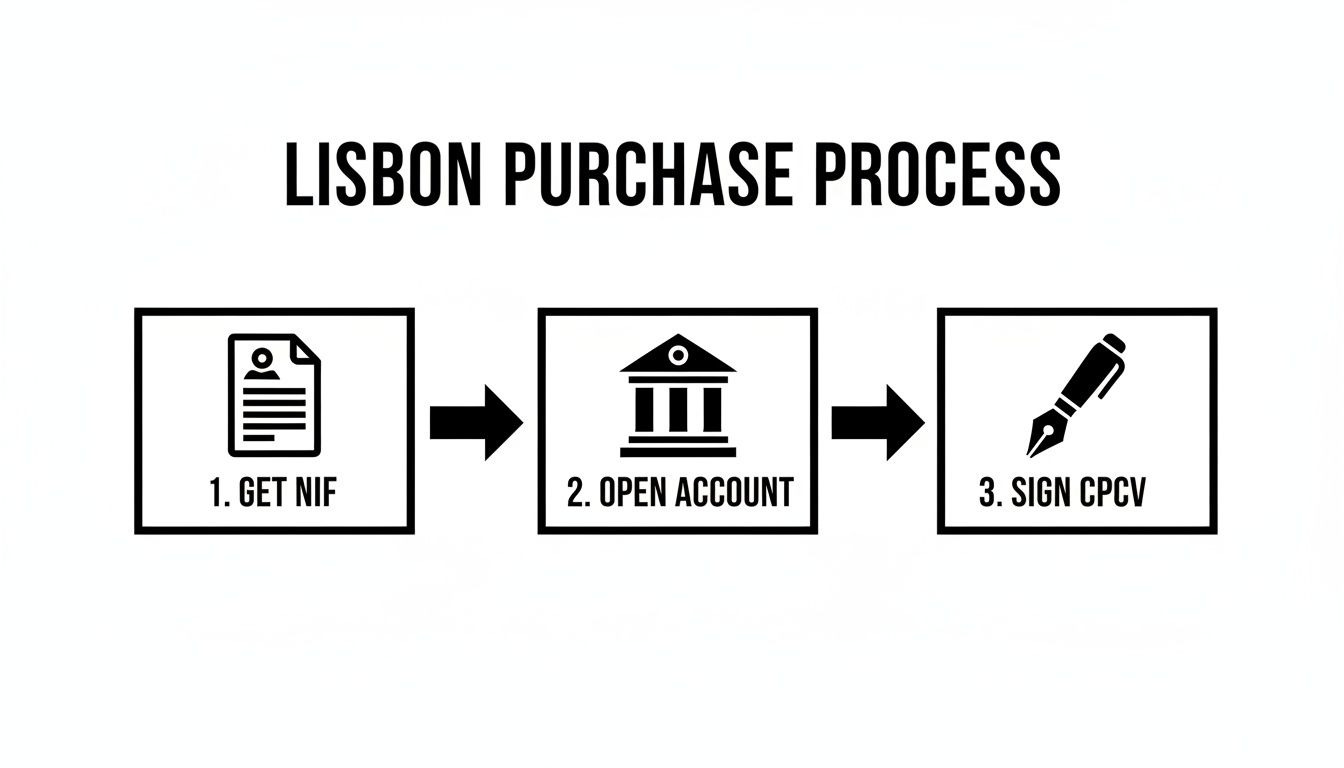
Consider these administrative tasks as prerequisites for the main process. Once complete, you are legally and financially prepared to proceed.
Assembling Your Professional Team
Unlike in the UK, where buyers may liaise directly with estate agents and conveyancers, the Portuguese system relies heavily on appointing a lawyer (advogado). The estate agent (agente imobiliário) represents the seller. Your lawyer's sole duty is to protect your interests.
Hiring an independent, multilingual lawyer is arguably the single most important decision you will make. Their role includes:
- Comprehensive Due Diligence: They will verify the property’s legal title, check for any encumbrances or mortgages tied to the property, and ensure all planning permissions and licences are in order.
- Contract Review: They will scrutinise the promissory contract and final deed, ensuring every clause is fair, legal, and in your best interest.
- Representation: With a Power of Attorney, they can act on your behalf at key signings, saving significant time and travel.
Investor Insight: Never use a lawyer recommended by the seller or their agent, as this creates a clear conflict of interest. Sourcing your own independent advogado ensures their only duty is to you and can prevent significant legal and financial issues.
Key Milestones in the Purchase Journey
Once you have found a property and had an offer accepted, the legal process begins. The first major milestone is signing the Promissory Contract of Purchase and Sale (Contrato de Promessa de Compra e Venda, or CPCV).
The CPCV is a legally binding contract that commits both you and the seller to the transaction. Upon signing, you will pay a deposit, typically 10% to 20% of the purchase price. This contract outlines all agreed terms: property details, price, and a target date for completion.
This structure provides significant security. If the seller withdraws after signing, they are typically required to pay you double the deposit. If you, the buyer, withdraw, you forfeit the deposit. This ensures commitment from both parties.
Following the CPCV signing, your lawyer completes the final due diligence. The last step is the signing of the Final Deed (Escritura Pública de Compra e Venda) at a Notary's office. The Notary is a state-appointed official who witnesses the transaction, confirms all legal paperwork and taxes are correct, and formally registers you as the new owner. Once you sign the Escritura and transfer the final balance, the property is officially yours.
While this approach may feel more formal than the UK system, it offers a high degree of investor protection. For those new to buying property abroad, our wider guide on investing in overseas property offers further insights on managing international transactions.
Financing Your Lisbon Property and Understanding the Costs

Before viewing properties, it is vital to gain a firm grasp of the financials. Securing financing and mapping out all associated costs are the two pillars that support a successful investment when you buy a house in Lisbon, Portugal.
For many UK nationals, using a Portuguese mortgage is a prudent strategy. It allows you to leverage your capital and take advantage of what remain, on the whole, favourable European interest rates. Portuguese banks are well-accustomed to dealing with foreign buyers.
Securing a Mortgage as a UK National
As a non-resident investor from the UK, you can realistically expect to secure a loan-to-value (LTV) ratio of between 60% and 70%. For a €400,000 apartment, this means you will need to provide a cash deposit of at least €120,000, or 30% of the purchase price.
The application process is thorough. Portuguese banks are data-driven and require a complete picture of your financial standing. Be prepared to compile a comprehensive file of documents.
They will almost certainly request:
- Proof of Income: Your last three to six months of payslips or audited accounts if self-employed.
- UK Tax Returns: Typically your last two years of tax returns (e.g., P60s or SA302s).
- Bank Statements: At least six months of statements from your primary UK account to demonstrate cash flow and savings.
- Credit Report: A current credit report from a major UK agency such as Experian.
- Property Details: The signed promissory contract (CPCV) and the property’s registration documents.
Engaging a specialist mortgage broker is highly recommended. They have existing relationships with lenders and can navigate the system more efficiently. A good broker knows which banks are offering the best terms for non-residents and will help present your application optimally. For a deeper dive into funding strategies, our guide on financing an investment property is a valuable resource.
Budgeting for Transaction Costs
A common oversight for first-time international buyers is underestimating closing costs. The advertised price is only the starting point. A series of non-negotiable taxes and fees must be factored into your budget.
In Portugal, these additional costs can easily amount to 8% to 10% of the property's price. Failure to account for this from the start can derail your entire financial plan.
Investor Takeaway: Never treat the purchase price as the final number. Prudent investors add a 10% contingency for closing costs to their budget. This is the simplest way to avoid a financial shortfall just before signing the final deed.
A Breakdown of the Main Costs
The following is a clear breakdown of expected costs, using a real-world scenario of a €400,000 apartment purchase to make the figures tangible.
Estimated Buyer Costs for a €400,000 Lisbon Property
This table provides an overview of the taxes and fees you should budget for when acquiring a property in Lisbon.
| Cost Item | Estimated Percentage | Estimated Amount (€) |
|---|---|---|
| Property Transfer Tax (IMT) | ~6.0% (variable rate) | ~€20,836 |
| Stamp Duty (Imposto do Selo) | 0.8% | €3,200 |
| Legal & Notary Fees | 1.0% – 2.0% | ~€6,000 |
| Mortgage-Related Fees | 0.6% (if applicable) | ~€2,400 |
| Total Estimated Costs | ~8.1% | ~€32,436 |
As illustrated, the total outlay extends well beyond the asking price.
The largest component is the IMT (Imposto Municipal sobre as Transmissões Onerosas de Imóveis). This property transfer tax is calculated on a sliding scale. For a €400,000 property, it would be approximately €20,836. Stamp Duty is simpler: a flat 0.8% of the property’s declared value.
Finally, legal and notary fees vary depending on the law firm but generally fall between 1% and 2%. In total, a €400,000 apartment purchase requires an additional cash outlay of over €32,000. Accurate budgeting for this from the outset is fundamental to a successful purchase.
Maximising Returns Through Rentals and Tax Planning
Acquiring your Lisbon property is the first step. The subsequent goal is to ensure the asset performs. A successful investment is determined by post-acquisition strategy, with rental income and tax efficiency shaping your true return.
When you buy a property in Lisbon, you have two primary rental options: long-term tenancies or short-term holiday lets, known locally as Alojamento Local (AL). Each has distinct advantages and disadvantages, influenced by market demand and evolving government regulations.
Analysing Long-Term vs. Short-Term Lets
Long-term rentals offer stability. They are ideal for tapping into Lisbon’s growing population of local professionals, families, and international tech workers. This approach ensures low tenant turnover, less intensive management, and a consistent, predictable income stream.
Conversely, the short-term AL model targets Lisbon’s large tourism market. The potential for high nightly rates, particularly during peak season, can generate significantly higher gross income. However, this route involves higher operational costs, more hands-on management, and greater exposure to regulatory risk, as the government continues to tighten rules for holiday lets in prime areas.
Investor Insight: Do not pursue headline yields without due diligence. A property in Avenidas Novas might offer a solid 5% net yield from a long-term professional tenant with minimal effort, whereas a seemingly higher 9% gross yield from a short-let in Alfama could be eroded by management fees, vacancy periods, and compliance costs.
Calculating Realistic Rental Yields
For UK and other international investors, Lisbon delivers rental yields that compare favourably to most home markets. As of March 2026, the city's average rental yield is a healthy 3.84%, but this figure masks a wide range. Yields can dip to around 2.1% in prime districts or exceed 6.02% in high-demand areas. These yields often surpass the compressed returns in many UK cities. For detailed data, you can explore the latest findings on rental returns in Lisbon.
To calculate your real return, you must progress from gross to net yield. This involves subtracting all annual operational costs from your rental income before dividing by the total acquisition cost.
These costs almost always include:
- Property Management Fees: Typically between 8% and 12% of the monthly rent.
- Condominium Fees (Condomínio): Monthly charges for building maintenance.
- Annual Property Tax (IMI): A municipal tax based on the property's registered value.
- Maintenance and Repairs: Budgeting around 1% of the property’s value annually is prudent.
- Insurance: Building and contents insurance are essential.
Only after accounting for these outgoings can you accurately assess your Lisbon investment's performance.
Understanding the Portuguese Tax Regime
As a non-resident landlord, income generated from your Portuguese property is taxed in Portugal. The current flat tax rate on rental income for non-residents is 25%.
You can typically deduct certain operational costs to lower your taxable income, including:
- The annual IMI tax payment.
- Condominium fees.
- Documented repair and maintenance costs.
The UK-Portugal Double Taxation Agreement prevents you from being taxed twice on the same income. You will declare your Portuguese rental income on your UK tax return and can generally claim a credit for the tax already paid in Portugal. Our guide can help you understand property taxes for international investors in more detail.
Effective tax management requires planning from day one. Hiring a Portuguese accountant (contabilista) is essential for ensuring compliance, optimising your tax position, and maximising the net returns from your Lisbon investment.
Common Questions from UK Investors
When buying in Lisbon from the UK, questions are inevitable due to the different legal system and property market. Here are direct answers to the most common queries from British investors, based on practical experience.
Can I Get A 'Golden Visa' If I Buy A House in Lisbon?
The answer is now simple: no, you cannot.
In late 2023, the Portuguese government removed direct real estate purchases as a qualifying option for its Golden Visa programme.
This means buying an apartment in Chiado or a villa in Cascais will not, by itself, secure residency through the Golden Visa scheme. UK investors seeking a residency permit must now explore other avenues, such as investment funds, capital transfers, or job creation in Portugal. It is vital to treat property investment and Golden Visa applications as separate endeavours.
Do I Need a Visa to Buy Property in Portugal?
No, you do not need a special visa to buy property. Portugal imposes no restrictions on foreign ownership, so as a British national, you have the same rights to buy and own property as a Portuguese citizen.
The purchase process is open to anyone, provided you adhere to the legal and financial procedures outlined in this guide.
The critical distinction is that owning a property does not automatically confer the right to live in it full-time. If you plan to stay in Portugal for more than 90 days in any 180-day period, you must apply for a long-stay visa, such as the D7 (Passive Income) or D8 (Digital Nomad) visa, from a Portuguese consulate in the UK.
Key Takeaway: Owning a Lisbon property is a straightforward investment. Living in it long-term is an immigration matter. These are two separate processes that must not be confused.
How Can I Manage My Rental Property from The UK?
The logistics of managing a rental from another country is a valid concern for absentee landlords. The most effective solution is to hire a professional property management company in Lisbon to act as your local team.
A reputable management firm will handle all operational aspects. Their services typically include:
- Tenant Sourcing and Vetting: Marketing the property and finding reliable tenants.
- Rent Collection: Ensuring timely payments and managing any arrears.
- Maintenance and Repairs: Coordinating with a network of trusted local tradespeople.
- Legal Compliance: Ensuring your property meets all local rental laws, which is crucial for short-term lets (Alojamento Local).
For this service, expect to pay a fee of around 8% to 12% of the monthly rent. While this is a cost to factor into your yield calculations, the professional oversight it provides is invaluable for a hands-off, stress-free investment.
What Are The Main Risks for UK Buyers?
While Lisbon is a stable and mature market, UK investors should be aware of specific risks. A primary risk is insufficient independent due diligence. Relying on the seller's agent or their recommended lawyer can lead to acquiring a property with hidden debts or legal issues. Always hire your own independent lawyer.
Another risk is the evolving regulation for short-term rentals. The rules for Alojamento Local (AL) licences are frequently updated, and some central Lisbon neighbourhoods have already halted the issuance of new ones. If your investment strategy depends on high-yield holiday lets, a viable long-term rental backup plan is essential.
Finally, do not overlook currency risk. Fluctuations between Pound Sterling and the Euro can impact both the final purchase cost and the value of rental income repatriated to the UK. Consulting a currency specialist to mitigate this exposure is a wise precaution.
At World Property Investor, we provide the in-depth analysis and practical guidance you need to navigate global property markets with confidence. Explore our comprehensive guides and start building your international portfolio today at https://www.worldpropertyinvestor.com.