
You’re probably looking at the Dominican Republic for the same reasons most first-time overseas buyers do. The climate is easy to understand, the lifestyle is tangible, and the property still feels attainable in a way many mature markets no longer do.
But buying a house in dominican republic isn’t a beach fantasy purchase. It’s a legal transaction in a foreign jurisdiction, with title risk, tax consequences, and market differences that matter far more than brochure photos. Buyers who do well here usually treat the purchase like a portfolio decision first and a lifestyle choice second.
For a UK investor, that discipline matters even more. The local buying process is manageable, but the primary oversight is often back home. Many generic guides explain how to sign a contract in the Dominican Republic. Far fewer explain what HMRC will expect from you afterwards, or why a seemingly minor issue like an incomplete survey can become a long-term ownership problem.
Investing in the Dominican Republic An Overview
The Dominican Republic sits in an interesting position within the Caribbean. It offers the lifestyle appeal buyers expect from the region, but with a market that is broader than a single resort strip and more varied than many smaller island jurisdictions.
That breadth matters. You’re not limited to one type of buyer, one type of tenant, or one type of exit. Some purchasers want a second home with occasional use. Others want a holiday-let in a tourism zone. Others prefer an urban residential asset tied to local demand rather than seasonal visitor flows.
The pricing also explains why international interest stays strong. A mainstream house can still cost materially less than comparable property in the UK, while premium coastal stock gives higher-budget buyers room to move up the quality curve without stepping straight into the pricing seen in more established luxury island markets.
The country also has underlying market momentum. As noted in this Dominican Republic market overview, the right way to assess an overseas purchase is to compare not just price, but depth of demand, legal enforceability, financing conditions, and exit flexibility.
Why the market attracts serious buyers
The Dominican Republic isn’t just selling sunshine. It has a large domestic economy, an active tourism sector, and multiple sub-markets that behave differently.
That gives investors optionality:
- Lifestyle buyers can focus on personal use and long-term capital preservation.
- Yield-driven buyers can target tourism-led locations where short-term rental demand is stronger.
- Defensive investors can look at the capital and established residential neighbourhoods rather than relying on holiday demand alone.
Practical rule: In the Caribbean, value comes from buying in a market with more than one demand driver. If tourism slows, you still want a credible domestic base of occupiers, buyers, lenders, and service providers.
What works and what doesn’t
What works is disciplined selection, clean title, and a clear ownership plan.
What doesn’t work is buying remotely off marketing material, assuming every coastal location behaves the same way, or treating a Dominican acquisition as if it were a turnkey UK buy-to-let. It isn’t. The opportunity is real, but so is the need for process.
Understanding the Property Market Landscape and Hotspots
Market selection drives most of the outcome. In the Dominican Republic, location shapes tenant profile, liquidity, operating complexity, and how exposed you are to tourism cycles.

The broad numbers give useful context. The market has attracted international investors, with rising demand in tourist areas such as Punta Cana and Cabarete, where beachfront condos saw 10-15% inquiry surges in 2024. National benchmarks in 2026 are cited at US$2,100-2,300 per m² for apartments and US$1,700-1,900 per m² for houses, compared with UK averages above £3,000 per m², while total financing reached US$6.28 billion by May 2024 according to Global Property Guide’s Dominican Republic price analysis.
That tells you two things. First, the market is no longer obscure. Second, pricing is still competitive enough to attract buyers who’ve been priced out of more mature coastal destinations.
Established hotspots
Punta Cana and Bávaro suit buyers who want a highly legible tourism market. Demand is easier to understand because the area is built around resort infrastructure, managed communities, and international visitor traffic. The trade-off is that stock can feel more commoditised. If your villa or house looks like ten others in the same development, rental performance and resale pricing depend heavily on management quality and ongoing presentation.
Cabarete has a different character. It appeals to buyers who want a more lifestyle-led north coast market with a recognisable expat base and activity-driven demand. Houses here often make sense for owners who value personal use alongside income rather than pure passive investment logic.
Santo Domingo is the outlier in the best sense. It isn’t a holiday narrative. It’s the capital, and that changes the investment case. Buyers here are usually targeting long-term residential demand, urban appreciation, and less reliance on tourist occupancy patterns.
A useful comparison of emerging and established international markets is available in this guide to emerging property investment markets.
Value markets and secondary locations
Not every buyer needs beachfront exposure. In practice, some of the best value sits away from the obvious resort zones.
The verified market data notes that 80% of sales range from US$70,000 to US$1.2 million, with full-size houses under US$300,000 still available in areas such as San Cristobal or Santo Domingo Este. That matters for investors who care more about entry price discipline than postcard views.
These areas won’t suit everyone. They’re less useful if your whole strategy depends on holiday lets. But they can make sense if your goal is lower acquisition cost, domestic-user appeal, or a simpler residential holding.
How to match hotspot to strategy
A buyer usually falls into one of three camps:
| Buyer type | Best fit | Main trade-off |
|---|---|---|
| Lifestyle-led owner | Cabarete, Las Terrenas, selected coastal communities | More hands-on management if rented out |
| Holiday-let investor | Punta Cana, Bávaro, resort zones | More competition from similar stock |
| Urban long-term investor | Santo Domingo | Less of the Caribbean second-home feel |
That distinction is more important than many first-time buyers realise. A house that feels perfect on a viewing trip may be poorly suited to your actual objective.
One short video can help you visualise the on-the-ground context before narrowing your shortlist.
Houses versus other asset types
For buying a house in dominican republic, the main advantage over condos is control. You’ll usually have more autonomy over layout, occupancy style, and future repositioning. The downside is operational. Houses generally require more oversight, more maintenance coordination, and closer attention to boundaries, access rights, and local compliance.
A good house in the wrong micro-location will underperform a simpler asset in the right one. In this market, the street, the surrounding inventory, and the management reality matter as much as the headline town name.
The Legal Framework for Foreign Property Ownership
Foreign ownership is straightforward in principle. The hard part isn’t whether you’re allowed to buy. It’s whether the specific property is properly documented, correctly surveyed, and transferred in a way that protects you later.

Your lawyer must be independent
This is the point many overseas buyers underestimate. The developer’s lawyer is not your lawyer. The seller’s notary is not your adviser. You need your own Dominican attorney with no economic dependence on the other side of the transaction.
That lawyer’s job isn’t ceremonial. They check title history, seller authority, debts attached to the property, and whether what you think you’re buying matches what sits on the register.
If you’re unfamiliar with overseas acquisition structure, this practical guide to buying property abroad is a helpful framework for building the right advisory team before money moves.
Why the deslinde matters
The deslinde is one of the most important local concepts to understand. In simple terms, it is the survey and boundary demarcation that confirms the land has been properly defined and recorded.
That sounds technical, but the practical issue is simple. If boundaries are unclear, future disputes become more likely. That can affect resale, financing, inheritance administration, neighbouring claims, and even your basic confidence that the house and land correspond to the legal file.
For houses, especially detached homes, rural plots, and beachfront property, this isn’t a box-ticking exercise. It’s core risk control.
Restrictions and local realities
The legal system also has location-specific sensitivities. Coastal land deserves extra scrutiny because proximity to the shore can trigger public-access and use restrictions. Homes marketed as “beachfront” sometimes sound simpler in sales material than they look in legal review.
A prudent foreign buyer should assume that every attractive site needs verification in four areas:
- Title quality. Clean ownership history and enforceable transfer.
- Survey status. Properly documented boundaries.
- Access rights. Roads, easements, and practical entry.
- Community rules. If the house sits in a gated development, the bylaws matter.
Investor’s view: The safest purchase is rarely the one with the most persuasive sales pitch. It’s the one with the clearest paperwork.
What experienced buyers avoid
Seasoned international buyers usually avoid three things.
- Unclear representation. If one adviser claims to be acting for everyone, step back.
- Informal assurances. Verbal statements about future permissions, beach access, or easy title correction aren’t enough.
- Pressure to move before legal review. Urgency is common in property sales. It should never outrun due diligence.
A legally secure purchase often feels slower than a casual one. That’s a feature, not a flaw.
Your Step-by-Step Guide to the Purchase Process
The Dominican process is manageable if you treat it as a sequence and refuse to skip any link in the chain.
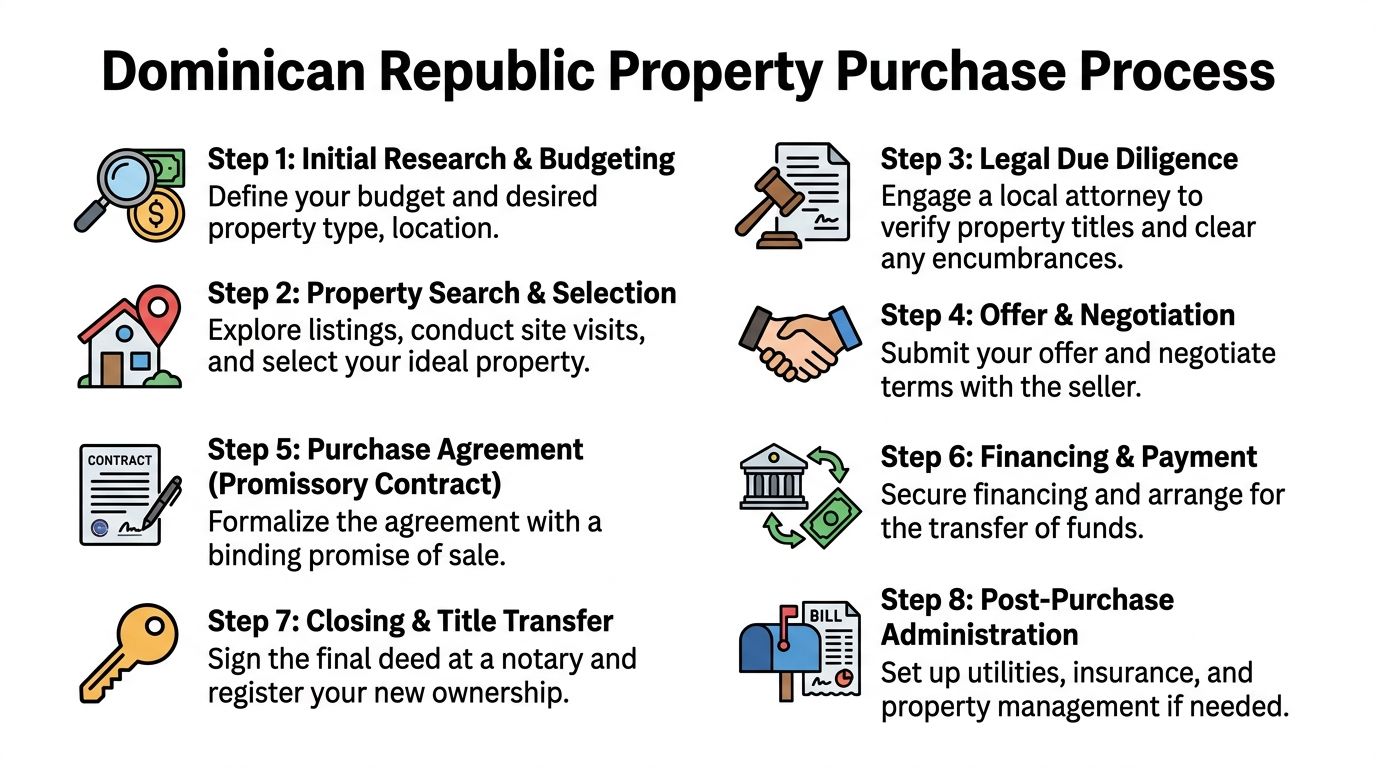
According to DR Listings’ guide to buying property in the Dominican Republic, title defects can affect up to 30% of transactions, an independent Dominican attorney typically charges 1-1.5%, a 10% deposit is standard at the Promise of Sale stage, the buyer pays a 3% transfer tax, and properly guided closings can take 30-45 days. The same source notes the 60m public beach buffer as a frequent legal issue in coastal transactions.
Step 1 Research the area before viewing stock
Don’t start with a listing. Start with the strategy.
A buyer looking for a family-use villa with occasional rentals should inspect different locations from someone seeking a purely income-producing house. The same applies to management model, community rules, and resale audience.
Before viewing, define:
- Purpose. Personal use, rental income, or a hybrid.
- Holding period. Short-term flip logic is far weaker than long-term ownership discipline.
- Operational tolerance. Some buyers want a staffed, serviced environment. Others are comfortable with a more independent house.
Step 2 Make the offer carefully
Offers are often made verbally or in simple written form. That’s normal. It doesn’t mean the transaction is informal.
At this stage, the main objective is to agree the broad commercial terms while keeping legal review fully open. Don’t let enthusiasm for a house turn into premature commitment.
Step 3 Appoint your attorney before signing anything binding
Your lawyer should be engaged immediately after terms are broadly accepted. That’s when proper work begins.
They should review title, obtain the relevant no-debt documentation, verify the survey position, and investigate whether there are encumbrances or transfer obstacles.
Step 4 Review the Promise of Sale properly
The Promise of Sale is the binding agreement that sets the purchase terms, default provisions, representations, and completion mechanics. Through this agreement, many foreign buyers become locked into a transaction they haven’t fully understood.
The 10% deposit is standard, but the amount matters less than the drafting. Your protections depend on what the contract says about title issues, defects, timing, and seller obligations.
Never treat the Promise of Sale as a holding form. In practical terms, it is the deal.
Step 5 Complete due diligence before releasing confidence, not just funds
This stage is where disciplined buyers separate themselves from hopeful ones.
Your attorney should verify at minimum:
- Registered title. The seller must have legal power to sell.
- No-debt status. Liens, mortgages, or unpaid obligations need to be identified.
- Deslinde survey. Boundaries must be clear and recorded.
- Spousal and ownership authority. If signatures are required from a spouse or another rights holder, get them.
- Condominium or community standing. For houses inside organised developments, fee status and community compliance matter.
If the property is coastal, insist on extra scrutiny around maritime-zone restrictions and practical use rights.
Step 6 Prepare for closing logistics
A smooth deal can still stumble on administration. If you’re buying from the UK, document collection and payment execution need planning.
Most foreign buyers should organise:
| Item | Why it matters |
|---|---|
| Passport and secondary ID | Required for buyer identification |
| Power of attorney if remote | Allows signing and registration without travel |
| Traceable transfer route | Reduces payment-risk disputes |
| Written closing statement | Confirms who pays what and when |
Remote purchases can work, but they only work well when authority documents and payment instructions are settled early.
Step 7 Sign the final Deed of Sale and pay the tax
Once due diligence clears, the parties sign the final Deed of Sale before a notary. The balance is paid, and the transfer tax becomes payable.
This is the stage many first-time buyers emotionally describe as “completion”. Legally, it still isn’t the end.
Step 8 Register the title in your name
Registration is what makes ownership enforceable. Until the transfer is properly recorded at the Registro de Títulos, your practical control is incomplete.
That’s why experienced advisers watch registration just as closely as contract signing. A house isn’t safely “yours” because the keys changed hands. It becomes secure when the register reflects the new ownership correctly.
Common process mistakes
The failures are usually predictable.
- Using the seller’s lawyer creates obvious conflicts.
- Assuming beachfront means unrestricted leads to unpleasant surprises.
- Treating registration as admin is one of the most expensive misunderstandings in overseas property buying.
For buying a house in dominican republic, the process isn’t difficult. It’s entirely unforgiving of shortcuts.
Calculating Costs Financing and Investment Returns
The purchase price is only the first number that matters. The more important question is what the house costs to acquire, hold, operate, and eventually sell.
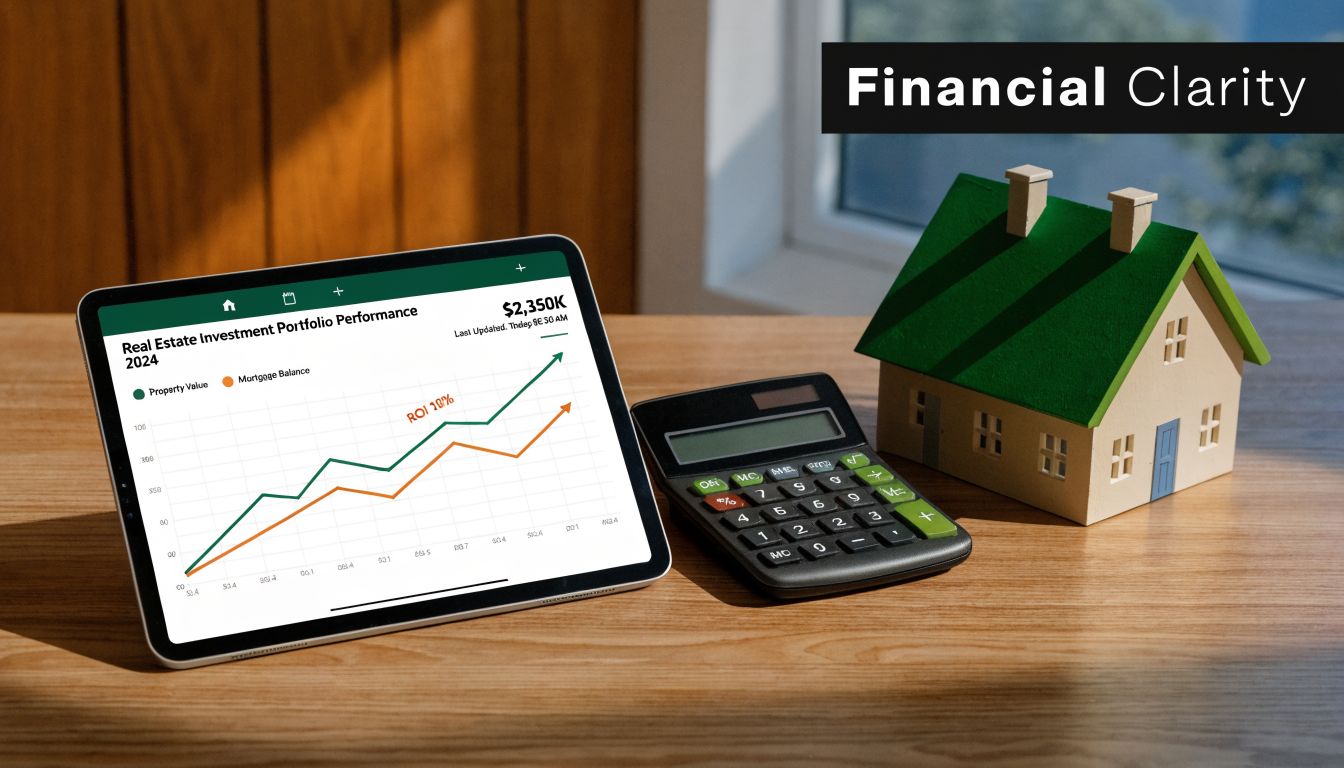
As of early 2026, a typical 3-bedroom house has a median price of US$300,000-360,000, while 80% of sales sit between US$70,000 and US$1.2 million. In 2025, the national average sale price was US$329,394 at US$2,070 per m², up 4.04% year on year, and total house purchase loans reached US$6.28 billion in May 2024, a 15.6% annual increase, according to The Lat Investor’s Dominican housing price report.
Build your acquisition budget properly
At acquisition, focus on the full stack of costs rather than just the asking price.
You should expect to budget for:
- Transfer tax. The buyer pays 3%.
- Legal fees. Your attorney typically charges 1-1.5%.
- Notarial and administrative costs. These are additional and should be listed clearly before closing.
- Registration-related expenses. Small in comparison with the purchase price, but still part of the closing file.
If you don’t map these costs in advance, your return assumptions are distorted from day one.
Financing is available, but cash still dominates
Local mortgage markets have developed, and the growth in house-purchase lending shows more financing activity than many overseas buyers assume. Even so, many foreign acquisitions are still structured with cash.
That creates a practical divide.
Cash buyers can usually move faster and negotiate from a cleaner position.
Financed buyers need to check not just rate and loan terms, but also how the lending process fits with title review, valuation standards, and closing timing.
How to think about returns
Headline yield is easy to overstate. Net return is what matters.
For a Dominican house, a sensible underwriting model should subtract:
- Management costs
- Insurance
- Repairs and maintenance
- Vacancy or unused periods
- Community or service charges where relevant
- Tax leakage in both jurisdictions
For a more detailed framework, this guide on how to calculate return on investment property is a useful benchmark for comparing overseas deals on a like-for-like basis.
The best-looking gross yield often belongs to the hardest asset to operate. Houses with gardens, pools, staff, and coastal wear can earn well, but they also demand more.
ROI is operational, not just market-driven
Two houses bought at the same price can perform very differently depending on management and presentation. That’s especially true if you plan to resell into the international-buyer market later.
A polished, well-positioned house almost always has an advantage. If you’re thinking ahead to exit strategy, even a simple guide to the cost of staging a home can help frame how presentation affects buyer perception when you eventually bring the property back to market.
A practical framework for comparing deals
Use four filters before you buy:
| Filter | Question to ask |
|---|---|
| Entry price | Is this house priced sensibly for its micro-location and condition? |
| Operating burden | How much oversight will it require from abroad? |
| Income realism | Does the rental case still work after management and upkeep? |
| Exit depth | Who is the likely future buyer? |
That last point is often overlooked. A house with broad appeal to both local and foreign buyers is usually easier to exit than a highly personalised trophy property.
UK Tax Obligations and Avoiding Common Pitfalls
Many British buyers make mistakes. They focus extensively on the Dominican purchase and hardly at all on the UK consequences.
If you’re UK tax resident, overseas property income doesn’t sit outside HMRC’s reach because the house is in the Caribbean. It follows you home, into your tax return, your capital gains calculations, and potentially your estate planning.
The verified UK-focused guidance is clear. UK investors must declare Dominican rental income to HMRC, where it can be taxed at up to 45%. The UK-DR treaty allows credit for Dominican withholding taxes of 10-27%, but incomplete claims are a common problem. On sale, UK Capital Gains Tax at 18-28% can apply alongside 27% Dominican gains tax, and the asset may fall into your worldwide estate for 40% inheritance tax above the £325k threshold, as outlined in this UK tax summary for Dominican property buyers.
Rental income is a UK reporting issue, not just a local one
Many overseas owners think local deductions or withholding settle the matter. They don’t.
You still need proper records for rental receipts, deductible expenditure, and any local tax already suffered if you want to claim relief accurately in the UK. Sloppy records can mean you overpay, under-claim treaty relief, or create avoidable compliance issues later.
If you’re working through cross-border structuring questions, this overview of strategies to avoid double taxation is a useful starting point before you speak to a UK tax adviser.
Capital gains need planning before purchase, not at exit
The eventual sale creates a second layer of complexity. The wrong assumption is that gain is taxed once, in one place, and sorted.
In practice, the interaction between Dominican tax, UK CGT, relief availability, acquisition documentation, and ownership structure needs to be considered well before you buy. If you leave it until disposal, your options are narrower.
For wider context on disposal planning, this guide to capital gains tax on foreign property is worth reviewing.
A foreign property purchase is not just a property decision. For a UK resident, it is also a tax-reporting decision from day one.
Inheritance tax is often the hidden risk
This point gets neglected because it isn’t urgent until it suddenly is. A Dominican house can still sit inside your worldwide estate for UK inheritance tax purposes.
For high-net-worth families, that means ownership form, succession planning, wills, and family-use arrangements should be aligned early. Don’t assume the fact that the asset is offshore makes it ring-fenced from UK estate exposure.
Common mistakes that cause trouble on the ground
The tax issues are one side of risk. The practical ownership mistakes are the other.
The most common ones are familiar:
- Ignoring community documents. A house in a gated project may come with rules on rentals, pets, use, alterations, and fees.
- Underestimating remote management. Distance magnifies every small maintenance issue.
- Buying pre-construction without hard legal review. Approved plans, land title, developer credibility, and payment protections matter more than showroom finishes.
- Confusing strong demand with easy operations. A busy tourist area can still be a difficult asset to run well.
The sensible UK approach
For British buyers, the strongest approach is simple.
Use a Dominican property lawyer for the local transaction. Use a UK tax adviser for UK reporting and structuring. Make sure they are each looking at the same facts, not separate versions of the deal.
That’s how you avoid paying for the same mistake twice. Once in the Dominican Republic, and again to HMRC.
Post-Purchase Strategy and Your Investor Checklist
The acquisition is only the opening move. The long-term result depends on how the house is run after completion.
A well-bought property can still disappoint if the management is weak, the maintenance response is slow, or the owner never sets clear rules for personal use versus rental use. That’s especially true when the owner is based in the UK and the house is in a coastal climate that punishes neglect quickly.
What to organise immediately
After purchase, focus on the operating basics first.
- Property management. Choose a manager with local presence, not just a marketing website.
- Utilities and bill payment. Make sure accounts, payment authority, and arrears risk are fully mapped.
- Insurance. Check that the policy matches actual use, especially if the house will be rented.
- Document storage. Keep certified copies of title, contracts, tax records, and survey documents in both local and UK files.
Think about the exit before you need it
The best owners manage with resale in mind. They keep paperwork clean, document improvements, and avoid casual alterations that complicate a future sale.
A house that can be explained clearly is easier to refinance, easier to sell, and easier to pass on. That includes legal documents, community standing, tax records, and practical maintenance history.
Buy for enjoyment if you want to. Manage for exit even if you don’t plan to sell soon.
A concise investor checklist
Use this as a final sense-check before committing:
- Strategy defined. You know whether this is lifestyle-led, income-led, or mixed.
- Location matched to objective. You aren’t buying a tourism asset for a residential strategy, or the reverse.
- Independent lawyer appointed. No conflicts. No shortcuts.
- Title and survey verified. Especially for detached or coastal houses.
- Total acquisition cost modelled. Not just the purchase price.
- UK tax advice taken. Rental, capital gains, and estate exposure understood.
- Management plan agreed. Someone local is accountable after closing.
- Exit path considered. You know who the likely future buyer will be.
Buying a house in dominican republic can be a very sensible move for a UK investor. The value can be compelling, the market is broad enough to give choice, and the ownership process is workable. The buyers who do best are the ones who stay calm, verify everything, and treat every stage. From search to tax filing. As part of one investment decision.
If you’re comparing overseas markets and want country-by-country guidance grounded in real investment mechanics, World Property Investor offers practical research on where to buy, how to assess risk, and what to watch before committing capital abroad.