
For UK residents investing in overseas property, understanding your tax obligations is a fundamental requirement. The core principle is straightforward: as a UK resident, you are generally liable for UK tax on your worldwide income and gains.
This means any profit realised from the sale of an overseas property is potentially subject to UK Capital Gains Tax (CGT), irrespective of the property's location.
Your Guide to UK Tax on Overseas Property
Navigating international property investment demands a clear understanding of tax obligations, both in the UK and in the jurisdiction of your asset. For UK residents, HM Revenue & Customs (HMRC) requires the declaration of profits from worldwide assets. This guide provides a practical breakdown of how this applies to foreign property, clarifying how your personal circumstances and the property's specifics determine your final tax liability.
Successful global property investment is built on prudent financial planning, not just identifying high-yield markets. For a deeper analysis of location selection, our guide on investing in overseas property offers further actionable insights.
The Basics of UK CGT for Global Investors
When you dispose of a foreign property for a price higher than its acquisition cost, the resulting profit is a 'capital gain'. Your liability for UK CGT is determined by several key factors that form the basis of your tax calculation.
- Your Residency Status: Being a UK resident is the primary trigger for taxation on your worldwide gains.
- Property's Location: While the gain is taxed in the UK, the property's location introduces local tax laws and the potential application of double taxation treaties.
- Available Reliefs: You may be able to reduce or eliminate your UK tax liability through specific reliefs, such as Private Residence Relief, if the property served as your main home.
Establishing these elements correctly is the first step toward accurate tax reporting and avoiding significant penalties. The objective is to ensure compliance while making informed decisions that support your long-term investment strategy.
To clarify these foundational points, the table below provides a concise summary.
UK CGT on Foreign Property: Key Concepts at a Glance
This table summarises the foundational principles for UK residents selling an overseas property, providing a quick reference for the key factors involved.
| Concept | Explanation for UK Residents |
|---|---|
| Worldwide Taxation | As a UK resident, you are taxed on your global income and gains, including profits from overseas property sales. |
| Residency is Key | Your UK residency status is the primary factor that determines your liability for CGT on foreign assets. |
| Local Taxes Matter | The country where the property is located may also tax the gain, which can lead to double taxation issues. |
| Reliefs and Allowances | UK tax rules, including the annual exempt amount and reliefs like Private Residence Relief, apply to foreign property gains. |
| Double Taxation Treaties | The UK has agreements with many countries to prevent you from being taxed twice on the same gain. |
Understanding these core concepts ensures you have a solid footing before diving into the more detailed calculations and reporting requirements.
Navigating the Annual Exempt Amount
A crucial component of your calculation is the annual exempt amount (AEA), which represents the threshold of profit you can make in a tax year before any CGT is due. This allowance has been significantly reduced in recent years, a policy change with major implications for investors.
According to Gov.uk data, the annual exempt amount was reduced from £12,300 to £6,000 for the 2023/24 tax year. It was reduced again to just £3,000 for the 2024/25 tax year, bringing a far greater number of investors with smaller gains into the CGT net.
For residential property, any gain exceeding this minimal threshold is taxed at 18% for basic rate taxpayers or 28% for higher rate taxpayers. These reductions mean that even modest profits from selling a foreign property are now highly likely to trigger a UK tax liability.
How to Correctly Calculate Your Capital Gain
Calculating your taxable gain involves more than subtracting the purchase price from the sale price. For foreign property, UK investors must be precise, particularly when managing currency conversions and identifying allowable deductible costs. A correct calculation is essential for HMRC compliance and ensures you do not overpay tax.
The fundamental calculation is straightforward. You begin with the sale proceeds and then subtract the legitimate costs associated with acquiring, improving, and selling the property.
The Calculation Formula:
Sale Proceeds – (Acquisition Costs + Allowable Expenses) = Taxable Gain
This provides the gain in the local currency. However, for HMRC purposes, every figure in this calculation must be converted into Pound Sterling, a critical step where complexities can arise.
This diagram illustrates how owning a foreign property creates a UK tax liability.
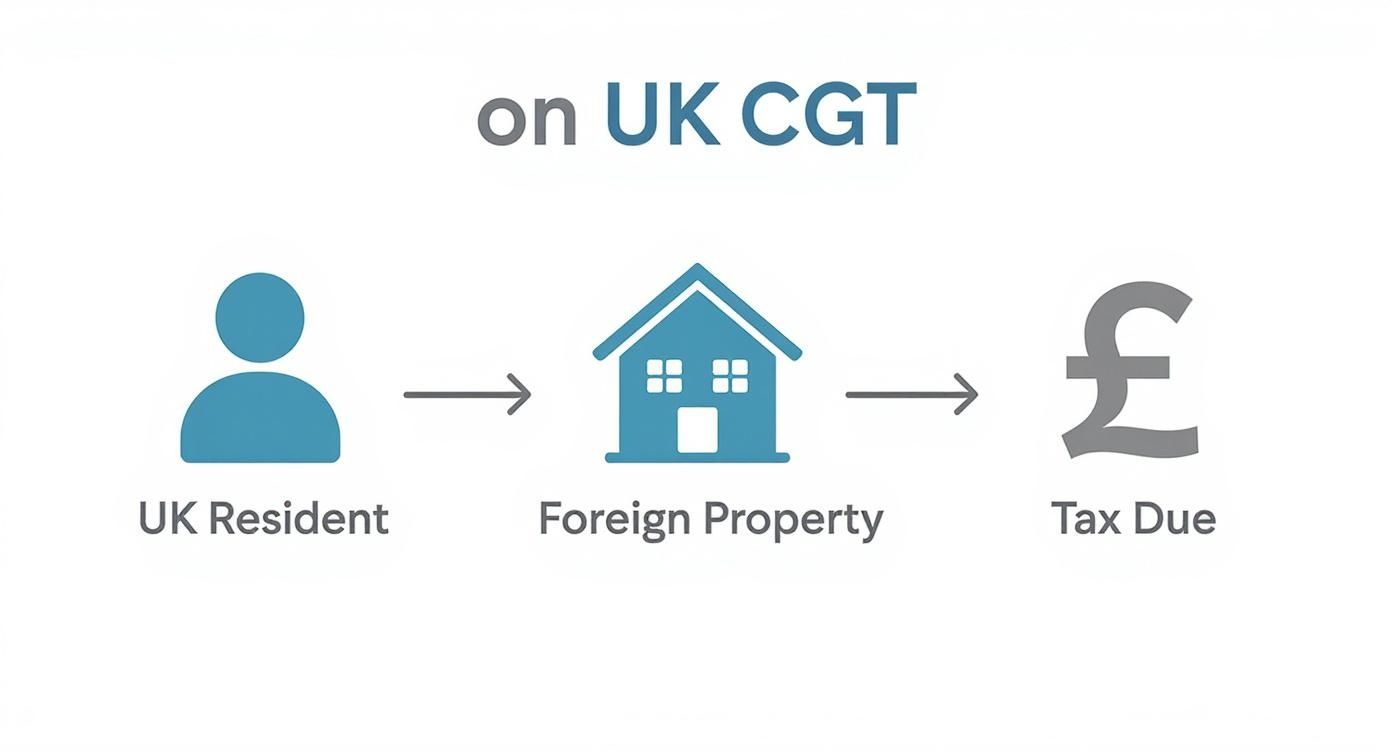
As shown, the final stage always involves converting all figures to Sterling, making currency exchange an indispensable part of the process.
Step 1: Identifying Allowable Costs And Expenses
First, you must collate all costs that HMRC permits to be offset against your gain. These are the expenses that directly reduce your profit and, consequently, your tax bill. They represent the legitimate costs of buying, improving, and disposing of your asset.
Common allowable expenses include:
- Acquisition Costs: The original purchase price of the property, plus associated legal fees, stamp duty (or its local equivalent), and survey costs incurred at the time of purchase.
- Capital Improvement Costs: Expenditure that genuinely enhances the property, such as constructing an extension, adding a swimming pool, or installing a new central heating system. It is important to note that routine maintenance and redecoration do not qualify.
- Disposal Costs: Fees paid during the sale of the property. Common examples include estate agent commissions, auctioneer fees, advertising costs, and legal fees related to the sale.
Maintaining meticulous records of all such expenses is non-negotiable. Without receipts and invoices to substantiate your claims, HMRC can disallow them, thereby increasing your taxable gain and tax liability.
Step 2: Converting All Figures to Pound Sterling
This is a step that frequently presents challenges for investors. HMRC requires that all figures—the purchase price, improvement costs, and the final sale price—are converted into Pound Sterling. Crucially, you must use the exchange rate effective on the exact date each transaction occurred.
You cannot simply use the exchange rate on the date you file your tax return. You must source the historical exchange rate for the day you acquired the property, the day you paid for capital improvements, and the day the sale proceeds were received.
This means that currency market fluctuations can themselves create a taxable gain or a loss. If the pound has weakened against the local currency between the purchase and sale dates, your gain in Sterling could be significantly larger than it appears in the local currency, even if the property's value has not changed substantially.
A Practical Example of Calculating The Gain
Let's illustrate with a clear example. A UK resident purchased an apartment in an emerging market a decade ago and has recently sold it. This market has shown strong capital appreciation, but local yields have remained moderate.
- Purchase (2014): An apartment was acquired for €200,000. On the completion date, the GBP/EUR exchange rate was £1 = €1.25. In Sterling, the purchase cost was £160,000.
- Improvements (2018): €25,000 was spent on a new kitchen. The exchange rate on the payment date was £1 = €1.15. In Sterling, this cost £21,739.
- Sale (2024): The apartment was sold for €300,000. On the sale date, the exchange rate was £1 = €1.18. The sale proceeds in Sterling were £254,237.
Now, we combine these figures to determine the taxable gain:
- Total Costs in Sterling: £160,000 (purchase) + £21,739 (improvements) = £181,739
- Gross Gain in Sterling: £254,237 (sale) – £181,739 (total costs) = £72,498
This figure of £72,498 is your capital gain before applying any tax-free allowances or reliefs. Executing these steps correctly is vital not only for tax compliance but also for accurately assessing the investment's performance. For a better understanding of performance metrics, you can learn more about how to calculate return on investment (ROI) for real estate in our dedicated guide.
Understanding Your Residency and Domicile Status
For HMRC purposes, your personal tax status is the starting point for determining your liability on foreign property. Two distinct but often confused terms are central to this: residency and domicile. A clear understanding of both is fundamental for any global property investor.
Simply put, your residency is determined by where you physically live and spend your time during a given tax year. If you meet the criteria of the UK’s Statutory Residence Test, HMRC classifies you as a UK resident. For most individuals, this means your worldwide gains—including profit from the sale of property in Turkey or France—are within the scope of UK Capital Gains Tax (CGT).
Domicile, by contrast, is a more permanent and complex legal concept. It refers to the country you consider your permanent home, the place to which you have deep-rooted and substantial connections. It is entirely possible to be a UK resident for many years while remaining domiciled elsewhere. This status can provide access to a different set of tax rules.
The Role of Domicile and the Remittance Basis
For UK residents who are not domiciled in the UK ('non-doms'), a special tax regime known as the remittance basis of taxation may be available. This can be a powerful tool for managing tax on foreign property gains, although the rules have become increasingly stringent.
The remittance basis effectively creates a shield around your foreign income and gains. As long as the proceeds from selling an overseas property remain outside the UK—meaning you do not 'remit' them or bring them into the country—they may fall outside the scope of UK CGT.
This allows non-domiciled individuals to defer or avoid UK tax on foreign gains, provided the funds are not used or enjoyed in the UK. However, accessing this basis is not automatic and may involve a significant annual charge for long-term UK residents.
Understanding the various property taxes you may face is a key part of international investment. You can find out more in our detailed guide to understanding property taxes for investors.
What About Non-UK Residents?
The tax landscape for non-UK residents selling UK property has changed significantly. A major policy shift occurred in April 2015, when Capital Gains Tax was extended to cover the disposal of UK residential property by non-residents. Previously, non-residents were generally exempt from CGT on UK property sales. The impact was immediate: in the first full tax year, HMRC collected approximately £100 million in CGT from non-residents, a figure that has grown with improved reporting. You can discover further insights on UK tax policy changes from PwC to learn more.
This underscores the importance of correctly establishing your status for each tax year. Your liability for capital gains tax on foreign property is directly linked to whether HMRC considers you a UK resident for the specific year in which you dispose of the asset.
Ultimately, your residency and domicile status are not mere administrative details. They are the core determinants of how your global assets are taxed. For expatriates and international investors, seeking professional advice on this matter is essential for compliant and effective financial planning.
Using Double Taxation Treaties to Your Advantage
A primary concern for any global property investor is the risk of being taxed twice on the same profit—once in the country where the property is located, and again in the UK.
Fortunately, a critical instrument of international tax law exists to prevent this: the Double Taxation Agreement (DTA). The UK has an extensive network of such treaties with over 130 countries, all designed to eliminate double taxation.
These agreements establish a framework for determining which country has the primary right to tax and provide mechanisms to ensure you do not pay tax on the same gain twice. For UK residents selling foreign property, the key provision within these treaties is Foreign Tax Credit Relief (FTCR).
Understanding this relief is fundamental to managing your total liability on the capital gains tax on foreign property.
How Foreign Tax Credit Relief Works
Foreign Tax Credit Relief can be thought of as a credit against your UK tax liability. Any capital gains tax you have already paid to a foreign tax authority on the property sale can be directly offset against the amount owed to HMRC.
This system ensures you ultimately pay tax at the higher of the two countries' rates, not a cumulative total of both.
The core principle is simple: the tax paid abroad acts as a credit against your UK CGT liability. If the foreign tax is lower than the UK tax, you pay the difference to HMRC. If the foreign tax is higher, your UK liability on that gain is typically reduced to zero.
This is essential for investors with portfolios across different jurisdictions, from established European markets like Germany to high-growth emerging economies in Southeast Asia. Before investing, it is prudent to review the specifics of the DTA between the UK and the target country, as terms can vary. You can explore our breakdown of the best countries to invest in property to see how these factors influence different markets.
A Practical Example of Claiming Relief
Let’s apply this to a real-world scenario. A UK resident has just sold a holiday apartment in Spain, realising a significant capital gain.
- Your UK CGT Liability: After calculating the gain in Pound Sterling and applying UK allowances, your UK Capital Gains Tax liability is determined to be £8,000.
- Spanish CGT Already Paid: You have already settled the equivalent of £5,000 in capital gains tax with the Spanish tax authorities on the same disposal.
- Claiming FTCR: You can now claim a foreign tax credit for the £5,000 paid in Spain.
The calculation to determine your final UK tax bill is as follows:
£8,000 (Original UK CGT) – £5,000 (Spanish CGT paid) = £3,000 (Final tax payable to HMRC)
Without the DTA, the total tax paid would have been £13,000. The treaty caps your total tax liability across both countries at £8,000—the higher of the two tax rates.
Claiming Foreign Tax Credit Relief: A Simplified Example
To further clarify, the table below demonstrates the calculation for a UK resident selling a Spanish property and offsetting the tax paid.
| Calculation Step | Amount (£ Sterling) | Notes |
|---|---|---|
| Calculated UK CGT Liability | £8,000 | The total CGT due to HMRC before any reliefs are applied. |
| Foreign Tax Paid (Spain) | £5,000 | The amount of CGT already paid to the Spanish tax authority. |
| Foreign Tax Credit Claimed | (£5,000) | The amount of foreign tax you can offset against your UK bill. |
| Final UK CGT Payable | £3,000 | The remaining balance owed to HMRC after the credit is applied. |
This example demonstrates the significant financial benefit of Foreign Tax Credit Relief in reducing your final tax bill.
It is vital to retain official documentation proving the payment of foreign tax. HMRC will require this evidence when you make your claim via your Self Assessment tax return. Understanding these treaties is not just good practice; it is a fundamental component of a successful international property investment strategy.
Reporting and Paying UK Capital Gains Tax
Maintaining compliance with HM Revenue & Customs (HMRC) is a non-negotiable aspect of any successful investment strategy. After calculating the gain on your foreign property, the next step is to report it correctly and pay any tax due on time. Failure to do so can lead to interest charges and penalties that erode your investment returns.
For UK residents, there are two primary methods for reporting: the ‘real time’ Capital Gains Tax service or the annual Self Assessment tax return. Determining the appropriate route is key to meeting your obligations and avoiding compliance issues. The correct method typically depends on whether you already file a tax return and the type of asset sold.
Reporting via the Real Time CGT Service
For many investors, the most direct method for reporting a gain is through HMRC's dedicated online service. This system is designed for individuals who do not normally file a Self Assessment tax return but need to report a one-off gain.
The primary advantage of this service is its speed and simplicity. It allows you to report the gain and pay the tax shortly after the sale, rather than waiting until the end of the tax year. This facilitates better cash flow planning and reduces the risk of overlooking the liability.
This method is particularly suitable if you are not self-employed and have no other complex tax affairs that mandate a full Self Assessment return. However, the deadlines are strict and require prompt action.
Critical Deadlines You Cannot Miss
When dealing with HMRC, timing is critical. The reporting window for gains on overseas residential property is particularly tight and requires immediate attention following the completion of a sale.
- For UK Residential Property: You must report and pay any CGT due within 60 days of the completion date.
- For Foreign Residential Property: This same 60-day window applies if you are a UK resident selling an overseas home.
- For Other Assets: For gains on other assets, such as non-residential property, the standard Self Assessment deadline of 31 January following the tax year of the sale applies.
Missing the 60-day deadline can result in automatic penalties, making it imperative to begin the reporting process as soon as your foreign property sale is finalised.
Reporting Through Self Assessment
If you already file a Self Assessment tax return annually—for reasons such as being self-employed or having rental income—you must report your foreign property gain via this method. You will need to complete the capital gains summary pages (SA108) as part of your annual return.
The deadline for this is 31 January following the end of the tax year in which the property was sold. For example, if you sold a property in June 2024 (within the 2024/25 tax year), your deadline to report and pay the CGT would be 31 January 2026. This provides a significantly longer timeframe compared to the real-time service, but you must be registered for Self Assessment.
Accurate reporting is just one piece of the puzzle; our broader collection of investment guides can help you with other aspects of building a global portfolio.
Keeping Records for a Foreign Property Sale

In matters of tax, especially concerning the capital gains tax on foreign property, meticulous record-keeping is your most critical defence. It is not merely an administrative task but the construction of a robust, defensible case for your tax calculations from the outset.
Throughout the period of ownership, you must maintain a comprehensive paper trail. This financial archive is essential for calculating your CGT liability accurately and, crucially, for substantiating every figure you report. HMRC can initiate an enquiry years after a sale, and vague recollections or missing documentation will be insufficient.
Your Essential Document Checklist
To calculate your gain correctly and satisfy HMRC requirements, you must retain a clear record of every transaction related to the property. These documents form the basis of your CGT return and justify your allowable costs. Without them, your deductions may be disallowed, potentially inflating your tax bill significantly.
Your financial archive should include:
- Proof of Acquisition: The original purchase contract, completion statement, and evidence of payment for all associated costs such as legal fees, surveys, and local property taxes (the equivalent of stamp duty).
- Capital Improvement Receipts: Detailed invoices for any work that genuinely enhanced the property’s value, such as major projects like an extension, a new roof, or a complete kitchen renovation, not routine maintenance.
- Disposal Documentation: The final sale agreement, contracts with estate agents, and receipts for all legal and professional fees paid during the sale process.
- Currency Exchange Records: Statements or records showing the specific exchange rates on the exact dates of purchase, any capital improvements, and the final sale. This is vital for an accurate sterling calculation.
Why Every Receipt Matters
Each document in your file serves a specific purpose in reducing your taxable gain. Your purchase contract establishes your initial base cost, while receipts for improvements increase this cost basis, directly reducing your final profit figure.
Retaining these records is not just good practice; it is a non-negotiable requirement of tax compliance. HMRC operates on the principle of "prove it." The burden is squarely on you, the taxpayer, to provide evidence for every cost you claim against your capital gain. A well-organised file is your proof.
Frequently Asked Questions
When dealing with capital gains tax on a foreign property, several common questions arise. Here are clear, practical answers to the queries we most frequently receive from UK investors.
Do I Pay Capital Gains Tax If I Make a Loss?
No, Capital Gains Tax (CGT) is only levied on profits. If you sell your foreign property and the final calculation in Pound Sterling demonstrates a loss, no CGT is payable on that specific disposal.
However, the loss is still valuable. You should declare it to HMRC on your tax return. A reported capital loss can be used to offset gains made on other assets in the same tax year. If you have no other gains to offset, you can carry the loss forward to reduce your CGT liability in future years.
What If the Foreign Country Has No Capital Gains Tax?
This is a common point of confusion, particularly for investors in jurisdictions like Dubai where no local CGT is levied. The rule is clear: if you are a UK tax resident, HMRC is concerned with your worldwide gains. The tax laws in the property's location do not alter this UK obligation.
Therefore, even if you sell a property in a zero-tax jurisdiction, you must still calculate the gain in Sterling, report it to HMRC, and pay any applicable UK Capital Gains Tax. As no foreign tax was paid on the sale, no Foreign Tax Credit Relief can be claimed. Your gain—less your costs and the UK’s annual exempt amount—will be fully liable for UK CGT.
Can I Claim Private Residence Relief on a Foreign Home?
Yes, this is possible. Private Residence Relief (PRR) is not restricted to UK properties. If your property abroad was genuinely your only or main home for a period of your ownership, you may be able to claim this relief, which can significantly reduce—or even eliminate—your CGT liability.
The operative word is "genuinely". To qualify, you must be able to demonstrate that the property was the centre of your life for that period.
Key Takeaway: Proving a foreign property was your main home requires solid evidence. HMRC will expect to see documentation such as local council tax bills, utility statements in your name, a local bank account, and proof of integration into the local community. If you own more than one home, a formal nomination of the foreign property as your main residence with HMRC is required to be certain of securing the relief.
If a formal nomination was never made, HMRC will determine which property was your main home based on the facts. If your claim is successful, the portion of the gain corresponding to the time it was your main residence, plus the final nine months of ownership, is exempt from UK CGT.
At World Property Investor, we provide the clarity and data you need to make informed decisions in the global real estate market. From understanding tax implications to identifying high-yield opportunities, our guides are designed to help you invest with confidence. https://www.worldpropertyinvestor.com