
For UK investors analysing the European property landscape, Budapest presents a compelling opportunity. Recent price corrections have created a strategic entry point into a market underpinned by robust long-term fundamentals. This environment is markedly different from the UK's high-value, low-yield paradigm, offering a rare combination of a structurally undersupplied housing market and resilient rental demand.
Is Now a Favourable Time to Invest in Budapest?
For a discerning UK-based property investor, timing is paramount. While many established Western European markets exhibit signs of saturation and compressed yields, emerging hubs like Budapest offer a different narrative. The current climate is not a downturn; it is a strategic window for acquiring assets with significant long-term capital growth potential.
The market has recently undergone a necessary correction. After a period of rapid price appreciation, shifts in global interest rates have moderated the market, creating more rational entry points for cash buyers or those with robust financing. This adjustment has brought prices back to sustainable levels, allowing market fundamentals—rather than speculation—to drive investment decisions.

A Market Correction Creates Opportunity
Key market signals confirm the current opportunity for UK investors. Analysis from Hungarian central statistical bodies in late 2023 showed that Budapest residential prices experienced a quarterly decline of 9.5%, a more pronounced adjustment than the national average. Concurrently, transaction volumes decreased by 42% year-on-year.
While these figures may initially appear concerning, they are clear indicators of a buyer's market. Furthermore, a 45% reduction in permits for new multi-unit residential construction points towards a future supply constraint. This is likely to exert upward pressure on prices by 2026-2027 as demand begins to outstrip new housing stock.
This contrasts sharply with prime UK locations. Central London, for example, offers stability but generates modest net yields, often around 3.3% according to recent industry reports. In Budapest, gross yields of 4-5% are consistently achievable, providing a stronger income stream from the outset.
Favourable Economic Fundamentals
Beyond immediate price advantages, Budapest’s underlying economic drivers remain solid. The city is a major hub for international business, technology, and higher education, attracting a consistent flow of expatriates, students, and young professionals. This creates a deep and resilient tenant pool, ensuring consistent rental demand for well-located apartments.
For UK investors, the currency exchange rate between the Pound Sterling (GBP) and the Hungarian Forint (HUF) can also offer a significant advantage, increasing purchasing power.
Investor Takeaway: The Budapest property market is not in decline; it is recalibrating. This period offers a rare opportunity to acquire prime assets at corrected prices before the next growth cycle, which many economists predict will gain momentum as interest rates stabilise.
Budapest vs Central London: An Investor Snapshot
To place the opportunity in perspective, a comparison of key metrics for an investor considering an apartment in Budapest versus a similar asset in a prime London borough is instructive.
| Metric | Budapest | Central London |
|---|---|---|
| Average Price per Sq. Metre | ~£2,500 – £4,500 | ~£12,000 – £20,000 |
| Typical Gross Rental Yield | 4.0% – 5.5% | 2.5% – 3.5% |
| Property Transfer Tax | 4% | 2% – 15% (Stamp Duty Land Tax) |
| Market Outlook | Poised for recovery & growth | Mature, stable, low growth |
| Foreign Buyer Restrictions | Permit required (procedural) | None |
This side-by-side analysis highlights the stark contrast in both capital outlay and potential returns. The lower entry cost and higher yield potential make Budapest a compelling choice for portfolio diversification.
For further exploration of high-yield locations, our guide on the best buy-to-let locations globally provides additional context. Ultimately, current market dynamics position Budapest as a prime target for astute investors seeking tangible growth and income beyond saturated markets.
Locating the Right Budapest District for Investment Objectives
Selecting a district in Budapest is a strategic decision that extends beyond aesthetics. For a global investor, it involves aligning a district's character, regulatory environment, and growth trajectory with specific financial goals. An apartment ideal for steady, long-term rental income may be unsuitable for high-yield holiday lets.
To execute this effectively, one must look beyond tourist maps and adopt an investor's perspective. This requires understanding the fundamental differences between established, prime districts and emerging neighbourhoods with significant appreciation potential. Your investment strategy—be it capital preservation, high rental yields, or future growth—must dictate the property search.
Prime Districts for Capital Preservation
For investors prioritising stability and capital protection, Budapest’s most prestigious districts are the benchmark. These areas exhibit the greatest resilience during market fluctuations due to their historical significance, prime real estate, and sustained demand from affluent tenants and buyers.
- District V (Belváros-Lipótváros): This is the city's political and commercial heart, home to the Parliament, St. Stephen's Basilica, and the Danube promenade. Properties command the highest prices but offer blue-chip security, comparable to investing in a prime London borough.
- District I (Castle District): Located on the Buda side, this historic area offers unique charm and prestige. Stringent building regulations preserve its character and severely limit new supply, insulating property values and appealing to a niche market of high-end buyers.
While rental yields in these prime districts are generally lower, the potential for steady, long-term capital appreciation is significantly higher. These locations are suited to a conservative, buy-and-hold strategy.
High-Yield and Emerging Districts
Investors focused on maximising rental income and capturing future growth should look beyond the historic core. Certain districts offer a compelling combination of affordability, strong rental demand, and ongoing urban regeneration projects that signal future value appreciation.
The key is identifying areas with a sustainable tenant pool. Recent regulatory changes in Budapest’s short-term rental market are reshaping the investment landscape. A ban on Airbnb-style lets in the popular District VI, coupled with a significant increase in tourist taxes, has compelled investors to pivot towards long-term rentals. You can discover more insights about the Budapest real estate market to understand this evolving landscape.
This shift makes districts with high student populations particularly attractive, as they offer semester-long stability and predictable cash flow. This regulatory environment makes certain districts far more appealing for a yield-focused approach:
- District VIII (Józsefváros): The inner parts of this district, particularly the Palace Quarter, have undergone significant revitalisation. It is home to several major universities, creating robust demand for student accommodation. Property prices remain lower than the city centre, facilitating healthier gross rental yields.
- District IX (Ferencváros): This area benefits from regeneration and a large student population from institutions like Semmelweis University. It offers a blend of classic architecture and modern developments, with proximity to the city centre making it a prime location for local and international tenants.
Investor Takeaway: Align your district choice with your risk appetite. Prime districts offer security, while emerging areas provide the potential for higher yields and capital growth. A thorough understanding of local rental regulations is non-negotiable and will directly impact your net returns.
The Impact of Local Regulations
The influence of local council regulations on investment strategy cannot be overstated. The situation in District VI (Terézváros) serves as a potent case study. Historically a prime location for lucrative holiday lets, the district’s recent ban has rendered this business model obsolete.
Investors who failed to anticipate this regulatory shift saw potential income streams nullified. Conversely, those focused on long-term tenancy models in student-heavy districts like VIII and IX have experienced strengthening demand for their properties.
This underscores the need for due diligence that extends beyond property viewings and price comparisons. The optimal location is determined not just by geography, but by navigating the legal and economic micro-climates of each district. Our guide on the critical role location plays in real estate success provides a deeper framework for this analysis.
Navigating The Purchase Process as a Foreign Buyer
For a non-EU citizen, acquiring an apartment in Budapest is a clear and structured legal process. Unlike some markets with opaque regulations, Hungary has a well-defined system that is straightforward with the right professional guidance.
The entire transaction is contingent upon a qualified Hungarian lawyer, or ügyvéd. Their involvement is not merely recommended; it is a mandatory legal requirement for any property transaction. This professional will manage every critical legal step, from verifying the property's title deed to drafting and countersigning the final purchase contract.
The Role of Your Hungarian Lawyer
Engaging a lawyer should be the first step, undertaken even before making an offer. They act as your representative, safeguarding your interests throughout the process.
Their responsibilities include:
- Title Deed Verification: They will conduct a search at the Land Registry (Földhivatal) to confirm the property's legal status, ensuring there are no undisclosed liens, mortgages, or other encumbrances.
- Contract Drafting: They prepare a bilingual sale and purchase agreement, a legally binding document outlining all terms, conditions, payment schedules, and deadlines.
- Escrow Account Management: The standard 10% deposit is held securely in the lawyer’s client account, providing protection for both buyer and seller.
- Permit Application: For non-EU nationals, your lawyer will submit the application for the foreign buyer's acquisition permit on your behalf.
Securing the Foreign Buyer's Permit
As a UK investor or other non-EU citizen, you must obtain a permit from the local Government Office to acquire property. This is a procedural formality rather than a significant hurdle, and your lawyer manages the entire application.
The approval process typically takes 30 to 60 days. It is a standard part of the transaction timeline, and the purchase contract is always conditional upon the permit being granted. This ensures your deposit is protected in the unlikely event of a denial.
Investor Takeaway: Do not be deterred by the foreign buyer permit. It is a standard procedural requirement, not a genuine obstacle. Managed by a competent lawyer, it is a routine step in the acquisition timeline that rarely presents issues for legitimate buyers.
The infographic below illustrates the evolution of Budapest districts, which can help align your investment strategy with your goals, be it preservation, growth, or rental yield.
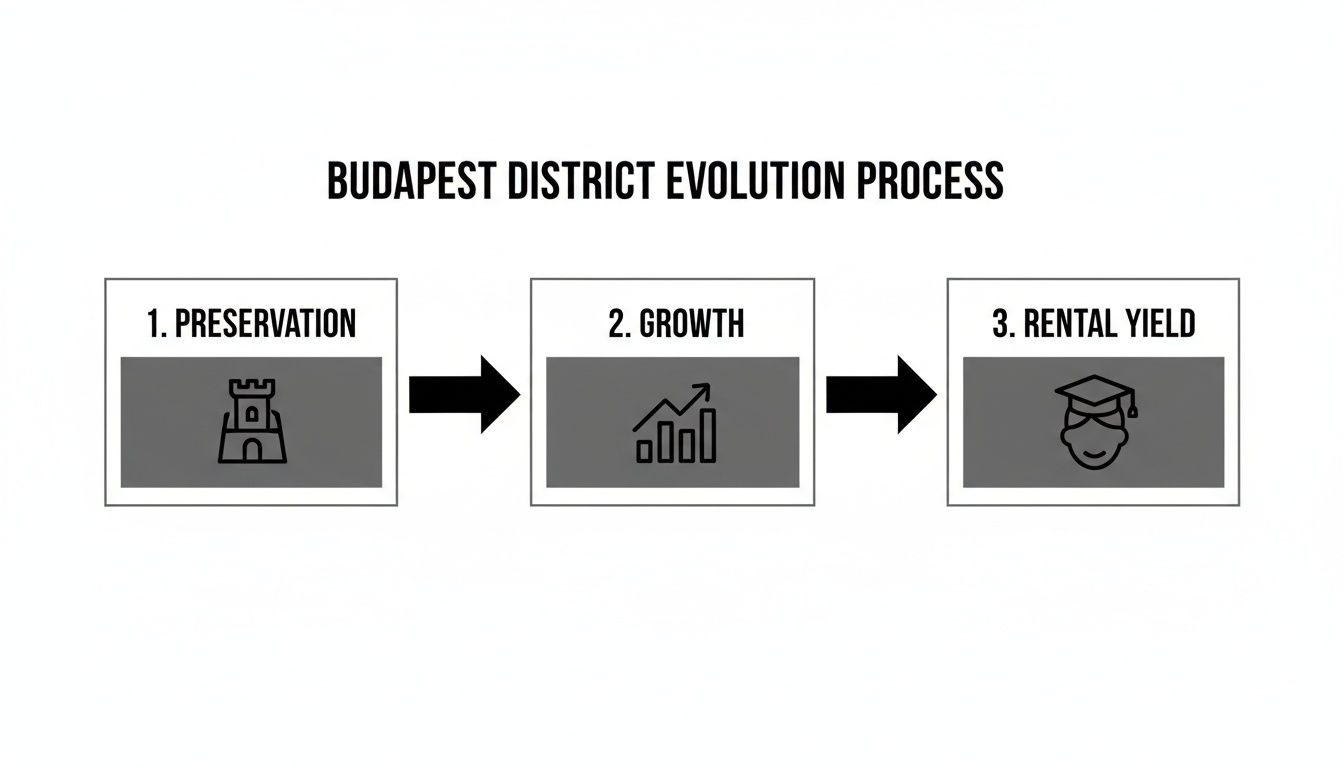
This visual framework shows how different investment objectives correspond with specific types of districts across the city.
From Offer to Ownership: A Clear Roadmap
Once a lawyer is engaged, the purchase follows a distinct sequence of events.
First, your estate agent submits a formal written offer. Upon acceptance, this forms the basis of the main sale and purchase agreement.
Next, you will sign the comprehensive purchase contract prepared by your lawyer. At this stage, you pay the 10% deposit into the lawyer's secure escrow account.
Immediately after signing, your lawyer submits the contract to the Land Registry. This places a "széljegy" (a preliminary registration note) on the property's title deed, effectively reserving it for you and preventing the owner from selling it to another party while the transaction is pending.
Once the foreign buyer's permit is granted, the final balance of the purchase price is payable. Upon the seller's receipt of the full payment, your lawyer obtains a declaration of completion, and you may take possession of the apartment.
The final step is final registration. Your lawyer submits the closing documents to the Land Registry, which officially registers you as the new owner. While this can take several months to process, your ownership rights are legally secured from the moment of payment and handover.
This structured legal framework provides international investors with a high degree of security. For a broader perspective on buying abroad, you can learn more about investing in overseas property in our detailed guide.
Financial Analysis: Funding and Acquisition Costs
Robust financial planning is the foundation of a successful property investment in Budapest. This involves not only securing the purchase price but also understanding the funding mechanism and accurately forecasting all associated costs.
For the majority of UK investors, acquiring property in Budapest is a cash transaction, as this is the most straightforward route. While obtaining a mortgage from a Hungarian bank is not impossible for a foreigner, the process can be arduous.
Can You Secure a Hungarian Mortgage?
Should you explore local financing, it is essential to proceed with a clear understanding of the challenges. Hungarian banks are notably cautious when lending to non-residents, particularly those earning in a foreign currency like Sterling.
Expect to encounter the following requirements:
- A substantial deposit. A down payment of 30% to 50% is standard for foreign buyers, as it is the bank's primary method of mitigating risk.
- Extensive documentation. You will need to provide comprehensive, officially translated documents verifying your income, tax history, and existing liabilities in the UK.
- Currency risk. The mortgage will be denominated in Hungarian Forints (HUF). This exposes you to exchange rate fluctuations for the entire loan term. A depreciation of GBP against HUF could increase your monthly repayments.
Given these obstacles, most UK buyers find it more practical to use cash, release equity from a UK property, or arrange financing with a UK-based lender familiar with their financial profile.
The True Cost of Buying: A Transparent Breakdown
A common oversight for new investors is underestimating closing costs. In Hungary, these fees are predictable and can be budgeted for with precision. A reliable rule of thumb is to allocate an additional 6-8% of the purchase price to cover all transactional expenses.
Investor Takeaway: It is prudent to budget for 8% on top of the purchase price. This builds in a sufficient buffer, ensuring all taxes and professional fees are covered without any last-minute financial pressure.
The primary one-off acquisition costs are as follows:
- Property Transfer Tax (Stamp Duty): This is the largest single cost, set at a flat rate of 4% of the property’s market value.
- Lawyer’s Fees: As legal representation is mandatory, expect to pay between 1% and 1.5% of the purchase price, plus 27% VAT. This fee is comprehensive, covering all legal work.
- Land Registry Fee: A nominal administrative charge of HUF 6,600 (approximately £15) is required to register your ownership.
For clarity, here is a detailed breakdown of expected costs.
Estimated Acquisition and Ownership Costs in Budapest
| Cost Item | Estimated Percentage or Amount | Notes |
|---|---|---|
| One-Time Acquisition Costs | ||
| Property Transfer Tax | 4% of purchase price | The largest closing cost, payable after contract execution. |
| Lawyer's Fee | 1% – 1.5% (+ 27% VAT) | Mandatory fee for legal representation and conveyancing. |
| Land Registry Fee | HUF 6,600 (approx. £15) | Fixed administrative fee to register title. |
| Recurring Ownership Costs | ||
| Common Charge (Közös Költség) | £50 – £150 / month | Covers building maintenance, insurance, waste disposal, and sometimes utilities. |
| Utilities (Gas, Electric, Water) | Varies by usage | Based on individual consumption. |
| Landlord's Insurance | £100 – £200 / year | Essential for asset protection. |
| Income Tax on Rental Profit | 15% flat rate | Levied on net rental income after deducting allowable expenses. |
The transparency and predictability of these costs are key strengths of Budapest as an investment location.
Factoring in Ongoing Costs
Financial planning must extend beyond the acquisition. To calculate your true net yield, you must factor in the recurring costs of ownership, which are essential for maintaining the property and ensuring legal compliance.
The most significant is the közös költség, or common charge. This monthly fee, paid to the building's homeowners' association, covers the maintenance of communal areas, building insurance, and refuse collection. It typically ranges from £50 to £150 per month.
Additionally, you must budget for utility bills, annual property insurance, and the 15% flat-rate income tax on net rental earnings.
To explore various funding options, our comprehensive guide on financing an investment property covers multiple strategies.
Developing a Profitable Budapest Rental Strategy
Once the property is acquired, the focus shifts to optimising its financial performance. A successful rental strategy for a Budapest apartment requires a data-driven analysis of the market, not speculation.
The city's rental market is robust but bifurcated into two distinct segments: stable long-term tenancies and the more complex short-term holiday market. Understanding the dynamics of each is the first step toward maximising income.
Long-Term vs. Short-Term Lets
While high nightly rates from tourism may seem attractive, Budapest's regulatory environment has decisively shifted in favour of long-term rentals. Strict new rules and outright bans on short-term lets in key districts like VI (Terézváros) have made the Airbnb model significantly more complex and risky.
For most investors, the long-term rental market offers a more predictable and profitable path. Demand is consistently high, driven by a deep and reliable tenant pool:
- International Students: Major universities like Semmelweis and ELTE attract thousands of students annually, all requiring quality accommodation for the academic year.
- Expatriate Professionals: As a major hub for multinational corporations, Budapest sees a continuous flow of professionals on multi-year contracts.
- Young Hungarian Professionals: A growing cohort of young locals rent in central, well-connected districts before purchasing their own homes.
This model provides consistent monthly income, lower tenant turnover, and significantly reduced operational demands compared to the daily management of holiday lets.
Calculating Your True Rental Yield
To ascertain your real return, you must look beyond the headline rent. Professional investors differentiate between gross and net yield to obtain an accurate assessment of an asset's performance.
Gross yield is a top-level calculation: (Annual Rental Income / Property Purchase Price) x 100. It serves as a useful initial benchmark for comparing properties.
Net yield is the critical metric. It accounts for all operational costs, revealing the actual return on investment.
Investor Takeaway: Always forecast returns using net yield. This requires subtracting all recurring costs—management fees, common charges, insurance, maintenance, and taxes—from your gross rental income. It is the only way to accurately evaluate an investment's performance.
Factoring in Essential Costs
To calculate net yield accurately, budget for these key expenses:
- Property Management Fees: For remote management, a local agent is essential. Fees typically range from 10% to 15% of the monthly rent.
- Common Charges (Közös Költség): These monthly building fees range from £50 to £150.
- Income Tax: Hungary has a favourable flat income tax rate of 15% on net rental profit.
- Maintenance and Voids: It is prudent to establish a contingency fund—perhaps one month's rent per year—to cover unexpected repairs and vacant periods.
A crucial factor supporting rental values is Hungary's persistent undersupply of new housing. The country has one of the lowest rates of new housing construction in Europe, which supports both rental income and long-term capital growth.
Gross yields typically range from 4-5%. A well-managed property can achieve a net yield of circa 3.5%. For example, a €300,000 apartment generating €12,500 annually could, after all costs, provide a net income of approximately €10,500, representing a 3.5% net yield—a solid return compared to many cooling UK buy-to-let markets.
For a detailed breakdown of these calculations, our guide on how to calculate return on investment for real estate provides a step-by-step methodology. By incorporating these costs into your financial model from the outset, you can project the performance of your Budapest apartment with confidence.
A Practical Investment Checklist
This checklist provides a structured approach to navigating the Budapest property market, covering essential steps and highlighting common pitfalls.
Foundational Stage: Finance and Legal Preparation
Before viewing properties, establish your financial and legal groundwork.
- Engage a Lawyer First: Your first action should be to retain an independent Hungarian lawyer (ügyvéd). They represent your interests exclusively. This is non-negotiable.
- Define Your Financial Plan: Determine if you are a cash buyer or require financing. If exploring a mortgage, initiate discussions early to understand what is realistically achievable.
- Budget Comprehensively: The asking price is only the starting point. Account for the 4% property transfer tax and 1-1.5% (+VAT) for legal fees. Allocate a buffer of at least 8% above the purchase price to cover all costs and contingencies.
Diligence Stage: Vetting and Making an Offer
With your professional team and financing in place, begin the property search with rigorous due diligence.
Investor Takeaway: Never rely solely on an estate agent's representations. Your lawyer must conduct an independent title search at the Land Registry (Földhivatal) to confirm ownership and identify any encumbrances.
Focus on:
- Inspecting the Property and Building: Assess the physical condition of the building. Request to review minutes from homeowners' association meetings to identify planned major works for which you would be liable.
- Formalising the Offer: Submit your offer in writing via your agent to create a clear, documented record of the proposed terms.
- Scrutinising the Purchase Agreement: Your lawyer will draft a bilingual contract. Review every clause, ensuring it includes essential conditions, such as making the sale contingent upon the approval of your foreign buyer's permit.
Completion Stage: Closing the Transaction
The final stage involves completing the transaction and taking possession.
- Deposit Transfer: Upon signing the purchase contract, you will transfer the 10% deposit to your lawyer's secure escrow account.
- Permit Application: Your lawyer will apply for the foreign buyer's permit, a standard administrative step that typically takes 30-60 days.
- Final Payment and Handover: Once the permit is granted, the final 90% of the purchase price is due. Upon receipt by the seller, the keys are transferred, and your lawyer will file for the final registration of your title deed.
Frequently Asked Questions: Investing in Budapest
Here we address common questions from investors considering the Budapest market.
Does Buying an Apartment Grant Me a Residence Permit?
The short answer is no. Purchasing property in Hungary does not, in itself, grant an automatic right to a residence permit. While property ownership can support a residency application by demonstrating local ties, the application process is entirely separate and subject to its own specific criteria.
Is a Hungarian Bank Account Necessary?
While not legally mandatory, it is highly practical and strongly recommended. Managing all transactions from an overseas account can be complex and costly. A local bank account simplifies the transfer of the purchase price, payment of legal fees, and management of ongoing costs such as common charges, utilities, and taxes.
Pro Tip: A multi-currency account with a service like Wise or Revolut is an excellent alternative or supplement. It allows you to hold funds in both HUF and your home currency (e.g., GBP), providing greater control over exchange rates and avoiding excessive bank transfer fees.
Is It Safe for a Foreigner to Buy Property in Budapest?
Yes, the process is very safe. Hungary’s legal framework is robust and offers strong protection for foreign property owners, granting them the same legal standing as Hungarian citizens.
The security of the system is underpinned by two key elements:
- The mandatory involvement of a qualified lawyer (ügyvéd) representing your interests.
- The transparent and reliable Land Registry system, which provides an official record of ownership.
By following the correct legal procedures with a qualified lawyer, your ownership rights are fully protected under Hungarian law. A safe and successful investment in Budapest depends not on luck, but on thorough due diligence and expert legal counsel.
At World Property Investor, we provide the clarity and data required to explore global real estate with confidence. Our guides cover market analysis and legal procedures to help you make informed investment decisions.
Find your next opportunity at https://www.worldpropertyinvestor.com.