
The most popular advice about buying overseas property is also the least reliable: find a desirable location, negotiate well, and let a local agent handle the rest. That approach can work for a holiday purchase, but it leaves serious gaps for anyone using property as an investment, rental asset, second home or future residence.
The difficult questions usually sit outside the brochure. Which country can legally tax your rent? How will exchange rates affect your sterling return? Does the title protect you in the same way as a UK title? Will owning a home abroad change the tax you pay when you later buy in England or Northern Ireland?
A disciplined purchase starts with those questions, not with photographs of a villa. The following playbook focuses on market selection, ownership law, tax residency, currency exposure, due diligence, finance and eventual exit. For readers considering a particular jurisdiction, a specialist guide such as buying property in Israel from abroad can provide useful local context, but no guide replaces independent legal and tax advice.
Table of Contents
- Why Most Overseas Property Buyers Underestimate the Complexity
- Selecting the Right Market Using Data and Economic Drivers
- Navigating Legal and Ownership Rules Across Jurisdictions
- Understanding Tax and Residency Implications
- Due Diligence and Closing Workflow for International Purchases
- Financing Strategies and Managing Currency Risk
Why Most Overseas Property Buyers Underestimate the Complexity
Buying a property abroad looks familiar because the visible steps are familiar. You search, view, offer, sign and pay. The underlying systems may be entirely different, however, and a transaction that feels routine in the UK can carry unfamiliar obligations elsewhere.
Three factors create most of the complexity:
- Tax residency: Your tax position usually follows your residence and wider circumstances, not only the country where the property sits.
- Currency exposure: Your purchase, rent, mortgage and sale may all involve different currencies. A profitable local-currency result can look very different after conversion into pounds.
- Local legal rules: Ownership rights, contracts, registration, planning permissions and completion procedures depend on the jurisdiction.
The mistake is treating these as administrative details to solve after agreeing a price. They should shape the shortlist from the beginning. A market with attractive holiday demand may be unsuitable if short-term letting is restricted. A cheap apartment may be poor value if the ownership structure is difficult to sell. A property producing rent in euros still needs to be assessed against sterling expenses, UK reporting and the costs of managing it from a distance.
Practical rule: Never transfer a reservation deposit until you know who will verify the title, who will calculate the tax exposure and which currency you'll ultimately need for the purchase.
UK data provides a useful counterweight to claims that international buyers dominate property ownership. In England and Wales, 181,701 titles were registered to individuals with an overseas correspondence address, representing 0.7% of all registered titles. That share had more than doubled from about 0.25% in 2010, while still remaining below 1% of all titles, as reported by the Centre for Public Data's analysis of overseas individuals. The figures suggest that overseas ownership has grown materially, but remains a small part of the overall market.
The same analysis highlights why clean comparisons can be difficult. Official figures for overseas-owned titles held by companies have been published since 2017, but there hasn't historically been an equivalent official total for overseas individuals. Buyers and advisers therefore need to interpret correspondence addresses and ownership structures carefully rather than rely on one supposedly definitive measure.
A successful purchase is achievable, but enthusiasm must come after structure. Define the purpose of the property, understand your tax residence, choose a market that supports that purpose, then test the asset and its ownership documents independently.
Selecting the Right Market Using Data and Economic Drivers
Market selection deserves more research than property selection. A beautiful building in a weak rental market remains a weak investment, while a less glamorous property in a location with durable employment, transport access and local demand may offer a more resilient result.
Start by deciding what “success” means. A holiday home has a different test from a buy-to-let investment. If you want personal use, compare access, maintenance and local services. If you want income, examine achievable rent after management, insurance, vacancy, repairs, local taxes and financing. If capital growth matters most, study employment, infrastructure, population movement and the supply of competing homes.
Recent UK evidence illustrates how concentrated overseas demand can be. Hamptons reported that overseas-based house-hunters represented just 1.0% of prospective buyers in Great Britain in Q1 2025, the lowest share in its records, compared with 2.0% in 2015, according to its analysis of overseas house-hunter demand. Separately, CBRE estimates cited in that analysis put around 270,000 homes across England and Wales at an overseas correspondence address or overseas company, including about 105,000 homes in London. London's foreign demand is concentrated rather than evenly distributed, with 20% of new homes sold in London in 2023 going to overseas buyers.
That distinction matters globally. Established markets such as Spain, France and the UK often offer deeper professional services, clearer resale evidence and more mature finance, but they may also have stronger competition and higher acquisition costs. Emerging markets in Southern Europe, the Middle East and Southeast Asia can offer different growth prospects, yet buyers may face greater currency, regulatory, political, construction or resale risk.
Build a decision matrix before viewing homes
Use a shortlist of two or three markets. Score each against the purpose of the purchase rather than the strength of its marketing.
| Market | Typical Rental Yield | Entry Price Range | Foreign Ownership Rules | Key Growth Driver |
|---|---|---|---|---|
| Spain | Varies by city and property type | Varies by region and asset | Verify national and local rules | Tourism, employment and infrastructure |
| France | Varies by city and property type | Varies by region and asset | Verify ownership, tax and letting rules | Employment centres and lifestyle demand |
| UK | Varies by city and property type | Varies by region and asset | Overseas ownership is established, but structures require review | Employment, regeneration and housing demand |
| Middle East markets | Varies by designated area and asset | Varies by location and tenure | Check freehold zones and buyer eligibility | Infrastructure, business activity and population growth |
| Southeast Asian markets | Varies by tenure and locality | Varies by location and asset | Land and condominium rules can differ sharply | Tourism, urbanisation and expanding services |
The table deliberately avoids universal yield or price claims. “Typical” figures can mislead when one city permits short-term letting and another does not, or when a headline gross yield ignores service charges and management. Use completed transactions, local rental evidence and comparable properties, not an agent's best-case projection.
World Property Investor's market research tools can sit alongside local agents, property managers, official planning documents and independent valuation evidence. The useful question isn't whether a market is fashionable. It's whether the demand is supported by several independent drivers and whether you can still operate the property when conditions become less favourable.
Navigating Legal and Ownership Rules Across Jurisdictions
Foreign ownership law is a threshold issue. Before comparing balconies, beaches or projected rent, confirm that you can own the property, hold the proposed title and use it for your intended purpose.
Some jurisdictions distinguish sharply between land ownership and ownership of an apartment. Others create designated areas for foreign freehold ownership, use leasehold structures, impose approval requirements or limit the proportion of units that foreigners can hold. A developer's statement that “foreign buyers are welcome” isn't a legal opinion.

Establish who represents you
The developer's lawyer protects the developer's process. The selling agent protects the transaction. Your interests require independent local counsel, appointed by you and paid by you, with authority to stop the purchase if the title or contract fails review.
A local lawyer should explain:
- Title and tenure: Confirm whether you receive freehold, leasehold, a long lease, shares in a company or another interest.
- Foreign eligibility: Verify nationality, residency, ownership-area and land-use restrictions directly under local law.
- Planning status: Check permissions, building compliance, completion certificates and any unresolved enforcement issues.
- Encumbrances: Search for mortgages, liens, easements, disputes, unpaid charges and restrictions on transfer.
- Contract mechanics: Review reservation terms, deposit treatment, completion deadlines, default penalties, remedies and the law governing disputes.
- Rental use: Confirm whether local licensing, zoning, building rules or municipal restrictions affect short-term or long-term letting.
The legal professional may be a solicitor, notary or another locally regulated practitioner. Those roles aren't interchangeable across countries. Ask how the practitioner is licensed, who holds client money, whether documents will be translated and which professional has responsibility for registration.
Buyers considering corporate ownership should also understand the commercial and legal consequences before creating an entity. A resource such as Escrow Consulting Group's offshore playbook may help frame questions about offshore structures, but it shouldn't replace jurisdiction-specific advice. Compare the structure's administration, banking, tax reporting, inheritance and sale implications with straightforward personal ownership.
Use a pre-payment control
The FCA has warned UK consumers to exercise caution around overseas property schemes and unauthorised firms. Its warning concerning Harlequin Investments remains a useful reminder that a polished promotion doesn't establish legitimacy. Before sending money, check the promoter against the FCA's consumer warning information, obtain independent legal advice in the destination country and verify the destination account.
For a broader country-by-country starting point, use this foreign ownership restrictions by country resource, then confirm the current position with local counsel. Legal due diligence isn't an optional extra. It's the mechanism that turns an attractive listing into an enforceable asset.
Understanding Tax and Residency Implications
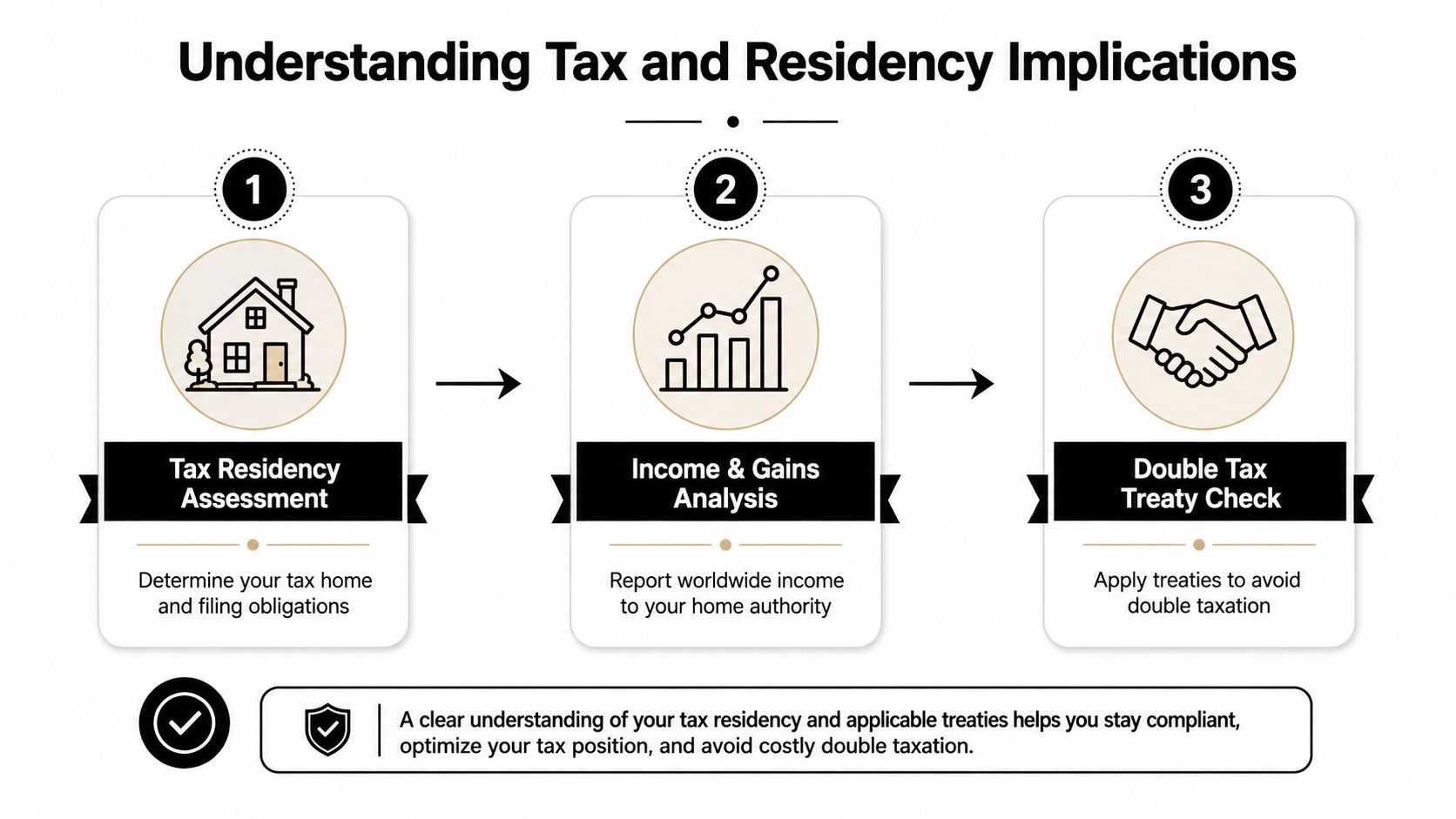
The purchase price is only one part of the tax calculation. UK residents must assess the continuing UK position alongside the rules in the country where the property sits. HMRC states that foreign rental income is taxable in the UK, and UK residents are subject to UK Capital Gains Tax on gains from overseas property. From 6 April 2025, HMRC says UK residents are taxed on the arising basis on worldwide income and gains under its guidance on foreign income.
Model the transaction across both jurisdictions before committing. The local country may tax rent, ownership or disposal, while the UK may require the income and gain to be reported through Self Assessment. Foreign tax credit relief may reduce double taxation. The double taxation treaties overview explains how treaty positions affect relief, but the result still depends on the relevant rules, records and treaty position.
Treat sterling conversion as part of the tax calculation
Keep acquisition costs, rental receipts, improvements, finance costs and disposal proceeds in an organised record. HMRC calculations use sterling amounts, not just the gain shown in the local currency. Currency movements between purchase, income and sale dates can therefore alter the taxable result and the foreign tax credit available.
The classification of rental activity creates another trap. HMRC treats rent and other receipts from property outside the UK as profits of an overseas property business, separate from a UK property business. Losses from one business cannot be offset against profits from the other, as explained in the HMRC property income manual. A UK landlord with an overseas loss should not assume it automatically reduces UK rental profit.
Check the UK property interaction
An overseas home can affect the SDLT position when you later buy another residential property in England or Northern Ireland. Current guidance and tax commentary indicate that an overseas dwelling may count when assessing the higher SDLT surcharge. The non-resident 2% SDLT surcharge can also apply to non-UK residents buying residential property in England or Northern Ireland. Residence, ownership, property type and the transaction facts determine the outcome, so model the position before exchanging contracts, using specialist advice and the SDLT treatment for overseas buyers as a starting point.
Spain illustrates how local compliance can fall on the buyer. When a property is bought from a non-resident seller, the purchaser must withhold and pay 3% of the agreed consideration to the Spanish tax authority using form 211, according to the Spanish Tax Agency. Treat this as a transaction requirement, not an informal market convention.
Returning expatriates need a further review. HMRC notes that non-residents may still face UK tax on overseas property if they return to the UK within 5 years of leaving, under its guidance on selling overseas property. If emigration or a return is part of the plan, specialist advice can help you simplify your emigration process, while a qualified adviser should assess residency before the move or purchase.
Due Diligence and Closing Workflow for International Purchases
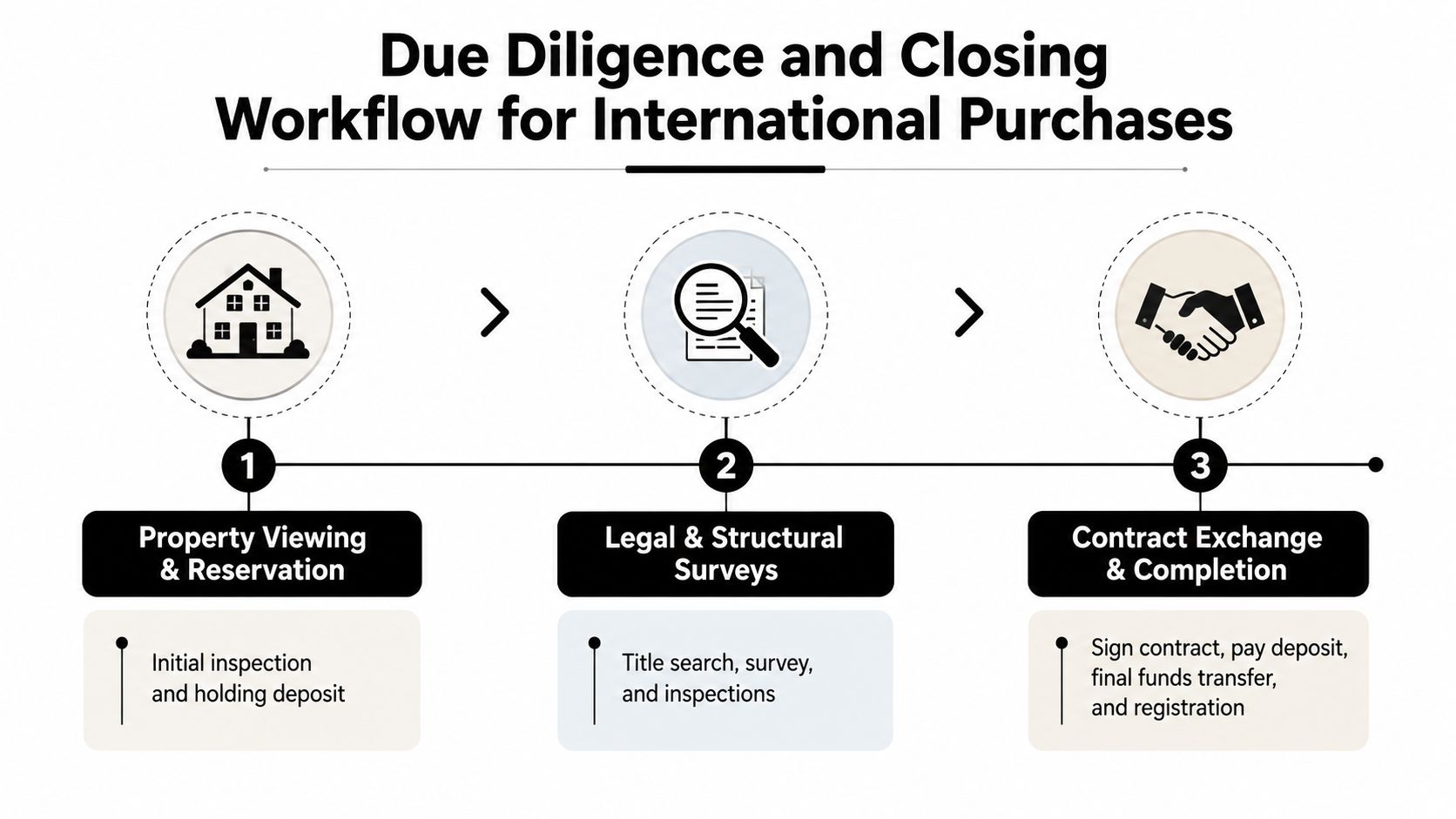
A reliable closing process separates excitement from evidence. The reservation stage should preserve your ability to withdraw if the title, survey, planning position or funding cannot be verified.
Start with a physical inspection, even if you're buying from a respected developer. Check structure, damp, drainage, access, boundaries, services, communal areas and the condition of fixtures. Where standards and construction methods differ from those familiar in Britain, an independent surveyor is especially valuable.
Follow the evidence trail
Your lawyer should search the title and identify every party with a legal or financial interest. Don't rely on a sales contract that describes the property more generously than the registered documents.
A practical sequence is:
- Viewing and reservation: Record the property's exact identity, seller, agreed terms, holding deposit rules and refund conditions. Obtain written confirmation of what happens if legal checks fail.
- Survey and title review: Commission the structural inspection and title search independently. Check planning permissions, building compliance, access rights, utilities, community charges and outstanding liabilities.
- Contract review: Confirm the completion timetable, currency, payment stages, default provisions, remedies and responsibility for taxes and registration. Translate the contract properly rather than relying on an informal summary.
- Source of funds: Prepare bank statements, sale records, inheritance evidence, mortgage documents and identification before the transfer deadline. International banks and lawyers may need a clear audit trail under anti-money-laundering procedures. The source of funds verification guidance helps buyers organise this evidence.
- Completion and registration: Transfer funds only through the agreed controlled process, obtain completion confirmation, register the title and move utilities and insurance into the correct names.
- Post-completion management: Arrange local tax representation where required, appoint a manager if you won't be present and store original documents securely.
Off-plan purchases need extra caution. A staged payment schedule should be tied to independently verified construction milestones, with clear remedies for delay or defective delivery. With a private seller, confirm authority to sell and settle any secured debt before completion. Escrow arrangements can reduce payment risk, but only if the account holder, release conditions and governing law are clear.
The timing may extend over several months. Treat the purchase as a sequence of gates rather than an agent's optimistic promise. Set cash aside for surveys, translation, legal work, taxes, travel, banking and remedial works, and don't commit the full budget to the headline price.
This video can help buyers visualise the practical sequence before they appoint professionals:
The transaction isn't finished when the keys arrive. Registration, tax filings, utilities, insurance, management and document retention determine whether ownership remains orderly after completion.
Financing Strategies and Managing Currency Risk
Finance should be designed around the asset's full lifecycle, not just the deposit. UK buyers commonly consider remortgaging a domestic property, applying for a specialist international mortgage, using local finance or accepting developer finance. Each route changes the balance between approval speed, security, interest cost, currency exposure and flexibility.
Domestic borrowing may be easier to understand and can keep the debt in pounds, but it puts pressure on the UK property and personal affordability. A local mortgage may align debt with rental receipts, yet the application can involve unfamiliar underwriting, local documentation and a loan in the property currency. Developer finance may simplify the purchase process, but buyers must scrutinise the rate, term, security and consequences of delayed completion.
Currency risk deserves its own decision. If rent arrives in euros but your personal costs and mortgage are in pounds, the cash flow can move even when occupancy and local rent remain stable. The same applies at exit. A local-currency capital gain may translate into a smaller sterling gain, or a local gain may be offset by exchange movements and selling costs.
Use a written currency policy:
- Timing: Decide when funds will be converted instead of reacting to daily market movements.
- Protection: Ask a regulated currency specialist about forward contracts, limit orders and multi-currency accounts.
- Matching: Where appropriate, match borrowing and rental receipts in the same currency.
- Records: Keep the exchange rates and transfer costs used for purchase, income and disposal calculations.
The currency hedging guide can help you compare these techniques, but the right choice depends on your cash-flow needs and risk tolerance.
Exit planning starts before completion. HMRC requires UK residents to consider Capital Gains Tax when disposing of overseas property, so preserve purchase documents, improvement invoices, selling costs, local tax evidence and exchange-rate records. Ownership through a company, partnership or trust may alter administration, inheritance, financing and sale consequences. Get advice before choosing the structure, not when a buyer is already waiting.
The sound strategy connects finance, currency and exit. Borrowing cheaply can be unhelpful if it leaves you exposed to the wrong currency. A strong local yield can disappoint if conversion costs consume the surplus. A tax-efficient purchase structure can become expensive to unwind. Model the purchase, holding period and sale together.
World Property Investor offers country and city guides, market analyses, rental yield research, foreign-ownership information and step-by-step buying advice for international buyers. Visit World Property Investor to compare markets, investigate tax and legal considerations, and build a more defensible overseas property decision before committing funds.