
For UK investors seeking returns beyond the saturated, low-yield markets of Western Europe, Romania has emerged as a credible investment destination. The market combines consistent economic growth, attractive rental yields, and a transparent legal framework for foreign buyers. This blend of affordability and fundamental strength is attracting sophisticated investors looking to diversify their portfolios.
Why UK Investors Are Turning to Romanian Real Estate
Unlike many stagnant property markets closer to home, Romania offers a dynamic environment where both capital growth and rental income are supported by strong economic fundamentals.
The country’s EU membership provides a stable and predictable regulatory backdrop, while its economy consistently outperforms many European counterparts. For investors, this represents a calculated allocation based on tangible market data, not a speculative venture.
Strong Economic Growth and EU Stability
Romania's economy has demonstrated remarkable resilience and growth. Consistent GDP expansion, driven by a burgeoning technology sector and significant foreign direct investment, creates a favourable environment for real estate appreciation.
This economic momentum translates directly into increased demand for both residential and commercial property, particularly in major urban centres. For a UK investor, this means acquiring assets in a market with a solid economic foundation, while EU membership adds a crucial layer of legal and financial security.
Attractive Rental Yields and Capital Appreciation
The potential for compelling returns is a primary driver for investment. Compared to the compressed yields typical of most UK cities, Romania offers far more attractive figures.
- Gross Rental Yields: In prime locations such as Bucharest or Cluj-Napoca, investors can realistically target gross rental yields of 5% to 7%. These figures are rarely achievable in established Western European capitals.
- Capital Growth: While yields provide steady income, the potential for capital appreciation remains strong. Rising wages and ongoing infrastructure improvements are expected to support continued growth in property values in key urban areas.
Key Takeaway: For investors focused on long-term wealth creation, Romania offers a balanced proposition: consistent cash flow from rental income and the realistic prospect of significant capital gains over time.
Lower Entry Costs and Favourable Taxation
The relative affordability of Romanian real estate is a significant advantage. The capital required to acquire a high-quality apartment in a desirable city-centre location is substantially lower than in the UK or other major European hubs.
This lower entry point allows investors to enter the market with less upfront capital and potentially diversify across multiple assets to mitigate risk.
Furthermore, the tax regime is notably straightforward. A flat 10% tax on rental income and low annual property taxes help to maximise net returns, ensuring a greater proportion of earnings is retained by the investor. To understand how Romania compares to other high-potential locations, see our analysis of the top emerging property investment markets.
Understanding Foreign Ownership Regulations
Before assessing specific properties, it is essential to understand the legal framework. Romania’s EU membership ensures a generally stable and transparent property system, but crucial distinctions exist for non-EU nationals, which now includes UK citizens post-Brexit.
Previously, UK buyers enjoyed the same rights as any EU national. The current regulations treat UK investors as non-EU/EEA nationals, which introduces a key restriction regarding the direct ownership of land. Romanian law prevents non-EU citizens from directly owning land, including freehold houses with their associated plots.
However, the purchase of apartments and commercial spaces remains entirely straightforward.
The Standard Solution: A Romanian SRL
For investors wishing to acquire a house with land or a development plot, there is a well-established and secure legal pathway: establishing a Romanian-registered company, known as a Societate cu Răspundere Limitată (SRL). This is the standard methodology for non-EU international investors.
The formation of an SRL should be viewed as a professional structuring tool, not a prohibitive barrier. A Romanian SRL is a domestic legal entity, affording it the same property acquisition rights as a Romanian citizen. This creates a clean, legally compliant structure for all investment activities.
Key Takeaway: An SRL is not a complication but a professional vehicle for your investment. It provides liability protection and a formal framework for holding assets, managing rental income, and executing transactions within the Romanian legal system.
Establishing an SRL is a routine procedure handled by a local solicitor and is relatively efficient.
- Timeline: The entire process typically takes 1 to 2 weeks.
- Costs: Budget between €500 and €1,500 for all legal and registration fees, dependent on the chosen legal firm and complexity.
- Share Capital: The minimum share capital requirement is nominal, often just 200 RON (approximately £40).
This structure not only enables the purchase but also ensures full compliance and security. It simplifies tax reporting for rental income and capital gains, particularly for investors planning to build a portfolio of multiple properties. You can learn more about the broader considerations for international real estate in our comprehensive guide to investing in overseas property.
Permitted Ownership Structures
It is vital to be clear on which assets can be acquired directly versus those requiring an SRL structure. The rules are designed to be accessible while protecting strategic assets like agricultural land.
Direct Personal Ownership (as a UK Citizen):
- Flats and Apartments: These can be purchased directly in an individual's name without restriction, as the purchase relates to the unit, not the land beneath it.
- Commercial Spaces: Similar to apartments, commercial units within larger buildings can be acquired directly.
Ownership via a Romanian SRL:
- Houses with Land: This is the primary reason investors establish an SRL. The company legally owns both the building and the land it occupies.
- Building Plots: An SRL can purchase vacant land designated for development.
- Agricultural Land: While an SRL can own farmland, this is a more regulated area with pre-emption rights for neighbours and the state. Specialist legal advice is essential for such acquisitions.
Understanding these distinctions from the outset ensures a correctly structured and legally sound transaction.
Identifying Prime Investment Locations in Romania
Selecting the right location is the foundation of successful property investment. In Romania, the opportunities extend beyond the capital, Bucharest, with significant growth occurring in major regional cities. An effective strategy requires analysis of the underlying economic drivers of each distinct urban market.
An investor targeting stable, long-term rental income from corporate tenants will focus on different districts than one seeking high capital growth in an emerging technology hub. A deep understanding of what defines a good location in real estate investment success provides a solid framework for decision-making.
The following provides a comparison of the key investment hubs.
Romanian Property Market Snapshot: Key Investment Hubs
This table offers a high-level comparison of Romania's primary cities for property investment, highlighting key metrics for investors.
| City | Primary Investment Driver | Average Price/sqm (City Centre) | Estimated Gross Rental Yield |
|---|---|---|---|
| Bucharest | Corporate & Long-Term Lets | €2,300 – €2,800 | 4% – 5% |
| Cluj-Napoca | Technology & Student Rentals | €2,500 – €3,000 | 5% – 6% |
| Timișoara | Industrial, Expat & Mixed Use | €1,600 – €2,000 | 4.5% – 6% |
| Iași | IT, Outsourcing & Student Lets | €1,500 – €1,900 | 5% – 6% |
The optimal city depends entirely on an investor's budget, risk appetite, and financial objectives. While Bucharest offers stability, the regional hubs present compelling opportunities for higher yields and growth.
Bucharest: The Established Powerhouse
As Romania’s capital and economic engine, Bucharest is the country's most mature and liquid property market. It attracts the majority of foreign direct investment and hosts the headquarters of most multinational corporations.
For property investors, this creates a deep and resilient rental market. The city is divided into six administrative sectors. Sector 1, in the north, is the most affluent district, home to premium office space, luxury apartments, and embassies. It is the primary target for high-end corporate lets, commanding the highest prices in Romania. In contrast, districts like Sector 3 and 6 offer more accessible entry points with solid rental demand from young professionals and families.
Investor Takeaway: Bucharest offers stability and predictable rental demand, particularly from corporate tenants. Yields are slightly lower than in emerging cities, typically 4-5%, but the market's liquidity and potential for long-term capital preservation are its core strengths.
Cluj-Napoca: Romania’s Technology Hub
Cluj-Napoca has firmly established its reputation as Romania’s premier technology centre. Home to major universities and a vibrant start-up ecosystem, the city attracts a young, educated, and increasingly affluent demographic. This has fuelled intense demand for modern, high-quality rental accommodation.
The constant influx of technology professionals and students creates a dynamic rental market with very low vacancy rates. While property prices have risen significantly, they still offer value compared to other European tech hubs. Investors here are positioned to benefit from continued economic expansion and strong capital appreciation, with rental yields that often outperform Bucharest, typically in the 5-6% range.
Timișoara and Iași: Emerging Opportunities
Beyond the two main hubs, Timișoara in the west and Iași in the east present compelling alternatives attracting sophisticated investors.
-
Timișoara: With a strong industrial base and strategic location near the Hungarian and Serbian borders, Timișoara is a key economic hub. It has a growing expatriate community, and its designation as a European Capital of Culture has boosted its profile and infrastructure. Its property market is considered well-balanced, offering affordable prices and respectable yields of 4.5-6%.
-
Iași: As the largest city in eastern Romania and another major university centre, Iași is a powerhouse for IT and outsourcing. It offers some of the most attractive entry prices among the major cities. This, combined with strong rental demand from its large student population, can deliver yields of 5-6%.
This growing appeal is backed by data. According to analysis from major real estate consultancies, Western European investors, including a significant UK contingent, invested €1.75 billion into Romanian real estate over the last five years, capturing a 39% market share. You can find more data on the €4.5 billion transaction volume at cwechinox.com.
The Purchase Process: From Offer to Ownership
The Romanian property purchase process is logical and secure, but it requires a methodical approach and expert local representation. The system relies heavily on a public notary, who acts as an impartial state official guaranteeing the legality of the transaction.
Understanding the key stages from the outset ensures a smooth process from asset identification to holding the title deeds.
When managed professionally, the entire transaction can be completed within four to six weeks. This efficient timeline is a significant advantage for investors keen to deploy capital without protracted legal delays.
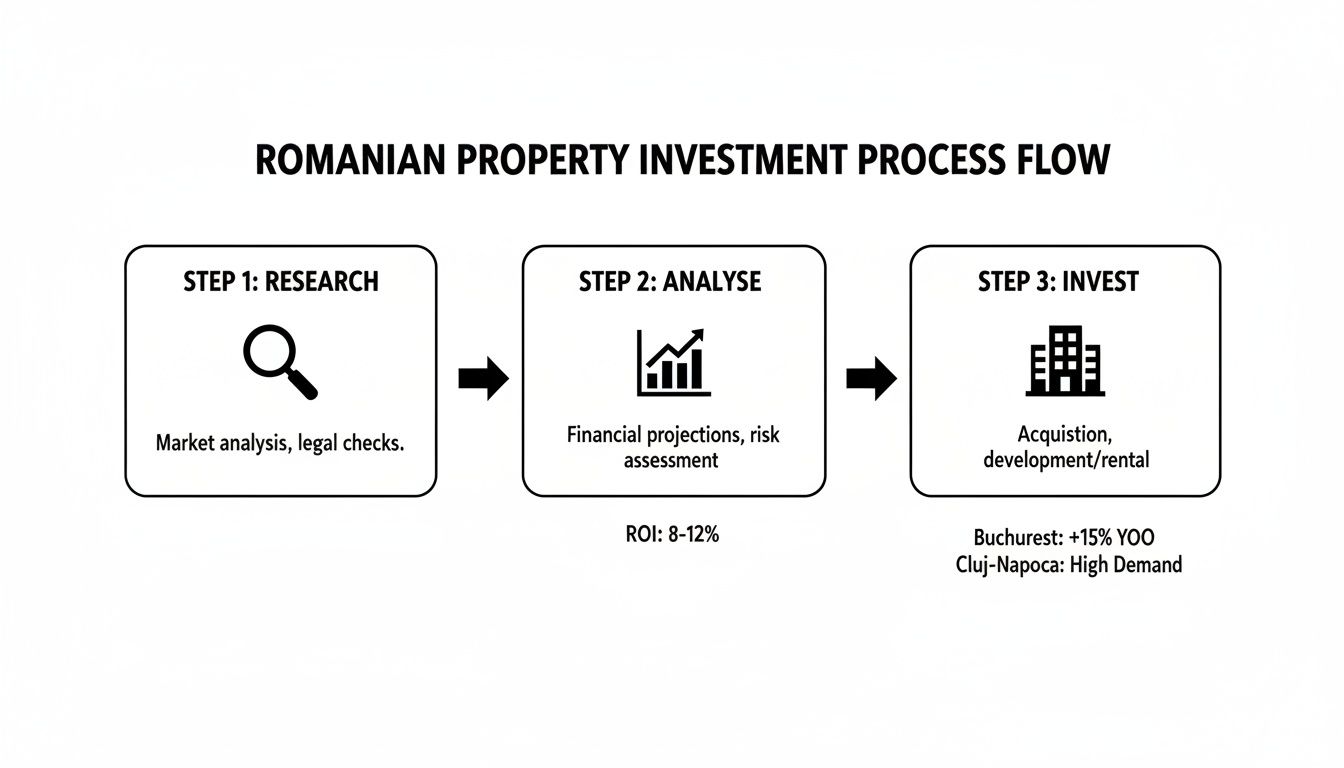
This visual outlines the core components of a successful acquisition: research, analysis, and execution, providing a clear strategic roadmap.
Assembling Your Professional Team
Your first action should be to engage a reputable, independent solicitor and a trusted real estate agent. This team is your representation on the ground, tasked solely with protecting your interests.
An experienced solicitor will conduct thorough due diligence, verify all legal documentation, and can act on your behalf via a Power of Attorney if you cannot be present. Your agent provides critical market intelligence and manages negotiations with the seller.
Conducting Essential Due diligence
Once a property is identified, your solicitor's primary role is to perform comprehensive due diligence. This is the most critical phase for risk mitigation.
The cornerstone is verifying the Land Registry extract, known as the 'extras de carte funciară'. This document is the property’s definitive legal record and must be scrutinised for several key details:
- Clear Title: Confirmation that the seller is the legal owner with the right to sell.
- No Encumbrances: It will reveal any registered mortgages, liens ('sarcini'), or legal disputes that could impede the sale.
- Property Details: Verification that the physical specifications of the property—size and layout—match official records.
Your solicitor must also obtain a fiscal certificate to confirm all property taxes are paid. Any outstanding tax liabilities can transfer to the new owner.
From Offer to Pre-Sale Agreement
With due diligence successfully completed, a formal offer can be made. Once the price and terms are agreed, the next step is signing a pre-sale agreement, or 'promisiune de vânzare-cumpărare'.
This is a legally binding document that formalises the terms of the transaction. It is signed before a public notary and outlines all key conditions: the agreed price, the completion date, and any other specific clauses.
Upon signing the pre-sale agreement, a deposit, typically 10% of the purchase price, is paid. These funds are held securely in the notary’s escrow account until completion, protecting both parties.
This agreement provides certainty while final preparations are made. Should the seller withdraw, they are often contractually obligated to return double the deposit. If the buyer defaults, the deposit is forfeited.
The Final Sale Agreement and Registration
The final stage is the signing of the sale-purchase agreement ('contract de vânzare-cumpărare'). This must be executed in person (or by your solicitor via Power of Attorney) at a public notary’s office.
At this meeting, the remaining balance of the purchase price is transferred. The notary performs a final check of all documentation, reads the contract aloud to ensure all parties understand their obligations, and witnesses the signing.
Immediately after signing, the notary submits the ownership transfer for registration with the Land Registry. You receive an official registration receipt on the day. Within a few weeks, the Land Registry issues the updated title deed in your name, confirming you as the legal owner.
Understanding Financial Commitments and Returns
Successful investment is contingent on a forensic understanding of the financials. A clear analysis of all acquisition and ongoing costs is essential to accurately forecast net returns when buying property in Romania.
This financial discipline is critical, particularly as UK investors increase their presence in the market. According to GOV.UK data, UK foreign direct investment stock in Romania reached £1.0 billion by the end of 2023, a 22.4% increase from the previous year. This growing confidence reflects a wider recognition of the country's solid fundamentals. Further details are available in the UK Government Romania Trade and Investment Factsheet.
Transaction Costs and Acquisition Fees
When budgeting for an acquisition, it is prudent to allocate an additional 1.5% to 3.5% of the property’s value to cover one-off transaction costs. These fees are modest compared to many other European markets.
- Notary Fees: This is the largest single cost, typically between 0.5% and 1.5%. It is calculated on a sliding scale based on the property’s value and covers the notary's legal work in verifying and finalising the sale.
- Land Registry Tax: A fee of 0.15% to 0.5% is payable for the official registration of the new ownership title.
- Agent Commission: This typically ranges from 2% to 4% of the sale price but is often split between buyer and seller. Your share is likely to be approximately 1% to 2%.
For a €100,000 property, an additional €1,500 to €3,500 should be budgeted for these essential acquisition costs.
Ongoing Ownership Expenses and Taxation
For buy-to-let investors, Romania's low holding costs and simple tax system are highly advantageous, contributing to healthier and more predictable net rental income.
The annual property tax is exceptionally low, often amounting to just a few hundred euros per year for a prime city-centre apartment, a fraction of the council tax liabilities UK investors are accustomed to.
Key Takeaway: The tax regime for rental income is clear and favourable. All rental earnings are subject to a flat 10% income tax after a standard deduction for expenses. This straightforward approach simplifies financial forecasting and enhances the overall return on investment.
Financing Options for UK Buyers
Obtaining a mortgage from a Romanian bank is possible for UK citizens but requires thorough preparation. Lenders apply stricter criteria to non-resident applicants.
Most banks will limit the loan-to-value (LTV) ratio to 60% to 70% for non-residents. This means a cash deposit of at least 30% to 40% of the property's value is required.
To apply, you must provide a set of translated and notarised documents, including:
- Proof of stable, verifiable income (employment contracts, tax returns).
- UK credit reports.
- Bank statements demonstrating sufficient funds for the deposit and fees.
Engaging a local mortgage broker specialising in non-resident financing is highly recommended. They can navigate the banking bureaucracy and present your application effectively. Before committing, it is vital to calculate the return on investment (ROI) for real estate by factoring in all costs and financing terms to accurately project profitability.
Essential Due Diligence and Mitigating Risks

Meticulous due diligence is the cornerstone of successful property investment globally. In Romania, it is the primary defence against future legal complications and financial loss.
The most important preliminary investment is in a reputable, independent local solicitor. They provide essential on-the-ground expertise, protecting your interests and ensuring the process is secure and transparent.
A primary task is a thorough title search at the local Land Registry office (Oficiul de Cadastru și Publicitate Imobiliară). Your solicitor will obtain a current Land Registry extract—an 'extras de carte funciară'—to confirm the seller is the legal owner and that the property is free from liens, mortgages, or legal claims ('sarcini').
Your Core Due Diligence Checklist
Beyond the title search, a comprehensive check must cover several other practical and legal points. Ensure your legal team methodically addresses this list before you commit significant capital.
- Building Permit Verification: Confirm all structures are legal, built with the correct permits, and comply with local zoning laws. Unauthorised constructions can lead to fines or demolition orders.
- Fiscal Certificate Check: This is non-negotiable. Your solicitor must obtain a fiscal certificate to prove all property taxes and utility bills are paid. Any outstanding debts can transfer to the new owner.
- Energy Performance Certificate (EPC): The seller is legally obligated to provide this document, which is essential for understanding the property's energy efficiency and forecasting running costs.
Key Takeaway: Your professional team is your most valuable asset. Attempting to navigate local bureaucracy and verify documents in a foreign language without expert assistance is a high-risk strategy. Budget for quality legal support from the outset.
Common Pitfalls to Avoid
Investors new to the Romanian market often make similar, avoidable errors.
A frequent misstep is underestimating the cost and time required to renovate older buildings, particularly in historic centres. Always obtain detailed quotes from multiple contractors before finalising an offer.
Another common oversight is failing to fully investigate a property's legal history. Some older properties may have restitution claims from pre-communist era owners, which can create significant legal complications. A diligent solicitor will identify these red flags early in the process.
Before finalising a purchase, it is prudent to review guides that help determine a property's investment potential to ensure your due diligence aligns with your financial objectives.
The growing presence of institutional investors underscores the need for a professional approach. In the first quarter of 2025, UK investors accounted for 68% of total commercial real estate investment, committing €105.9 million. This demonstrates clear confidence in the market. You can learn more about this surge in UK investment into Romania and see why a thorough, professional strategy is essential.
Frequently Asked Questions for UK Buyers
Navigating a new property market inevitably raises practical questions. Here are clear answers to the most common queries from UK investors considering Romania.
Can I obtain a mortgage in Romania as a UK citizen?
Yes, it is possible for a UK citizen to secure a mortgage from a Romanian bank, but expect a rigorous application process. Lenders are more cautious with non-resident applicants.
You will likely need to provide a larger deposit, typically in the 30% to 40% range, and submit robust proof of a stable income from the UK. Key documents—such as employment contracts and recent tax returns—must be officially translated and notarised. Engaging a mortgage broker with experience in non-resident applications is strongly recommended to streamline the process.
Do I need a Romanian bank account to buy property?
While not technically a legal requirement for the purchase itself—as funds can be managed through the notary’s escrow account—opening a local bank account is a practical necessity.
A Romanian account simplifies all post-purchase activities, including paying annual property taxes, settling fees, and managing utility bills. For buy-to-let investors, it is essential for receiving rental income. Major Romanian banks have English-speaking staff and are accustomed to serving foreign clients.
Our Tip: View a local bank account as a long-term asset management tool. While not a prerequisite for the transaction, it is indispensable for the efficient ongoing management of your property.
What are the regulations for letting out my Romanian property?
You are fully permitted to let out your property to generate income. It is mandatory to declare all rental income to the Romanian tax authority, ANAF.
This income is taxed at a flat rate of 10% after standard deductions, which is highly competitive. Your rental contract must also be officially registered with ANAF. Many non-resident landlords find that hiring a local property management company is the most efficient way to handle tenant sourcing, rent collection, and ensure full tax compliance.
At World Property Investor, we provide the in-depth guides and data-driven analysis you need to make confident decisions in global real estate. Explore our resources to find your next high-yield opportunity.
Find out more at https://www.worldpropertyinvestor.com