
Emerging property markets are locations that offer the potential for higher-than-average returns in exchange for accepting greater risk. Think of them as the 'growth stocks' of the real estate world, a stark contrast to the 'blue-chip' stability found in prime global cities like London or New York.
Understanding Emerging Property Markets
For the discerning global investor, the appeal of an emerging property market is a fundamental trade-off: the pursuit of superior capital growth and rental yields, balanced by the need to navigate greater volatility.
Unlike established hubs such as Central London or Manhattan—characterised by high entry costs and modest yields, often between 2-4% according to industry analysis—emerging markets present a different proposition.
An emerging market is not always in a developing nation. It could be a regional city within a mature economy, such as Manchester in the UK, which has been transformed by significant regeneration and economic shifts. The common thread is always a powerful catalyst for rapid, fundamental change.
The Core Investor Proposition
The investment case is built on a simple principle: entering a market ahead of mainstream recognition. By identifying areas with strong underlying fundamentals before they become widely known, investors can benefit from accelerated price appreciation. The objective is to capture value as the area matures, infrastructure improves, and demand from tenants and future buyers intensifies. For a broader perspective on investment strategies, our overview of global property investment provides valuable context.
What are the signals of a genuine emerging market? Key characteristics typically include:
- Significant Infrastructure Investment: New transport links, business parks, or major public amenities act as powerful growth drivers.
- Favourable Demographics: A growing, young, and skilled population fuels both immediate rental demand and future buyer interest.
- Economic Diversification: A local economy moving from reliance on a single industry to a more robust, mixed base is a strong indicator of long-term stability.
- Government-Backed Regeneration: Public investment in an area de-risks private capital and boosts overall market confidence.
An emerging market is a calculated investment in the future. While established markets offer stability and wealth preservation, emerging markets provide a genuine opportunity for significant wealth creation—provided rigorous due diligence is performed.
This dynamic means that while a 10% annual return on investment (ROI) may be realistic in an emerging location, it is accompanied by risks such as lower liquidity and potential regulatory changes. The key, which we explore in this guide, is to balance this potential against a clear-eyed understanding of the risks involved.
A Framework for Evaluating Emerging Markets
Knowing that emerging markets hold potential is one thing; identifying a viable opportunity is another. To progress from speculative interest to a sound investment, a repeatable analytical framework is essential. Chasing high returns based on anecdotal evidence is not a strategy—it is speculation.
This framework breaks down the complex task of market analysis into five critical pillars. Consider it a pre-investment checklist for committing capital. It is the process seasoned professionals use to dissect any opportunity, anywhere in the world.
This flowchart illustrates the core dynamics, showing how capital often flows from stable, lower-yield markets towards areas with greater growth prospects, creating a cycle of development and opportunity.
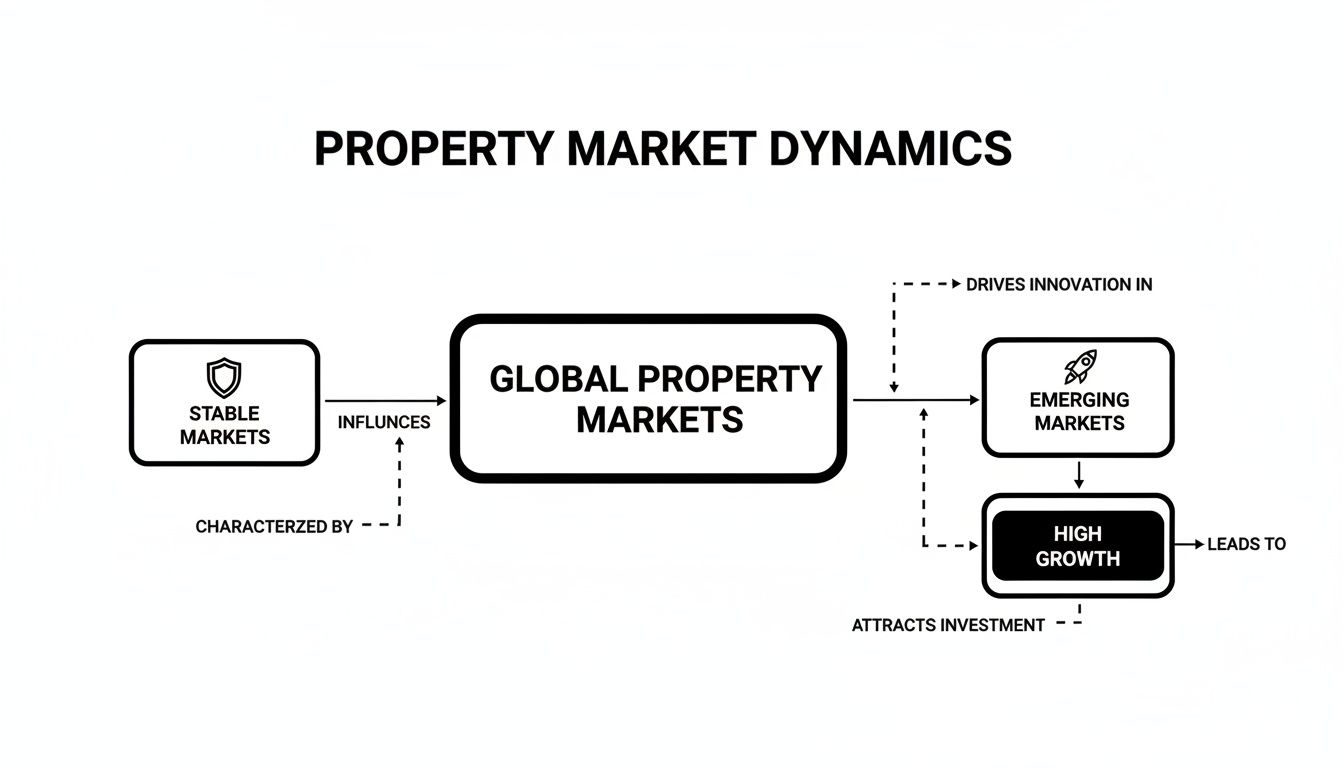
The key takeaway is that capital and talent are constantly seeking the next growth story. An investor's task is to identify these narratives before they become common knowledge.
Established vs Emerging Market Characteristics
To fully grasp the opportunity, it helps to compare emerging markets with mature markets like London or Paris. This table provides a high-level overview of the trade-offs between risk, reward, and market dynamics.
| Characteristic | Established Markets (e.g., London, Paris) | Emerging Markets (e.g., Regional UK Cities, Southeast Asia) |
|---|---|---|
| Return Potential | Lower yields, steady capital growth | Higher potential yields and rapid capital growth |
| Risk Profile | Low volatility, high stability, low political risk | Higher volatility, potential for currency and political risk |
| Entry Price | High, significant capital required | Low to moderate, more accessible entry points |
| Liquidity | High, easy to buy and sell | Variable, can be slower to exit in some markets |
| Market Maturity | Mature, transparent, highly regulated | Developing, less transparent, regulations can change |
| Growth Drivers | Global economic stability, established industries | New infrastructure, population growth, expanding economies |
The choice is not about which is "better," but which aligns with your personal risk tolerance and investment objectives. Established markets offer safety and predictability; emerging markets provide the potential for significant growth.
Economic and Demographic Drivers
The foundation of any healthy property market is a robust, growing local economy. Before considering a single property, it is crucial to analyse the macroeconomic trends that will fuel demand for years to come.
Start with the fundamentals: is the city's or country's Gross Domestic Product (GDP) growing consistently? Look for GDP growth that outpaces the national average, as this signals a particularly dynamic local economy. Credible data can be found from national bodies, such as the Office for National Statistics (ONS) in the UK.
Next, analyse the employment market. A market with a diverse and expanding employment base is healthy. Are major companies establishing or expanding their presence? Is a particular sector, like technology or life sciences, creating high-quality, well-paid jobs? This is crucial, as it creates a growing pool of tenants and future buyers.
Finally, look for investment. Large-scale public and private infrastructure projects—new rail lines, airport expansions, or digital network upgrades—are strong positive indicators. They signal long-term confidence in an area's future.
The Legal and Tax Landscape
For international investors, understanding the local legal framework is non-negotiable. The rules governing foreign ownership can vary dramatically between countries and even regions.
Your potential gross return is irrelevant until you understand how much of it you will retain. Tax efficiency is a critical, and often overlooked, component of your net return on investment.
You must obtain clear answers on these points before proceeding:
- Foreign Ownership Rules: Can you purchase freehold property as a non-resident? Are there restrictions on certain property types or locations?
- Property Taxes: What are the ongoing costs? Investigate annual council tax, Stamp Duty Land Tax (SDLT), or other transaction taxes payable at purchase.
- Income and Capital Gains Tax: How will your rental income and any profit from a future sale be taxed? Crucially, are there double-taxation treaties between your home country and the investment location? Government websites, such as Gov.uk, provide a vital starting point.
For a detailed comparison of different legal systems, our guide on the best countries to invest in property offers valuable perspective.
Supply and Demand Dynamics
At its core, property investment is simple economics. The principle of supply and demand ultimately drives prices. In a promising emerging market, you should look for clear, sustainable evidence that demand is consistently outstripping supply.
Begin by reviewing local housing authority reports and planning portals. Is there a structural shortfall of homes? This creates natural upward pressure on both rental and sales prices. Concurrently, investigate the construction pipeline. A sudden flood of new developments could dilute rental yields and slow capital growth in the short term.
Demographics are a critical part of the demand equation. A city with a large and growing university population, for instance, signals strong, consistent demand for rental accommodation. This granular analysis helps pinpoint specific sub-markets and property types with the most robust prospects.
Ultimately, you are seeking a sustainable mismatch: where the number of new households being formed is greater than the number of new homes being built. This is the sweet spot for any property investor.
Spotlighting Promising Regional UK Markets
To see this evaluation framework in action, we can examine a mature, stable economy like the United Kingdom. While London commands global headlines, some of the most compelling emerging property markets are developing in its regional cities. These urban hubs are undergoing profound economic shifts, making them prime examples of growth opportunities.
We will analyse three key cities—Manchester, Birmingham, and Glasgow—to demonstrate how to identify the specific demand drivers that signal real investment potential. This is about understanding the deep-rooted fundamentals that can deliver returns beyond the national average.

Manchester: The Northern Powerhouse Engine
Manchester is a textbook example of successful urban regeneration. Once an industrial heartland, it has reinvented itself as a major centre for technology, media, and finance. The relocation of major BBC departments to MediaCityUK was a catalyst, sparking corporate investment and creating thousands of high-skill jobs.
This economic boom has fuelled powerful demographic trends. The city’s large student population creates a deep and resilient rental market. Crucially, many graduates now remain in Manchester, drawn by career opportunities that once existed only in London. This retention of young, skilled professionals provides a constant source of tenant demand.
Key investment drivers in Manchester include:
- Corporate Relocations: Major firms continue to establish significant operations, attracted by a skilled workforce and lower operational costs than London.
- Infrastructure Investment: Ongoing expansion of the Metrolink tram system and projects like High Speed 2 (HS2) promise to enhance connectivity.
- Supply and Demand Imbalance: Despite a busy construction pipeline, new household formation continues to outpace the delivery of new homes, placing upward pressure on rents and values.
Birmingham: A City Undergoing Transformation
Birmingham, the UK's second-largest city, is in the midst of a remarkable transformation. For decades, it was often overlooked by investors, but massive public and private investment is now unlocking its potential. Projects like the Big City Plan are reshaping the city centre, creating new public spaces, commercial districts, and residential communities.
The arrival of HS2 is a genuine game-changer, set to reduce journey times to London and cement Birmingham's position as a critical national hub. This has already attracted major employers like HSBC, which moved its UK headquarters to the city, bringing a significant influx of professional tenants.
The most compelling emerging markets often have a clear, transformative catalyst. For Birmingham, large-scale infrastructure and corporate relocations provide undeniable proof of long-term confidence and growth potential.
This combination of enhanced connectivity and job creation is a powerful formula. The city offers more accessible entry prices than Manchester, with rental yields that are equally, if not more, attractive. Gross yields in some central postcodes can exceed 6%, a figure difficult to achieve in more mature UK markets.
Glasgow: Scotland's Economic Hub
Glasgow offers another distinct investment proposition, anchored by its strong financial services sector and a growing technology scene. As Scotland's largest city, it is a major economic engine with a diverse employment base. The International Financial Services District (IFSD) is home to institutions like Barclays and JP Morgan, creating a steady stream of professional tenants.
Like Manchester, Glasgow benefits from a large student population of over 50,000, ensuring consistent demand for rental properties, especially Houses in Multiple Occupation (HMOs). The city's property market has historically offered some of the highest rental yields among major UK cities, often reaching 7-8% in certain areas.
While property prices have seen strong growth, they remain highly affordable compared to other major UK cities. This provides an accessible entry point for investors seeking a balance of rental income and potential for capital appreciation.
According to the UK House Price Index, new-build average prices have at times shown double-digit year-on-year growth compared to low single-digit growth for existing homes. This highlights how supply constraints for new, high-quality stock are pushing values above the wider market. Find out more about the latest UK house price trends on GOV.UK.
Choosing Your Investment Strategy and Asset Type
Pinpointing a promising emerging market is an excellent start, but how you invest is as important as where. Your strategy and choice of property must align with the unique dynamics of these high-growth locations, as well as your own financial goals and risk tolerance.
The right path depends on your objectives. Are you seeking long-term, passive income from steady rental cash flow? Or are you aiming for a quicker profit by capitalising on a wave of capital appreciation? Each objective demands a different approach.
Defining Your Strategic Approach
In emerging markets, investors typically adopt one of three main strategies. Each has a distinct risk and reward profile.
- Buy-to-Let: The classic, income-focused strategy. You purchase a property to let, generating monthly income while benefiting from gradual capital growth over the long term. It is ideal for patient investors who prioritise consistent returns.
- Fix-and-Flip: This strategy focuses on capital gains over a shorter timeline. The goal is to acquire an undervalued property, renovate it to increase its value, and sell it for a profit. It requires more active management but can yield faster returns.
- Off-Plan Investment: This involves purchasing a property from a developer before it is built, often at a discount. The primary goal is to profit from capital appreciation during the construction phase. Upon completion, the property's market value may have risen significantly.
Selecting the Right Asset Class
Once you have a strategy, the next step is to select a suitable property type. In many emerging property markets, particularly those with revitalised city centres, certain asset types perform exceptionally well due to demographic and economic shifts.
A key trend in high-demand urban locations is a 'flight to quality'. Tenants and buyers are willing to pay a premium for modern, well-located, purpose-built properties. For an investor, this translates directly into higher rental income and stronger capital growth.
Consider these high-demand options:
- Residential Apartments: One- and two-bedroom flats near major transport links or employment hubs are the foundation for most buy-to-let investors. They have the broadest appeal.
- Purpose-Built Student Accommodation (PBSA): In cities with large universities, PBSA offers a hands-off, high-yield investment backed by reliable, annual student demand.
- Co-Living Spaces: A newer concept gaining traction, co-living targets young professionals seeking flexible, community-focused living. These properties can generate excellent yields per square metre. Our guide to the best UK buy-to-let locations explores how different asset types perform across various regional markets.
Recent market analysis indicates strong rental growth in prime central locations, fuelled by intense demand for high-quality space. A slowdown in the planning pipeline for new build-to-rent (BtR) projects is also constraining future supply. This combination of rising rents and limited new stock improves the cash-flow prospects for owners of quality rental properties.
Navigating Risks and Performing Due Diligence
The pursuit of higher returns in emerging markets is invariably accompanied by greater risk. To protect your capital, it is essential to adopt a structured, methodical approach to due diligence. This means identifying and mitigating common pitfalls before committing funds.
Investing in these fast-moving locations presents challenges rarely seen in established markets. These include liquidity issues—where selling a property quickly at your target price can be difficult—and sudden regulatory changes that could alter your tax obligations. Other risks include construction delays on off-plan projects and currency fluctuations that can erode profits.

A Practical Due Diligence Checklist
A thorough checklist is non-negotiable. This process is your defence mechanism, helping you identify red flags early and make decisions based on data, not emotion.
Your pre-investment audit should always cover these four areas:
- Developer and Builder Vetting: Do not rely solely on marketing materials. Investigate the developer's history. Look for a solid portfolio of successfully completed projects. Seek independent reviews and, if possible, speak to previous buyers.
- Legal and Ownership Verification: Engage an independent solicitor who specialises in local property law. Their role is to verify the developer legally owns the land, confirm all planning permissions are in place, and ensure your purchase contract protects your interests.
- Comprehensive Cost Analysis: Look beyond the headline price. Create a detailed spreadsheet accounting for all potential costs: stamp duty, legal fees, ongoing service charges, letting agent fees, and a contingency for repairs or void periods. Our guide on financing an investment property offers further insight into realistic budgeting.
- Exit Strategy Planning: Plan your exit before you enter. Who is your target buyer when you eventually sell? A local homeowner? Another investor? Understanding your exit route from day one helps you select the right property in the right location.
The quality of your due diligence is directly proportional to the quality of your investment outcome. Rushing this stage is the most common and costly mistake an investor can make in an emerging market.
Understanding Market Volatility
Supply and demand dynamics are critical. Monitoring key metrics like transaction volumes and construction activity provides vital clues about a market's health. For instance, while sales volumes may appear stable, a constraint on new housing completions can support prices in the medium term.
Despite economic headwinds, many forecasters see real growth ahead, with some predicting cumulative gains of around 22% over five years in certain UK regions. For investors examining emerging UK sub-markets, these supply issues suggest that well-chosen properties could deliver significant growth as the economy stabilises. You can explore the UK housing outlook and data in more detail to understand these trends.
Your Next Steps to Investing in Emerging Markets
You have the framework, understand the risks, and know what to look for. This guide has provided the foundational knowledge to move from observer to active participant. Now, it is time to apply that knowledge with a clear, actionable plan.
The path forward is a structured process of crystallising your objectives, conducting focused research, and building a trusted professional team on the ground.
Define Your Investment Goals
Before analysing any market, you must analyse your own objectives. A successful strategy is built on clarity about your financial situation and what you hope to achieve.
- Budget and Capital: How much can you realistically invest? Include a contingency fund for unforeseen costs, such as legal fees or an initial void period.
- Risk Appetite: Are you comfortable with the higher volatility of an off-plan development for the prospect of strong capital gains? Or do you prefer the steady income from an established rental property?
- Target Returns: Define a realistic figure for both your target annual rental yield and your long-term capital appreciation.
Your personal investment profile should dictate your choice of market, not the other way around. Clear goals act as a filter, immediately ruling out unsuitable locations and strategies.
Begin In-Depth Research
Once your goals are defined, begin shortlisting potential markets. Select two or three promising locations that align with your criteria and apply the evaluation framework discussed earlier. This is where you dive deep into local economic data, infrastructure plans, and demographic trends.
Build Your Professional Team
You cannot succeed alone, especially when investing internationally. The final and most critical step is to assemble a reliable team on the ground. This network will be your most valuable asset.
It should include a trusted local solicitor, a well-connected estate agent with deep local knowledge, and an experienced mortgage broker who understands the challenges of arranging finance for international buyers. This team will guide you through the final stages with confidence.
Frequently Asked Questions
When exploring emerging property markets, several key questions consistently arise. Here are straightforward answers to the most common queries from investors.
How Much Capital Do I Need to Start?
Entry points in emerging markets are often much lower than in major capitals. Some investors begin with as little as a £50,000 deposit for an off-plan apartment.
However, financing can be more complex for overseas buyers. You must budget for the full cost: the purchase price, plus taxes, legal fees, and a contingency fund for unexpected expenses. For a deeper dive, our beginner's guide to real estate investing is an excellent resource.
What Are Realistic Rental Yields in an Emerging Market?
This varies significantly, but a gross rental yield of 5% to 8% is a realistic target in a strong emerging market. This compares favourably to the 2% to 4% yields often seen in established markets like Paris or Sydney.
The headline figure is not the whole story. You must calculate the net yield—your true cash-flow performance after deducting all costs, such as management fees, service charges, and potential void periods.
How Can I Find a Reliable Local Agent or Developer?
Thorough due diligence is your best tool. Do not rely on marketing materials alone.
When evaluating a developer, investigate their history. Request a portfolio of completed projects and, if possible, speak to previous purchasers. A long, proven track record is a positive indicator.
For agents, check for professional licences or accreditations and search for independent online reviews. Never rely on a single source. Your goal is to build a trusted local team, including an independent solicitor who acts solely in your interest.
At World Property Investor, we provide the in-depth guides and data-driven analysis you need to identify and evaluate the best emerging property markets worldwide. Start your research with us today.